Mercury-Free Adsorptive Stripping Voltammetry for Iron Detection: Advanced Procedures and Applications in Biomedical Research
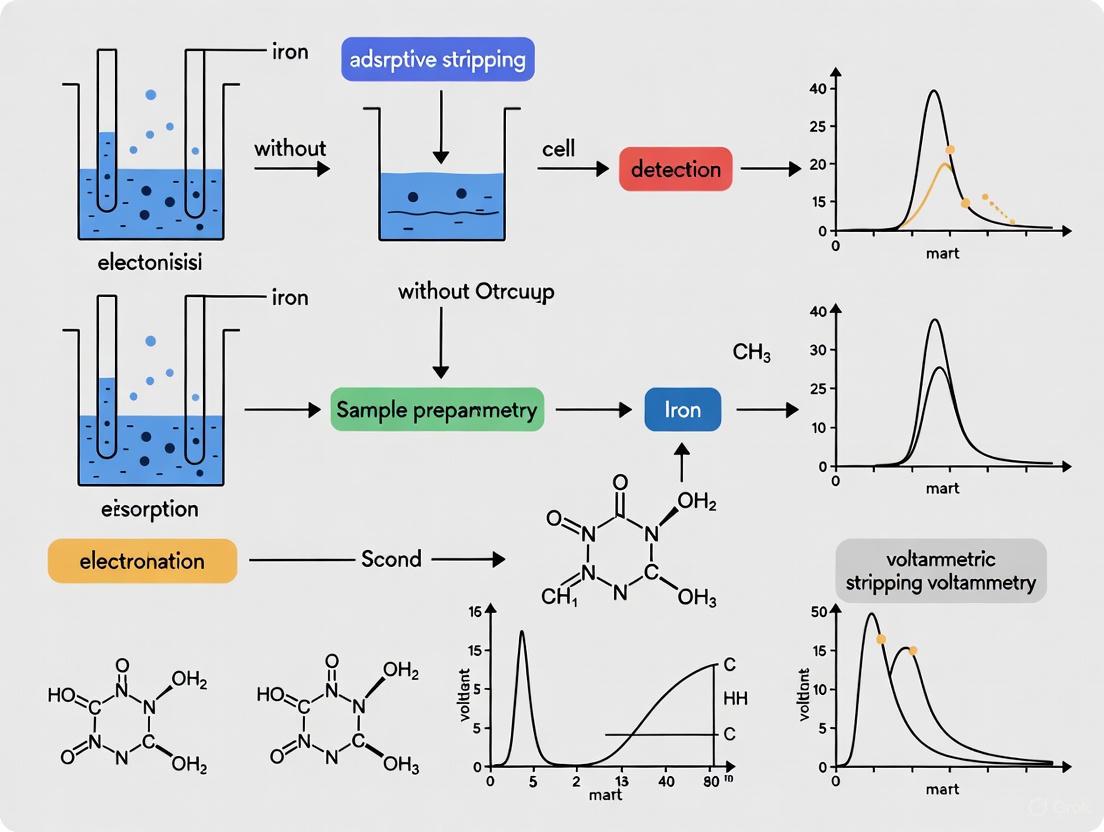
This comprehensive review explores the significant advancements in mercury-free adsorptive stripping voltammetry (AdSV) for the sensitive and selective detection of iron species.
Mercury-Free Adsorptive Stripping Voltammetry for Iron Detection: Advanced Procedures and Applications in Biomedical Research
Abstract
This comprehensive review explores the significant advancements in mercury-free adsorptive stripping voltammetry (AdSV) for the sensitive and selective detection of iron species. Tailored for researchers, scientists, and drug development professionals, the article covers the foundational principles of mercury-free electrodes, detailed methodological protocols for iron speciation, critical troubleshooting and optimization strategies, and rigorous validation against established techniques. It highlights the successful application of novel electrode materials like bismuth and antimony-bismuth films, along with key complexing agents, for determining iron in complex matrices including clinical and environmental samples. The content underscores the method's portability, cost-effectiveness, and growing relevance for on-site monitoring and biomedical research, addressing the pressing need for environmentally friendly analytical alternatives.
The Rise of Mercury-Free Electrodes: Principles and Materials for Iron Sensing
The Critical Need for Mercury Alternatives in Electroanalysis
For decades, mercury-based electrodes were considered the gold standard in electroanalytical chemistry, particularly for stripping voltammetry techniques used in trace metal detection. The hanging mercury drop electrode (HMDE) and mercury film electrode (MFE) offered exceptional reproducibility, a wide cathodic potential range, high hydrogen overpotential, and the ability to form amalgams with various metal ions, enabling impressive preconcentration capabilities [1] [2]. This made them particularly valuable for detecting heavy metals at trace levels, with sub-parts-per-billion detection limits reported for lead, copper, cadmium, and zinc [2] [3].
However, mercury's significant toxicity and associated environmental and health risks have led to strict regulatory restrictions worldwide. European regulations have implemented policies against mercury use, effectively discouraging its application in analytical chemistry [1]. This regulatory landscape, combined with growing environmental awareness, has accelerated the search for safer, high-performance alternative electrode materials that maintain the analytical advantages of mercury while eliminating its dangers [4] [1]. The development of mercury-free electrodes has opened new possibilities for in-situ analysis, process control, and the design of portable analytical devices that can be deployed outside traditional laboratory settings [1].
Emerging Mercury-Free Electrode Materials
Carbon-Based Substrates and Composites
Carbon-based materials represent one of the most promising categories of mercury alternatives. Boron-doped diamond (BDD) electrodes have emerged as particularly valuable due to their wide potential window, low background current, high chemical stability, and mechanical robustness [5]. These electrodes demonstrate excellent performance in both anodic and cathodic regions, making them suitable for various analytes. The surface of BDD electrodes can be electrochemically pretreated to obtain predominantly hydrogen or oxygen-terminated surfaces, modifying their hydrophobicity and electrochemical properties for specific applications [5].
Graphite-epoxy composite electrodes (GECE) offer another compelling alternative, combining the conductive properties of graphite with the ease of processing of epoxy polymers [3]. These composites exhibit attractive electrochemical, physical, and mechanical properties while being inexpensive to produce. Research has demonstrated that unmodified GECE can achieve detection limits of 1 ppb for lead and copper using differential pulse anodic stripping voltammetry (DPASV), with the advantage of not reaching saturation current even at extended preconcentration times of 30 minutes [3]. This behavior is attributed to their structure, which functions as a complex microelectrode array at a rough surface, enhancing their accumulation capabilities.
Bismuth, Antimony, and Other Metal Films
Bismuth-coated electrodes have gained significant attention as an environmentally friendly alternative with electrochemical characteristics similar to mercury. Bismuth offers favorable hydrogen overpotential, low toxicity, and the ability to form alloys with heavy metals rather than amalgams [1]. These electrodes can be prepared as films coated on various substrates including carbon, gold, and platinum, and have demonstrated excellent performance for the analysis of metal ions including zinc, cadmium, lead, copper, and others using anodic stripping voltammetry [1].
Antimony-based electrodes, while having higher toxicity than bismuth (though still significantly lower than mercury), provide advantageous properties including a wide operational potential window, good hydrogen overpotential, and the ability to function in very acidic media (pH ≤ 2) [1]. These characteristics make them particularly useful for analyzing samples requiring low pH conditions without electrode degradation. Gold electrodes have also been investigated as mercury alternatives, especially when fabricated from inexpensive sources such as recordable CDs, offering another pathway to cost-effective, environmentally friendly electroanalysis [3].
Modified and Nanomaterial-Enhanced Electrodes
Surface modification strategies have significantly enhanced the performance of mercury-free electrodes. The incorporation of nanomaterials including nanoparticles, carbon nanotubes, and graphene has dramatically increased the effective surface area and improved electron-transfer kinetics [4] [1]. These modifications have enabled achievement of detection limits comparable to or even surpassing those of traditional mercury electrodes.
Other modification approaches employ conducting polymers, ionic liquids, and biomolecules to improve selectivity for target analytes [1]. Molecularly imprinted polymers have shown particular promise for creating selective recognition sites on electrode surfaces, while the integration of specific ionophores and ligands enhances selectivity toward particular metal ions [1] [6]. These modification strategies often employ hybrid approaches that combine multiple materials and molecules to optimize electrode performance for specific analytical challenges.
Table 1: Performance Comparison of Mercury-Free Electrode Materials
| Electrode Material | Key Advantages | Typical Detection Limits | Representative Applications |
|---|---|---|---|
| Bismuth-film | Low toxicity, favorable hydrogen overpotential, similar to mercury | Sub-ppb for heavy metals | Anodic stripping voltammetry of Zn, Cd, Pb, Cu |
| Boron-Doped Diamond | Wide potential window, low background current, high stability | 10⁻⁷ M for pharmaceuticals | Drug analysis, environmental monitoring |
| Graphite-Epoxy Composite | Low cost, no saturation at long deposition times, simple fabrication | 1 ppb for Pb and Cu | Heavy metal detection in environmental samples |
| Antimony-film | Works at very low pH (≤2), wide potential window | Comparable to bismuth for multiple metals | Analysis in acidic media |
| Nanomaterial-Modified | High surface area, improved electron transfer | pM range for specific metals | Ultra-trace analysis in complex matrices |
Application Notes: Iron Detection via Adsorptive Stripping Voltammetry
Challenges in Iron Speciation and Detection
The detection of iron presents particular challenges in electroanalysis due to the distinct chemical properties of its common oxidation states (Fe(II) and Fe(III)), continuous oxidation-state interconversion, presence of interfering species, and complex behavior in diverse environmental and biological matrices [4]. Iron is a redox-active element with essential roles in biological systems and environmental processes, but becomes problematic at elevated concentrations, with the World Health Organization setting a guideline of 0.3 mg/L (5.36 μM) for drinking water [4]. Above this level, iron causes undesirable tastes, odors, and discoloration in water, indirectly impacting health and water quality.
Selective trace detection of iron demands careful optimization of electrochemical methods, including appropriate electrode material selection, electrode surface modifications, operating conditions, and sample pretreatments [4]. The development of mercury-free methods for iron detection has intensified over the past decade, driven by needs across environmental monitoring, health diagnostics, and industrial applications [4] [6]. Adsorptive stripping voltammetry has emerged as a particularly powerful technique for iron determination, enabling ultra-trace detection by combining selective complexation with sensitive electrochemical measurement.
Ligand Systems for Iron AdSV
The selection of appropriate complexing agents is crucial for successful iron detection using AdSV. Several ligand systems have been developed and optimized for iron determination across different sample matrices:
Catechol and its derivatives: Form stable complexes with iron ions that strongly adsorb to electrode surfaces, with well-defined reduction signals [7]. Catechol has the additional advantage of allowing simultaneous determination of multiple elements (Cu, Fe, V, U) in a single measurement with well-separated reduction peaks [7].
1-nitroso-2-naphthol: Provides sensitive detection of iron species through formation of adsorbable complexes, with applications in natural water analysis [7].
Thiazolylazo-p-cresol and dihydroxynaphthalene: Used for selective iron determination, with the latter employing catalytic effects in the presence of bromate to enhance sensitivity [7].
Solochrome violet RS: Specifically employed for aluminum determination but demonstrates the broader principle of using dye complexes for metal ion detection in AdSV [7].
These ligand systems enable the preconcentration of iron species onto the electrode surface through adsorption rather than electrolysis, making them particularly suitable for metals that do not form amalgams efficiently. The choice of ligand depends on the specific sample matrix, required sensitivity, and potential interferences from coexisting ions.
Table 2: Ligand Systems for Iron Detection via Adsorptive Stripping Voltammetry
| Complexing Ligand | Detection Principle | Linear Range | Sample Matrix | Key Advantages |
|---|---|---|---|---|
| Catechol | Reduction of element | nM range | Natural waters | Multi-element capability (Cu, Fe, V, U) |
| 1-nitroso-2-naphthol | Reduction of element | Not specified | Natural waters | High adsorption efficiency |
| 2,3-Dihydroxynaphthalene | Catalytic effect with bromate | Not specified | Natural waters | Enhanced sensitivity via catalysis |
| Salicylaldoxime | Reduction of element | Not specified | Natural waters | Good selectivity for iron |
| Thiazolylazo-p-cresol | Reduction of element | Not specified | Natural waters | Strong complexation with iron |
Mercury-Free Electrode Modification Strategies for Iron Detection
Significant progress has been made in designing and developing modified mercury-free electrodes through various surface modification strategies to enhance their performance for iron detection. These modifications have greatly improved the sensitivity and selectivity of iron sensors, though further validation is needed to ensure their reliability in complex sample matrices [4].
Nanomaterial modifications have been particularly impactful, with various carbon nanomaterials, metal nanoparticles, and nanocomposites employed to increase the effective surface area and improve electron transfer kinetics. These modifications enable lower detection limits and better resistance to fouling in complex matrices [4]. Conducting polymer films such as polyaniline, polypyrrole, and polythiophene provide platforms for further functionalization while enhancing stability and selectivity toward target ions [4].
The integration of ion-selective membranes and novel ligands specifically designed for iron complexation has improved selectivity by reducing interference from coexisting ions. These approaches often combine multiple modification strategies to create hybrid materials with optimized properties for iron detection in challenging environments [4]. Despite these advancements, achieving ultra-low detection limits in real-world samples with minimal interference remains challenging and emphasizes the need for enhanced sample pretreatment methods and continued development of more selective modification approaches [4].
Experimental Protocols
Protocol 1: Mercury-Free Electrode Preparation for Iron Detection
Objective: Preparation of a bismuth-film modified screen-printed carbon electrode for iron detection using adsorptive stripping voltammetry.
Materials and Equipment:
- Screen-printed carbon electrode (SPCE)
- Bismuth nitrate solution (1000 mg/L in 1% HNO₃)
- Acetate buffer (0.1 M, pH 4.5)
- Iron standard solutions (Fe(II) and Fe(III))
- Catechol solution (0.01 M in ethanol)
- Voltammetric analyzer with three-electrode configuration
Procedure:
Electrode Pretreatment: Cycle the SPCE potential between 0 V and +1.5 V (vs. Ag/AgCl) in 0.5 M H₂SO₄ at 100 mV/s for 20 cycles to activate the carbon surface.
Bismuth Film Formation: Transfer the electrode to a solution containing 5 mg/L Bi(III) in acetate buffer (0.1 M, pH 4.5). Apply a deposition potential of -1.2 V for 120 s with stirring to electrodeposit the bismuth film.
Complex Formation and Adsorption: Incubate the modified electrode in a sample solution containing iron and 0.001 M catechol in acetate buffer (pH 4.5) for 60 s at open circuit potential to allow iron-catechol complex formation and adsorption.
Stripping Measurement: Transfer the electrode to a clean acetate buffer solution (pH 4.5). Record the adsorptive stripping voltammogram using a square wave waveform with the following parameters: initial potential -0.2 V, final potential -1.0 V, frequency 25 Hz, amplitude 25 mV, step potential 5 mV.
Calibration: Perform standard additions of iron standards to establish the calibration curve for quantitative analysis.
Protocol 2: Iron Speciation Analysis Using Mercury-Free Electrodes
Objective: Simultaneous determination of Fe(II) and Fe(III) using a boron-doped diamond electrode with ligand-assisted voltammetry.
Materials and Equipment:
- Boron-doped diamond electrode (BDDE)
- Britton-Robinson buffer (0.04 M, pH 2-12)
- 1-nitroso-2-naphthol solution (0.01 M in methanol)
- Nitrogen gas for deaeration
- Fe(II) and Fe(III) standard solutions
Procedure:
Electrode Pretreatment: Apply an anodic pretreatment to the BDDE by holding at +2.0 V for 30 s, followed by cathodic pretreatment at -2.0 V for 30 s in 0.5 M H₂SO₄ to create a reproducible surface termination.
Sample Preparation: Mix the water sample with Britton-Robinson buffer (pH 6.0) and 1-nitroso-2-naphthol to final concentrations of 0.1 M buffer and 0.001 M ligand.
Degassing: Purge the solution with nitrogen gas for 300 s to remove dissolved oxygen.
Adsorption Step: Apply an adsorption potential of -0.1 V for 90 s with stirring to accumulate the iron-ligand complexes on the electrode surface.
Voltammetric Scan: Initiate a cathodic square wave scan from -0.1 V to -1.2 V with the following parameters: frequency 15 Hz, amplitude 50 mV, step potential 4 mV.
Speciation Analysis: Identify Fe(II) and Fe(III) based on their characteristic peak potentials. Quantify using standard addition methods with appropriate Fe(II) and Fe(III) standards.
The Scientist's Toolkit: Essential Reagents and Materials
Table 3: Key Research Reagent Solutions for Mercury-Free Iron Detection
| Reagent/Material | Function | Typical Concentration | Storage Conditions |
|---|---|---|---|
| Catechol | Complexing agent for iron adsorption | 0.001-0.01 M in measurement solution | 4°C, protected from light |
| 1-nitroso-2-naphthol | Selective ligand for iron complexation | 0.001 M in measurement solution | Room temperature in amber glass |
| Bismuth nitrate | Source for bismuth-film electrode preparation | 5-20 mg/L in deposition solution | Acidified stock at 4°C |
| Acetate buffer | Supporting electrolyte for iron detection | 0.1 M, pH 4.0-5.5 | Room temperature |
| Britton-Robinson buffer | Universal buffer for pH optimization | 0.04 M, adjustable pH 2-12 | Room temperature |
| Nanomaterial dispersions | Electrode modifiers (CNTs, graphene, nanoparticles) | 0.1-1.0 mg/mL in suitable solvent | Freshly prepared or sonicated before use |
Visualization of Experimental Workflows
Mercury-Free Iron Detection Workflow
Electrode Modification Strategies Diagram
The development of mercury-free electrodes for electroanalysis represents a critical advancement in analytical chemistry, aligning analytical practices with environmental safety and sustainability goals. While significant progress has been made in the past decade, several challenges remain in the widespread adoption of these alternatives. Future research directions should focus on enhancing the sensitivity and selectivity of mercury-free electrodes to match or exceed the performance of mercury-based systems, particularly for complex sample matrices [4].
The integration of advanced materials, including engineered nanomaterials and selective receptors, holds promise for next-generation sensors with improved performance characteristics. Additionally, the development of standardized protocols and validation methods for mercury-free electrodes will facilitate their adoption in regulatory analysis and quality control applications [4] [6]. As electrochemical sensors continue to evolve toward miniaturization, portability, and integration with digital technologies, mercury-free platforms will play an increasingly important role in decentralized testing, environmental monitoring, and point-of-care diagnostics [1].
The transition to mercury-free electroanalysis represents not merely a substitution of materials but a paradigm shift that opens new possibilities for analytical chemistry—enabling safer, more sustainable, and more versatile analytical systems that can address emerging challenges in environmental monitoring, healthcare, and industrial process control.
The phase-out of mercury-based electrodes has catalyzed the development of environmentally friendly, sensitive, and selective alternative materials for the voltammetric detection of trace metals. Within this context, bismuth-based electrodes, antimony-bismuth composites, and advanced nanocomposites have emerged as superior substrates, particularly for the detection of iron and other heavy metals in complex matrices. Adsorptive Stripping Voltammetry (AdSV) is a powerful electroanalytical technique that combines an adsorptive accumulation step with a stripping voltammetric scan, achieving ultra-trace detection limits [8] [9]. When determining non-complexing metals like iron, the methodology typically involves forming an adsorptive complex with a selective ligand, such as 1-(2-pyridylazo)-2-naphthol (PAN), on the electrode surface prior to the reduction and stripping steps [10]. This application note details the protocols and performance of these essential electrode materials, framed within a thesis focused on mercury-free AdSV procedures for iron detection.
Core Electrode Materials and Properties
Material Specifications and Performance
The table below summarizes the key characteristics and analytical performance of the primary electrode materials used in mercury-free AdSV for iron and heavy metal detection.
Table 1: Performance of Mercury-Free Electrode Materials for Metal Detection
| Electrode Material | Target Analyte(s) | Supporting Electrolyte & Ligand | Detection Limit | Linear Range | Key Advantages |
|---|---|---|---|---|---|
| In-situ Bismuth Film Electrode (BiFE) [10] | Fe(III) | 0.1 M acetate buffer (pH 4.0), 5.0 µM PAN | 0.1 µg L⁻¹ | 0.4 - 60.0 µg L⁻¹ | Excellent sensitivity, well-defined peaks, validated with CRMs. |
| Bismuth-Antimony Film Electrode (Bi-SbFE) [11] | Cd(II), Pb(II) | Acetate buffer, metals added to solution | - | - | Enhanced stability and performance for simultaneous detection. |
| Antimony Film Electrode (SbFE) [12] | Cd(II), Pb(II), Zn(II) | Acetate buffer | - | - | Effective in acidic media, low stripping signal of Sb itself. |
| Nano Cellulosic Fibers/CPE [13] | Hg(II) | 0.1 M NaOH, acetate buffer (pH 3) | 97 ng mL⁻¹ | 300-700 ng mL⁻¹ | Green material, good selectivity against interfering ions. |
| Double Accumulation Lead-Film Electrodes [8] | U(VI) | 0.2 M acetate buffer (pH 4.2), Cupferron | 1.1×10⁻¹¹ mol L⁻¹ | - | Ultra-trace detection, double accumulation for enhanced sensitivity. |
The Scientist's Toolkit: Essential Research Reagents
Table 2: Key Reagent Solutions for AdSV of Iron
| Reagent / Material | Typical Concentration / Specification | Function in the Protocol |
|---|---|---|
| 1-(2-Pyridylazo)-2-naphthol (PAN) [10] | 5.0 µM in final solution | Selective complexing agent for Fe(III) to form an adsorptive complex. |
| Acetate Buffer [10] | 0.1 mol L⁻¹, pH 4.0 | Supporting electrolyte; provides optimal pH for complex formation and accumulation. |
| Bismuth Standard Solution [10] | ~4 mg L⁻¹ in final solution (for in-situ plating) | Precursor for forming the bismuth film on the glassy carbon electrode. |
| Antimony Standard Solution [11] | ~1 mg L⁻¹ in final solution (for in-situ plating) | Precursor for forming a bismuth-antimony alloy film. |
| High-Purity Nitrogen Gas | 99.99% | For deaerating the solution to remove dissolved oxygen (unless otherwise specified). |
Experimental Protocols
Protocol 1: Determination of Iron with a Bismuth Film Electrode (BiFE)
This protocol is adapted from the method for determining Fe(III) in water samples using an in-situ bismuth film electrode and PAN as the complexing agent [10].
Workflow Diagram: Iron Detection via AdSV with a BiFE
Step-by-Step Procedure:
- Electrode Preparation: Polish a glassy carbon electrode (GCE) with alumina slurry (e.g., 0.05 µm) on a microcloth. Rinse thoroughly with distilled water and dry.
- Solution Preparation: Transfer 10-20 mL of the sample or standard solution into the voltammetric cell. Add the supporting electrolyte to achieve final concentrations of 0.1 mol L⁻¹ acetate buffer (pH 4.0) and 5.0 µmol L⁻¹ PAN. Add Bi(III) standard to yield a final concentration of approximately 4 mg L⁻¹ for in-situ film formation [10].
- Deaeration: Purge the solution with high-purity nitrogen or argon for 8-10 minutes to remove dissolved oxygen. Maintain a blanket of gas above the solution during measurement.
- Film Deposition & Analyte Accumulation: While stirring the solution, apply a deposition potential of -1.1 V vs. Ag/AgCl for 60-120 seconds. This step simultaneously deposits the bismuth film and pre-concentrates the Fe(III)-PAN complex on the electrode surface [10].
- Stripping and Measurement: After a 10-second equilibration period (without stirring), initiate the voltammetric scan. A Differential Pulse Voltammetry (DPV) or Square-Wave Voltammetry (SWV) scan in the anodic direction is recommended. The peak for the reduction of the accumulated Fe(III)-PAN complex is typically observed around -0.4 V to -0.5 V [10].
- Electrode Cleaning: After measurement, apply a cleaning potential (e.g., +0.3 V for 30 seconds) with stirring to remove residual metals and the bismuth film from the electrode surface before the next run.
Protocol 2: Fabrication of a Bismuth-Antimony Film Electrode (Bi-SbFE)
This protocol outlines the preparation of a bismuth-antimony alloy film for the simultaneous determination of trace metals like Cd and Pb, a approach that can be optimized for iron detection [11].
- Substrate Preparation: Clean the glassy carbon electrode as described in Protocol 1.
- Solution Preparation: Prepare the sample or standard solution in an appropriate supporting electrolyte (e.g., acetate buffer). Directly add standard solutions of Bi(III) and Sb(III) to the measurement cell to achieve final concentrations of 4 mg L⁻¹ Bi and 1 mg L⁻¹ Sb, respectively [11].
- Simultaneous Deposition: Apply a fixed deposition potential of -1.1 V vs. Ag/AgCl to the GCE for a predetermined time (e.g., 120-300 s) with solution stirring. This co-deposits bismuth, antimony, and the target metals onto the electrode surface.
- Stripping Measurement: Record the anodic stripping voltammogram using SWV or DPV. The Bi-Sb alloy film has been shown to provide well-defined, sensitive peaks for Cd and Pb [11].
Comparative Analysis and Selection Guidelines
The choice of electrode material is critical for method sensitivity, selectivity, and robustness.
- Bismuth vs. Antimony: While both are effective mercury substitutes, they exhibit different electrode kinetics and mechanisms. Studies show that electrode reactions at BiFEs can involve adsorption phenomena and often exhibit faster electron transfer kinetics compared to SbFEs [12]. BiFEs have been more extensively validated for iron detection [10].
- Alloy Films (Bi-Sb): Combining bismuth and antimony can yield electrodes with synergistic properties, potentially offering enhanced stability and performance for simultaneous multi-element analysis [11].
- Nanocomposites: Modifying electrodes with nanomaterials like nano cellulosic fibers, carbon nanotubes, or graphene significantly increases the active surface area, improves conductivity, and can impart selectivity [14] [13]. This is a key strategy for achieving ultra-low detection limits and mitigating matrix effects in complex samples.
Diagram: Decision Workflow for Electrode Material Selection
Bismuth, antimony-bismuth, and nanocomposite-based electrodes represent a mature and high-performance toolkit for modern, environmentally responsible electroanalysis. The detailed protocols for BiFE and Bi-SbFE provide a robust foundation for the sensitive determination of iron and other heavy metals using Adsorptive Stripping Voltammetry. The selection of the optimal material depends on the specific analytical requirements, including the required detection limit, the complexity of the sample matrix, and the need for single versus multi-analyte detection. Future developments will continue to leverage nanomaterial engineering and sophisticated electrode architectures to further push the boundaries of sensitivity and field-based applicability.
Fundamentals of Adsorptive Stripping Voltammetry for Iron Species
Adsorptive Stripping Voltammetry (AdSV) is a highly sensitive electrochemical technique used for the trace-level determination of metal ions and organic compounds that can be adsorbed onto an electrode surface. For iron species, which play critical roles in environmental, biological, and industrial systems, AdSV offers a powerful alternative to conventional spectroscopic methods, combining low detection limits with portable instrumentation and operational simplicity [4]. Unlike anodic stripping voltammetry used for electrodeposited metals, AdSV involves the accumulation of a metal complex via adsorption, followed by electrochemical reduction or oxidation of the adsorbed species [15] [16].
The development of mercury-free electrodes for iron detection represents a significant advancement in the field, addressing environmental and safety concerns associated with traditional mercury electrodes [4]. This application note details the fundamental principles, optimized protocols, and performance characteristics of AdSV for iron speciation and quantification, providing researchers with practical methodologies for implementation in various analytical contexts.
Principles and Instrumentation
Fundamental Mechanism
The analytical process in AdSV for iron determination occurs through several distinct stages. First, a complex is formed between iron ions (Fe(II) or Fe(III)) and a selective organic ligand in solution. This complex subsequently accumulates on the working electrode surface through adsorption during a controlled accumulation period at a fixed potential. The adsorption step is followed by a potential scan that initiates the electrochemical reduction (or oxidation) of the adsorbed species, generating a measurable current response proportional to the iron concentration. Finally, between measurements, the electrode undergoes a cleaning step to remove residual reaction products and regenerate the surface [15] [17] [18].
Key System Components
- Working Electrodes: Modern AdSV methodologies increasingly utilize mercury-free electrodes including glassy carbon electrodes (GCE) modified with nanomaterials, solid bismuth electrodes, and silver nanoparticle-based sensors [19] [16] [4].
- Reference and Counter Electrodes: Standard Ag/AgCl reference electrodes and platinum wire auxiliary electrodes complete the three-electrode system.
- Instrumentation: Potentiostats capable of performing various voltammetric techniques (cyclic, square-wave, differential pulse) are employed, with computerized systems for data acquisition and processing.
The workflow below illustrates the core analytical procedure in AdSV for iron detection:
Research Reagent Solutions and Materials
The following table details essential reagents and materials required for implementing AdSV methodologies for iron detection:
Table 1: Essential Research Reagents for Iron AdSV
| Reagent/Material | Function/Purpose | Example Specifications |
|---|---|---|
| Complexing Ligands | Forms adsorbable complex with iron ions | Catechol, Solochrome Violet RS, Cupferron [20] [17] |
| Supporting Electrolyte | Provides conductive medium; controls pH | Acetate buffer (pH 3-5), Britton-Robinson buffer, PIPES buffer [19] [17] |
| Electrode Modifiers | Enhances sensitivity and selectivity | Carbon black, Biogenic Silver Nanoparticles (BAgNPs), Bismuth films [19] [16] [21] |
| Standard Solutions | Calibration and quantification | Fe(II) and Fe(III) stock solutions (1000 mg/L) in ultrapure water [19] |
| pH Adjusters | Optimizes complex formation and adsorption | NaOH, HCl, acetic acid solutions (analytical grade) [19] |
Current Methodologies and Performance
Recent research has focused on developing novel electrode modifications and optimized complexing systems to enhance the sensitivity and selectivity of iron detection via AdSV. The following table summarizes the performance characteristics of selected AdSV methodologies for iron determination:
Table 2: Performance Comparison of AdSV Methods for Iron Detection
| Method / Electrode System | Linear Range | Detection Limit | Applications | Key Advantages |
|---|---|---|---|---|
| GCE/CB-BAgNPs [19] | 5-25 mg L⁻¹ | 0.083 mg L⁻¹ | Medicinal samples | Excellent stability (RSD 0.44% after 100 cycles); green synthesis |
| HMDE/Catechol [17] | - | 0.5-1 µg/L (≈ 9-18 nM) | Water samples | High sensitivity for Fe(total); uses standard complexing agent |
| HMDE/Solochrome Violet RS [20] | - | - | High purity materials | Specific for high-purity matrices; requires interference management |
| GCE/Iron-Ofloxacine [18] | 0.5-1.7 µM | 11 nM | Pharmaceutical, biological fluids | Utilizes drug-metal complex; suitable for biomedical analysis |
Representative Protocol: Carbon Black/Biogenic Silver Nanoparticle Modified GCE
Electrode Modification Protocol
- GCE Pretreatment: Polish the glassy carbon electrode (3 mm diameter) with 0.3 µm alumina slurry on a microcloth pad, followed by rinsing with distilled water and ultrasonic cleaning in ethanol and water for 5 minutes each [19].
- Modification Suspension: Prepare a homogeneous suspension containing 1.0 mg mL⁻¹ carbon black (CB) and an appropriate volume of biogenic silver nanoparticles (BAgNPs) synthesized at pH 6.10 in ultrapure water [19].
- Coating Application: Deposit 10 µL of the CB-BAgNPs suspension onto the cleaned GCE surface and allow it to dry at room temperature for 15 minutes to form a stable modified layer [19].
Measurement Parameters
- Accumulation Potential: Optimized at +0.5 V (vs. Ag/AgCl)
- Accumulation Time: 180 seconds in quiescent solution
- Scan Technique: Cyclic Voltammetry with scan rate of 50 mV s⁻¹
- Supporting Electrolyte: 0.1 mol L⁻¹ acetate buffer (pH 4.5)
- Equilibration Time: 2 seconds before potential scan [19]
Representative Protocol: Catechol Complex Method with Mercury-Free Electrodes
Solution Preparation
- Supporting Electrolyte: Prepare 0.1 M PIPES buffer (pH 7.0) or phosphate buffer for optimal complex formation [17].
- Complexation: Add catechol solution to the sample to achieve a final concentration of 0.5-1.0 mM, ensuring excess ligand for complete iron complexation [17].
- Decxygenation: Purge the solution with high-purity nitrogen or argon for 300 seconds to remove dissolved oxygen, which can interfere with the measurement [17].
Measurement Parameters
- Accumulation Potential: -0.2 V (vs. Ag/AgCl) for 60-120 seconds
- Scan Technique: Differential Pulse Voltammetry with pulse amplitude 50 mV, step time 0.5 s
- Potential Scan: From -0.2 V to -1.0 V for reduction of the iron-catechol complex
- Cleaning Step: Apply a conditioning potential of +0.3 V for 15 seconds between measurements to refresh the electrode surface [17].
Critical Parameters and Optimization
pH Dependence
The solution pH significantly influences both complex formation and adsorption efficiency. For most iron-ligand systems, optimal response occurs in slightly acidic to neutral conditions (pH 4.0-7.5). The carbon black/biogenic silver nanoparticle system demonstrates optimal response at pH 4.5 in acetate buffer, while the catechol complex method performs best in PIPES buffer at pH 7.0 [19] [17]. The ofloxacine-iron complex system achieves maximum response at pH 7.5 in Britton-Robinson buffer [18].
Interference Management
Common interferents in iron AdSV include surface-active compounds, humic substances, and metal ions with similar reduction potentials or complexation behavior. The presence of chloride and sulfate anions has been shown to significantly affect iron solochrome violet complex peaks, requiring standard addition methods or matrix-matched calibration for accurate quantification [20]. Using the AdSV technique with a solid bismuth microelectrode has demonstrated advantages in minimizing surfactant interference compared to ASV approaches [16].
Applications and Validation
AdSV methods for iron determination have been successfully applied to diverse sample matrices including pharmaceutical formulations, biological fluids, environmental waters, and high-purity materials [19] [20] [17]. Method validation typically demonstrates excellent recovery rates (95.0-104.6%) and precision (RSD < 10%), with good correlation against reference methods such as HPLC and atomic absorption spectrometry [15] [18].
For complex matrices, sample pretreatment including digestion, filtration, or extraction may be necessary to eliminate organic matter or particulate interference. The exceptional stability of modified electrodes like the CB-BAgNPs/GCE (RSD 0.44% after 100 cycles) makes them particularly suitable for high-throughput analysis [19].
Adsorptive Stripping Voltammetry represents a robust, sensitive, and environmentally friendly approach for iron species determination across diverse analytical applications. The continued development of mercury-free electrodes with novel modifications has significantly enhanced the technique's practicality while maintaining the exceptional sensitivity required for trace-level iron analysis. The protocols and methodologies detailed in this application note provide researchers with foundational frameworks for implementing and further advancing AdSV techniques in their respective fields.
The accurate determination of iron speciation is critical in fields ranging from oceanography to clinical diagnostics. This application note details three key complexing agents—1-(2-pyridylazo)-2-naphthol (PAN), cupferron, and salicylaldoxime (SA)—used in adsorptive cathodic stripping voltammetry (AdCSV) for the sensitive and selective detection of iron. With the increasing regulatory pressure to eliminate toxic mercury from analytical methods, this document provides standardized protocols for using these ligands with environmentally friendly alternative electrodes, supporting the advancement of sustainable analytical chemistry.
Table 1: Key Characteristics of Iron-Complexing Agents
| Complexing Agent | Target Iron Species | Typical Detection Limit | Linear Range | Common Electrode & Conditions |
|---|---|---|---|---|
| PAN | Fe(III) | Sub-µg L⁻¹ levels [22] | 1–200+ µg L⁻¹ [22] | Sb-Bi Film / GCE; Acetate Buffer (pH 4) [22] |
| Cupferron | Fe(III) (and other metals) | Not explicitly defined for Fe | Not explicitly defined for Fe | Lead Film Electrode (PbFE); Ammonia Buffer (pH 8.15) [23] |
| Salicylaldoxime (SA) | Dissolved Fe speciation (Fe') | - | - | Hanging Mercury Drop Electrode (HMDE); pH 8.0-8.2 [24] [25] |
Detailed Agent Profiles and Mechanisms
1-(2-Pyridylazo)-2-naphthol (PAN)
PAN is a reagent known for its high selectivity towards Fe(III) over Fe(II). The complexation and subsequent electrochemical reduction of the Fe(III)-PAN complex form the basis for a highly sensitive and specific analytical method. Its key advantage in mercury-free analysis is the ability to form a stable complex that strongly adsorbs onto bismuth- and antimony-based film electrodes [22].
Cupferron (N-Nitrosophenylhydroxylamine)
Cupferron is a versatile chelating agent that forms stable, electroactive complexes with numerous metal ions, including Fe(III), Al(III), and Cu(II) [26] [27] [23]. Its mechanism involves the formation of a five-membered chelate ring via its N–O functional groups, coordinating to metal ions [26]. While its selectivity for iron in a mixture can be a challenge, this strong complexing power is effectively leveraged in stripping voltammetry when appropriate experimental conditions and sample preparation are applied [23].
Salicylaldoxime (SA)
Salicylaldoxime is a well-established added ligand in Competitive Ligand Exchange-Adsorptive Cathodic Stripping Voltammetry (CLE-AdCSV) for determining dissolved iron speciation in complex matrices like seawater [24] [25]. It competes with natural organic ligands to form an electroactive Fe-SA complex (historically thought to be Fe(SA)₂, but now considered to be FeSA) [24]. SA is particularly valued because it does not suffer from significant interference with humic substances, allowing it to detect a broader spectrum of iron-binding ligands compared to other agents like TAC or NN [24] [25].
Experimental Protocols
Protocol for Iron(III) Determination using PAN with Sb-Bi Film Electrode
Workflow Overview:
Step-by-Step Procedure:
- Electrode Preparation: Polish a glassy carbon electrode (GCE) with an alumina slurry (0.05 µm) on a micro-cloth pad. Rinse thoroughly with ultrapure water.
- Film Deposition: Place the polished GCE into a solution containing 20 mg L⁻¹ each of Bi(III) and Sb(III) in 0.1 M acetate buffer (pH 4). Apply a deposition potential of -1.3 V vs. Ag/AgCl for 300 seconds with stirring to form the antimony-bismuth film (SbBiFE) [22].
- Sample Preparation: Transfer 10 mL of the sample or standard (in 0.1 M acetate buffer, pH 4) to the voltammetric cell.
- Complex Formation: Add an aliquot of a PAN stock solution to achieve a final concentration of 5 µM in the cell. Allow the solution to mix [22].
- Preconcentration & Measurement:
- Preconcentration: With stirring, apply a deposition potential of -0.5 V vs. Ag/AgCl for 60 seconds. This adsorbs the Fe(III)-PAN complex onto the electrode surface.
- Stripping: After a 10-second equilibration period, initiate a Square Wave (SW) voltammetric scan from -0.5 V to -1.2 V.
- Analysis: The reduction peak for the Fe(III)-PAN complex will appear at approximately -0.9 V vs. Ag/AgCl [22]. Quantify the iron concentration using the standard addition method.
Protocol for Iron Speciation using Salicylaldoxime (CLE-AdCSV)
Workflow Overview:
Step-by-Step Procedure:
- Electrode Conditioning: Stabilize the signal on a Hanging Mercury Drop Electrode (HMDE) by performing multiple conditioning scans in the sample. For SA, this involves scans in the range of -0.1 V to -0.6 V [24].
- Titration Series: Split the filtered seawater sample into multiple aliquots. To each aliquot, add an ammonia buffer (pH ~8.2) and SA (final concentration typically 5 µM or 25 µM) [24] [25].
- Standard Addition: Add increasing concentrations of an iron standard to the aliquots, creating a titration series.
- Equilibration: Allow the samples to equilibrate for several hours or overnight. This ensures the competition between SA and natural ligands for iron reaches equilibrium [24].
- Measurement: For each titrated aliquot, measure the Fe-SA complex by AdCSV. A typical procedure involves an adsorption step at 0 V (or a mild negative potential) for 30-120 seconds, followed by a cathodic stripping scan [24] [25].
- Data Interpretation: Plot the peak current against the total added iron concentration. Analyze the resulting titration curve using non-linear regression based on the Langmuir isotherm, facilitated by software like ProMCC or ECDSoft, to determine the concentration ([Lₜ]) and conditional stability constant (log K'ᵢFe'L) of the natural iron-binding ligands [24].
The Scientist's Toolkit: Research Reagent Solutions
Table 2: Essential Reagents and Materials for Iron AdCSV
| Item | Specification / Function |
|---|---|
| Supporting Electrolyte | Acetate buffer (pH 4 for PAN); Ammonia buffer or HEPES (pH ~8.2 for SA and cupferron). |
| Complexing Agent Stock Solutions | 1-10 mM PAN in solvent (e.g., methanol); 5-50 mM Salicylaldoxime; 1-10 mM Cupferron. |
| Electrode Material | Glassy Carbon Electrode (GCE) base for film electrodes; In-situ formed Sb-Bi or Pb films. |
| Film Forming Solutions | Standard solutions of Bi(III), Sb(III), and Pb(II) (e.g., 1000 mg L⁻¹) for in-situ plating. |
| Iron Standard Solution | Certified single-element standard of Fe(III) (e.g., 1000 mg L⁻¹) in dilute acid. |
| Data Analysis Software | ProMCC (for speciation modeling) [24]; ECDSoft (for instrument control and data acquisition) [24]. |
Performance and Application Context
Table 3: Comparative Analytical Performance and Applications
| Complexing Agent | Key Advantages | Limitations & Challenges | Ideal Application Context |
|---|---|---|---|
| PAN | High selectivity for Fe(III); Compatible with advanced Bi-based film electrodes; Suitable for on-site analysis [22]. | Requires careful optimization of film composition and deposition [22]. | Determination of total Fe(III) or total iron (after oxidation) in freshwaters, tap water, and soil extracts [22]. |
| Cupferron | Strong complexing agent; Forms well-defined, adsorbable complexes with many metals; Useful for Al determination [23]. | Lacks specificity for iron; Can be prone to interferences in complex matrices [26]. | Determination of trace metals in controlled matrices or after separation; Studies of corrosion processes (e.g., Al release) [23]. |
| Salicylaldoxime (SA) | Detects a wide range of natural ligand classes (incl. humics); Well-established for seawater speciation; High sensitivity [24] [25]. | Typically requires a mercury electrode for optimal performance; Long equilibration times (hours) [24]. | Investigation of dissolved iron speciation (ligand concentration and strength) in marine and freshwater systems [24] [25]. |
The accurate determination of iron speciation, distinguishing between its two major oxidation states Fe(II) and Fe(III), represents a critical analytical challenge across environmental science, biological research, and industrial monitoring. Despite iron's abundance, its speciation analysis remains complex due to the dynamic interconversion between redox states, the influence of environmental matrices, and the often ultra-trace concentration levels in natural systems [4] [6]. The drive toward environmentally sustainable analytical methods has accelerated research into mercury-free electrochemical techniques, particularly adsorptive stripping voltammetry (AdSV), which offers the sensitivity, selectivity, and portability needed for modern iron speciation studies [4] [28].
Electrochemical methods provide significant advantages for iron speciation analysis due to their direct detection capabilities, cost-effectiveness, and suitability for field deployment [6]. Unlike bulk techniques that measure total iron content, voltammetric methods can directly distinguish between Fe(II) and Fe(III) based on their distinct electrochemical signatures, enabling real-time monitoring of redox transformations that are crucial for understanding biogeochemical cycles, pharmaceutical chemistry, and environmental pollution dynamics [4] [29].
Theoretical Foundations of Iron Speciation
Chemical Behavior and Environmental Significance
Iron exists primarily as Fe(II) (ferrous) and Fe(III) (ferric) in natural waters, with distinct chemical properties governing their environmental behavior. Fe(II) is more soluble but readily oxidizes in oxygen-rich environments, while Fe(III) has lower solubility but tends to form stable complexes with organic ligands [30] [6]. This redox cycling significantly impacts iron's bioavailability and geochemical reactivity, particularly in marine environments where iron often limits primary productivity [30] [31].
The speciation of iron in natural systems is controlled by complex interactions with inorganic anions and organic ligands. In seawater, Fe(III) forms complexes with chloride, sulfate, hydroxide, bicarbonate, and carbonate ions, with the specific interaction and ion pairing models providing frameworks for predicting iron behavior across different ionic strengths (0 to 3 M) [30]. Organic complexation with humic-like substances (HULIS) plays a particularly important role in enhancing and stabilizing iron solubility in atmospheric aerosols and aquatic systems [31].
The Need for Mercury-Free Approaches
Traditional mercury electrodes provided excellent sensitivity for trace metal analysis but posed significant environmental and safety concerns [4]. The development of robust mercury-free alternatives has become a research priority, driven by stricter regulations and the need for field-deployable instrumentation. Modern approaches utilize bismuth-based electrodes, carbon nanomaterials, and chemically modified surfaces that offer comparable performance to mercury while being environmentally benign [4] [28].
Advanced Materials for Mercury-Free Detection
Electrode Materials and Modification Strategies
Recent advancements in electrode design have focused on enhancing sensitivity and selectivity through nanomaterial integration and surface functionalization. Nitrogen and sulfur co-doped graphene quantum dots (N, S-GQDs) represent a particularly promising modification material, creating an electron-rich surface that facilitates fast electron transfer between Fe(III) and the electrode surface [29]. The doped heteroatoms generate additional coordination sites and structural defects that preferentially interact with iron species, significantly improving detection limits to the nanomolar range [29].
Bismuth-based electrodes have emerged as the leading mercury replacement due to their favorable electrochemical properties, low toxicity, and ability to form alloys with metal ions. The electrochemically activated bismuth bulk annular band electrode (BiABE) enables determination without oxygen removal and features easy surface regeneration through electrochemical activation at -1.9 V for 20 seconds [28]. Solid bismuth microelectrodes (SBiμE) with diameters as small as 25 μm provide enhanced mass transport, reduced capacitive currents, and excellent signal-to-noise ratios, making them ideal for ultra-trace analysis [32].
Table 1: Advanced Electrode Materials for Iron Speciation
| Electrode Material | Modification/Type | Key Features | Detection Technique | Reference |
|---|---|---|---|---|
| Glassy Carbon Electrode (GCE) | N, S-doped Graphene Quantum Dots | Enhanced electron transfer, high active surface area | Hydrodynamic Amperometry, SWV | [29] |
| Bismuth Electrode | Bulk Annular Band (BiABE) | In-situ activation, no O₂ removal needed | Catalytic DPV | [28] |
| Bismuth Electrode | Solid Microelectrode (SBiμE, Ø=25μm) | Minimal capacitive current, excellent S/N ratio | DPASV | [32] |
| Carbon Paste Electrode (CPE) | Unmodified | Identification of solid-phase iron nanoparticles | Anodic Voltammetry | [33] |
Research Reagent Solutions
Table 2: Essential Reagents for Iron Speciation Analysis
| Reagent | Function/Purpose | Application Context | |
|---|---|---|---|
| Triethanolamine (TEA) | Complexing agent for Fe(III) | Forms electroactive complex for adsorptive stripping | [28] |
| Potassium Bromate (KBrO₃) | Catalytic oxidant | Signal amplification in catalytic systems | [28] |
| Acetate Buffer | Supporting electrolyte | pH control (pH 3-4) for optimal iron redox behavior | [32] |
| Britton-Robinson Buffer | Versatile buffer system | Wide pH range (2-12) for studying pH effects | [34] |
| Trilon B (EDTA) | Chelating agent | Background electrolyte for nanoparticle studies | [33] |
| Sodium Citrate | Metal buffer component | Controls iron bioavailability in speciation assays | [35] |
| Ferrozine | Chromogenic Fe(II) indicator | Spectrophotometric iron speciation and redox assays | [35] |
Experimental Protocols
Protocol 1: Ultra-Sensitive Fe(III) Detection Using N, S-GQD Modified Electrode
This protocol demonstrates the application of nitrogen and sulfur co-doped graphene quantum dots for highly sensitive detection of Fe(III) in aqueous solutions, achieving detection limits of 0.23 nM [29].
Materials and Equipment:
- Glassy carbon electrode (GCE, 2 mm diameter)
- Citric acid (99.5%) and thiourea (99%) for N,S-GQD synthesis
- Ag/AgCl reference electrode and platinum wire counter electrode
- AUTOLAB PGSTAT 30 potentiostat
- Ultrasonic bath and centrifuge
- Supporting electrolyte: 0.1 M KNO₃, adjusted to pH 4.0
Step-by-Step Procedure:
Synthesis of N,S-GQDs:
- Dissolve 0.21 g citric acid (1 mmol) and 0.23 g thiourea (3 mmol) in 5 mL deionized water
- Transfer to Teflon-lined autoclave and heat at 160°C for 4 hours
- Precipitate with ethanol and collect by centrifugation at 5000 rpm for 10 minutes
- Redisperse in water at 1 mg/mL concentration for electrode modification
Electrode Modification:
- Polish GCE with 0.05 μm alumina slurry and sonicate in ethanol/water (1:1) for 5 minutes
- Perform 60 repetitive cyclic voltammetry scans (0.0 to 1.0 V, 100 mV/s) in N,S-GQD solution
- Alternatively, apply 3 μL droplet of N,S-GQD solution (1 mg/mL) and dry for 2 hours
Measurement Procedure:
- Transfer 5 mL of 0.1 M KNO₃ (pH 4.0) to electrochemical cell
- Apply constant potential of +0.4 V with stirring at 800 rpm
- After current stabilization, add standard Fe(III) solutions in successive additions
- Record current response after each addition
- Construct calibration curve from current vs. concentration data
Validation and Applications: This method has been successfully validated for determination of Fe(III) in pharmaceutical products and environmental water samples, with recovery rates of 95-104% [29]. The modified electrode exhibits excellent selectivity against common interfering ions and maintains stability over multiple measurement cycles.
Protocol 2: Catalytic Voltammetric Determination at Bismuth Electrode
This protocol utilizes a bismuth bulk annular band electrode with catalytic signal enhancement for trace iron determination in environmental waters [28].
Materials and Equipment:
- Bismuth bulk annular band electrode (BiABE, surface area: 12.6 mm²)
- Triethanolamine hydrochloride (TEA·HCl, 99.5%)
- Potassium bromate (KBrO₃, analytical grade)
- Sodium hydroxide (99.99% trace metals basis)
- M20 electrochemical analyzer with M164 electrode stand
Step-by-Step Procedure:
Solution Preparation:
- Prepare supporting electrolyte containing 1 M NaOH, 5 mM triethanolamine, and 5 mM potassium bromate
- Purify TEA and KBrO₃ by recrystallization before use
- Prepare Fe(III) standard solutions in the concentration range of 1-476 μg/L
Electrode Activation:
- Activate BiABE surface at -1.9 V for 20 seconds in the measurement solution
- No separate activation cell required (in situ method)
Measurement Conditions:
- Use differential pulse voltammetry with the following parameters:
- Pulse amplitude: 50 mV
- Pulse time: 10 ms
- Scan rate: 20 mV/s
- Record voltammograms without preconcentration time
- Measure in quiescent solution after stirring
- Use differential pulse voltammetry with the following parameters:
Calibration and Quantification:
- Construct calibration curve from peak current at approximately -1.3 V vs. Ag/AgCl
- For samples with complex matrices, apply standard addition method
- For total iron determination, include UV digestion step prior to analysis
Method Performance: This method achieves a detection limit of 0.28 μg/L (5.0 × 10⁻⁹ mol/L) with relative standard deviation of 3.3% for 40 μg/L Fe(III). The catalytic system provides approximately 10-fold signal enhancement compared to non-catalytic conditions, enabling direct determination in tap water, river water, and certified reference materials without preliminary concentration steps [28].
Protocol 3: Iron Speciation in Solid Nanoparticles Using Carbon Paste Electrode
This protocol describes the identification and quantification of iron-based nanoparticles using carbon paste electrodes, particularly useful for studying nanoparticle stability in biological and environmental systems [33].
Materials and Equipment:
- Carbon paste electrode (CPE: graphite powder mixed with silicone oil)
- Background electrolyte: 0.02 mol/dm³ Trilon B (pH 3.5)
- Iron nanoparticles with various coatings (Fe₃O₄, carbon-coated iron, diazonium-coated)
- STA voltammetric analytical complex
Step-by-Step Procedure:
Electrode Preparation:
- Mix spectral graphite powder (1.0 g) with silicone oil (0.5 mL)
- Pack into fluoroplastic case with graphite rod current collector
- Freshly prepare electrode surface before each measurement
Measurement Conditions:
- Use direct current mode (1st derivative) with potential range from +1.0 to -1.2 V (cathodic) and -1.2 to +1.0 V (anodic)
- Scan rate: 80-90 mV/s
- Record anodic voltammograms after cathodic polarization
Identification of Iron Species:
- Identify Fe₃O₄ and carbon-coated iron nanoparticles by anodic peak at -0.12 ± 0.01 V
- Detect diazonium-coated nanoparticles by additional peak at 0.45 ± 0.05 V
- Correlate peak current with nanoparticle concentration in carbon paste
Stability Assessment:
- Monitor nanoparticle dissolution in simulated biological fluids
- Measure released Fe(III) ions by inversion voltammetry
- Compare dissolution profiles for different coating types
Applications: This approach enables direct analysis of iron nanoparticle transformations in aggressive media, providing insights into coating effectiveness and potential biological impacts. Carbon-coated and diazonium-coated nanoparticles demonstrate significantly enhanced stability compared to uncoated Fe₃O₄ nanoparticles [33].
Comparative Method Performance
Table 3: Performance Comparison of Iron Speciation Methods
| Method | Electrode System | Linear Range | Detection Limit | Applications | Key Advantages | |
|---|---|---|---|---|---|---|
| Hydrodynamic Amperometry | N,S-GQD/GCE | 1-100 nM | 0.23 nM | Pharmaceuticals, water samples | Excellent sensitivity, wide linear range | [29] |
| Catalytic DPV | BiABE | 1-476 μg/L (18 nM-8.5 μM) | 0.28 μg/L (5 nM) | Environmental waters | No O₂ removal, catalytic enhancement | [28] |
| DPASV | SBiμE (25 μm) | 0.1-30 nM | 0.034 nM | Ultra-trace analysis | Minimal sample volume, low capacitive current | [32] |
| Anodic Voltammetry | Carbon Paste Electrode | Varies with nanoparticle loading | - | Nanoparticle studies | Direct solid-phase analysis | [33] |
Troubleshooting and Optimization Guidelines
Common Issues and Solutions:
Poor Reproducibility:
- Ensure consistent electrode pretreatment/polishing
- Verify modifier concentration and deposition time
- Control temperature and stirring conditions
Interference Effects:
- Use appropriate complexing agents to enhance selectivity
- Implement standard addition method for complex matrices
- Optimize pH to suppress competing reactions
Signal Drift:
- Regularly renew electrode surface
- Check reference electrode stability
- Degas solutions when required
Low Sensitivity:
- Verify modifier integrity and loading
- Optimize accumulation potential and time
- Check catalytic system components (BrO₃⁻, TEA)
Optimization Strategies:
- Systematically vary accumulation potential in 100 mV increments
- Test different electrolyte pH values (2-8) to maximize response
- Evaluate multiple complexing agents (TEA, catechol, dimethylglyoxime) for specific applications
- Optimize pulse parameters (amplitude, time, frequency) in stripping techniques
The development of robust, mercury-free methods for iron speciation represents a significant advancement in environmental and pharmaceutical analysis. The protocols detailed herein provide researchers with reliable approaches for distinguishing Fe(II) and Fe(III) across concentration ranges from micromolar to sub-nanomolar levels. The integration of advanced materials like doped graphene quantum dots and bismuth-based electrodes with catalytic enhancement strategies offers performance comparable to traditional mercury-based methods while aligning with green chemistry principles.
Future directions in iron speciation analysis will likely focus on further miniaturization for in-field deployment, development of multi-element speciation capabilities, and integration with automated sampling systems for continuous monitoring applications. The continued refinement of these mercury-free approaches will expand our understanding of iron biogeochemistry and enable more effective environmental monitoring and pharmaceutical quality control.
Step-by-Step Protocols for Mercury-Free AdSV Iron Analysis
The development of sensitive, reliable, and environmentally friendly electrodes is a cornerstone of modern electroanalysis. For stripping voltammetry, a technique renowned for its exceptional sensitivity in trace metal and organic species determination, mercury electrodes have historically been the material of choice. However, due to the well-known toxicity of mercury, the search for viable alternatives has become a paramount research focus [36]. Bismuth-based electrodes have emerged as the most promising successor, offering an excellent combination of low toxicity, high sensitivity, and performance comparable to their mercury counterparts [36] [37]. This protocol details the fabrication of two key types of bismuth-based electrodes: the in-situ bismuth film electrode (SbBiFE) on screen-printed substrates and a solid bismuth microelectrode array, framing their application within mercury-free adsorptive stripping voltammetry procedures for iron detection [10].
The Scientist's Toolkit: Essential Research Reagents & Materials
The following table catalogues the key materials required for the fabrication and application of bismuth-based electrodes.
Table 1: Key Research Reagents and Materials for Bismuth Electrode Fabrication and Analysis.
| Item Name | Function / Application | Representative Examples / Notes |
|---|---|---|
| Bismuth Precursor | Source of Bi(III) ions for film formation. | Bismuth nitrate pentahydrate [36]. |
| Screen-Printed Electrode (SPE) | Disposable substrate for SbBiFE. | Graphite working and counter electrodes with a silver pseudo-reference electrode [36]. |
| Conductive Substrate | Support for bismuth sputtering. | Silicon wafers for lithographically-fabricated electrodes [37]. |
| Nafion Resin | Protective cation-exchange polymer coating. | 5 wt% solution in lower aliphatic alcohols/water; improves mechanical stability of bismuth film [36]. |
| Complexing Agent | Forms adsorbable complex with the target analyte. | 1-(2-pyridylazo)-2-naphthol (PAN) for iron determination [10]. |
| Supporting Electrolyte | Provides conductive medium and controls pH. | Acetate buffer (pH 4.0-4.5) for Cd/Pb analysis [36] [10]; Ammonia buffer for other applications [37]. |
| Standard Solutions | Calibration and quantitative analysis. | 1000 mg/L AAS standard solutions of target metals (e.g., Cd, Pb, Fe) [36] [37]. |
Fabrication Protocols
Protocol 1: Screen-Printed Bismuth Film Electrode (SbBiFE)
This protocol describes the preparation of a bismuth film on commercially available screen-printed electrodes (SPEs), which is particularly suitable for disposable, on-site analysis [36].
Workflow: SbBiFE Fabrication and Analysis
Materials and Apparatus
- Screen-printed electrodes (SPEs): Graphite working electrode, graphite counter electrode, silver pseudo-reference electrode [36].
- Electrochemical Analyzer: PalmSens or Amel 4330 potentiostat, connected to a computer with control software (e.g., VApeak) [36].
- Bismuth Stock Solution (1000 mg/L): Prepared from bismuth nitrate pentahydrate in 0.5 M nitric acid [36].
- Supporting Electrolyte: 0.1 M acetate buffer, pH 4.4.
- Nafion Solution: 5 wt% in lower aliphatic alcohols/water [36].
- Cleaning Solvents: Ethanol and 0.01 M hydrochloric acid.
Step-by-Step Procedure
- Electrode Pre-cleaning: Rinse the SPE with ethanol and then copiously with double-distilled water. Soak the electrode in 0.01 M HCl solution to remove any potential surface contaminants [36].
- Oxidative Pre-treatment (Choose one):
- Ex-situ Bismuth Film Deposition: Transfer the pre-treated SPE to a deaerated 0.1 M acetate buffer (pH 4.4) containing 0.1 mM Bi(III). With solution stirring, apply a deposition potential of -1.20 V for 30 seconds to electroreduce Bi(III) ions and form a metallic bismuth film on the carbon working electrode [36].
- Nafion Coating: Immediately after film deposition, pipette 1 μL of the Nafion solution onto the surface of the bismuth-modified working electrode. Allow it to dry in air. This protective layer enhances mechanical stability [36].
Note: The freshly prepared SbBiFE should be used immediately for analysis, as the bismuth film is susceptible to oxidation upon storage [36].
Protocol 2: Solid Bismuth Microelectrode Array
This protocol outlines the construction of a robust, re-usable solid bismuth microelectrode array, which eliminates the need for in-situ bismuth plating and offers enhanced current amplification [38].
Materials and Apparatus
- Microelectrode Array Substrate: A suitable insulating chip with embedded micro-conductive tracks.
- Metallic Bismuth: High-purity bismuth wire or shot.
- Potentiostat/Galvanostat for electrodeposition.
- Heating system for melting bismuth.
- Microscopy equipment (e.g., MA200 Inverted Metallographic Microscope) for quality control [38].
Step-by-Step Procedure
- Array Fabrication: The base array of micro-wells or cavities is fabricated on an insulating substrate using photolithographic techniques, creating the template for the bismuth microelectrodes [38].
- Bismuth Filling: Melt high-purity bismuth metal under an inert atmosphere. Using a controlled pressure or electrochemical driving force, fill the micro-cavities on the array substrate with the molten bismuth, ensuring no air bubbles are trapped.
- Surface Polishing: After the bismuth has solidified, carefully polish the surface of the array to a mirror finish, exposing the individual bismuth micro-discs and ensuring a clean, reproducible electrode surface [38].
- Pre-treatment (Activation): Before each measurement, an activation step is recommended to reduce any surface oxides. Immerse the electrode in the supporting electrolyte and apply an activation potential of -2.75 V for a short duration (e.g., 30 seconds) [38].
Application Note: Iron Detection via Adsorptive Stripping Voltammetry
The following section validates the application of the fabricated electrodes for the sensitive determination of iron, a critical analyte in environmental and industrial samples [10].
Workflow: Iron Detection via AdSV
Optimized Experimental Procedure for Iron Detection
- Solution Preparation: Transfer a known volume of the water sample (e.g., 10 mL) to the electrochemical cell. Add the supporting electrolyte (0.1 M acetate buffer, pH 4.0) and the complexing agent (1-(2-pyridylazo)-2-naphthol, PAN) to a final concentration of 5.0 μmol/L [10].
- Accumulation Step: Immerse the fabricated bismuth working electrode (e.g., a bismuth-film or solid bismuth microelectrode), along with the reference and counter electrodes, into the solution. With solution stirring, apply an accumulation potential of -0.40 V for 60 seconds. This facilitates the formation and adsorptive accumulation of the Fe(III)-PAN complex on the electrode surface [10].
- Stripping Step: After a brief equilibration period (e.g., 5-10 s) without stirring, initiate the voltammetric scan in the negative direction using a square-wave or differential-pulse waveform. The reduction current of the adsorbed complex is measured, producing a peak typically around -0.7 V to -0.9 V (vs. Ag/AgCl) [10].
- Calibration and Quantification: Record the stripping voltammograms for standard additions of iron and construct a calibration curve by plotting peak current versus concentration. Use this curve to determine the unknown iron concentration in the sample.
Performance Data
The analytical performance of bismuth-based electrodes for trace metal analysis is summarized in the table below.
Table 2: Analytical Performance of Bismuth-Based Electrodes for Trace Metal Determination.
| Analyte | Electrode Type | Technique | Linear Range | Limit of Detection (LOD) | Reference |
|---|---|---|---|---|---|
| Cd(II) & Pb(II) | Lithographed Sputtered BiFE | SWASV | N.R. | Cd(II): 1 μg/L; Pb(II): 0.5 μg/L | [37] |
| Fe(III) | Bismuth-Film on GCE | AdSV | 0.4 - 60.0 μg/L | 0.1 μg/L | [10] |
| Sunset Yellow | Solid Bi Microelectrode Array | AdSV | 5 ×10⁻⁹ - 1×10⁻⁷ mol/L | 1.7 ×10⁻⁹ mol/L | [38] |
| Cd(II) & Pb(II) | Screen-Printed BiFE (This work) | DPASV | To be determined by calibration | To be determined as 3σ/m | [36] |
Abbreviations: SWASV: Square Wave Anodic Stripping Voltammetry; AdSV: Adsorptive Stripping Voltammetry; DPASV: Differential Pulse Anodic Stripping Voltammetry; GCE: Glassy Carbon Electrode; N.R.: Not Reported.
These detailed protocols for fabricating SbBiFE and solid bismuth microelectrode arrays provide researchers with robust, mercury-free platforms for electroanalysis. The application note for iron detection demonstrates the practical utility and high sensitivity of these electrodes in adsorptive stripping voltammetry. The optimized procedures, coupled with the excellent analytical figures of merit, position bismuth-based electrodes as the premier sustainable alternative for trace metal and organic species determination in complex matrices.
In the development of robust adsorptive stripping voltammetry (AdSV) procedures for iron detection, the careful selection and optimization of the supporting electrolyte is a critical foundational step. This optimization is paramount for achieving high sensitivity, selectivity, and reproducibility, especially within the modern research context of developing environmentally friendly, mercury-free electrochemical sensors [4]. The supporting electrolyte conducts current and controls the ionic strength, but its pH and chemical composition directly influence fundamental electrochemical parameters including the electrochemical double layer, the charge transfer kinetics, and the stability and adsorbability of the target metal-ligand complex on the electrode surface [4] [24]. This application note provides a detailed, practical guide for researchers to systematically optimize the supporting electrolyte for the voltammetric determination of iron.
Key Electrolyte Parameters and Composition Tables
The optimal supporting electrolyte system depends on the specific electrode material and the complexing ligand used. The tables below summarize key parameters and common compositions for mercury-free iron determination.
Table 1: Key Parameters for Supporting Electrolyte Optimization in Iron AdSV
| Parameter | Influence on Analysis | Optimization Goal |
|---|---|---|
| pH Value | Governs proton activity, ligand complexation efficiency, metal speciation, and stability of the electrode surface. | Maximize signal-to-noise ratio for the target Fe-ligand complex. |
| Buffer Type & Concentration | Maintains stable pH; specific ions can influence complex adsorption and signal enhancement (e.g., NH₄⁺). | Provide sufficient buffering capacity without suppressing the analytical signal. |
| Complexing Ligand | Selectively forms an adsorbable complex with the target iron species (e.g., Fe(III)). | Ensure high stability and strong adsorption of the Fe-ligand complex on the electrode. |
| Electrode Material | Defines the potential window, surface properties, and required surface activation. | Choose a non-toxic, high-performance alternative to mercury (e.g., Bi, Au, modified carbon). |
Table 2: Exemplary Supporting Electrolyte Compositions for Iron AdSV
| Electrode Material | Optimal Supporting Electrolyte | pH | Key Additives / Notes | Application / Reference |
|---|---|---|---|---|
| Bismuth Bulk Annular Band Electrode (BiABE) | Sodium hydroxide (NaOH) base | Alkaline | 25 µM Triethanolamine (TEA)100 µM KBrO₃ (catalytic enhancer) | Direct determination in water samples; LOD: 0.28 µg/L [28] |
| Lead-coated Glassy Carbon (GCE/PbF) | Acetate-based buffer (CH₃COONH₄, CH₃COOH, NH₄Cl) | 5.6 | NH₄⁺-based salts shown to significantly enhance sensitivity for other metals [39] | General principle for signal enhancement in adsorptive stripping voltammetry [39] |
| Hanging Mercury Drop Electrode (HMDE) | Salicylaldoxime (SA) in seawater | ~8.2 | Method for investigating natural iron speciation (ligand concentration & stability constant) [24] | Competitive Ligand Exchange-AdCSV (CLE-AdCSV) for iron speciation studies [24] |
Recommended Experimental Protocols
Protocol A: Optimization of Electrolyte pH
This protocol outlines a systematic procedure for determining the optimal pH for iron detection using a specific ligand-electrode system.
1. Principle: The peak current of the target iron-ligand complex is highly dependent on the pH of the supporting electrolyte. This procedure identifies the pH that yields the maximum analytical signal.
2. Research Reagent Solutions:
- Acetate Buffer Stock Solution (1 M): Prepared from high-purity CH₃COOH and NaOH.
- Iron Standard Solution (1 mg/L): Diluted from a certified 1000 mg/L stock solution.
- Complexing Ligand Solution (e.g., 5 mM TEA): Prepared in purified water.
- pH Adjustment Solutions: Diluted HCl and NaOH solutions.
3. Step-by-Step Procedure: 1. Prepare a series of 10 mL volumetric flasks. 2. To each flask, add an appropriate volume of acetate stock and the ligand solution to achieve final concentrations (e.g., 0.1 M buffer, 25 µM TEA). 3. Add a fixed, known concentration of iron standard to each flask. 4. Adjust the pH of each solution to a specific value across the desired range (e.g., pH 3.0 to 6.0 in 0.5 increments) using dilute HCl or NaOH. 5. Transfer each solution to the electrochemical cell. 6. Perform the AdSV measurement according to the established method for your electrode. 7. Record the peak current for the iron complex at each pH value. 8. Plot the peak current versus pH to identify the optimum.
Protocol B: Catalytic System for Signal Enhancement
This protocol describes the use of a catalytic system to significantly amplify the stripping signal for ultra-trace iron detection.
1. Principle: In an alkaline medium with TEA, the reduction current of Fe(III) can be catalytically enhanced by an oxidizing agent like bromate (BrO₃⁻), leading to a much higher sensitivity [28].
2. Research Reagent Solutions:
- Sodium Hydroxide Solution (1 M): Prepared from high-purity pellets.
- Triethanolamine (TEA) Solution (5 mM): Purified by recrystallization.
- Potassium Bromate Solution (5 mM): Prepared in purified water.
- Iron Standard Solution (1 mg/L).
3. Step-by-Step Procedure: 1. Into the electrochemical cell, add 10 mL of the supporting electrolyte containing NaOH (e.g., final concentration ~0.01 M) and TEA (e.g., 25 µM). 2. Add the potassium bromate solution to achieve a final concentration of 100 µM [28]. 3. Deoxygenate the solution with high-purity nitrogen or argon for the required time if necessary (some solid electrodes like the BiABE can operate without deaeration [28]). 4. Execute the voltammetric procedure: * Activation/Pre-concentration: Apply the optimized accumulation potential (e.g., -0.2 V vs. Ag/AgCl for a BiABE) for a set time with stirring. * Equilibration: Stop stirring and allow the solution to equilibrate for a few seconds. * Stripping Scan: Record the voltammogram using the differential pulse technique in the cathodic direction. 5. A well-defined peak for the Fe(III)-TEA complex, amplified by the BrO₃⁻ catalytic cycle, will be observed.
The workflow for this catalytic detection method is summarized in the following diagram:
The Scientist's Toolkit: Essential Reagents
Table 3: Key Research Reagent Solutions for Iron AdSV
| Reagent Solution | Typical Concentration | Critical Function |
|---|---|---|
| Acetate Buffer | 0.1 - 0.3 M | Provides a stable acidic pH environment (pH ~3-5) for complexation and measurement. |
| Sodium Hydroxide (NaOH) | 0.01 - 0.1 M | Creates an alkaline medium required for specific complexing agents like TEA. |
| Triethanolamine (TEA) | 5 - 25 µM | Complexing agent for Fe(III); forms an adsorbable complex on the electrode surface. |
| Salicylaldoxime (SA) | 5 - 25 µM | Common added ligand for competitive speciation studies (CLE-AdCSV) of iron. |
| Potassium Bromate (KBrO₃) | 50 - 200 µM | Catalytic oxidant that regenerates Fe(III) at the electrode surface, amplifying the signal. |
| Ammonium Chloride (NH₄Cl) | Component of buffer | Can enhance analytical sensitivity by improving the adsorption of metal complexes [39]. |
Troubleshooting and Best Practices
- Signal Instability: Ensure consistent electrochemical activation of the solid electrode (e.g., BiABE) before each measurement or series of measurements to reduce surface oxides and ensure a fresh, reproducible surface [28].
- Low Sensitivity: Verify the purity of reagents, particularly the complexing ligand and catalytic agent. Consider using NH₄⁺-based acetate buffers instead of Na⁺-based ones for potential signal enhancement, a strategy successfully applied to other metal ions [39].
- Poor Reproducibility: Meticulously control the accumulation potential and time. For solid electrodes, ensure a consistent and clean surface via standardized polishing or activation protocols.
- Interferences: In complex matrices, employ standard addition methods for quantification. For speciation analysis, follow established CLE-AdCSV guidelines, including careful conditioning of the electrode to ensure a stable stripping signal [24].
Procedure for Adsorptive Accumulation and Stripping
Adsorptive Stripping Voltammetry (AdSV) is a highly sensitive electroanalytical technique used for the trace-level determination of metal ions and organic compounds that can be adsorbed onto the surface of a working electrode [40] [41]. The procedure involves two fundamental steps: the accumulation of the analyte onto the electrode surface via adsorption, followed by an electrochemical stripping step that quantifies the adsorbed species [40]. This method is particularly valuable for detecting iron ions in environmental, pharmaceutical, and clinical samples due to its exceptional sensitivity and low detection limits [4] [42].
The development of mercury-free electrochemical sensors is a critical advancement, driven by the toxicity of mercury and strict regulatory restrictions [4]. This protocol details a reliable AdSV procedure using a mercury-free electrode for the determination of iron, aligning with the growing demand for environmentally safe analytical methods [4] [42]. The method is applicable to the speciation of Fe(II) and Fe(III) in complex matrices, which is essential for understanding their distinct roles in biological and environmental systems [4] [43].
Principle of the Method
The analytical signal in AdSV is generated from the electrochemical response of the analyte species that have been preconcentrated onto the electrode surface by adsorption. For iron detection, this often involves forming a complex with a selective ligand at the electrode-solution interface, which facilitates adsorption and enhances both sensitivity and selectivity [4] [40].
The general AdSV process for metal ions like iron can be summarized as follows:
- Complex Formation: The target metal ion (e.g., Fe(II) or Fe(III)) in the bulk solution forms a complex with a suitable chelating agent.
- Adsorptive Accumulation: The formed metal-chelate complex is transported to and adsorbed onto the electrode surface under a controlled potential and time. This is a non-faradaic preconcentration step.
- Potential Scan (Stripping): After a quiet period, the potential is scanned in a cathodic or anodic direction. This scan reduces or oxidizes the adsorbed species, generating a measurable current signal.
- Electrode Regeneration: The electrode is cleaned to remove the reaction products and prepare it for the next measurement.
The peak current (i_p) in the resulting voltammogram is directly proportional to the surface concentration of the adsorbate (Γ), which is related to the bulk concentration of the analyte (C_b) and the accumulation time (t_acc) via the adsorption isotherm [40].
Experimental Protocols
Reagents and Solutions
- Iron Standard Solutions: Prepare stock solutions of 1000 mg L⁻¹ Fe(II) and Fe(III) from high-purity salts (e.g., ammonium iron(II) sulfate hexahydrate and iron(III) nitrate). Prepare working standards daily by serial dilution [42].
- Supporting Electrolyte: A suitable buffer is required to control pH and ionic strength. For iron determination, sodium acetate buffer (0.1 M, pH 4.6) or Britton-Robinson buffer is commonly effective [4] [42].
- Complexing Agent: Select a ligand that forms a strong, surface-active complex with iron. Dihydroxyazo dyes (e.g., catechol) are highly effective for this purpose [40].
- Ultrapure Water: Use deionized water (resistivity ≥18 MΩ·cm) for all solution preparations.
- Purified Gas: Use nitrogen or argon (99.99% purity) for deaeration.
Apparatus and Equipment
- Voltammetric Analyzer: A potentiostat capable of performing techniques such as Square-Wave Voltammetry (SWV) and Differential Pulse Voltammetry (DPV).
- Electrochemical Cell: A conventional three-electrode glass cell.
- Working Electrode: Bismuth-film modified Glassy Carbon Electrode (BiF/GCE). This is a recommended mercury-free alternative known for its well-defined signals and environmental friendliness [41].
- Reference Electrode: Ag/AgCl (3 M KCl).
- Counter Electrode: Platinum wire.
- pH Meter.
- Analytical Balance.
Electrode Preparation and Modification
Procedure for Preparing the Bismuth Film Electrode (BiF/GCE):
- Glassy Carbon Electrode (GCE) Polishing: Polish the GCE surface sequentially with 1.0, 0.3, and 0.05 μm alumina slurry on a microcloth pad. Rinse thoroughly with ultrapure water between each polish and after the final polish.
- Ultrasonic Cleaning: Sonicate the polished GCE in an ethanol:water (1:1 v/v) mixture for 2 minutes, then in ultrapure water for another 2 minutes to remove any adhered alumina particles. Dry at room temperature.
- Bismuth Film Plating (in situ method): Transfer 10 mL of the supporting electrolyte (e.g., acetate buffer, pH 4.6) containing 10 μmol L⁻¹ Bi(NO₃)₃ to the electrochemical cell. Deaerate with nitrogen for 10 minutes. While stirring the solution, deposit the bismuth film onto the GCE by applying a potential of -1.2 V vs. Ag/AgCl for 60 seconds. The bismuth ions are co-reduced with the target analyte or deposited simultaneously [41].
Optimized AdSV Procedure for Iron Detection
- Solution Preparation: Pipette 10 mL of the supporting electrolyte (sodium acetate buffer, pH 4.6) into the electrochemical cell. Add an appropriate volume of the iron standard or sample solution and the complexing agent (e.g., 0.1 mM catechol).
- Deaeration: Purge the solution with nitrogen for 10 minutes to remove dissolved oxygen, which can interfere with the measurement.
- Adsorptive Accumulation: With the solution under constant stirring, apply an accumulation potential of -0.6 V vs. Ag/AgCl for a defined accumulation time of 30-60 seconds. This step preconcentrates the iron-chelate complex onto the BiF/GCE surface.
- Equilibration: Stop stirring and allow the solution to become quiescent for a rest period of 10 seconds.
- Stripping Scan: Initiate the voltammetric scan in the cathodic direction using the Square-Wave Voltammetry (SWV) mode. The recommended parameters are:
- Initial Potential: -0.4 V
- Final Potential: -1.0 V
- Frequency: 60 Hz
- Pulse Amplitude: 20 mV
- Scan Increment: 10 mV
- Peak Recording: Record the voltammogram. The reduction peak for the iron complex will typically appear between -0.7 V and -0.9 V vs. Ag/AgCl.
- Electrode Regeneration: To ensure reproducibility, clean the electrode surface between measurements by applying a cleaning potential of +0.5 V for 10 seconds in a fresh portion of the supporting electrolyte [41].
Calibration and Quantification
- Prepare a series of standard iron solutions covering the expected concentration range in the sample.
- Run the AdSV procedure for each standard solution in triplicate.
- Plot the average peak current (
i_p) against the concentration of the iron standard. - Construct a calibration curve, which should be linear in the working range. Use the equation of this curve (
i_p = a + bC) to calculate the unknown concentration in the sample.
Analysis of Real Samples
- Water Samples: Filter the water sample through a 0.45 μm membrane filter. Acidify to pH ~2 if the sample is to be stored. For analysis, adjust an aliquot to the pH of the supporting electrolyte.
- Pharmaceuticals: Accurately weigh a portion of the homogenized powder equivalent to the expected iron content. Dissolve and sonicate in methanol or the supporting electrolyte. Centrifuge and dilute the supernatant appropriately with the supporting electrolyte before analysis [15] [42].
- Biological Fluids (e.g., Serum): Deproteinize the serum sample by adding a precipitating agent (e.g., trichloroacetic acid), vortex, and centrifuge. Use the clear supernatant for analysis, often requiring a standard addition method for accurate quantification [15].
The following workflow diagram illustrates the complete AdSV procedure from start to finish:
Results and Data Analysis
Optimization of Key Parameters
Optimal analytical performance requires careful optimization of chemical and instrumental parameters. The following parameters are critical for developing a robust AdSV method for iron.
Table 1: Optimization of Key Experimental Parameters for Iron AdSV
| Parameter | Optimized Condition | Effect and Consideration |
|---|---|---|
| Supporting Electrolyte & pH | Acetate buffer, pH 4.6 | Peak current and shape are highly dependent on pH. It affects complex formation and the protonation state of the ligand and electrode surface [42]. |
| Type and Concentration of Ligand | 0.1 mM Catechol | The ligand must form a strong, surface-active complex with iron. Concentration must be in excess relative to the analyte [40]. |
| Accumulation Potential (Eacc) | -0.6 V vs. Ag/AgCl | Affects the efficiency of the complex's adsorption. Studied over a range from -0.3 V to -0.8 V [44]. |
| Accumulation Time (tacc) | 30-60 s | Peak current increases with time, linear at low concentrations, plateauing as surface saturation is reached [41]. |
| Stripping Mode Parameters | SWV: Frequency=60 Hz, Pulse Amp=20 mV | SWV offers speed and sensitivity. DPV is also a common and sensitive alternative [15] [41]. |
Analytical Performance
When optimized, the AdSV method provides excellent performance for trace iron analysis, as demonstrated by the following validation data from representative studies.
Table 2: Typical Analytical Performance Data for Iron Determination by AdSV
| Analyte | Linear Range (μg L⁻¹) | Limit of Detection (LOD) | Limit of Quantification (LOQ) | Electrode / Technique | Reference |
|---|---|---|---|---|---|
| Fe(II)/Fe(III) | Varies with method | ~ 10⁻¹¹ – 10⁻¹⁰ mol/L | ~ 10⁻¹⁰ – 10⁻⁹ mol/L | HMDE / AdSV | [40] |
| Free Iron in Pharmaceuticals | Specific to formulation | Method dependent | Method dependent | DPP / Polarography | [42] |
| Model Drug (DIB) | 9 - 900 μg L⁻¹ | 1.5 μg L⁻¹ | 5.0 μg L⁻¹ | PbF/GCE / SW-AdSV | [41] |
The Scientist's Toolkit
This section lists the essential reagents and materials required to execute the adsorptive stripping voltammetry procedure for iron detection.
Table 3: Essential Research Reagent Solutions and Materials
| Item | Function / Purpose |
|---|---|
| Bismuth(III) Nitrate (Bi(NO₃)₃) | Source of bismuth ions for the in-situ formation of the environmentally friendly bismuth film working electrode [41]. |
| Glassy Carbon Electrode (GCE) | A robust, solid electrode substrate that serves as the support for the bismuth film. |
| Catechol (1,2-Dihydroxybenzene) | A chelating ligand that forms a strong, adsorptive complex with iron ions, enabling their preconcentration on the electrode surface [40]. |
| Sodium Acetate Buffer (pH 4.6) | The supporting electrolyte; it maintains a constant pH and ionic strength, which is critical for reproducible complex formation and adsorption [42]. |
| High-Purity Nitrogen (N₂) Gas | An inert gas used to purge dissolved oxygen from the solution, preventing interference from oxygen reduction during the cathodic scan. |
| Standard Solutions of Fe(II) & Fe(III) | Used for instrument calibration and validation of the analytical method. |
Iron Speciation Analysis in Water and Biological Matrices
Iron speciation analysis, which distinguishes between its different oxidation states and forms, is critical in environmental and biological sciences. The redox-active nature of iron means its bioavailability, toxicity, and environmental mobility are highly dependent on whether it exists as ferrous (Fe(II)) or ferric (Fe(III)) ions [4]. In biological systems, iron is essential for oxygen transport and enzymatic functions, but imbalances are linked to health disorders; in the environment, it influences ecosystem health and global climate regulation [4] [45].
The need for precise speciation drives the development of advanced analytical techniques. While conventional methods like ICP-MS and AAS are established, they often lack portability and require complex sample preparation [4] [6]. Electrochemical techniques, particularly adsorptive stripping voltammetry (AdSV), offer a powerful alternative due to their high sensitivity, selectivity, and suitability for on-site analysis [6] [22]. A major trend in this field is the move away from environmentally hazardous mercury-based electrodes toward sophisticated mercury-free sensors, aligning with green chemistry principles [4]. This document outlines detailed protocols and application notes for mercury-free iron speciation, supporting research into safer, portable, and highly sensitive analytical methods.
State of the Art in Mercury-Free Iron Speciation
Comparative Analytical Techniques
The determination of iron species relies on various techniques, each with distinct strengths and limitations. The table below summarizes the primary methods used for iron analysis.
Table 1: Comparison of Techniques for Iron Analysis
| Technique | Principle | Advantages | Disadvantages | Suitability for Speciation |
|---|---|---|---|---|
| ICP-MS [4] | Ionization & mass detection | Ultra-sensitive, multi-element | High cost, complex operation, requires skilled personnel | When coupled with separation methods |
| ICP-OES [4] | Optical emission from excited atoms | Fast, high sensitivity, multi-element | Expensive, matrix effects | When coupled with separation methods |
| AAS/FAAS [4] | Light absorption by atoms | High specificity, well-established | Single-element, slower | When coupled with separation methods |
| Electrochemical Methods (e.g., Voltammetry) [6] [22] | Current from redox reaction at electrode | Portable, cost-effective, simple, suitable for on-site analysis | Requires careful optimization | Excellent for direct speciation |
Electrochemical methods stand out for field applications and speciation. Their portability, cost-effectiveness, and ability to provide real-time data make them ideal for on-site monitoring in environmental and clinical settings [6] [22]. Recent advancements focus on modifying working electrodes with nanomaterials and novel films to achieve the sensitivity and selectivity required for trace-level speciation in complex matrices [4].
Advanced Electrode Materials and Modifications
The core of modern mercury-free AdSV lies in engineered electrode surfaces. Key modification strategies include:
- Bimetallic Films: The use of antimony-bismuth films (SbBiFE) on glassy carbon electrodes (GCE) has been shown to provide excellent sensitivity and a reproducible platform for Fe(III) detection [22].
- Nanocomposites: Incorporating materials like gold-bismuth nanoparticles on functionalized graphene oxide or nitrogen-doped carbon quantum dots enhances electron transfer and offers specific binding sites for iron species [22].
- Ligand-Based Selectivity: The choice of complexing ligand is crucial. 1-(2-pyridylazo)-2-naphthol (PAN) selectively complexes with Fe(III), allowing for its specific pre-concentration on the electrode surface before the stripping step, thereby enabling speciation [22].
Application Notes: Mercury-Free Adsorptive Stripping Voltammetry
Research Reagent Solutions
The following table details the essential materials and reagents required for the established protocol using an antimony-bismuth film electrode.
Table 2: Essential Research Reagents and Materials
| Item | Specification/Example | Function/Purpose |
|---|---|---|
| Working Electrode | Glassy Carbon Electrode (GCE) | Platform for electrochemical reaction and film deposition. |
| Electrode Modifier | Antimony-bismuth film (SbBiFE) | Mercury-free sensing film that enhances sensitivity and signal. |
| Complexing Ligand | 1-(2-pyridylazo)-2-naphthol (PAN) | Selectively binds to Fe(III) ions, enabling adsorptive accumulation and speciation. |
| Supporting Electrolyte | 0.1 mol L⁻¹ Acetate Buffer (pH 4.0) | Provides a consistent ionic strength and pH for the electrochemical reaction. |
| Standard Solutions | Fe(III) and Fe(II) stock solutions (e.g., 1000 mg L⁻¹) | Used for calibration and method validation. |
| Portable Potentiostat | -- | Enables on-site voltammetric measurements (e.g., Square Wave AdCSV). |
Quantitative Performance Data
The optimized mercury-free AdSV procedure delivers high performance, as validated against standard methods.
Table 3: Analytical Performance of the SbBiFE/PAN Method for Fe(III)
| Parameter | Result | Experimental Conditions |
|---|---|---|
| Linear Range | Up to at least 50 µg L⁻¹ | Acetate buffer, pH 4; 5 µmol L⁻¹ PAN |
| Limit of Detection (LOD) | Demonstrated in sub-µg L⁻¹ range | - |
| Accuracy (Recovery) | 95.3% (optimization test), 103.16% (with SRM 1643f) | 5 µg L⁻¹ Fe(III) in synthetic solution |
| Repeatability (RSD) | < 5% (e.g., ± 6.6 µg L⁻¹ for tap water) | Analysis of real water samples (n=3) |
| Validation vs. ICP-OES | Excellent agreement (e.g., 207.8 vs. 200.9 µg L⁻¹ in tap water) | Analysis of tap, lake, and seawater |
Experimental Workflow for Iron Speciation
The following diagram illustrates the standardized protocol for iron speciation analysis using a modified glassy carbon electrode.
Detailed Experimental Protocol
Solutions and Reagents
- Acetate Buffer (0.1 mol L⁻¹, pH 4.0): Prepare from sodium acetate and acetic acid. This serves as the supporting electrolyte.
- Ligand Solution (5 µmol L⁻¹ PAN): Dissolve 1-(2-pyridylazo)-2-naphthol in a suitable solvent (e.g., ethanol) and dilute to the working concentration with the acetate buffer.
- Modifier Solution (40 mg L⁻¹ Bi, 10 mg L⁻¹ Sb): Prepare from standard solutions of bismuth and antimony ions.
- Iron Standard Solutions: Prepare Fe(III) and Fe(II) stock solutions (e.g., 1000 mg L⁻¹) from certified salts and dilute as needed for calibration.
Electrode Modification and Measurement Procedure
This protocol is adapted from established methods for portable analysis [22].
- Electrode Preparation: Clean the Glassy Carbon Working Electrode (GCE) surface thoroughly with alumina slurry (e.g., 0.05 µm) on a polishing cloth, then rinse with purified water.
- Film Deposition (In-situ): Place the cleaned GCE, reference electrode, and counter electrode into an electrochemical cell containing 10 mL of acetate buffer and the modifier solution (Bi & Sb). To form the SbBi film, apply a deposition potential of -1.0 V for a duration of 60 seconds under stirring.
- Analyte Accumulation: Add the PAN ligand to the cell for a final concentration of 5 µmol L⁻¹. Introduce the sample (water or digested biological fluid). Under stirring, apply a preconcentration potential (e.g., -0.3 V) for 60-120 seconds. This adsorbs the Fe(III)-PAN complex onto the electrode surface.
- Stripping Scan: After a quiet time of 10 seconds, initiate the Square Wave Adsorptive Cathodic Stripping Voltammetry (SW-AdCSV) scan. A typical parameter set is: potential range from -0.3 V to -0.9 V, frequency 25 Hz, step potential 4 mV, amplitude 20 mV.
- Quantification: The cathodic peak current at approximately -0.55 V (vs. Ag/AgCl) is proportional to the Fe(III) concentration. Construct a calibration curve using standard additions or an external calibration method.
Iron Speciation Workflow
- For Fe(III) Concentration: Follow the protocol above directly on an untreated, filtered sample.
- For Total Iron Concentration: Acidify a separate aliquot of the sample with nitric acid (to ~1% v/v) and heat, or expose to UV digestion to oxidize all Fe(II) to Fe(III). Then analyze this oxidized sample using the same protocol. The result is the total iron content.
- For Fe(II) Concentration: Calculate the Fe(II) concentration by difference:
[Fe(II)] = [Total Fe] - [Fe(III)].
The move toward mercury-free electrochemical sensors is a defining trend in analytical chemistry. The protocols detailed here, centered on adsorptive stripping voltammetry with modified electrodes like the SbBiFE, provide a robust, sensitive, and environmentally friendly framework for iron speciation. The ability to perform these analyses on-site with portable instrumentation opens new possibilities for real-time monitoring in environmental water quality assessment, clinical diagnostics, and industrial process control, directly supporting the advancement of safer and more accessible analytical methodologies.
Accurate and sensitive iron quantification in complex sample matrices is critical across environmental monitoring, clinical diagnostics, and industrial applications. Adsorptive stripping voltammetry (AdSV) provides an exceptionally sensitive analytical technique for trace metal analysis, particularly suited for metals like iron that form electroactive complexes with organic ligands. This technique involves the accumulation of a metal complex on the working electrode surface followed by electrochemical stripping, enabling detection limits in the nanomolar to picomolar range. Growing environmental and safety concerns have driven the development of mercury-free electrodes, with bismuth-based electrodes emerging as a promising alternative due to their comparable performance, low toxicity, and "environmentally friendly" label [16] [32].
This application note details practical AdSV methodologies for determining iron species in tap water, seawater, and clinical samples using mercury-free electrodes. We provide optimized experimental protocols, performance data across different matrices, and guidance for overcoming matrix-specific challenges to achieve reliable iron speciation and quantification.
Experimental Principles and Instrumentation
Principles of Adsorptive Stripping Voltammetry for Iron
AdSV for iron detection leverages a two-step process: (1) adsorptive accumulation and (2) electrochemical stripping. In the first step, iron ions (Fe(II) or Fe(III)) in the sample solution form a complex with a specifically chosen chelating agent. This complex is selectively adsorbed and pre-concentrated onto the surface of the working electrode at a controlled potential and time. In the second step, the potential is scanned, and the reduction or oxidation current of the adsorbed complex is measured. This stripping current is directly proportional to the concentration of iron in the original sample [40]. The method's exceptional sensitivity stems from the efficient pre-concentration step, which effectively separates the analyte from the bulk solution and deposits it onto the electrode surface.
The Mercury-Free Electrode: Solid Bismuth Microelectrode
The solid bismuth microelectrode (SBiµE) is a key advancement in green electroanalytical chemistry. Unlike traditional mercury electrodes or in-situ plated bismuth film electrodes, the SBiµE is prepared as a solid metallic bismuth microelectrode, eliminating the need to add bismuth ions to the sample solution [16]. This electrode offers several advantages:
- Environmental Friendliness: Avoids the toxicity of mercury and the introduction of additional bismuth salts into samples [16] [38].
- Microelectrode Benefits: Features a small diameter (e.g., 25 µm), which provides a high signal-to-noise ratio, minimal capacitive currents, and reduced sensitivity to solution convection, allowing for analysis in unstirred solutions [16] [32].
- Reusability and Stability: With proper activation and polishing, the SBiµE offers excellent long-term stability and reproducible results [32] [38].
A critical step before each measurement is electrode activation, which involves applying a sufficiently negative potential (e.g., -2.4 V to -2.5 V vs. Ag/AgCl) for a short duration (e.g., 20-45 seconds). This step reduces any bismuth oxide (Bi₂O₃) that may have formed on the electrode surface back to metallic bismuth, ensuring optimal electrochemical activity and reproducible accumulation of the analyte [16] [32].
The Scientist's Toolkit: Essential Reagents and Materials
Table 1: Key research reagents and materials for AdSV-based iron detection.
| Item | Function / Description | Example / Specification |
|---|---|---|
| Solid Bismuth Microelectrode (SBiµE) | Working electrode for adsorptive accumulation and stripping. | 25 µm diameter; requires daily polishing and electrochemical activation [16]. |
| Chelating Agent (Ligand) | Forms an adsorbable complex with Fe(III) ions. | Cupferron; select based on selectivity and complex stability [16]. |
| Acetate Buffer | Supporting electrolyte; provides consistent ionic strength and pH. | 0.1 mol/L, pH 3.0–4.0; optimal pH is ligand and sample dependent [16]. |
| Reference Electrode | Provides a stable potential reference. | Ag/AgCl (saturated KCl) [46]. |
| Counter Electrode | Completes the electrical circuit in the three-electrode cell. | Platinum wire [46]. |
| Standard Solutions | For calibration and method validation. | Fe(II) and Fe(III) standard solutions in dilute nitric acid or water [46]. |
| Ultrapure Water (>18 MΩ·cm) | Preparation of all solutions to minimize contamination. | Essential for achieving low detection limits. |
| Pipettes and Volumetric Ware | Precise liquid handling. | Class A; pre-cleaned with dilute acid to avoid trace metal contamination. |
Application Case Studies: Protocols and Data Analysis
Case Study 1: Iron Speciation in Tap Water
Objective: To determine the concentration of labile Fe(III) in tap water.
Sample Pre-treatment: Collect tap water in acid-cleaned polyethylene bottles. Acidify samples to pH 2 with high-purity nitric acid to preserve metal ions and prevent adsorption onto container walls. For direct analysis, adjust the pH of the sample to match the supporting electrolyte using sodium hydroxide or acetic acid. If necessary, filter through a 0.45 µm membrane to remove particulate matter [46].
AdSV Protocol:
- Electrode System: SBiµE as working electrode, Ag/AgCl reference electrode, platinum counter electrode.
- Supporting Electrolyte: 0.1 M acetate buffer (pH 3.5) containing 3.0 µM Cupferron as the complexing agent [16].
- Activation: Activate the SBiµE at -2.4 V for 20 s.
- Accumulation: Accumulate the Fe(III)-Cupferron complex on the electrode at -0.65 V for 60 s with solution stirring.
- Equilibration: 15 s without stirring.
- Stripping Scan: Record the voltammogram using a differential pulse scan from -0.4 V to -1.0 V.
- Calibration: Use the standard addition method for quantification.
Results and Performance: Table 2: Analytical figures of merit for Fe(III) determination in tap water.
| Parameter | Value |
|---|---|
| Linear Range | 1 × 10⁻⁹ – 1 × 10⁻⁷ mol/L |
| Detection Limit | 3.9 × 10⁻¹⁰ mol/L |
| Recovery in Spiked Tap Water | 95 – 105% |
| Relative Standard Deviation (RSD) | < 5% (n=7) |
Interference Management: Major cations (Ca²⁺, Mg²⁺) and anions (Cl⁻, SO₄²⁻) typically found in tap water at mg/L levels do not significantly interfere. For samples with high organic content (e.g., humic substances), standard addition is crucial to compensate for matrix effects [16].
Case Study 2: Total Iron in Seawater
Objective: To determine the total bioavailable iron concentration in complex seawater matrix.
Sample Pre-treatment: Collect seawater using trace metal-clean techniques. Acidity to pH 1.8-2.0 for storage. Prior to analysis, UV digestion is strongly recommended to destroy dissolved organic matter (DOM) and release organically complexed iron, allowing for the determination of total bioavailable iron [46].
AdSV Protocol:
- Electrode System: As per Case Study 1.
- Supporting Electrolyte and Ligand: 0.1 M acetate buffer (pH 3.0) with 5.0 µM Cupferron. The high chloride content of seawater does not interfere with the Fe(III)-Cupferron signal.
- Activation: Activate at -2.5 V for 45 s to ensure a fully clean surface [16].
- Accumulation: Accumulate at -0.65 V for 120 s (longer accumulation is needed for lower concentrations).
- Stripping: Use a negative-going differential pulse scan.
Results and Performance: Table 3: Analytical figures of merit for iron determination in seawater.
| Parameter | Value |
|---|---|
| Linear Range | 5 × 10⁻¹⁰ – 5 × 10⁻⁸ mol/L |
| Detection Limit | 1.4 × 10⁻¹⁰ mol/L |
| Analysis Time | ~ 10 minutes per sample (including accumulation) |
| Compatibility | Validated in Synthetic Sea Water and Baltic Sea water [16] |
Matrix Consideration: Seawater contains high concentrations of salts and DOM, which can bind metal ions and affect the AdSV signal. The combination of UV digestion and the standard addition method effectively overcomes these challenges, providing an accurate measure of total iron. The SBiµE has been proven effective for direct analysis in environmental waters like the Baltic Sea [16] [32].
Case Study 3: Iron in Clinical Samples (Serum)
Objective: To quantify iron levels in human serum for diagnostic purposes.
Sample Pre-treatment: Dilute serum sample (e.g., 1:5 or 1:10) with the supporting electrolyte to reduce the viscosity and protein content. Protein precipitation with dilute acids (e.g., 10% trichloroacetic acid) followed by centrifugation may be necessary to eliminate fouling of the electrode surface by proteins [4].
AdSV Protocol:
- Electrode System: As previous case studies.
- Supporting Electrolyte and Ligand: 0.1 M acetate buffer (pH 4.0) with a selective ligand (e.g., Cupferron). The slightly higher pH can help minimize nonspecific adsorption of biomolecules.
- Activation and Accumulation: Optimize conditions for the diluted/pre-treated sample matrix. Activation at -2.5 V for 30 s and accumulation at -0.65 V for 90 s are recommended starting points.
- Stripping and Calibration: Use differential pulse stripping and the standard addition method for quantification.
Results and Performance: Table 4: Analytical figures of merit for iron determination in serum.
| Parameter | Value |
|---|---|
| Linear Range | 1 × 10⁻⁸ – 1 × 10⁻⁶ mol/L |
| Detection Limit | 5 × 10⁻⁹ mol/L |
| Correlation with Reference Method | ICP-MS (when applicable) |
| Key Advantage | Rapid analysis with minimal sample volume |
Critical Considerations: Clinical samples present the highest risk of electrode fouling. Dilution and protein precipitation are essential. All protocols should be validated against established clinical methods like ICP-MS [4]. Strict adherence to quality control and bio-safety protocols is mandatory.
The application of adsorptive stripping voltammetry with a solid bismuth microelectrode provides a robust, sensitive, and environmentally friendly solution for iron detection across diverse and complex sample matrices. The detailed protocols for tap water, seawater, and clinical serum samples demonstrate the method's versatility and reliability. Key to success is understanding and addressing matrix-specific challenges through appropriate sample pre-treatment, the use of the standard addition method for quantification, and proper maintenance of the mercury-free electrode. This approach offers researchers a powerful tool for iron speciation and ultra-trace analysis in environmental monitoring, oceanography, and clinical diagnostics.
Optimizing Sensitivity and Overcoming Interference in Iron AdSV
In the development of a robust adsorptive stripping voltammetry (AdSV) procedure for iron detection, the careful optimization of operational parameters is paramount to achieving high sensitivity and selectivity, particularly when utilizing environmentally friendly mercury-free electrodes. The accumulation step, where the analyte is concentrated onto the electrode surface, is the cornerstone of the method's sensitivity. Two of the most critical parameters governing this step are the accumulation potential and accumulation time. The accumulation potential controls the thermodynamic driving force for the adsorption of the iron-ligand complex onto the electrode, directly influencing the efficiency of the pre-concentration process. Meanwhile, the accumulation time determines the amount of complex adsorbed, thus controlling the analytical signal's intensity; however, a balance must be struck, as excessively long times can lead to saturation and non-linear responses rather than continued signal growth. This application note provides a detailed experimental protocol and consolidated data to guide researchers in systematically optimizing these parameters for the determination of iron using a bismuth film electrode, a leading mercury-free alternative.
The optimization of accumulation potential and time is highly dependent on the specific electrode-ligand system employed. The following tables consolidate key quantitative data from foundational and contemporary research, providing a benchmark for expected parameter ranges and performance outcomes.
Table 1: Optimized Accumulation Parameters for Iron Determination in Different Systems
| Electrode | Ligand/Complexing Agent | Supporting Electrolyte | Optimum Accumulation Potential (V) | Optimum Accumulation Time (s) | Achieved Detection Limit |
|---|---|---|---|---|---|
| Bismuth Film Electrode (BiFE) [10] | 1-(2-Piridylazo)-2-naphthol (PAN) | 0.1 mol L⁻¹ Acetate Buffer (pH 4.0) | -0.40 V | 60 | 0.1 μg L⁻¹ |
| Hanging Mercury Drop Electrode (HMDE) [47] | Iron-thiocyanate-nitrite complex | Not Specified | Not Specified | 30 | 0.04 μg L⁻¹ |
| Solid Bismuth Microelectrode (for Pb(II)) [32] | Not Applicable (Anodic Stripping) | 0.1 mol L⁻¹ Acetate Buffer (pH 3.4) | -1.4 V | 30 | 3.4 × 10⁻¹¹ mol L⁻¹ |
Table 2: Effect of Parameter Variation on Analytical Signal
| Parameter | Typical Optimization Range | Effect of Increasing Parameter | Risk of Over-Optimization |
|---|---|---|---|
| Accumulation Potential | -0.8 V to -0.2 V (vs. Ag/AgCl) | Increases signal to an optimum, then may decrease due to unwanted redox reactions or desorption. | Can induce reduction/oxidation of the complex or competing species, leading to increased background noise or poor reproducibility. |
| Accumulation Time | 10 s to 300 s | Linear increase in signal until electrode surface coverage is maximized; plateaus at longer times. | Prolonged times can lead to saturation, non-linear calibration, and increased analysis time without signal benefit. |
Detailed Experimental Protocol
This protocol outlines the systematic optimization of accumulation potential and time for the determination of Fe(III) using a bismuth film electrode (BiFE) and 1-(2-piridylazo)-2-naphthol (PAN) based on a validated method [10].
Materials and Reagents
- Electrochemical Cell: A conventional three-electrode cell system is used.
- Working Electrode: Bismuth-coated glassy carbon electrode (BiFE).
- Counter Electrode: Platinum wire.
- Reference Electrode: Ag/AgCl (sat. KCl).
- Supporting Electrolyte: 0.1 mol L⁻¹ acetate buffer, pH 4.0.
- Ligand Solution: 5.0 μmol L⁻¹ 1-(2-piridylazo)-2-naphthol (PAN) in a suitable solvent (e.g., methanol).
- Iron Standard Solution: 1000 mg L⁻¹ Fe(III) stock solution. Dilute appropriately to prepare working standards.
- Bismuth Stock Solution: For in-situ bismuth film formation, if applicable.
Equipment and Instrumentation Setup
- Potentiostat/Galvanostat: Configured for adsorptive stripping voltammetry.
- Software: For instrument control, data acquisition, and peak current measurement.
- Electrode Preparation: The glassy carbon electrode should be polished meticulously with alumina slurry (e.g., 0.05 μm) on a microcloth, followed by rinsing thoroughly with distilled water and sonicating for 1-2 minutes to remove any adsorbed particles. The bismuth film is then plated in-situ by adding Bi(III) ions to the measurement solution and applying a deposition potential, or ex-situ from a separate plating solution.
Optimization Procedure
Part A: Optimization of Accumulation Potential (E_accum)
- Prepare the Test Solution: Transfer 10 mL of the 0.1 mol L⁻¹ acetate buffer (pH 4.0) into the electrochemical cell. Add PAN to a final concentration of 5.0 μmol L⁻¹ and a known quantity of Fe(III) standard (e.g., to a final concentration of 10 μg L⁻¹).
- Set Fixed Parameters: Deaerate the solution with pure nitrogen for 300 seconds. Set the accumulation time (
t_accum) to a fixed value of 60 seconds. Define the stripping parameters (e.g., Differential Pulse Voltammetry with pulse amplitude 25 mV, pulse height 4.0 mV, frequency 15 Hz). - Run the Experiment: Perform the AdSV measurement while varying the accumulation potential over a range from -0.1 V to -0.7 V (vs. Ag/AgCl) in increments of 0.05 V. The procedure for each potential is:
- Apply the accumulation potential under stirring.
- After the accumulation period, stop stirring and allow a 10-second equilibration period.
- Initiate the potential scan and record the stripping voltammogram.
- Data Analysis: Plot the peak current of the Fe(III)-PAN complex versus the applied accumulation potential. The potential that yields the maximum peak current is the optimum accumulation potential.
Part B: Optimization of Accumulation Time (t_accum)
- Prepare the Test Solution: Identical to Part A.
- Set Fixed Parameters: Use the optimum accumulation potential (
E_accum) determined in Part A. All other stripping parameters remain unchanged. - Run the Experiment: Perform the AdSV measurement while varying the accumulation time over a range from 15 seconds to 180 seconds.
- Data Analysis: Plot the peak current of the Fe(III)-PAN complex versus the accumulation time. The optimum time is selected from the linear region of the curve before the signal begins to plateau, balancing sensitivity with analysis time.
Validation and Calibration
Once the optimum parameters are established, a calibration curve should be constructed using a series of Fe(III) standards. The method's accuracy must be validated using certified reference materials (CRMs) such as CRM-MFD and CRM-SW, as demonstrated in the literature [10].
Experimental Workflow and Signaling Pathway
The following diagram visualizes the complete experimental workflow, from electrode preparation to quantitative analysis, highlighting the central role of the optimization cycle.
The Scientist's Toolkit: Research Reagent Solutions
The successful implementation of this AdSV procedure relies on a set of key materials and reagents. The following table details these essential components and their specific functions within the experimental framework.
Table 3: Essential Reagents and Materials for Fe(III) AdSV with a BiFE
| Item | Specification / Example | Critical Function in the Protocol |
|---|---|---|
| Bismuth Film Electrode (BiFE) | Glassy carbon substrate with plated Bi film. | The core mercury-free working electrode; provides a non-toxic surface for the adsorptive accumulation of the Fe-PAN complex [10]. |
| Complexing Ligand | 1-(2-Piridylazo)-2-naphthol (PAN) >95% purity. | Forms an electroactive complex with Fe(III) ions, which is selectively adsorbed onto the BiFE surface, enabling sensitive detection [10]. |
| Supporting Electrolyte | 0.1 mol L⁻¹ Acetate Buffer, pH 4.0. | Controls the pH of the solution, which is crucial for the stability and formation of the Fe-PAN complex and the performance of the bismuth film. |
| Accumulation Potential | Optimized value (e.g., -0.40 V vs. Ag/AgCl). | The key electrical parameter that drives the thermodynamic adsorption of the Fe-PAN complex onto the electrode, maximizing pre-concentration [10]. |
| Accumulation Time | Optimized value (e.g., 60 s). | The key temporal parameter that determines the amount of complex adsorbed, directly controlling the intensity of the analytical signal [10]. |
| Certified Reference Material (CRM) | e.g., CRM-SW (Estuarine Water). | Used for method validation to ensure accuracy and freedom from matrix effects in real-world sample analysis [10]. |
Managing Electrode Surface Activation and Conditioning
In the development of reliable adsorptive stripping voltammetry (AdSV) procedures for iron detection without mercury, proper management of the electrode surface is a critical determinant of success. The shift towards environmentally friendly mercury-free electrodes introduces complexities in surface activation and conditioning that are absent from traditional mercury-based systems. A poorly conditioned electrode can lead to poor reproducibility, signal drift, and inaccurate quantification, compromising the entire analytical procedure.
This protocol details specialized conditioning procedures for different mercury-free electrode materials used in iron speciation analysis. The methods described herein ensure stable voltammetric signals, enhance measurement sensitivity, and maintain electrode-to-electrode reproducibility—addressing a fundamental challenge in electrochemical analysis of iron in complex matrices.
Electrode Conditioning Fundamentals
The Role of Conditioning in Mercury-Free Iron Detection
Electrode conditioning encompasses all procedures applied to prepare and maintain the electrochemical activity of an electrode surface. For mercury-free electrodes used in iron detection, effective conditioning serves three primary functions:
- Removal of Passivation Layers: Solid electrodes readily form oxide layers (e.g., bismuth oxide on bismuth electrodes) that impede electron transfer kinetics. Conditioning procedures chemically or electrochemically reduce these layers to restore electroactive surfaces [48].
- Enhancement of Reproducibility: Standardized pre-treatment minimizes signal variance between measurements and different electrode batches, which is crucial for obtaining reliable iron speciation data [24].
- Optimization of Complex Adsorption: In AdSV, the electrode must efficiently adsorb the iron-ligand complex during the accumulation step. Proper conditioning ensures consistent adsorption characteristics across analyses [49].
Electrode Material Considerations
Different electrode materials require specific conditioning approaches tailored to their surface chemistry and operational parameters:
- Bismuth-Based Electrodes: Prone to oxidation in air, forming Bi₂O₃ that adversely affects metal accumulation efficiency [48].
- Antimony-Bismuth Composite Electrodes: Require optimized film deposition conditions to ensure adhesion and electrochemical stability [49].
- Screen-Printed Carbon Electrodes: Need activation to enhance surface reactivity and ensure reproducible performance in unmodified configurations [50].
Electrode-Specific Conditioning Protocols
Solid Bismuth Microelectrode (SBiµE) Conditioning
The following protocol is adapted for determination of trace metals using bismuth-based electrodes and can be applied to iron detection systems with appropriate modification [48].
Materials Required:
- Solid bismuth microelectrode (Ø = 25 µm)
- Polishing setup with silicon carbide paper (2500 grit)
- Ultrasonic bath
- Acetate buffer (0.1 mol L⁻¹, pH 3.4)
- Triply distilled water
Step-by-Step Procedure:
- Mechanical Polishing: Begin each measurement day by gently polishing the microelectrode on silicon carbide paper (2500 grit) using figure-eight motions.
- Ultrasonic Cleaning: After polishing, rinse the electrode with distilled water and place in an ultrasonic bath for exactly 30 seconds to remove residual polishing material.
- Electrochemical Activation: Place the cleaned electrode in a cell containing 0.1 mol L⁻¹ acetate buffer (pH = 3.4). Apply an activation potential of -2.5 V for 30 seconds under stirring conditions.
- Stabilization: Condition the electrode at the accumulation potential (-1.4 V) for 30 seconds in the sample solution before commencing the actual measurement.
Technical Notes:
- The activation step effectively reduces the bismuth oxide layer that forms during air exposure.
- Electrode stability should be verified by running standard solutions before sample analysis.
- This procedure enables detection limits as low as 3.4 × 10⁻¹¹ mol L⁻¹ for metal ions when using the differential pulse technique [48].
Antimony-Bismuth Film Electrode (SbBiFE) Conditioning
This protocol specifically addresses the modification of glassy carbon electrodes with antimony-bismuth films for iron(III) determination using Square Wave Adsorptive Cathodic Stripping Voltammetry (SW-AdCSV) with PAN as the complexing agent [49].
Materials Required:
- Glassy carbon electrode (GCE, 3 mm diameter)
- Bismuth standard solution (100 mg L⁻¹ in 0.1 mol L⁻¹ acetate buffer, pH = 4)
- Antimony standard solution (50 mg L⁻¹ in 0.1 mol L⁻¹ acetate buffer, pH = 4)
- Acetate buffer (0.1 mol L⁻¹, pH = 4)
- Nitrogen gas (high purity)
Film Formation Procedure:
- Electrode Pre-cleaning: Polish the GCE with alumina slurry (0.05 µm) on a polishing cloth, rinse thoroughly with distilled water, and dry.
- Solution Preparation: Transfer 10 mL of 0.1 mol L⁻¹ acetate buffer (pH = 4) to the electrochemical cell. Add Bi(III) and Sb(III) standard solutions to achieve final concentrations of 100 mg L⁻¹ Bi and 50 mg L⁻¹ Sb in the cell.
- Decxygenation: Purge the solution with nitrogen gas for 8 minutes to remove dissolved oxygen.
- Film Deposition: Immerse the GCE and apply a deposition potential of -1.4 V vs. Ag/AgCl for 300 seconds under stirring conditions.
- Equilibration: After deposition, turn off stirring and equilibrate for 15 seconds before the stripping step.
Optimization Data: The table below summarizes the optimization of SbBi film formation parameters for iron(III) determination, with accuracy assessed through recovery percentages of 5 µg L⁻¹ iron(III) in synthetic solution [49].
Table 1: Optimization of SbBi Film Formation Parameters
| Test | Bi Concentration (mg L⁻¹) | Sb Concentration (mg L⁻¹) | Deposition Time (s) | Recovery (%) |
|---|---|---|---|---|
| 1 | 300 | 200 | 300 | 76.7 |
| 4 | 100 | 50 | 300 | 95.3 |
| 5 | 100 | 50 | 120 | 89.8 |
| 6 | 100 | 50 | 30 | 88.7 |
| 7 | 20 | 10 | 300 | 80.5 |
Critical Parameters:
- Optimal film formation occurs with 100 mg L⁻¹ Bi, 50 mg L⁻¹ Sb, and 300 s deposition time, yielding 95.3% recovery.
- Shorter deposition times (30-120 s) with the same metal concentrations reduce recovery to 88.7-89.8%.
- Higher metal concentrations (300 mg L⁻¹ Bi, 200 mg L⁻¹ Sb) produce thicker films with worse sensitivity despite longer deposition.
- The formed SbBiFE is selective for iron(III) over iron(II), enabling speciation analysis [49].
Conditioning for Competitive Ligand Exchange-AdCSV with SA
For hanging mercury drop electrodes (HMDE) used in Competitive Ligend Exchange-Adsorptive Cathodic Stripping Voltammetry (CLE-AdCSV) with salicylaldoxime (SA), specific conditioning ensures stable AdCSV signals in iron speciation studies [24].
Materials Required:
- Hanging mercury drop electrode (HMDE)
- Salicylaldoxime (SA) solution (5-25 µM, depending on application)
- Acetate buffer or seawater sample (pH-adjusted)
- Nitrogen gas (high purity)
Conditioning Procedure:
- Initial Electrode Setup: Form a fresh mercury drop of consistent size according to manufacturer specifications.
- Signal Stabilization: Perform 5-10 conditioning scans in the sample solution containing SA until a stable baseline and iron peak response is achieved.
- Potential Cycling: Cycle the applied potential through the full operational window (-0.1 V to -0.6 V vs. Ag/AgCl reference) during conditioning scans.
- Validation: Verify conditioning effectiveness by measuring a standard iron solution with known concentration.
Application Notes:
- The conditioning process removes surface-active contaminants that might foul the electrode.
- For SA-based CLE-AdCSV, proper conditioning is essential for reproducible determination of iron speciation parameters (L~Fe~ and log K'~Fe'L~^cond^) [24].
- This conditioning approach has been validated across diverse marine systems including basin-scale studies and hydrothermal systems [24].
Research Reagent Solutions
The table below details essential reagents and materials required for implementing these electrode conditioning protocols in mercury-free iron detection research.
Table 2: Key Research Reagent Solutions for Electrode Conditioning
| Reagent/Material | Function in Conditioning | Application Specifics |
|---|---|---|
| Silicon Carbide Paper (2500 grit) | Mechanical polishing of solid electrodes | Creates uniform surface topography; removes passivation layers [48] |
| Bismuth Standard Solution | Formation of bismuth-film electrodes | Provides Bi(III) ions for electrodeposition; optimal at 100 mg L⁻¹ [49] |
| Antimony Standard Solution | Composite film formation with bismuth | Enhances electrode stability; optimal at 50 mg L⁻¹ with Bi [49] |
| Acetate Buffer (pH 4) | Supporting electrolyte for film formation | Optimal pH for SbBiFE preparation; maintains consistent electrochemical environment [49] |
| Salicylaldoxime (SA) | Added ligand in CLE-AdCSV | Competes with natural ligands for iron binding; enables speciation analysis [24] |
| Nitrogen Gas (High Purity) | Decxygenation of solutions | Removes dissolved oxygen that interferes with stripping measurements [49] |
| Ultrasonic Bath | Removal of polishing residues | Cleans electrode surface after mechanical polishing [48] |
Quality Control and Troubleshooting
Performance Verification
- Standard Solution Testing: Regularly analyze iron standards with known concentrations to verify conditioning effectiveness. Recovery should be 95-105% for properly conditioned electrodes [49].
- Reproducibility Assessment: Calculate relative standard deviation (RSD) for replicate measurements (n=3). Properly conditioned electrodes typically yield RSD < 5% for peak current [48].
- Visual Inspection: For film electrodes, examine surface homogeneity. Irregular films should be removed and re-deposited.
Troubleshooting Common Issues
- Poor Signal Reproducibility: Ensure consistent deposition times and potentials. Verify electrode surface cleanliness and solution degassing.
- Film Detachment: Optimize deposition time and metal ion concentrations. For SbBiFE, 300 seconds deposition with 100 mg L⁻¹ Bi and 50 mg L⁻¹ Sb provides optimal adhesion [49].
- High Background Current: Extend conditioning cycles or implement additional cleaning steps. Verify purity of electrolyte solutions.
Workflow Integration
The following diagram illustrates the complete electrode conditioning workflow integrated within an overall adsorptive stripping voltammetry procedure for iron detection:
Electrode Conditioning Workflow
Proper electrode surface activation and conditioning is not merely a preliminary step but a fundamental component of reliable adsorptive stripping voltammetry for iron detection without mercury. The protocols detailed herein for various mercury-free electrode platforms address the specific challenges associated with each material system.
When implemented consistently, these conditioning procedures ensure the sensitivity, reproducibility, and accuracy required for precise iron speciation analysis across diverse sample matrices—from environmental waters to biological systems. As mercury-free electrochemical methods continue to advance, standardized conditioning approaches will play an increasingly vital role in generating comparable, high-quality data across laboratories and research platforms.
Identifying and Mitigating Common Interferences (e.g., Surfactants, Humic Substances)
The development of mercury-free electrochemical sensors for iron detection represents a significant advancement in environmental and health sciences, driven by the need for safer, portable, and reliable analytical methods. Adsorptive stripping voltammetry (ASV) procedures for iron detection are particularly prized for their high sensitivity and low detection limits [4]. However, a significant challenge in applying these methods to real-world samples is their susceptibility to interference from various chemical species commonly found in complex matrices. Substances such as surfactants and humic substances can adsorb onto electrode surfaces, alter double-layer properties, complex with target analytes, or compete for adsorption sites, thereby compromising the accuracy and sensitivity of the measurement [4] [51]. This application note provides a detailed framework for identifying and mitigating these common interferences, ensuring the reliability of mercury-free ASV procedures for iron detection within a broader research context.
Common Interfering Substances and Their Effects
In the analysis of environmental water samples, biological fluids, or soil extracts, the electrode-solution interface can be affected by a variety of chemical species. The table below summarizes the primary categories of interferents, their sources, and their impact on the ASV signal for iron species.
Table 1: Common Interfering Substances in ASV Iron Detection
| Interferent Category | Example Compounds | Common Sources | Primary Interference Mechanism | Effect on Iron ASV Signal |
|---|---|---|---|---|
| Surfactants | Sodium dodecyl sulfate (SDS), Triton X-114, Benzyldimethyltetradecylammonium chloride (BTAC) [51] | Industrial discharges, domestic wastewater, reagents [51] | Adsorption onto the electrode surface, blocking active sites; alteration of the electrical double-layer structure. | Signal suppression or broadening; shift in peak potential [51]. |
| Humic Substances | Humic Acid (HA), Fulvic Acid (FA) [51] | Natural organic matter in soil and water [51] | Complexation with Fe(II)/Fe(III) ions; non-specific adsorption onto the electrode. | Signal suppression due to reduced free ion concentration or surface fouling [51]. |
| Organic Compounds | Phenols [51] | Industrial and agricultural waste [51] | Competitive adsorption at the electrode surface; possible redox interactions. | Signal suppression; altered peak shape. |
| Co-existing Metal Ions | Cu(II), Zn(II), Pb(II), Cd(II) [4] | Natural and anthropogenic sources | Overlapping stripping peaks; competitive adsorption with the ligand-iron complex [4]. | False positive signals; inaccurate quantification of iron. |
Protocols for Interference Identification and Mitigation
Protocol 1: Systematic Interference Screening
Objective: To identify and quantify the impact of potential interferents on the iron ASV signal.
Sample Preparation:
- Prepare a series of standard solutions containing a fixed, known concentration of Fe(II) or Fe(III) (e.g., 1.0 µM).
- Spike these standard solutions with varying, known concentrations of the suspected interfering substance (e.g., humic acid, SDS). A typical range might be 0.1 to 100 µg mL⁻¹ [51].
- Adjust all solutions to the optimal pH and ionic strength using an appropriate buffer (e.g., Britton-Robinson buffer for pH 2-11) [51].
ASV Measurement:
- Employ the standardized mercury-free ASV procedure (e.g., using a nanomaterial-modified electrode).
- Record the stripping peak current and potential for iron in both the presence and absence of the interferent.
Data Analysis:
- Calculate the signal recovery:
(Peak Current with Interferent / Peak Current without Interferent) * 100%. - Plot the signal recovery against the interferent concentration to determine the tolerance limit (commonly defined as the concentration causing a ±10% change in signal).
- Calculate the signal recovery:
Protocol 2: Mitigation via Standard Addition Method
Objective: To compensate for matrix effects in complex samples.
Sample Analysis:
- Perform the ASV measurement on the unspiked, pre-treated sample.
- Sequentially spike the sample with at least three standard additions of known iron concentration.
- After each addition, perform the ASV measurement under identical conditions.
Data Analysis:
- Plot the stripping peak current against the concentration of the added iron standard.
- Extrapolate the linear plot to the x-axis. The absolute value of the x-intercept gives the original concentration of iron in the sample. This method corrects for multiplicative matrix interferences.
Protocol 3: Mitigation via Surfactant-Assisted β-Correction Principle
Objective: To leverage surfactants to enhance signal stability and counteract interference, rather than cause it.
- Principle: While surfactants can be interferents, they can also be used strategically. Certain surfactants like SDS can form organized assemblies (micelles) that pre-concentrate the analyte or modulate the electrode-solution interface, potentially improving sensitivity and selectivity [51].
- Procedure:
- To your standard and sample solutions, add a controlled, low concentration of an anionic surfactant (e.g., SDS at 0.1-10 µg mL⁻¹) [51].
- Allow the solution to equilibrate to ensure micelle formation if above the critical micelle concentration.
- Proceed with the ASV measurement. The surfactant can help stabilize the signal and minimize non-specific adsorption of other interferents.
Protocol 4: Sample Pre-treatment for Humic Substance Removal
Objective: To eliminate humic acid and fulvic acid interference via solid-phase extraction.
Solid-Phase Extraction (SPE) Column Preparation:
- Use a cartridge packed with a sorbent suitable for organic matter removal (e.g., C18, polymeric sorbents).
- Condition the cartridge with methanol followed by the mobile phase (e.g., acidified water at pH 2).
Sample Loading and Elution:
- Acidify the water sample to pH ~2 to protonate humic acids and improve their retention.
- Pass the sample through the conditioned SPE cartridge. Humic substances will be retained on the sorbent.
- Collect the eluent, which should now be free of humic interferences. The iron ions, being ionic, will pass through the cartridge and be collected.
- Adjust the pH of the eluent as needed before ASV analysis [51].
The Scientist's Toolkit: Key Research Reagent Solutions
The following table lists essential materials and their specific functions in developing and applying interference-resistant, mercury-free ASV sensors for iron.
Table 2: Essential Reagents and Materials for Mercury-Free Iron ASV Research
| Reagent/Material | Function/Application | Specific Example/Note |
|---|---|---|
| Nanomaterial Modifiers (e.g., Graphene, CNTs, Metal Nanoparticles) | Enhance electrode surface area, electron transfer kinetics, and selectivity; provide sites for functionalization [4]. | Used to modify glassy carbon or screen-printed electrodes to achieve mercury-free performance [4]. |
| Iron-Selective Ligands | Complex with Fe(II)/Fe(III) to form adsorbable species for stripping analysis; improve selectivity [4]. | Ligands like 1-nitroso-2-naphthol or catechol derivatives are commonly used [4]. |
| Britton-Robinson (B-R) Buffer | Provides a wide, controllable pH range (2-11) for optimizing the complexation and adsorption steps [51]. | pH is critical for iron speciation and complex stability [51]. |
| Sodium Dodecyl Sulfate (SDS) | Anionic surfactant used to study interference or, at controlled levels, to enhance sensitivity and resist fouling [51]. | Can be both an interferent and a mitigation agent depending on concentration and application [51]. |
| Humic Acid (HA) & Fulvic Acid (FA) | Model natural organic matter compounds used to simulate and study interference from complex environmental matrices [51]. | Used in interference screening protocols to validate method robustness [51]. |
| Solid-Phase Extraction (SPE) Cartridges | For sample pre-treatment to remove organic interferents like humic substances from water samples [51]. | A crucial step for analyzing real-world environmental samples with high organic content [51]. |
Experimental Workflow and Signaling Pathways
The following diagram illustrates the logical workflow for dealing with interferences in mercury-free ASV for iron, from identification to mitigation and final analysis.
Diagram 1: Interference identification and mitigation workflow.
The diagram below outlines the signaling pathway involved in the specific catalytic etching mechanism, a concept that can be adapted for designing interference-resistant sensors.
Diagram 2: Catalytic etching signal transduction pathway.
Enhancing Selectivity through Ligand and pH Control
The accurate detection of specific metal ions in complex matrices is a cornerstone of environmental monitoring, industrial process control, and biomedical research. For the sensitive technique of adsorptive stripping voltammetry (AdSV), selectivity remains a paramount challenge, particularly when moving away from traditional mercury-based electrodes. AdSV is an electroanalytical technique that combines an adsorptive accumulation step with a voltammetric measurement, offering exceptionally low detection limits [7] [52] [53]. This protocol focuses on the strategic use of ligand chemistry and pH control to achieve high selectivity for iron (Fe(III)) detection, aligning with the requirements for developing mercury-free electrochemical sensors. By carefully selecting complexing agents and optimizing the solution pH, researchers can dictate which metal ions form adsorbable complexes on the electrode surface, thereby isolating the target analyte from potential interferents.
Theoretical Foundation: Mechanisms of Selective Adsorption
The selectivity in AdSV is governed by the thermodynamic and kinetic aspects of metal-complex formation and its subsequent adsorption. The core principle involves the target metal ion (e.g., Fe³⁺) reacting with a selected ligand (L) in solution to form a complex (MLₐᵇ⁺). This complex must then be selectively adsorbed onto the working electrode surface before being electrochemically reduced or oxidized during the stripping step [9]. The overall process can be summarized as: Ma⁺ + bL → MLₐᵇ⁺ (solution) → MLₐᵇ⁺ (electrode surface) + xe⁻ → products [9]
The affinity between a ligand and a metal ion is highly dependent on the solution's pH. The pH influences the speciation of both the metal ion and the ligand, particularly for pH-sensitive molecules like gallic acid [54] or tannin components [55]. For instance, the deprotonation state of a ligand can significantly enhance its ability to coordinate with metal cations. A computational study on epigallocatechin gallate (EGCG), a key functional unit of persimmon tannin, demonstrated that the deprotonated form complexes more strongly with Fe(III) and In(III) than its un-deprotonated counterpart [55]. Furthermore, the binding mechanism itself can vary with the metal, offering a pathway for selectivity. The same DFT study revealed that the EGCG–Fe(III) interaction is dominated by chelation and electrostatic interaction, whereas the EGCG–In(III) complex is controlled by electrostatic interactions and aromatic ring stacking effects [55]. The calculated binding energies confirmed a stronger affinity for Fe(III) over In(III) in neutral or acidic conditions, providing a theoretical basis for selective separation [55].
Research Reagent Toolkit
The following table details the essential materials and reagents required for implementing ligand- and pH-controlled AdSV procedures.
Table 1: Essential Reagents for Selective Adsorptive Stripping Voltammetry
| Reagent Category | Specific Examples | Function in the Protocol |
|---|---|---|
| Complexing Ligands | Catechol, Gallic Acid, 1-Nitroso-2-naphthol, Tannin-based compounds (e.g., EGCG) [7] [55] [54] | Forms an electrochemically active complex with the target metal ion, enabling its adsorption on the electrode surface. |
| Buffer Systems | Acetate Buffer, Phosphate Buffer (PBS) [56] [54] | Maintains the solution at an optimal pH to control metal-ligand complex formation and ensure analytical reproducibility. |
| Working Electrodes | Mercury-Coated Micro-Wire Electrodes, Bismuth Film Electrodes (BiFE), Glassy Carbon Electrodes (GCE) [56] [54] | Serves as the substrate for the adsorptive accumulation and the subsequent electrochemical stripping reaction. |
| Electrode Modifiers | Multi-Walled Carbon Nanotubes (MWCNT), Mn₃O₄/TiO₂ Composite Nanosheets [56] [57] | Enhances the electrode surface area, improves electrocatalytic properties, or imparts additional selectivity. |
| Chemical Additives | Potassium Bromate (KBrO₃) [54] | Acts as a catalytic agent in catalytic adsorptive stripping voltammetry (CAdSV) to amplify the Faradaic current. |
Experimental Protocols
Protocol 1: Selective Adsorption of Fe(III) using Mn₃O₄/TiO₂ Composite Nanosheets
This protocol utilizes the selective adsorption properties of a nanocomposite material for the separation and pre-concentration of Fe(III) prior to its determination by a complementary technique like ICP-OES [57].
1. Synthesis of Mn₃O₄/TiO₂ Composite Nanosheets:
- Mix equimolar aqueous solutions of TiO₂ and manganese nitrate tetrahydrate.
- Titrate the mixture with NH₄OH solution until the pH exceeds 10.0.
- Stir this basic solution at 60.0 °C for 30 minutes.
- Collect the resulting precipitate by centrifugation, wash it thoroughly with double-distilled deionized water, and dry it at 80 °C for 24 hours [57].
2. Selectivity and Adsorption Procedure:
- Prepare standard solutions of various metal ions (e.g., Au³⁺, Cd²⁺, Co²⁺, Cr³⁺, Fe³⁺, Pd²⁺, Zn²⁺) at a concentration of 5 mg L⁻¹.
- Add 50 mg of the synthesized Mn₃O₄/TiO₂ nanosheets to 50 mL of the metal ion mixture.
- Adjust the pH of the solution to the desired value (e.g., pH 5.0) using a buffer and shake the mixture for 20 minutes to facilitate adsorption.
- Separate the nanosheets from the solution via filtration or centrifugation.
- Determine the concentration of metal ions remaining in the supernatant using ICP-OES. The static uptake capacity for Fe(III) with this material has been determined to be 69.80 mg g⁻¹ [57].
Protocol 2: Adsorptive Stripping Voltammetry of Fe(III) using Catechol
This protocol outlines a direct voltammetric determination of Fe(III) using catechol as a complexing agent, adaptable to various working electrodes.
1. Solution Preparation:
- Prepare a 0.1 M acetate or phosphate buffer as the supporting electrolyte.
- Add the sample or standard solution containing Fe(III) to the voltammetric cell.
- Introduce catechol to the solution at a final concentration of 0.1 - 1.0 mM [7].
2. Voltammetric Measurement:
- Transfer the solution to the voltammetric cell and deoxygenate by purging with an inert gas (e.g., nitrogen or argon) for 5-10 minutes.
- Accumulation Step: Hold the working electrode at a selected adsorption potential (e.g., -0.10 V) while stirring the solution for a defined period (e.g., 30-180 s). This accumulates the Fe(III)-catechol complex on the electrode surface.
- Equilibration Step: Stop stirring and allow the solution to become quiescent for a short period (e.g., 15 s).
- Stripping Step: Initiate a cathodic (negative-going) potential scan. The reduction current of the adsorbed complex is measured, producing a peak at a characteristic potential [7] [52] [53].
- Cleaning Step: Apply a cleaning potential with stirring between measurements to remove residual complex from the electrode surface.
Data Presentation and Analysis
The effectiveness of ligand and pH control is quantitatively assessed through parameters like adsorption capacity, detection limit, and selectivity coefficients. The following tables summarize exemplary data.
Table 2: Analytical Performance of Fe(III) Detection Methods
| Method / Material | Linear Range | Limit of Detection (LOD) | Optimal pH | Key Reagent |
|---|---|---|---|---|
| AdSV with Catechol [7] | Not Specified | Not Specified | ~5.0 - 7.0 | Catechol |
| Mn₃O₄/TiO₂ Nanosheets with ICP-OES [57] | Up to 69.80 mg g⁻¹ (capacity) | Not Specified | ~5.0 | Mn₃O₄/TiO₂ |
| CAdSV for V(V) with Gallic Acid [54] | 0 - 1000 ng L⁻¹ | 0.88 ng L⁻¹ | 5.0 | Gallic Acid / KBrO₃ |
Table 3: Selectivity Study of Mn₃O₄/TiO₂ Nanosheets for Various Metal Ions (at pH 5) [57]
| Metal Ion | Adsorption Affinity |
|---|---|
| Fe³⁺ | High (Highest Selectivity) |
| Au³⁺, Pd²⁺ | Moderate to Low |
| Cd²⁺, Co²⁺, Cr³⁺, Zn²⁺ | Low (Minimal Adsorption) |
Workflow and Signaling Visualization
The following diagrams illustrate the logical workflow for a selective AdSV experiment and the conceptual signaling pathway for metal-ligand complex formation.
Figure 1: Experimental workflow for a selective AdSV procedure.
Figure 2: Signaling pathway of pH- and ligand-controlled selectivity.
Addressing Limitations and Intrinsic Challenges of the AdsSV Technique
Adsorptive Stripping Voltammetry (AdsSV) is a powerful electroanalytical technique known for its exceptional sensitivity, enabling the detection of trace levels of various metal ions and organic compounds. The method involves the initial accumulation of an analyte onto the electrode surface via adsorption, followed by a voltammetric stripping step that quantifies the adsorbed species [58]. Despite its analytical prowess, the AdsSV technique is fraught with intrinsic challenges that can impede its accuracy, reproducibility, and widespread application, particularly in complex matrices such as environmental or biological samples. A primary hurdle is the selection and preparation of a suitable working electrode, especially in the post-mercury era. Furthermore, potential matrix interference from co-existing species in real samples can severely compromise adsorption efficiency and the subsequent electrochemical stripping response [59]. Issues such as lengthy pre-concentration times, limited reproducibility, and the fundamental constraint of finite electroactive surface area further complicate its routine use [59] [60]. This application note delineates these limitations within the context of mercury-free iron detection and provides detailed protocols and strategies to overcome them.
Critical Analysis of AdsSV Limitations and Strategic Solutions
The successful implementation of an AdsSV procedure requires a deep understanding of its potential pitfalls. The table below summarizes the primary limitations and corresponding mitigation strategies.
Table 1: Key Limitations of AdsSV and Strategic Solutions for Iron Detection
| Challenge Category | Specific Limitation | Impact on Analysis | Proposed Solution & Rationale |
|---|---|---|---|
| Electrode Material | Move away from toxic mercury electrodes [60]. | Loss of a well-defined, reproducible electrode surface. | Use of carbon-based electrodes (e.g., BPPG, SPCE) or functionalized surfaces [58] [60]. |
| Solid electrodes have heterogeneous surfaces. | Poor peak shape and resolution, non-uniform adsorption. | Electrode modification with nanomaterials (CNTs, graphene) to enhance surface area and adsorption [58]. | |
| Sensitivity & Detection Limits | Finite electroactive surface area limits analyte adsorption [59]. | Restricted sensitivity and high limit of detection (LOD). | Functionalization with specific chelating agents (e.g., salicylic acid) to pre-concentrate iron [61]. |
| High capacitive background currents on high-surface-area electrodes [58]. | Poor signal-to-noise ratio, obscuring faradaic signals. | Careful optimization of accumulation potential and time; background subtraction techniques [60]. | |
| Matrix Effects & Interferences | Organic matter, biological species, or other inorganic ions [60]. | Competition for adsorption sites, complexation of target analyte. | Sample pre-treatment (e.g., UV digestion, filtration); use of standard addition for calibration [60]. |
| Presence of surface-active compounds. | Fouling of the electrode surface, leading to signal drift. | Renewal of electrode surface between measurements; use of protective membranes [60]. | |
| Practical & Operational Issues | Lengthy pre-concentration/electrolysis times [59]. | Conflict with time-saving requirements for rapid analysis. | Optimization of accumulation parameters to balance time and sensitivity. |
| Adsorption efficiency dependent on multiple variables. | Poor reproducibility and stability of measurements. | Multivariate optimization (e.g., via factorial design) of all experimental parameters [61]. |
The Central Role of Electrode Material and Surface Optimization
The choice of electrode material is arguably the most critical factor in designing a robust AdsSV method. The obsolescence of mercury electrodes due to toxicity concerns has necessitated the shift to solid electrodes, which introduces new complexities [60]. A study investigating carbon materials for AdsSV revealed that while modifying electrodes with high-surface-area materials like multi-walled carbon nanotubes (MWCNTs), carbon black, or graphene nanoplatelets increases the sensitivity (faradaic signal) of the analysis, it concurrently amplifies the background capacitive current [58]. Crucially, this study found that simply increasing surface area does not automatically improve the limit of detection (LOD), as the LOD is similarly influenced by both the faradaic and background signals [58]. Therefore, the selection and modification of the electrode must be carefully tuned to the specific analyte and matrix to achieve an optimal signal-to-noise ratio.
Detailed Experimental Protocols for Iron Determination
Protocol A: Functionalized Solid-Phase Extraction Prior to AdsSV
This protocol is adapted from a multivariate optimization study for iron determination in water samples using Amberlite XAD-4 resin functionalized with salicylic acid [61]. The method leverages a chelating solid-phase for pre-concentration, effectively addressing sensitivity and matrix interference challenges.
Research Reagent Solutions
- Amberlite XAD-4 resin: A macroreticular polystyrene copolymer serving as the solid support for the chelating agent.
- Salicylic Acid: The functionalizing agent that provides chelating groups for selective Fe(III) ion sorption.
- Hydrochloric Acid (HCl), 0.1-0.5 M: Used as the eluent to desorb the captured Fe(III) ions from the minicolumn.
- Chromazurol S (CAS) reagent: A spectrophotometric reagent for the visible-spectrophotometry (vis-spectrophotometry) detection of iron.
Step-by-Step Procedure:
- Synthesis of Functionalized Resin: Synthesize the chelating resin by covalently bonding salicylic acid to the Amberlite XAD-4 resin. Characterize the final product.
- Minicolumn Packing: Pack the synthesized resin into a suitable minicolumn to create the solid-phase extraction (SPE) cartridge.
- System Optimization (Multivariate): Optimize the SPE system using a factorial design and Doehlert matrix. The critical variables to optimize are:
- Extraction Step: Sample percolation rate (0.5-9 ml min⁻¹), sample metal concentration (20-200 µg L⁻¹), and flow-through sample volume (0-5 ml).
- Elution Step: Elution flow-rate (0.5-9 ml min⁻¹), and concentration/volume of HCl eluent (0.1-0.5 M). The optimization goal is to achieve at least 90% iron recovery rates.
- Sample Preparation: Filter and, if necessary, acidify the water sample (e.g., finished water from a treatment plant) to ensure iron is in a labile form.
- Pre-concentration (Extraction): Percolate the aqueous sample through the minicolumn at the optimized flow rate. Fe(III) ions are sorbed onto the resin via complexation with the immobilized salicylic acid.
- Elution: Pass the optimized volume and concentration of HCl eluent through the minicolumn at the determined flow rate to desorb the Fe(III) ions into a collected fraction.
- Detection: Mix the eluent fraction with the CAS reagent and measure the iron concentration by vis-spectrophotometry. The method achieved a detection limit of 2.3 µg L⁻¹ and a precision (RSD) of 9.3-2.8% for iron concentrations of 10.0-150 µg L⁻¹ [61].
Protocol B: Direct AdsSV at a Carbon-Based Electrode
This protocol outlines a general approach for performing AdsSV for iron detection directly at a carbon electrode, highlighting steps to mitigate common limitations.
Research Reagent Solutions
- Supporting Electrolyte/Buffer (e.g., Acetate buffer): Provides a consistent ionic strength and pH, which controls metal speciation and lability.
- Complexing Ligand (e.g., Cupferron, 2,3-Dihydroxynaphthalene): A reagent added to the solution that forms an adsorptive complex with the target metal ion (Fe), which is then accumulated on the electrode surface.
- Iron Standard Solutions: Prepared by dilution from a certified stock solution for calibration.
- Ultra-pure Water: Used to prepare all solutions to minimize contamination.
Step-by-Step Procedure:
- Electrode Preparation: Select a carbon-based electrode (e.g., BPPG, SPCE, or a carbon nanotube-modified SPCE). If using a solid electrode, polish it meticulously with alumina slurry on a polishing pad, then rinse thoroughly with ultra-pure water. For modified electrodes, follow the appropriate drop-casting or fabrication procedure [58].
- Solution Deaeration: Purge the sample/standard solution with an inert gas (e.g., nitrogen or argon) for at least 5-10 minutes to remove dissolved oxygen, which can cause interfering reduction currents.
- Accumulation/Adsorption Step: Immerse the working electrode in the stirred solution containing the sample and the complexing ligand. Hold the electrode at a pre-optimized accumulation potential for a fixed time (e.g., 30-120 seconds). This causes the Fe-ligand complex to adsorb onto the electrode surface.
- Equilibration: After accumulation, stop stirring and allow the solution to become quiescent for a short period (e.g., 10-20 seconds).
- Stripping Step: Initiate the voltammetric sweep (e.g., linear sweep, differential pulse, or square wave) in the anodic direction. The adsorbed Fe complex is stripped from the electrode, generating a measurable current peak.
- Electrode Cleaning: Apply a cleaning potential or perform a polishing step between measurements to refresh the electrode surface and prevent fouling.
- Calibration & Quantification: Perform a standard addition calibration by spiking the sample with known concentrations of iron standard. Plot the peak current versus concentration to determine the unknown concentration in the sample, which helps correct for matrix effects [60].
Visualization of the Integrated Workflow and Data Analysis
The following diagram illustrates the logical workflow for developing and troubleshooting an AdsSV method, integrating the concepts and protocols discussed.
Performance Data from Case Studies
The following table synthesizes quantitative performance data from relevant studies to illustrate achievable outcomes with optimized methods.
Table 2: Analytical Performance of Optimized Methods for Metal Ion Detection
| Analyte | Method / Electrode Strategy | Linear Detection Range | Achieved Limit of Detection (LOD) | Key Optimization Insight | Source |
|---|---|---|---|---|---|
| Cu²⁺ | Catalytic etching of CRO-templated AgNPs / Au Electrode | 0.1 pM to 1.0 nM | 0.03 pM | Replaces AdsSV; uses specific catalysis for extreme sensitivity. | [59] |
| Capsaicin (Model Analyte) | AdsSV / Various Carbon Electrodes | N/A | Similar for all electrodes | High-surface-area materials improve sensitivity but not LOD due to increased background. | [58] |
| Fe(III) | SPE with functionalized resin + Spectrophotometry | 10.0 - 150 µg L⁻¹ | 2.3 µg L⁻¹ | Multivariate optimization of extraction/elution variables to achieve >90% recovery. | [61] |
| Heavy Metals (General) | Anodic Stripping Voltammetry (ASV) / Solid Electrodes | Sub-ppb levels | Sub-ppb levels | Optimization of electrode material, pH, and calibration with standard addition is essential. | [60] |
Validating Performance: Benchmarking Against ICP-MS and Other Standards
In the development of a reliable analytical method, establishing key performance parameters is paramount. For adsorptive stripping voltammetry (AdSV) procedures aimed at detecting trace iron without mercury, the limits of detection (LOD) and quantification (LOQ), along with the linearity of the calibration model, are critical figures of merit that validate the method's performance [62] [63]. These parameters confirm that the method is "fit-for-purpose," providing the sensitivity required for monitoring iron in complex environmental, biological, or industrial samples [4] [6]. This protocol details the steps for establishing LOD, LOQ, and linearity within the context of developing a mercury-free electrochemical sensor for iron.
Theoretical Background
Key Definitions
- Limit of Detection (LOD): The lowest concentration of an analyte that can be reliably distinguished from the background noise, but not necessarily quantified as an exact value [62] [63]. It represents the concentration yielding a signal-to-noise ratio of approximately 3:1.
- Limit of Quantification (LOQ): The lowest concentration of an analyte that can be quantitatively determined with stated accuracy and precision [62] [63]. It is typically defined by a signal-to-noise ratio of 10:1.
- Linearity: The ability of a method to elicit test results that are directly proportional to the analyte concentration within a given range [64] [65]. It is assessed via a calibration curve and reported as the coefficient of determination (R²).
Calculation Methods
Multiple established criteria exist for calculating LOD and LOQ, which can yield different results. The choice of method must be reported for transparent comparison [62].
Table 1: Common Approaches for Calculating LOD and LOQ
| Method | Basis of Calculation | Formula(s) | Advantages/Limitations |
|---|---|---|---|
| Signal-to-Noise (S/N) [62] | Measurement of analyte signal relative to background noise. | ( LOD = 3 \times N ); ( LOQ = 10 \times N ) (where N is the noise level) | Simple, instrument-specific; provides an initial estimate. |
| Standard Deviation of the Blank [62] | Based on the mean and standard deviation of the blank signal. | ( LOD = \bar{y}{B} + 3\sigma{B} ); ( LOQ = \bar{y}{B} + 10\sigma{B} ) | Requires a true, analyte-free blank, which can be challenging with complex matrices [62]. |
| Calibration Curve [62] | Utilizes the standard error of the regression and the slope of the calibration curve. | ( LOD = 3.3 \times \frac{s{y/x}}{b} ); ( LOQ = 10 \times \frac{s{y/x}}{b} )Where ( s_{y/x} ) is the residual standard deviation and ( b ) is the slope. | Widely applicable; uses data from the calibration experiment itself. |
Experimental Protocol: AdSV for Iron with a Bismuth Film Electrode
This protocol outlines a specific procedure for determining iron using a mercury-free adsorptive stripping voltammetry method, adaptable based on the specific electrode and ligand chosen.
Research Reagent Solutions
Table 2: Essential Materials and Reagents
| Item | Function/Description | Example/Specification |
|---|---|---|
| Working Electrode | Sensor surface for accumulation and detection. | Bismuth-film coated glassy carbon electrode (BiFE) [4] [6] or screen-printed carbon electrode (BiSPCE) [66]. |
| Reference Electrode | Provides a stable, known potential. | Ag/AgCl (3 M KCl) [54]. |
| Counter Electrode | Completes the electrical circuit. | Platinum wire [54]. |
| Complexing Ligand | Forms an adsorptive complex with iron ions. | Examples: Gallic Acid [54], Quercetin-5'-sulfonic Acid (QSA) [66], or dihydroxyazo dyes [40]. |
| Supporting Electrolyte | Provides ionic conductivity and controls pH. | 0.1 M Acetate buffer, pH 5.0 [54]. |
| Chemical Oxidant | Enhances signal via catalytic cycle in CAdSV. | Potassium bromate (KBrO₃) [54]. |
| Standard Solution | Known concentration of analyte for calibration. | Iron standard (e.g., 1000 mg L⁻¹) in 0.5% nitric acid [54]. |
| Solvent | Medium for preparing standards and samples. | High-purity deionized water (e.g., 18.2 MΩ·cm) [64]. |
Step-by-Step Procedure
Step 1: Electrode Preparation
- Polishing: If using a solid glassy carbon electrode, polish the surface sequentially with 1.0, 0.3, and 0.05 μm alumina slurry on a microcloth. Rinse thoroughly with deionized water between steps and after final polish [54].
- Bismuth Film Plating: Transfer the electrode to a plating solution containing 20 mM Bi(III) in 0.5 M KBr and 1 M HCl. Electroplate at a potential of -0.25 V vs. Ag/AgCl for 300 seconds without stirring to form a thick bismuth film [54]. Rinse the prepared BiFE before use.
Step 2: Preparation of Standard Solutions
- Stock Solution: Prepare a concentrated iron stock solution (e.g., 100 mg L⁻¹) by diluting a commercial standard with the supporting electrolyte (acetate buffer, pH 5.0).
- Serial Dilution: Perform a serial dilution to prepare a minimum of five standard solutions spanning the expected concentration range (e.g., 0, 10, 25, 50, 100 µg L⁻¹) [64]. Use volumetric flasks and precision pipettes for accuracy.
Step 3: AdSV Measurement
- Solution Preparation: Pipette 19 mL of the acetate buffer (containing the complexing ligand, e.g., 0.2 mM gallic acid) into the voltammetric cell [54]. Add 1 mL of potassium bromate solution immediately before measurement.
- Deaeration: Deoxygenate the solution by purging with high-purity nitrogen gas for 5-10 minutes before analysis. Maintain a nitrogen blanket over the solution during measurements.
- Preconcentration (Accumulation): Immerse the electrode trio (working, reference, counter) into the solution under stirred conditions. Apply the optimized accumulation potential (e.g., -0.4 V [66]) for a fixed time (e.g., 10-120 seconds [66] [54]). This step accumulates the iron-ligand complex on the bismuth film surface.
- Equilibration: Cease stirring and allow the solution to become quiescent for a brief period (e.g., 15 seconds [54]).
- Stripping (Scan): Initiate the voltammetric scan. A common technique is Differential Pulse Voltammetry (DPV) with parameters such as: amplitude = 0.05 V, pulse width = 0.05 s, sample width = 0.05 s, and pulse period = 0.2 s [54]. Scan toward more negative potentials to reduce the accumulated complex.
- Electrode Cleaning: Apply a cleaning potential (e.g., -0.9 V for 20 s with stirring) in a fresh portion of the supporting electrolyte between measurements to remove residual species [54].
- Replication: Obtain between three and five replicate readings for each standard and sample [64].
Step 4: Data Collection and Calibration
- Record the peak current (in µA or nA) for each standard concentration.
- Plot the average peak current (y-axis) against the concentration of the standard (x-axis) to construct the calibration curve [64] [65].
Workflow for Analytical Figure of Merit Establishment
The following diagram illustrates the logical workflow from experimental setup to the final determination of LOD, LOQ, and linearity.
Data Analysis and Interpretation
Establishing Linearity
- Linear Regression: Use statistical software to fit the calibration data (peak current vs. concentration) to a linear model, ( y = mx + b ), where ( y ) is the peak current, ( m ) is the slope, ( x ) is the concentration, and ( b ) is the y-intercept [64].
- Coefficient of Determination (R²): Calculate the R² value, which quantifies the goodness of fit. A value ≥ 0.990 is typically indicative of acceptable linearity [64] [65].
- Visual Inspection: Examine the plot for any systematic deviations from linearity, which may indicate the upper limit of the linear dynamic range (limit of linearity, LOL) [64].
Calculating LOD and LOQ
Using the calibration curve approach is highly recommended [62].
- Calculate the residual standard deviation (( s_{y/x} )) from the linear regression. This is a measure of the vertical scatter of the data points around the regression line.
- Determine the slope (( b )) of the calibration curve.
- Apply the formulas:
- ( LOD = \frac{3.3 \times s{y/x}}{b} )
- ( LOQ = \frac{10 \times s{y/x}}{b} )
Performance Benchmarking
The table below summarizes reported performance for trace metal detection using mercury-free AdSV, providing a benchmark for iron sensor development.
Table 3: Exemplary LOD and LOQ Values from Mercury-Free AdSV Studies
| Analyte | Electrode | Ligand | LOD (µg L⁻¹) | LOQ (µg L⁻¹) | Linear Range (µg L⁻¹) | Citation Context |
|---|---|---|---|---|---|---|
| Molybdenum(VI) | Ex-situ Bismuth SPCE | Quercetin-5'-sulfonic Acid | 0.7 | 2.1 | 2.1 - 90.0 | [66] |
| Vanadium(V) | Mercury-coated Gold Micro-wire | Gallic Acid | 0.88 (ng L⁻¹) | ~2.7 (ng L⁻¹)* | 0 - 1000 (ng L⁻¹) | [54] |
| Iron (Example) | Various Mercury-Free | Nanomaterials, Polymers, Ligands | Challenging (varies) | Challenging (varies) | Varies | Achieving ultra-low LODs in real samples remains a key challenge [4]. |
| SPCE: Screen-Printed Carbon Electrode; *Estimated based on LOD. |
This application note provides a standardized protocol for establishing the critical figures of merit—LOD, LOQ, and linearity—for an adsorptive stripping voltammetry method designed for trace iron detection using environmentally friendly bismuth-based electrodes. By meticulously following the experimental procedures and data analysis guidelines outlined herein, researchers can robustly validate their analytical methods, ensuring generated data is reliable, reproducible, and fit for its intended purpose in environmental monitoring, health diagnostics, and industrial analysis [4] [6]. The move towards mercury-free sensors is vital for sustainable analytical chemistry, and rigorous method validation is the cornerstone of their successful application.
Validation with Standard Reference Materials (SRM 1643f)
The validation of analytical methods is a critical step in demonstrating their reliability and accuracy for real-world application. For trace metal analysis, such as the determination of iron in water samples, this process typically involves testing the method against Standard Reference Materials (SRMs) or Certified Reference Materials (CRMs), which have known analyte concentrations with well-characterized uncertainties. The use of SRM 1643f (Trace Elements in Water) from the National Institute of Standards and Technology (NIST) provides a benchmark for method validation. This protocol is framed within broader thesis research focused on developing an environmentally friendly adsorptive stripping voltammetry (AdSV) procedure for iron detection that eliminates the use of mercury-based electrodes, replacing them with safer, bismuth-based alternatives [10]. The following application note details the experimental protocol and validation data for the determination of iron using a bismuth film electrode (BiFE).
Experimental Protocol
Reagents and Solutions
- Bismuth Film Solution: A 200 mg L⁻¹ Bi(III) stock solution is prepared from bismuth nitrate (Bi(NO₃)₃) in a 0.5 mol L⁻¹ nitric acid medium [66].
- Iron Standard Solutions: Prepare a 1000 mg L⁻¹ Fe(III) stock solution from a certified standard. Prepare working standards through serial dilution daily.
- Complexing Agent: A 5.0 µmol L⁻¹ solution of 1-(2-pyridylazo)-2-naphthol (PAN) in a suitable solvent such as methanol [10].
- Supporting Electrolyte: A 0.1 mol L⁻¹ acetate buffer, adjusted to pH 4.0 [10].
- Standard Reference Material: NIST SRM 1643f (Trace Elements in Water). Reconstitute or dilute as per certificate instructions.
- All solutions should be prepared using high-purity deionized water (e.g., 18 MΩ·cm resistivity) and analytical grade reagents.
Instrumentation and Equipment
- Voltammetric Analyzer: A computer-controlled potentiostat capable of performing adsorptive stripping voltammetry (e.g., Metrohm 746 VA Trace Analyzer or equivalent) [67].
- Electrochemical Cell: A standard voltammetric cell (10-50 mL capacity).
- Working Electrode: A glassy carbon electrode (GCE), polished to a mirror finish before each film deposition.
- Bismuth Film Electrode (BiFE): Prepared by ex-situ or in-situ electrodeposition of bismuth onto the GCE surface. The ex-situ method involves plating the bismuth film from a separate solution containing the Bi(III) ions before transferring the electrode to the sample solution [66].
- Reference Electrode: Ag/AgCl (with KCl saturation).
- Counter Electrode: A platinum wire.
- pH Meter: Calibrated with standard buffers at pH 4.0 and 7.0.
- Laboratory Balance: Analytical balance with 0.1 mg precision.
Bismuth Film Electrode (BiFE) Preparation
The following protocol details the ex-situ plating method, which offers greater control over film morphology [66].
- Glassy Carbon Electrode (GCE) Pretreatment: Polish the GCE surface with 0.3 µm and then 0.05 µm alumina slurry on a microcloth pad. Rinse thoroughly with deionized water after each polishing step.
- Electrochemical Cleaning: Place the polished GCE in a supporting electrolyte (e.g., 0.1 M acetate buffer, pH 4.0). Cycle the potential between suitable limits to clean the surface.
- Bismuth Deposition: Transfer the cleaned GCE to a separate plating solution containing the 200 mg L⁻¹ Bi(III) in 0.5 M nitric acid. Under stirred conditions, apply a deposition potential of -0.8 V (vs. Ag/AgCl) for 60-120 seconds to deposit the bismuth film. The optimal deposition time should be determined experimentally to achieve a uniform, adherent film [66].
- Rinsing: Gently rinse the newly formed BiFE with deionized water to remove any loosely adhered bismuth particles or plating solution.
Analytical Procedure for Iron Determination
- Sample Preparation: Pipette an appropriate volume of the sample (e.g., 10 mL of SRM 1643f or a filtered water sample) into the electrochemical cell.
- Supporting Electrolyte and Complexation: Add 1.0 mL of the 0.1 mol L⁻¹ acetate buffer (pH 4.0) and an appropriate volume of the PAN stock solution to achieve a final concentration of 5.0 µmol L⁻¹ [10].
- Decaration: Purge the solution with high-purity nitrogen gas for 300 seconds to remove dissolved oxygen.
- Adsorptive Accumulation: With the solution under stirred conditions, apply an accumulation potential of -0.4 V (vs. Ag/AgCl) to the BiFE for a predetermined time (e.g., 60 seconds). During this step, the Fe(III)-PAN complex adsorbs onto the surface of the bismuth film.
- Stripping Measurement: After a 10-second equilibration period without stirring, initiate the voltammetric scan. The potential is scanned in the cathodic (negative) direction. The reduction current of the adsorbed complex is measured.
- Calibration: Repeat the procedure with a series of iron standard solutions to construct a calibration curve.
The workflow for the entire procedure, from electrode preparation to quantification, is summarized in the diagram below.
Validation with SRM 1643f
- Analysis of SRM: Analyze the NIST SRM 1643f following the exact procedure described in Section 2.4. A minimum of three replicate measurements should be performed.
- Accuracy Assessment: Calculate the mean measured iron concentration and compare it to the certified value provided in the SRM certificate. The percentage recovery should be calculated.
- Precision: The relative standard deviation (RSD) of the replicate measurements should be determined to assess precision.
Results and Discussion
Optimized Experimental Parameters
The key parameters for the AdSV determination of iron using the BiFE were optimized and are summarized in the table below [10].
Table 1: Optimized Experimental Parameters for Fe(III) Determination with BiFE and PAN
| Parameter | Optimum Condition | Remarks |
|---|---|---|
| Supporting Electrolyte | 0.1 mol L⁻¹ Acetate Buffer | Provides optimal pH and ionic strength |
| pH | 4.0 | Maximizes complex formation and adsorption |
| PAN Concentration | 5.0 µmol L⁻¹ | Ensures sufficient complexing agent |
| Accumulation Potential (E_ads) | -0.4 V (vs. Ag/AgCl) | Optimal potential for complex adsorption |
| Accumulation Time (t_ads) | 60 s | Balances sensitivity and analysis time; can be increased for lower detection limits |
| Detection Limit (LOD) | 0.1 µg L⁻¹ | For 60 s accumulation time |
| Linear Range | 0.4 - 60.0 µg L⁻¹ | Suitable for trace level analysis in waters |
Validation Data and Performance
The method was validated by analyzing certified reference materials, including SRM 1643f. The following table summarizes the typical validation metrics achieved.
Table 2: Method Validation and Performance Characteristics
| Validation Metric | Result | Acceptance Criterion |
|---|---|---|
| Certified Value (SRM 1643f) | To be confirmed from certificate | N/A |
| Mean Measured Value | Determined experimentally | N/A |
| Recovery (%) | 95% - 105% | Demonstrates accuracy [10] |
| Repeatability (RSD, %) | < 5% | For n=3 replicates [10] |
| Linear Range | 0.4 - 60.0 µg L⁻¹ [10] | Correlation coefficient (r) > 0.995 |
| Limit of Detection (LOD) | 0.1 µg L⁻¹ [10] | S/N = 3 |
The use of a bismuth film electrode eliminates the toxicity concerns associated with mercury electrodes while providing comparable sensitivity and a wide linear range for iron determination [10]. The excellent recovery rates obtained for certified reference materials confirm that the method is accurate and not significantly affected by the sample matrix when applied to water samples.
The Scientist's Toolkit: Essential Research Reagents and Materials
Table 3: Key Research Reagent Solutions and Materials
| Item | Function / Explanation |
|---|---|
| Bismuth Film Electrode (BiFE) | The core mercury-free sensing platform. It serves as the working electrode for the adsorptive accumulation and reduction of the metal complex [10]. |
| 1-(2-Pyridylazo)-2-naphthol (PAN) | The complexing ligand. It selectively forms an adsorbable complex with Fe(III), which is crucial for the pre-concentration step and analytical signal generation [10]. |
| Acetate Buffer (pH 4.0) | The supporting electrolyte. It maintains a constant pH, which is critical for stable complex formation and reproducible adsorption onto the electrode surface [10]. |
| Standard Reference Material 1643f | The validation standard. This NIST-traceable material with certified iron concentration is used to verify the accuracy and trueness of the analytical method. |
| Nitrogen Gas (High Purity) | The deaeration agent. It removes dissolved oxygen from the solution to prevent interfering reduction currents during the stripping scan. |
The accurate determination of iron in real samples is critical across environmental monitoring, clinical diagnostics, and drug development. This application note provides a comparative analysis of a modern adsorptive stripping voltammetry (AdSV) procedure against established plasma-based techniques (ICP-OES and ICP-MS) for iron detection. Focusing on a mercury-free method, we detail experimental protocols, performance characteristics, and practical considerations for researchers selecting an appropriate analytical technique.
The following table summarizes the core characteristics of each technique for iron determination.
Table 1: Comparative Overview of Analytical Techniques for Iron Detection
| Feature | Adsorptive Stripping Voltammetry (AdSV) | ICP-OES | ICP-MS |
|---|---|---|---|
| Principle | Electrochemical reduction of adsorbed metal complex [28] | Measurement of optically excited atoms/ions [68] [69] | Measurement of ionized atoms by mass-to-charge ratio [68] [69] |
| Typical LOD for Fe | ~0.28 µg/L (Catalytic) [28], ~5 µg/L (Standard) [70] | Parts-per-billion (ppb) range [68] [69] | Parts-per-trillion (ppt) range [68] [69] |
| Working Electrode | Bismuth bulk annular band electrode (BiABE) [28] | N/A (Plasma-based) | N/A (Plasma-based) |
| Key Reagents | Triethanolamine (TEA), KBrO₃ (for catalysis) [28] | High-purity nitric acid, Argon gas [71] | High-purity nitric acid, Argon gas [72] |
| Analysis Time | Minutes (after sample prep) [28] [70] | Fast multi-element analysis [4] | Fast multi-element analysis [4] |
| Cost | Low (cost-effective instrumentation) [70] | Moderate [69] | High (instrumentation and maintenance) [69] |
| Main Advantages | Mercury-free, portable, low cost, suitable for on-site analysis [28] [70] | Robust, high matrix tolerance, good for major/trace elements [68] | Ultra-trace detection, wide dynamic range, isotopic analysis [68] [69] |
| Main Challenges | Limited multi-element capability, electrode maintenance, interference in complex matrices [4] [70] | Spectral interferences, higher LOD than ICP-MS [69] | Polyatomic interferences, high matrix sensitivity, high cost [68] [69] |
Experimental Protocols
Mercury-Free AdSV for Iron Determination
Principle and Workflow
The method employs a bismuth bulk annular band electrode (BiABE) for the determination of trace iron. The protocol is based on the complexation of Fe(III) with triethanolamine (TEA) in an alkaline medium, followed by its adsorptive accumulation and cathodic stripping. The reduction current is catalytically enhanced in the presence of bromate ions (BrO₃⁻), significantly improving sensitivity [28]. A general workflow for voltammetric analysis is outlined below.
Materials and Equipment
- Voltammetric Analyzer: M20 multipurpose electrochemical analyzer or equivalent, equipped with M164 electrode stand [28].
- Working Electrode: Bismuth bulk annular band electrode (BiABE) [28]. The Bi drop electrode is a commercially available alternative requiring only electrochemical activation [70].
- Reference Electrode: Double-junction Ag/AgCl/3 mol L⁻¹ KCl [28].
- Auxiliary Electrode: Platinum wire [28].
- Reagents:
- Fe(III) Standard Solution: 1000 mg L⁻¹, diluted as required [28].
- Sodium Hydroxide (NaOH): 1 mol L⁻¹ solution, prepared from high-purity pellets [28].
- Triethanolamine (TEA) Solution: 5 mmol L⁻¹, prepared from TEA·HCl in distilled water [28].
- Potassium Bromate (KBrO₃) Solution: 5 mmol L⁻¹ in distilled water [28].
Step-by-Step Procedure
- Electrode Activation: Activate the BiABE in situ by applying a potential of -1.9 V for 20 s in the measurement solution. This step ensures a fresh and reproducible electrode surface [28].
- Measurement Solution Preparation: Transfer an aliquot of the pre-treated sample or standard into the electrochemical cell. Add the supporting electrolyte to achieve final concentrations of 0.1 mol L⁻¹ NaOH, 0.5 mmol L⁻¹ TEA, and 0.5 mmol L⁻¹ KBrO₃. Dilute to the final volume with high-purity water [28].
- Adsorptive Accumulation: While stirring the solution, allow the Fe(III)-TEA complex to adsorb onto the electrode surface for a predetermined time (typically 0-60 s). No potential is applied during this accumulation step [28].
- Voltammetric Measurement: After a 5-second equilibration period, initiate the cathodic potential scan using the Differential Pulse Voltammetry (DPV) mode. The typical parameters are: potential range from -0.6 to -1.4 V (vs. Ag/AgCl), pulse amplitude of 50 mV, pulse time of 40 ms, and step potential of 6 mV [28].
- Quantification: Measure the peak current at approximately -1.1 V. Construct a calibration curve by plotting peak current against Fe(III) concentration [28].
ICP-OES and ICP-MS for Iron Determination
Principle and Workflow
ICP-OES and ICP-MS share a common initial steps of sample introduction into a high-temperature argon plasma. ICP-OES quantifies elements by detecting their characteristic optical emissions, while ICP-MS separates and quantifies ions based on their mass-to-charge ratio (m/z) [68] [69]. The general workflow for plasma-based analysis is as follows.
Materials and Equipment
- ICP-OES or ICP-MS Instrument: Commercially available system.
- Digestion System: Microwave-assisted digestion system (e.g., Mutiwave 3000) [71].
- Consumables:
- Nitric Acid (HNO₃): High-purity grade (e.g., TraceMetal Grade) [71] [72].
- Hydrochloric Acid (HCl): High-purity grade, used if required by the digestion method [71].
- Internal Standards: A suitable internal standard (e.g., Scandium (Sc), Yttrium (Y), or Indium (In)) is highly recommended for both ICP-OES and ICP-MS to correct for drift and matrix effects [71] [73].
- Calibration Standards: Multi-element calibration standards prepared in the same acid matrix as the samples.
Step-by-Step Procedure
Sample Digestion:
- Accurately weigh approximately 0.5 g of solid sample or liquid sample into a digestion vessel.
- Add 6 mL of concentrated HNO₃ and 1 mL of HCl (if needed).
- Run the microwave digestion program according to the manufacturer's method (e.g., a multi-stage ramp to temperature and pressure) [71].
- After cooling, transfer the digestate to a volumetric flask and dilute to volume with high-purity water. For complex matrices, further dilution may be necessary, especially for ICP-MS [68].
ICP-OES Analysis:
- Instrument Setup: Follow manufacturer guidelines. Use a robust plasma condition. For organic matrices (e.g., wine), reducing the nebulizer gas flow can help maintain a stable plasma [73].
- Wavelength Selection: Use a sensitive, interference-free line for iron (e.g., Fe 238.204 nm or Fe 259.940 nm). The use of an internal standard is critical for complex matrices [71] [73].
- Analysis: Analyze samples, blanks, and calibration standards.
ICP-MS Analysis:
- Instrument Setup: Optimize the instrument for sensitivity and stability. For iron, which can suffer from polyatomic interferences (e.g., ᴬʳO⁺), use a collision/reaction cell (CRC) with He or H₂ gas to minimize these effects [71] [74].
- Isotope Selection: Monitor ⁵⁶Fe or ⁵⁷Fe. Use an internal standard (e.g., ⁴⁵Sc or ¹¹⁵In) added online to all samples and standards [72].
- Analysis: Analyze samples, blanks, and calibration standards.
The Scientist's Toolkit: Key Reagent Solutions
Table 2: Essential Reagents for Mercury-Free Iron AdSV
| Reagent | Function | Critical Notes |
|---|---|---|
| Bismuth Electrode | Mercury-free working electrode | BiABE requires electrochemical activation; Bi drop electrode is a commercial, low-maintenance alternative [28] [70]. |
| Triethanolamine (TEA) | Complexing agent for Fe(III) | Forms an electroactive complex with Fe(III) that adsorbs onto the electrode surface [28]. |
| Potassium Bromate (KBrO₃) | Catalytic oxidant | Catalytically regenerates Fe(III) at the electrode surface, amplifying the analytical signal ~10 fold [28]. |
| Sodium Hydroxide (NaOH) | Supporting electrolyte | Provides an alkaline medium (∼pH 13) required for Fe(III)-TEA complex formation and the catalytic reaction [28]. |
| High-Purity Water & Acids | Sample pre-treatment & cleaning | Essential for low blanks. Used for sample acidification, UV digestion, and glassware cleaning [28]. |
Analytical Performance and Application to Real Samples
Table 3: Performance Data in Real Sample Analysis
| Technique | Linear Range (for Fe) | LOD (for Fe) | Real Sample Application & Key Findings |
|---|---|---|---|
| AdSV (BiABE) | 1 – 476 µg/L [28] | 0.28 µg/L [28] | Certified Water, Tap & River Water: Validated against CRM. Simple filtration and acidification often sufficient. May require UV digestion to break down organic complexes [28]. |
| AdSV (Bi Drop) | Up to 500 µg/L [70] | 5 µg/L [70] | Drinking Water: Suitable for monitoring EPA SMCL (300 µg/L). Amenable to automation and online monitoring [70]. |
| ICP-OES | ppm to % levels [69] | Low ppb range [68] [69] | Wine, Food, Wastewater: Robust for high-matrix samples. Requires digestion for solids. Organic matrix (e.g., ethanol in wine) can cause signal shifts, necessitating matrix-matching or internal standardization [71] [73]. |
| ICP-MS | ppt to ppm levels [69] | Sub-ppb to ppt range [68] [69] | Urine, Biological Tissues, Food Safety: Ultra-trace analysis. Successfully determined Fe in urine biomonitoring [72]. Efficiently measures multiple elements simultaneously, even in complex biomatrices [71] [72]. |
The choice between AdSV, ICP-OES, and ICP-MS for iron determination is dictated by application requirements.
- AdSV with bismuth electrodes is a powerful, mercury-free, and cost-effective technique for labs focused on iron analysis in water samples, especially where portability or on-site analysis is desired. Its sensitivity is sufficient for regulatory compliance monitoring of drinking and environmental waters [28] [70].
- ICP-OES remains the workhorse for laboratories requiring robust, multi-element analysis of samples with higher iron concentrations or complex matrices, such as food, wastewater, and industrial materials [71] [68] [73].
- ICP-MS is the unequivocal choice for applications demanding the ultimate sensitivity, such as quantifying ultra-trace iron in clinical samples or studying isotopic patterns, despite its higher operational complexity and cost [4] [68] [72].
For a thesis focused on advancing mercury-free electroanalysis, the AdSV protocol detailed herein provides a validated, high-performance, and environmentally friendly methodology suitable for the accurate determination of iron in a variety of real-world samples.
Assessing Accuracy and Recovery in Spiked Biological and Environmental Samples
The accurate determination of trace iron concentrations in complex biological and environmental samples represents a significant analytical challenge, particularly when developing environmentally sustainable electrochemical methods. The move toward mercury-free electrodes in adsorptive stripping voltammetry (AdSV) necessitates rigorous validation procedures to ensure data reliability [4]. This application note provides detailed protocols for assessing the accuracy and recovery of iron determinations in spiked samples, a critical validation step within broader research on mercury-free AdSV procedures.
Accuracy and recovery experiments are fundamental for validating any new analytical method, as they demonstrate its capability to yield correct results despite the complex composition of real-world samples. These experiments evaluate the method's performance against known reference values and its resistance to matrix effects that can cause signal suppression or enhancement [7] [9].
Experimental Principles and Workflow
Adsorptive stripping voltammetry for iron determination involves a two-step process: a preconcentration step where iron complexes are adsorbed onto the electrode surface, followed by a stripping step where the adsorbed complexes are reduced or oxidized, generating a measurable current signal [7] [9]. The general workflow for accuracy and recovery assessment is outlined below.
This workflow provides a systematic approach for accuracy validation. Recovery results falling outside acceptable limits (e.g., 85-115%) necessitate investigation into matrix interferences and potential method re-optimization [7] [9].
Key Research Reagent Solutions
The selection of appropriate reagents is critical for forming the electroactive complexes necessary for sensitive iron detection in AdSV. The table below summarizes essential reagents and their functions.
Table 1: Essential Research Reagents for Iron AdSV
| Reagent | Function in Iron AdSV | Example Application Notes |
|---|---|---|
| Catechol | Forms adsorptive complexes with Fe(III); enables pre-concentration on electrode surface [7]. | Use in acetate buffer (pH 4.8); suitable for natural water analysis [7]. |
| 1-Nitroso-2-naphthol | Selective chelating agent for iron; forms reducible complex on electrode surface [7]. | Optimize concentration to minimize competitive ligand binding in complex matrices. |
| 2,3-Dihydroxynaphthalene | Acts as a complexing agent; can be coupled with bromate for catalytic signal enhancement [7]. | Enhances sensitivity for ultra-trace iron detection in biological fluids. |
| Acetate Buffer | Provides controlled pH environment (typically pH ~4.8) for optimal complex formation and stability [7]. | Critical for reproducible complex formation and adsorption efficiency. |
| Phosphate Buffer (PBS) | Used for pH control in biological sample analysis (e.g., pH 7.2 for serum) [75]. | Maintains physiological pH during analysis of biological fluids like serum. |
Detailed Experimental Protocols
Protocol for Recovery Assessment in Water Samples
This protocol is adapted from procedures used for trace metal determination in natural waters [7] [9].
Materials:
- Working Electrode: Mercury-free electrode (e.g., Bismuth-film glassy carbon electrode, pencil graphite electrode).
- Reference Electrode: Ag/AgCl (3 M KCl).
- Counter Electrode: Platinum wire.
- Supporting Electrolyte: 0.1 M acetate buffer, pH 4.8.
- Complexing Agent: 0.01 M Catechol solution in purified water.
- Iron Standard: 1000 mg/L Fe(III) stock solution.
- Sample: Filtered (0.45 μm) environmental water sample.
Procedure:
- Sample Preparation: Divide the water sample into four aliquots of 10 mL each in voltammetric cells.
- Aliquot 1: Unspiked sample.
- Aliquot 2: Spiked with 50 μL of Fe(III) stock solution (Low Spike).
- Aliquot 3: Spiked with 100 μL of Fe(III) stock solution (Medium Spike).
- Aliquot 4: Spiked with 200 μL of Fe(III) stock solution (High Spike).
- Reagent Addition: To each aliquot, add 1 mL of acetate buffer and 100 μL of catechol solution.
- Deaeration: Purge the solution with high-purity nitrogen or argon for 300 seconds to remove dissolved oxygen.
- Adsorptive Accumulation: Immerse the electrode system. While stirring, apply an accumulation potential (e.g., -0.1 V vs. Ag/AgCl) for a defined time (60-180 s) to adsorb the iron-catechol complex.
- Stripping Scan: After a 15-second equilibration period (no stirring), initiate a cathodic square-wave voltammetric scan toward more negative potentials (e.g., to -0.7 V).
- Peak Measurement: Record the voltammogram and measure the stripping peak current for iron, typically around -0.45 V.
- Quantification: Construct a standard addition calibration curve using the spiked aliquots. The recovery (%) for each spike level is calculated as:
- Recovery (%) = (Measured Concentration after Spike - Measured Native Concentration) / Theoretical Added Concentration × 100%
Protocol for Recovery Assessment in Biological Serum
This protocol is adapted from methodologies for neurotransmitter detection in serum, modified for iron analysis [75].
Materials:
- Working Electrode: Cytosine-modified pencil graphite electrode (CT/PGE) or other modified sensor.
- Supporting Electrolyte: Phosphate Buffer Saline (PBS), pH 7.2.
- Complexing Agent: As per Table 1 (e.g., 2,3-Dihydroxynaphthalene).
- Serum Sample: Commercially available or patient-derived human plasma serum.
Procedure:
- Sample Pre-treatment: Thaw frozen serum samples. Dilute 50 μL of human plasma serum to 20 mL with pH 7.2 PBS [75]. For total iron determination, a digestion step with UV irradiation or mild acidification may be required to release protein-bound iron [7].
- Spiking: Divide the diluted sample into spiked and unspiked aliquots.
- Analysis: Transfer 5 mL of the sample solution into the voltammetric cell. Add the selected complexing agent.
- Voltammetric Measurement: Follow a similar deaeration, accumulation, and stripping procedure as in Section 4.1, optimizing the accumulation potential and time for the specific iron-ligand complex at physiological pH.
- Recovery Calculation: Use the standard addition method to determine native and total iron concentrations and calculate recovery as described above.
Data Presentation and Analysis
The results from recovery studies should be systematically compiled to evaluate the method's accuracy across different sample types and concentration levels.
Table 2: Exemplary Iron Recovery Data in Spiked Samples
| Sample Matrix | Native [Fe] (nM) | Spike Added (nM) | [Fe] Found (nM) | Recovery (%) | RSD (%) (n=3) | Reference Method |
|---|---|---|---|---|---|---|
| Freshwater | 18.5 | 20.0 | 38.1 | 98.0 | 3.2 | ICP-MS |
| Wastewater | 95.3 | 50.0 | 142.1 | 93.6 | 4.8 | ICP-OES |
| Human Serum | 22.1 | 25.0 | 45.8 | 94.8 | 5.1 | GF-AAS |
| Soil Extract | 150.7 | 100.0 | 243.5 | 92.8 | 4.5 | FAAS |
Exemplary data demonstrates that a well-optimized mercury-free AdSV method can achieve recoveries consistently within the 85-115% range, which is typically considered acceptable for trace analysis [9]. The precision, expressed as Relative Standard Deviation (RSD), should generally be below 5%.
Troubleshooting and Optimization
Achieving satisfactory accuracy and recovery is contingent on optimizing several experimental parameters, which are summarized in the following diagram.
Systematic troubleshooting of recovery issues. For example, low recovery often stems from matrix effects or insufficient accumulation, while high recovery can indicate contamination [7] [9] [2].
Key optimization strategies include:
- Minimizing Matrix Effects: Use the standard addition method for quantification rather than a calibration curve in pure standards [9]. For samples with high organic content (e.g., soil extracts, serum), implement sample pre-treatment such as UV irradiation in the presence of an acid oxidant (e.g., H₂O₂) to destroy interfering organic matter [7].
- Managing Interferences: The presence of surface-active compounds can severely suppress the stripping signal. Monitor for peak shape distortion. If necessary, remove surfactants via solid-phase extraction or by introducing a purification step [9].
- Ensuring Reproducibility: Maintain a consistent electrode surface state. For solid electrodes, establish a reliable cleaning and/or pre-treatment protocol before each measurement or series of measurements [2]. Control stirring rate and geometry during the accumulation step precisely, as this is a critical factor influencing the mass transport and thus the amount of analyte adsorbed [2].
Rigorous assessment of accuracy and recovery through spiked sample analysis is a non-negotiable step in validating any adsorptive stripping voltammetry procedure for iron detection, especially when utilizing novel mercury-free electrodes. The protocols detailed herein provide a framework for demonstrating that a method produces accurate and reliable results in complex biological and environmental matrices. Successful validation, evidenced by recoveries close to 100% and good precision, builds confidence in the analytical data and supports the adoption of these safer, environmentally friendly electrochemical sensors in research, environmental monitoring, and clinical diagnostics.
Evaluating Portability, Cost, and Throughput Against Laboratory Techniques
In the evolving landscape of analytical science, the demand for sensitive, cost-effective, and field-deployable methods for metal ion detection is growing. This application note provides a critical evaluation of mercury-free adsorptive stripping voltammetry (AdSV) for iron detection against traditional laboratory techniques. Framed within broader thesis research on developing environmentally friendly analytical procedures, this analysis focuses on the practical trade-offs between portability, cost, and throughput to guide researchers and drug development professionals in method selection.
Comparative Technique Analysis
Performance Metrics of Iron Detection Methods
The selection of an appropriate analytical method requires careful consideration of multiple performance and operational parameters. The table below provides a quantitative comparison of established techniques for iron analysis.
Table 1: Comparison of Analytical Techniques for Iron Detection
| Technique | Detection Limit | Analysis Time | Portability | Equipment Cost | Sample Throughput | Technical Expertise Required |
|---|---|---|---|---|---|---|
| Mercury-Free AdSV | ~0.1-5 µg/L [76] [77] | Minutes to hours (includes accumulation) | High [76] [78] | Low [76] | Moderate (10-50 samples/day) | Moderate [76] |
| ICP-MS | <0.1 µg/L [76] | Minutes (after calibration) | Low [76] | Very High [76] | High (2000-2500 samples/day) [76] | High [76] |
| ICP-OES | ~1-10 µg/L [76] | Minutes (after calibration) | Low [76] | High [76] | High (2000-2500 samples/day) [76] | High [76] |
| GFAAS | ~0.5-5 µg/L [76] | Several minutes per element | Low [76] | High [76] | Low to Moderate (100-200 samples/day) [76] | High [76] |
| FAAS | ~50-100 µg/L [76] | Several minutes per element | Low [76] | Moderate [76] | Moderate (100-200 samples/day) [76] | Moderate [76] |
| Colorimetric | ~10-50 µg/L [76] | Minutes | Moderate [78] | Low [76] | High [76] | Low [76] |
Economic and Operational Considerations
Beyond technical performance, practical implementation factors significantly impact method selection, particularly for resource-constrained or field-based applications.
Table 2: Economic and Operational Comparison: Portable AdSV vs. Laboratory-Based Analysis
| Parameter | Portable AdSV | Laboratory Analysis (ICP-MS/AAS) |
|---|---|---|
| Initial Equipment Cost | $5,000-$15,000 [76] [78] | $50,000-$300,000+ [76] |
| Operational Cost per Sample | Low (minimal reagents, no gas) [76] | High (argon consumption, specialized lamps, maintenance) [76] |
| Sample Transportation | Not required [78] | Required (cost and time implications) [78] |
| Analysis Time (per sample) | 5-30 minutes (including accumulation) [76] [77] | 1-5 minutes (after calibration) [76] |
| Throughput for Batch Analysis | Lower (sequential measurement) [76] | Higher (simultaneous multi-element capability) [76] |
| Personnel Training Requirements | Moderate [76] | Extensive [76] |
| Field Deployment Capability | Excellent [76] [78] | Limited [76] |
Experimental Protocol: Mercury-Free AdSV for Iron Determination in Drinking Water
Principle
This protocol describes the determination of total iron in drinking water using adsorptive stripping voltammetry with a mercury-free working electrode. The method is based on the adsorptive accumulation of an iron-catechol complex on the electrode surface, followed by electrochemical reduction and subsequent stripping measurement [77] [79].
Research Reagent Solutions
Table 3: Essential Reagents and Materials for Iron AdSV Analysis
| Reagent/Material | Specification | Function | Storage Conditions |
|---|---|---|---|
| Catechol | Analytical grade, ≥99% [77] [79] | Complexing agent for iron | Room temperature, desiccator |
| Sodium Phosphate Buffer | 0.1 M, pH 7.0 [77] | Supporting electrolyte, pH control | 4°C |
| Iron Standard Solution | 1000 mg/L, traceable to NIST [76] | Calibration standards | Room temperature |
| Mercury-Free Working Electrode | Bismuth film, gold micro-wire, or modified carbon electrode [76] [54] | Sensor for electrochemical measurement | Dry, room temperature |
| Reference Electrode | Ag/AgCl (3 M KCl) [8] [77] | Stable potential reference | In 3 M KCl solution |
| Ultrapure Water | 18.2 MΩ·cm resistivity | Sample and solution preparation | Room temperature |
Equipment Setup
- Voltammetric Analyzer: CH Instruments 760 series or equivalent with three-electrode configuration [15]
- Working Electrode: Mercury-free electrode (bismuth film electrode recommended) [76] [54]
- Reference Electrode: Ag/AgCl (3 M KCl) [8] [77]
- Counter Electrode: Platinum wire [15]
- Data Processing: Computer with voltammetry software for peak quantification [15]
Procedure
Step 1: Sample Preparation
- Collect water samples in acid-washed polyethylene containers [77]
- Preserve samples by acidification to pH <2 with ultrapure nitric acid if not analyzing immediately [76]
- For total iron determination, add 1 mL of 0.1 M catechol solution to 10 mL of sample [77] [79]
- Adjust pH to 7.0 using sodium phosphate buffer [77]
Step 2: Electrode Preparation
- Polish working electrode with 0.05 μm alumina slurry on microcloth (if solid electrode) [15]
- Rinse thoroughly with ultrapure water
- For bismuth film electrodes, electrodeposit bismuth from plating solution at -0.25 V for 300 seconds [54]
Step 3: Instrumental Parameters
- Deposition Potential: -0.3 V vs. Ag/AgCl [77]
- Deposition Time: 60-240 seconds (depending on required sensitivity) [76] [77]
- Equilibrium Time: 15 seconds [15]
- Scan Parameters: Differential pulse voltammetry with pulse amplitude 50 mV, pulse width 50 ms, scan rate 20 mV/s [15] [54]
Step 4: Measurement Sequence
- Transfer 10 mL of prepared sample to electrochemical cell [15]
- Decoxygenate with nitrogen or argon for 5 minutes [15]
- Apply deposition potential with stirring for predetermined accumulation time [77]
- Stop stirring and allow 15-second equilibrium [15]
- Scan from -0.3 V to -1.0 V while recording current [77]
- Clean electrode at -0.9 V for 20 seconds between measurements [54]
Step 5: Calibration and Quantification
- Prepare calibration standards in range of 10-150 μg/L [77]
- Use standard addition method for complex matrices [76]
- Plot peak current versus concentration for quantification [77]
Workflow Visualization
Data Analysis and Validation
Quality Control Measures
- Recovery Studies: Spike samples with known iron concentrations; acceptable recovery: 95-105% [77]
- Detection Limit Calculation: Based on 3×standard deviation of blank signal [15]
- Precision Evaluation: Relative standard deviation <10% for replicate measurements [15]
Interference Management
- Competing Ions: Use selective complexing agents or masking compounds (e.g., bipyridyl for Fe(II) masking) [77]
- Organic Matter: Implement UV digestion for samples with high organic content [77]
- Surface Fouling: Apply protective membranes (e.g., polystyrene films) for complex matrices [54]
Application Scenarios and Recommendations
Technique Selection Guide
Optimal Application Domains
Portable AdSV is Recommended For:
- Field monitoring of drinking water sources [77]
- Rapid environmental screening at multiple sites [76] [78]
- Educational laboratories with budget constraints [76]
- Resource-limited settings without access to centralized laboratories [78]
Laboratory Techniques are Preferred For:
- Regulatory compliance testing requiring maximum sensitivity [76]
- High-throughput routine analysis of large sample batches [76]
- Complex matrices requiring multi-element analysis [76]
- Research applications demanding isotopic information [76]
Mercury-free adsorptive stripping voltammetry establishes a compelling alternative to traditional laboratory techniques for iron detection, particularly when portability, cost-effectiveness, and moderate throughput requirements align with application needs. While laboratory-based methods like ICP-MS maintain superiority for ultra-trace detection and high-volume analysis, AdSV delivers adequate sensitivity for most environmental and clinical iron monitoring applications at a fraction of the cost and with significantly greater deployment flexibility. The ongoing development of modified electrode materials and miniaturized instrumentation promises to further enhance the capabilities of voltammetric methods, solidifying their role in modern analytical frameworks that prioritize both performance and sustainability.
Conclusion
The development of mercury-free adsorptive stripping voltammetry represents a paradigm shift in iron analysis, successfully combining environmental safety with high analytical performance. The past decade has seen foundational progress in electrode materials, with bismuth-based and antimony-bismuth film electrodes emerging as robust, sensitive, and selective platforms. Coupled with optimized ligands and methodologies, these sensors now achieve detection limits competitive with traditional ICP techniques, while offering unparalleled advantages in portability and cost for on-site analysis. The successful application in determining iron speciation in water and validation against standard methods paves the way for their expanded use in biomedical research, including the monitoring of iron as a biomarker in neurodegenerative diseases and clinical diagnostics. Future directions should focus on integrating these sensors into compact, user-friendly devices for point-of-care testing, developing novel nanomaterials for enhanced sensitivity in complex biological fluids, and establishing standardized protocols for widespread adoption in pharmaceutical and clinical laboratories.
References
- 1. Voltammetric determination of metal ions beyond mercury ... [https://www.sciencedirect.com/science/article/abs/pii/S0003267017308735]
- 2. Stripping Voltammetry [https://www.basinc.com/manuals/EC_epsilon/Techniques/Stripping/stripping]
- 3. Graphite-epoxy composite as an alternative material to ... [https://www.sciencedirect.com/science/article/abs/pii/S0013468603003037]
- 4. Advancements in Mercury-Free Electrochemical Sensors ... [https://www.mdpi.com/1424-8220/25/5/1474]
- 5. Mercury-free and modification-free electroanalytical ... [https://www.sciencedirect.com/science/article/abs/pii/S0925400517302435]
- 6. Advances in the determination of trace amounts of iron ... [https://www.sciencedirect.com/science/article/abs/pii/S0039914024007446]
- 7. Adsorptive Stripping Voltammetry - an overview [https://www.sciencedirect.com/topics/chemistry/adsorptive-stripping-voltammetry]
- 8. An adsorptive stripping voltammetry procedure for ultra ... [https://www.sciencedirect.com/science/article/abs/pii/S0039914014005712]
- 9. Adsorptive Stripping Voltammetry for Determination of ... [https://pmc.ncbi.nlm.nih.gov/articles/PMC10222709/]
- 10. Determination of iron in water samples by adsorptive ... [https://pubmed.ncbi.nlm.nih.gov/18585171/]
- 11. bismuth-antimony film electrode for stripping voltammetric ... [https://www.semanticscholar.org/paper/BISMUTH-ANTIMONY-FILM-ELECTRODE-FOR-STRIPPING-OF-IN-Siriangkhawut-Ponhong/ae945b905c461ed4fd98ead5ecb84d7c2a8dc7ce]
- 12. Mechanisms and kinetics of electrode processes at ... [https://www.sciencedirect.com/science/article/abs/pii/S0013468613008591]
- 13. Adsorptive Stripping Voltammetric Technique for ... [https://link.springer.com/article/10.1007/s40009-013-0116-4]
- 14. Recent Trends in Electrochemical Methods for Real-Time ... [https://www.sciencedirect.com/science/article/abs/pii/S2451910325001085]
- 15. Adsorptive stripping voltammetric methods for ... [https://pmc.ncbi.nlm.nih.gov/articles/PMC5760885/]
- 16. Development and Comparison of New Voltammetric ... [https://pmc.ncbi.nlm.nih.gov/articles/PMC12655099/]
- 17. Determination of iron, copper and vanadium by adsorptive ... [https://www.metrohm.com/en/applications/ab-application-bulletins/ab-431.html]
- 18. A study of adsorptive stripping voltammetric behavior ... [https://www.sciencedirect.com/science/article/pii/S1319610309000325]
- 19. Voltammetric determination of iron in medicinal samples ... [https://www.sciencedirect.com/science/article/abs/pii/S0167732225015673]
- 20. Determination of iron in high purity materials by adsorptive ... [https://link.springer.com/article/10.1007/BF00323471]
- 21. Adsorptive Stripping Voltammetric Quercetin Determination ... [https://www.mdpi.com/1420-3049/29/18/4464]
- 22. A Promising Approach for Iron Speciation Analysis [https://www.mdpi.com/1420-3049/28/21/7404]
- 23. Application of adsorptive stripping voltammetry based on ... [https://pubmed.ncbi.nlm.nih.gov/34215061/]
- 24. Recommendations for best practice for iron speciation by ... [https://www.sciencedirect.com/science/article/abs/pii/S0304420323001445]
- 25. Iron Speciation in Fram Strait and Over the Northeast ... [https://www.frontiersin.org/journals/marine-science/articles/10.3389/fmars.2020.609379/full]
- 26. Selective separation of fluorite from dolomite using cupferron [https://www.sciencedirect.com/science/article/abs/pii/S0169433225018525]
- 27. Precipitation of metal-cupferron complexes from ... [https://www.sciencedirect.com/science/article/abs/pii/0039914066801212]
- 28. Voltammetric determination of iron with catalytic system at a ... [https://pubs.rsc.org/en/content/articlehtml/2017/ra/c7ra03019c]
- 29. Determination of trace amount of iron cations using ... [https://www.nature.com/articles/s41598-023-28872-x]
- 30. The speciation of Fe(II) and Fe(III) in natural waters [https://www.sciencedirect.com/science/article/pii/030442039500024L]
- 31. Iron (Fe) speciation in size-fractionated aerosol particles in the ... [https://acp.copernicus.org/articles/22/9461/2022/]
- 32. A Super-Sensitive Voltammetric Procedure for the ... [https://pmc.ncbi.nlm.nih.gov/articles/PMC12609752/]
- 33. Voltammetric Behavior, Identifying and Quantitatively ... [https://pmc.ncbi.nlm.nih.gov/articles/PMC6093071/]
- 34. Adsorptive stripping voltammetric methods for ... [https://www.sciencedirect.com/science/article/pii/S2095177912000202]
- 35. Preparation and iron redox speciation study of the Fe(II) [https://pmc.ncbi.nlm.nih.gov/articles/PMC6361542/]
- 36. Exploiting Chemistry to Improve Performance of Screen ... [https://pmc.ncbi.nlm.nih.gov/articles/PMC5039657/]
- 37. Lithographically fabricated disposable bismuth-film ... [https://www.sciencedirect.com/science/article/abs/pii/S0013468608003228]
- 38. New Long-Term Use Solid Bismuth Microelectrode Arrays ... [https://www.mdpi.com/1420-3049/30/2/345]
- 39. Supporting Electrolyte Manipulation for Simple ... [https://www.mdpi.com/1424-8220/22/21/8209]
- 40. Adsorptive Stripping Voltammetry—A New ... [https://pmc.ncbi.nlm.nih.gov/articles/PMC5181973/]
- 41. Square-wave adsorptive stripping voltammetric ... [https://link.springer.com/article/10.1007/s13738-019-01735-x]
- 42. Determination of free iron content in pharmaceutical ... [https://www.sciencedirect.com/science/article/abs/pii/S0022354925003429]
- 43. Recent advances in optical sensors for trace Iron-ion ... [https://www.sciencedirect.com/science/article/abs/pii/S0010854525005946]
- 44. Adsorptive Stripping Anodic Voltammetric Determination of ... [https://pmc.ncbi.nlm.nih.gov/articles/PMC3614753/]
- 45. Iron's irony: speciation, complexation & microbial ... [https://www.nature.com/articles/s43247-025-02839-4]
- 46. Ionic Speciation of Ecotoxic Lead (2+), Cadmium (2+), and ... [https://www.mdpi.com/2073-4441/17/10/1470]
- 47. Determination of trace amounts of iron by catalytic ... [https://pubmed.ncbi.nlm.nih.gov/18966540/]
- 48. A Super-Sensitive Voltammetric Procedure for the ... [https://www.mdpi.com/1996-1944/18/21/5022]
- 49. A Promising Approach for Iron Speciation Analysis - PMC [https://pmc.ncbi.nlm.nih.gov/articles/PMC10650053/]
- 50. Simultaneous determination of iron and copper using ... [https://www.sciencedirect.com/science/article/pii/S0026265X22004258]
- 51. An Eco-Friendly, Interference, and Solvent Free Surfactant ... [https://pmc.ncbi.nlm.nih.gov/articles/PMC10640129/]
- 52. 25.6: Stripping Methods [https://chem.libretexts.org/Bookshelves/Analytical_Chemistry/Instrumental_Analysis_(LibreTexts)/25%3A_Voltammetry/25.06%3A_Stripping_Methods]
- 53. Electrochemical stripping analysis [https://en.wikipedia.org/wiki/Electrochemical_stripping_analysis]
- 54. Trace vanadium analysis by catalytic adsorptive stripping ... [https://pmc.ncbi.nlm.nih.gov/articles/PMC2707498/]
- 55. Computational and Experimental Investigation of the ... [https://pmc.ncbi.nlm.nih.gov/articles/PMC9696512/]
- 56. pH-controlled voltammetric behaviors and detection of ... [https://www.sciencedirect.com/science/article/abs/pii/S1572665715002465]
- 57. Mn 3 O 4 /TiO 2 composite nanosheets as marker of iron for ... [https://www.sciencedirect.com/science/article/abs/pii/S016943321300932X]
- 58. Optimising carbon electrode materials for adsorptive ... [https://www.sciencedirect.com/science/article/abs/pii/S2352940717300203]
- 59. Ultrasensitive adsorptive stripping voltammetry-free ... [https://www.sciencedirect.com/science/article/abs/pii/S0304389425007691]
- 60. Addressing the practicalities of anodic stripping voltammetry ... [https://pubs.rsc.org/en/content/articlehtml/2019/an/c9an01437c]
- 61. Multivariate optimization of solid-phase extraction applied ... [https://pubmed.ncbi.nlm.nih.gov/17604823/]
- 62. A tutorial for computing limits of detection and ... [https://www.sciencedirect.com/science/article/abs/pii/S0003267021011685]
- 63. Methods for Estimating the Detection and Quantification ... [https://www.mdpi.com/1424-8220/24/11/3520]
- 64. How to Make a Calibration Curve: A Step-by-Step Guide [https://www.labmanager.com/how-to-make-a-calibration-curve-28411]
- 65. What Is a Calibration Curve in a Spectrophotometer? [https://www.hunterlab.com/blog/what-is-a-calibration-curve-in-a-spectrophotometer/]
- 66. Determination of molybdenum(VI) via adsorptive stripping ... [https://www.sciencedirect.com/science/article/abs/pii/S0026265X19325974]
- 67. A Validated Adsorptive Stripping Voltammetric ... [https://pmc.ncbi.nlm.nih.gov/articles/PMC3614714/]
- 68. Comparison of ICP-OES and ICP-MS for Trace Element ... [https://www.thermofisher.com/ar/en/home/industrial/environmental/environmental-learning-center/contaminant-analysis-information/metal-analysis/comparison-icp-oes-icp-ms-trace-element-analysis.html]
- 69. ICP-MS Vs ICP-OES: Which Technique Suits Your ... [https://www.alwsci.com/news/icp-ms-vs-icp-oes-which-technique-suits-your-85132644.html]
- 70. Trace metal analysis with solid-state electrodes – Part 1 | Metrohm [https://www.metrohm.com/en/discover/blog/20-21/trace-metal-analysis-with-solid-state-electrodes---part-1.html]
- 71. A Comparison of ICP-OES and ICP-MS for the ... [https://www.spectroscopyonline.com/view/comparison-icp-oes-and-icp-ms-determination-metals-food]
- 72. A simple and high-throughput ICP-MS method for the ... [https://www.sciencedirect.com/science/article/pii/S2666831925001602]
- 73. Determination of metals in wine by ICP-OES: Comparative ... [https://www.sciencedirect.com/science/article/pii/S0889157525011470]
- 74. Atomic spectrometry update: review of advances in elemental ... [https://pubs.rsc.org/en/content/articlehtml/2025/ja/d5ja90023a]
- 75. Highly Sensitive Square Wave Adsorptive Stripping ... [https://pmc.ncbi.nlm.nih.gov/articles/PMC12163804/]
- 76. Advancements in Mercury -Free Electrochemical Sensors for Iron ... [https://pmc.ncbi.nlm.nih.gov/articles/PMC11902859/]
- 77. (PDF) Total Iron Determination in Drinking Water Using Stripping ... [https://www.academia.edu/51414061/Total_Iron_Determination_in_Drinking_Water_Using_Stripping_Voltametry_Technique]
- 78. Lab Vs Portable Analysis: Pros And Cons [https://www.portableas.com/news/lab-vs-portable-analysis-pros-and-cons/]
- 79. Application of adsorptive to the speciation and... stripping voltammetry [https://pubs.rsc.org/en/content/articlelanding/1989/an/an9891400643]