Multiplexed Heavy Metal Detection with Arrayed Solid Electrodes: Strategies, Materials, and Biomedical Applications
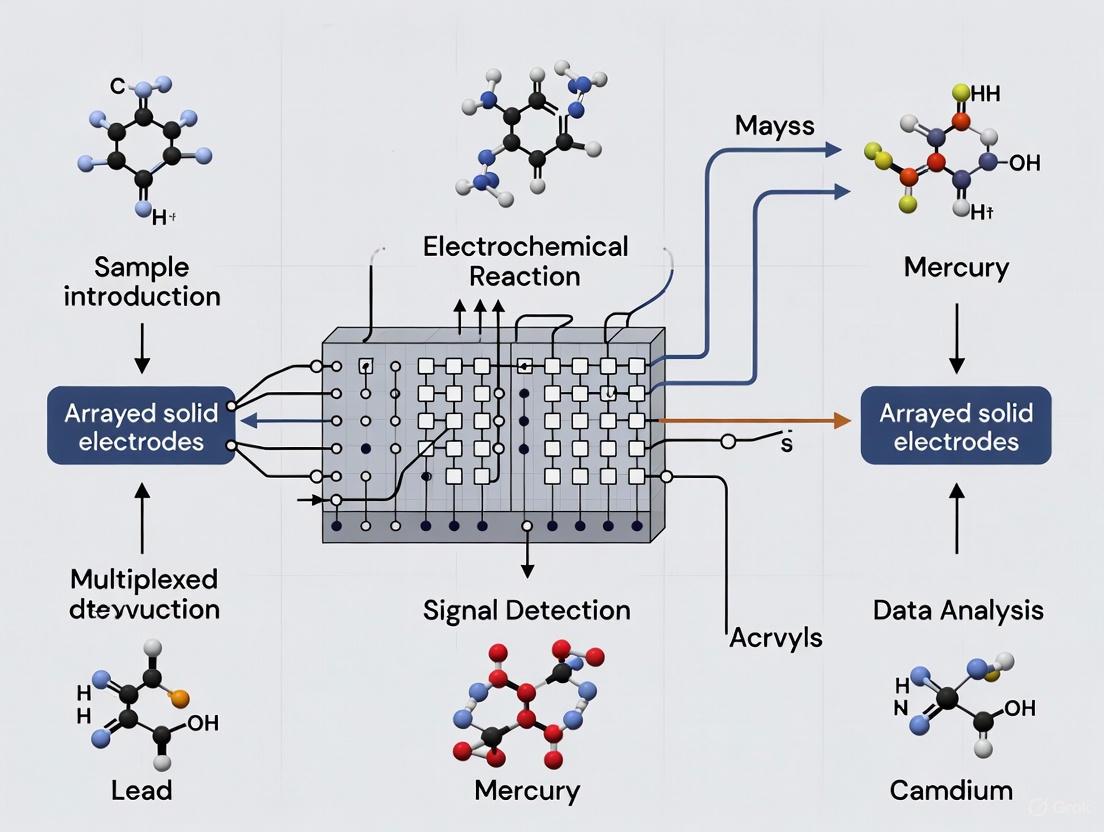
This article provides a comprehensive overview of the latest advancements in multiplexed heavy metal detection utilizing arrayed solid electrodes.
Multiplexed Heavy Metal Detection with Arrayed Solid Electrodes: Strategies, Materials, and Biomedical Applications
Abstract
This article provides a comprehensive overview of the latest advancements in multiplexed heavy metal detection utilizing arrayed solid electrodes. Aimed at researchers, scientists, and drug development professionals, it explores the foundational principles of electrochemical sensor arrays and the critical need for on-site, multi-analyte monitoring. The scope extends to the design and fabrication of electrode arrays, the application of novel nanomaterials and biorecognition elements for enhanced sensitivity, and advanced signal processing techniques including machine learning for data deconvolution. A critical evaluation of sensor performance, robustness in complex matrices, and a comparative analysis with traditional methods is also presented, offering a holistic guide for developing next-generation portable sensors for clinical and environmental diagnostics.
The Urgent Need and Core Principles of Multiplexed Heavy Metal Sensing
The Global Challenge of Heavy Metal Pollution and Its Impact on Human Health
Heavy metal pollution represents a major global threat to ecological systems and human health. Heavy metals are generally defined as metallic elements with a high density (specific density greater than 5 g/cm³) and atomic weight between 63.5 and 200.6 g/mol [1] [2]. While some heavy metals like zinc (Zn), iron (Fe), cobalt (Co), manganese (Mn), and copper (Cu) are essential nutrients required for various biochemical functions in living organisms, they become toxic when exceeding threshold concentrations [1] [2]. Other heavy metals including lead (Pb), mercury (Hg), cadmium (Cd), arsenic (As), and chromium (Cr) are detrimental even at trace levels [2].
Heavy metals enter the environment through both natural processes (soil erosion, natural weathering of the earth's crust, volcanic eruptions) and anthropogenic activities (mining, industrial effluents, urban runoff, sewage discharge, agricultural practices) [1] [2]. The persistence and bioaccumulative nature of heavy metals, combined with their potential to cause serious health effects even at low concentrations, makes them a significant environmental concern worldwide [1].
Health Impacts and Toxicity Mechanisms
Arsenic Toxicity
Arsenic is a prominently toxic and carcinogenic semimetal that exists in inorganic forms such as arsenite and arsenate compounds. Humans encounter arsenic through natural sources, industrial exposure, or contaminated drinking water [1]. Arsenic acts as a protoplasmic poison that primarily affects sulphydryl groups of cells, causing malfunctioning of cell respiration, cell enzymes, and mitosis [1].
The toxicity mechanism involves biotransformation where harmful inorganic arsenic compounds get methylated to produce monomethylarsonic acid (MMA) and dimethylarsinic acid (DMA). The intermediate product, monomethylarsonic acid (MMA III), is highly toxic and potentially responsible for arsenic-induced carcinogenesis [1].
Lead Toxicity
Lead is an extremely toxic heavy metal that disturbs various physiological processes in living organisms. Lead causes toxicity through ionic mechanisms and oxidative stress [1]. The ionic mechanism occurs when lead ions replace other bivalent cations like Ca²⁺, Mg²⁺, and Fe²⁺, which disturbs biological metabolism including cell adhesion, intracellular signaling, protein folding, enzyme regulation, and neurotransmitter release [1].
In oxidative stress, lead increases levels of reactive oxygen species (ROS) while decreasing antioxidant levels. This imbalance leads to oxidative deterioration of biological macromolecules, including damage to proteins, nucleic acids, membranes, and lipids [1].
Comparative Health Effects of Heavy Metals
Table 1: Health Effects of Priority Heavy Metal Pollutants
| Heavy Metal | Major Exposure Routes | Health Effects | Target Organs/Systems |
|---|---|---|---|
| Arsenic (As) | Contaminated drinking water, industrial sources | Skin lesions, cardiovascular diseases, cancer, peripheral neuropathy | Skin, cardiovascular system, nervous system [1] [3] |
| Lead (Pb) | Food, drinking water, industrial processes, domestic sources | Developmental delays, neurological disorders, cognitive impairments, anemia | Nervous system, hematopoietic system, kidneys [1] [3] |
| Mercury (Hg) | Contaminated aquatic animals, industrial releases | Neurological damage, renal dysfunction, impaired development | Nervous system, kidneys [1] |
| Cadmium (Cd) | Food, smoking, industrial exposure | Kidney damage, lung diseases, cancer risk, bone demineralization | Kidneys, respiratory system, skeletal system [3] |
| Chromium (Cr) | Industrial processes, contaminated water | Respiratory issues, increased lung cancer risk, skin irritation | Respiratory system, skin [3] |
Multiplexed Detection Technologies
Electrochemical Sensing Platforms
Electrochemical techniques, particularly anodic stripping voltammetry (ASV), have emerged as promising methods for heavy metal detection with high sensitivity, selectivity, and accuracy, while being amenable for on-site detection when coupled with portable potentiostats [4]. Recent advances have focused on developing multiplexed detection systems capable of simultaneously measuring multiple heavy metal ions.
Screen-printed electrodes (SPEs) have been developed as effective platforms for fabricating complete electrode systems in a small footprint. SPEs can be fabricated at low costs with high precision on flexible polyimide substrates, making them ideal for integration into flow injection systems [4]. When integrated with 3D-printed flow cells, these systems enable automated, on-site, and near-real-time monitoring of heavy metals in water samples [4].
Nanomaterial-Enhanced Sensing
Nanomaterials have significantly advanced heavy metal detection capabilities. Quantum dots (QDs), fluorescent semiconductor nanocrystals typically less than 10 nm in size, have shown remarkable potential for multiplexed detection due to their superior optical properties [2] [5]. These include high photoluminescence, quantum yield, broad absorption spectra, superior resistance to photobleaching, narrow and symmetric emission bands, composition and/or size-dependent spectral properties, and highly tunable surface chemistry [2].
Multi-emitter nanoprobes comprising diverse QDs of varying size, nature, and composition enable the acquisition of specific analyte-response profiles through multi-point detection. When combined with chemometric models to process photoluminescence responses, these systems allow accurate and selective detection of multiple analytical targets in a single sample analysis [5].
Advanced Data Processing Integration
The integration of machine learning algorithms and Internet of Things (IoT) technology has revolutionized heavy metal sensing capabilities. Deep learning models, particularly convolutional neural networks (CNNs), can process complex electrochemical data patterns that traditional methods might overlook, enabling more accurate detection, classification, and quantification of analytes [6].
IoT integration facilitates remote monitoring and provides user-friendly data interfaces, making advanced heavy metal quantification capabilities accessible to non-specialists. This synergy combines advanced sensor technology with real-time data analysis and enhanced decision-making capabilities [6].
Experimental Protocols
Protocol 1: Multiplexed ASV Detection Using Nanocomposite-Modified SPEs
This protocol describes the simultaneous detection of As(III), Cd(II), and Pb(II) using screen-printed electrodes integrated with a 3D-printed flow cell [4].
Materials and Equipment
- Screen-printed electrodes (SPEs) on polyimide substrate with dual working electrodes
- Nanocomposite modifiers: (BiO)₂CO₃-reduced graphene oxide (rGO)-Nafion and Fe₃O₄ magnetic nanoparticles decorated with Au nanoparticles-ionic liquid (Fe₃O₄-Au-IL)
- 3D-printed flow cell
- Portable potentiostat with square wave ASV capability
- Computational fluid dynamics (CFD) software for flow cell optimization
- Standard solutions of target heavy metals (As(III), Cd(II), Pb(II))
Electrode Modification Procedure
- Prepare (BiO)₂CO₃-rGO nanocomposite by hydrothermal synthesis
- Prepare Fe₃O₄-Au-IL nanocomposite by co-precipitation and decoration with Au nanoparticles
- Modify the first working electrode with (BiO)₂CO₃-rGO-Nafion suspension
- Modify the second working electrode with Fe₃O₄-Au-IL nanocomposite
- Allow modified electrodes to dry at room temperature for 2 hours
Measurement Parameters
- Deposition potential: -1.2 V (optimized for target metals)
- Deposition time: 120 seconds (optimized for sensitivity)
- Flow rate: 1.5 mL/min (optimized using CFD)
- Square wave parameters: frequency 15 Hz, amplitude 25 mV, step potential 5 mV
Analysis Procedure
- Integrate modified SPE with 3D-printed flow cell
- Condition electrodes by cycling in blank solution until stable baseline
- Introduce sample solution into flow system
- Apply deposition potential while solution flows over electrodes
- Record square wave stripping voltammograms from -1.0 to 0.5 V
- Quantify metals based on peak currents at characteristic potentials:
- As(III): ≈ -0.15 V
- Cd(II): ≈ -0.65 V
- Pb(II): ≈ -0.45 V
Performance Characteristics
Table 2: Analytical Performance of Multiplexed ASV Detection [4]
| Heavy Metal Ion | Linear Range (μg/L) | Limit of Detection (μg/L) | Recovery in Real Water Samples (%) |
|---|---|---|---|
| As(III) | 0–50 | 2.4 | 95–101 |
| Cd(II) | 0–50 | 0.8 | 95–101 |
| Pb(II) | 0–50 | 1.2 | 95–101 |
Protocol 2: Quantum Dot-Based Multiplexed Detection with Chemometric Analysis
This protocol describes the simultaneous detection of multiple metal ions (Ag⁺, Cu²⁺, Hg²⁺, Al³⁺, Pb²⁺, Fe³⁺, Fe²⁺, Zn²⁺, Ni²⁺, Cd²⁺, Ca²⁺) using a triple-emission nanoprobe and chemometric analysis [5].
Materials
- Triple-emission nanoprobe: Blue-emitting carbon dots (CDs), green-emitting glutathione-capped CdTe QDs (GSH-QDs), red-emitting 3-mercaptopropionic acid-capped CdTe QDs (MPA-QDs)
- Metal ion standard solutions (0.8 mmol/L intermediate solutions)
- Spectrofluorometer with kinetic measurement capability
- Chemometric software (PLS, unfolded-PLS, PLS-DA algorithms)
Nanoprobes Synthesis
- Synthesize MPA-CdTe QDs using hydrothermal synthesis with Cd:Te:MPA molar ratio of 1:0.1:1.7 at pH 11.5
- Synthesize GSH-CdTe QDs using hydrothermal synthesis with Cd:Te:GSH molar ratio of 1:0.2:1.2 at pH 10.5
- Synthesize carbon dots via aqueous synthetic route from appropriate precursors
- Purify QDs by precipitation in absolute ethanol and centrifugation
- Prepare triple-emitter solution by mixing CDs, GSH-QDs, and MPA-QDs in optimal ratio
Measurement Procedure
- Mix 500 μL of triple-emitter solution with 500 μL of sample solution
- Incubate for 5 minutes at room temperature
- Acquire first-order data: emission spectra from 400-700 nm with fixed excitation
- Acquire second-order data: time-resolved emission spectra collecting data over time
- Record photoluminescence responses for each metal ion and mixtures
Chemometric Analysis
- Data preprocessing: normalization, scatter correction, and alignment
- Build PLS and U-PLS models for quantification using first- and second-order data
- Build PLS-DA models for discrimination of metal ion mixtures
- Validate models using cross-validation and external validation sets
- Analyze molar ratio effects on model accuracy
Performance Characteristics
- Second-order data provides significantly better results than first-order data
- R²P values for PLS and U-PLS models exceed 0.9 for several metal ions
- Molar ratio between metal ions significantly impacts model accuracy
Research Reagent Solutions
Table 3: Essential Materials for Multiplexed Heavy Metal Detection Research
| Research Reagent | Function/Application | Examples/Specifications |
|---|---|---|
| Screen-printed electrodes (SPEs) | Platform for electrochemical detection; enables disposable, low-cost sensing | Polyimide substrate with graphite working electrode, Ag/AgCl reference electrode [4] |
| Nanocomposite modifiers | Enhance sensitivity and selectivity of electrodes | (BiO)₂CO₃-rGO-Nafion, Fe₃O₄-Au-IL, mercury-on-graphene films [4] [7] |
| Quantum dots (QDs) | Fluorescent probes for optical detection; size-tunable emission properties | CdTe QDs with different capping ligands (GSH, MPA); carbon dots [2] [5] |
| Ionic liquids (ILs) | Improve electron transfer and stability in electrochemical sensors | Used in nanocomposites like Fe₃O₄-Au-IL [4] |
| Chemometric algorithms | Process complex data from multiplexed detection; enable accurate quantification | PLS, unfolded-PLS, PLS-DA for analysis of first- and second-order data [5] |
| 3D-printed flow cells | Enable automated flow injection analysis; improve reproducibility | Custom-designed geometry optimized by computational fluid dynamics [4] |
| Metal ion standard solutions | Calibration and method validation | 1000 mg/L stock solutions in 0.5 mol/L HNO₃ for stability [5] |
Signaling Pathways and Workflow Diagrams
Heavy Metal Toxicity Pathways
Multiplexed Detection Workflow
The global challenge of heavy metal pollution requires advanced monitoring solutions that can accurately and simultaneously detect multiple contaminants. Multiplexed detection technologies, particularly those utilizing arrayed solid electrodes enhanced with nanomaterials, provide powerful tools for comprehensive environmental monitoring and health risk assessment. The integration of electrochemical and optical sensing platforms with advanced data processing techniques, including chemometrics and machine learning, enables researchers to address the complex nature of heavy metal pollution more effectively than ever before.
These technological advances support the development of portable, cost-effective, and user-friendly detection systems that can be deployed for real-time monitoring of heavy metals in various environmental matrices. As research continues, further improvements in sensitivity, selectivity, and multiplexing capabilities will enhance our ability to protect human health and ecosystems from the detrimental effects of heavy metal pollution.
Limitations of Traditional Laboratory-Based Detection Methods (AAS, ICP-MS)
Within the field of environmental science and public health, the accurate detection of heavy metal ions (HMIs) is paramount. Traditional laboratory-based techniques, notably Atomic Absorption Spectroscopy (AAS) and Inductively Coupled Plasma Mass Spectrometry (ICP-MS), have long been the cornerstone of analytical protocols for this purpose [8]. Their established sensitivity and accuracy are undeniable; ICP-MS, for instance, boasts detection limits ranging from sub-part per billion (ppb) to sub-part per trillion (ppt) for most elements and dominates the heavy metal testing market, holding a 60% share [9] [10].
However, the context of modern research, particularly in the development of multiplexed heavy metal detection with arrayed solid electrodes, brings the limitations of these traditional methods into sharp relief. This document details these constraints, framing them not merely as shortcomings but as drivers for innovation. The necessity for portable, rapid, and high-throughput analysis underscores the need for a paradigm shift from centralized laboratory analysis to decentralized, on-site sensing platforms [11] [12].
Core Limitations of Traditional Methods
The following table summarizes the principal limitations of AAS and ICP-MS, which collectively hinder their application in rapid, on-site, and resource-limited settings.
Table 1: Core Limitations of Traditional Heavy Metal Detection Methods
| Limitation Category | Atomic Absorption Spectroscopy (AAS) | Inductively Coupled Plasma Mass Spectrometry (ICP-MS) |
|---|---|---|
| Instrumentation & Cost | High equipment cost; lower sensitivity compared to ICP-MS limits detection of ultra-trace metals [8] [9]. | Very high capital and operational costs; requires significant laboratory infrastructure and highly skilled operators [4] [11] [10]. |
| Analytical Throughput | Typically analyzes only one element at a time, making multi-analyte detection inefficient and time-consuming [9]. | Although capable of multi-element analysis, complex sample preparation and run times limit true high-throughput application [13] [14]. |
| Portability & On-Site Use | Not suitable for on-site or real-time monitoring; requires controlled laboratory environment [12]. | Purely a laboratory-based technique; impractical for field deployment or instantaneous, on-site analysis [4] [11]. |
| Sample Preparation | Requires intricate and time-consuming sample pre-treatment, including acid digestion, to break down complex matrices [9]. | Demands complex sample preparation such as microwave-assisted acid digestion, which is resource-intensive and requires transportation of samples to a lab [4] [13] [14]. |
| Operational Complexity | Less complex than ICP-MS but still requires specialized training for technicians [10]. | Complex instrumentation and operation necessitate highly trained personnel, increasing operational costs [11] [10]. |
Application Notes: Emerging Alternatives in Multiplexed Detection
The limitations of AAS and ICP-MS have catalyzed the development of innovative alternatives better suited for multiplexed detection. These emerging technologies align with the demands of modern research, offering portability, rapid analysis, and the ability to simultaneously detect multiple analytes.
Application Note 1: Smartphone-Assisted Colorimetric Sensor Arrays
This technology represents a significant leap toward rapid, on-site screening. It utilizes nanozymes as signal recognition elements that catalyze a colorimetric reaction (e.g., oxidation of TMB). Different heavy metal ions inhibit this catalytic activity to varying degrees, creating a unique colorimetric fingerprint for each metal [15].
- Key Advantage: Enables high-throughput identification of multiple heavy metal ions (e.g., Hg²⁺, Pb²⁺, Co²⁺, Cr⁶⁺, Fe³⁺) at concentrations as low as 0.5 μM in just 5 minutes. The integration with a smartphone's RGB sensor allows for instant, instrument-free analysis [15].
- Thesis Context: This sensor array principle, which relies on cross-responsive receptors rather than a single specific "key," is a conceptual precursor to electronic tongues and arrayed electrode systems, demonstrating the power of pattern recognition for multiplexed analysis [15].
Application Note 2: Multiplexed Anodic Stripping Voltammetry (ASV) with Flow Cells
Anodic Stripping Voltammetry is an electrochemical technique known for its high sensitivity. Recent advances have integrated ASV with screen-printed electrodes (SPEs) and 3D-printed flow cells, creating a platform for automated, multiplexed detection [4].
- Key Advantage: Allows for the simultaneous detection of multiple HMIs like As(III), Cd(II), and Pb(II) with low detection limits (e.g., 0.8-2.4 μg/L). The flow system enables high-throughput analysis and near real-time monitoring with high accuracy (95–101% recovery in complex matrices) [4].
- Thesis Context: This approach directly aligns with research on arrayed solid electrodes. The use of nanocomposites (e.g., (BiO)₂CO₃-rGO-Nafion) to modify the working electrodes enhances sensitivity and selectivity, a key strategy in optimizing electrode arrays [4] [9].
Application Note 3: Nanoparticle-Enhanced Paper Analytical Devices (PADs)
PADs offer a low-cost, user-friendly alternative for toxic metal detection in resource-limited areas. The integration of nanoparticles (e.g., gold, silver) and colorimetric/electrochemical detection methods improves their sensitivity and selectivity [16].
- Key Advantage: Extreme portability and cost-effectiveness. Recent advancements through nanoparticle functionalization and smartphone-based readouts enable real-time, on-site detection without the need for complex infrastructure [16] [11].
- Thesis Context: PADs embody the principles of device miniaturization and field-deployability. Their development highlights the critical need for low-cost platforms, a consideration that also informs the design and material selection for disposable electrode arrays [16].
Experimental Protocols
Protocol 1: ICP-MS for Heavy Metal Analysis in Biological Tissue
This protocol, adapted from fish tissue analysis, exemplifies the complex sample preparation required for traditional methods [13] [14].
Workflow Overview
1. Sample Preparation:
- Collection & Dissection: Collect samples (e.g., fish). Dissect to isolate target tissues (muscle, liver, gills). Rinse with deionized water to remove surface contaminants [13].
- Dehydration & Homogenization: Dry tissues in a hot-air oven at 40–50°C until a constant weight is achieved. Grind the dried samples into a fine, homogeneous powder using a mortar and pestle or a mechanical homogenizer [13].
2. Acid Digestion:
- Weigh 25–500 mg of the homogenized dry sample into a sealed Teflon digestion vessel.
- Add 5-8 mL of high-purity nitric acid (HNO₃, 65%). For some matrices, add 1 mL of hydrogen peroxide (H₂O₂, 30%) [13] [14].
- Perform microwave-assisted digestion using a stepped program. Example parameters:
- Step 1: 400 W, ramp 7 min to 85°C, hold 5 min.
- Step 2: 800 W, ramp 10 min to 110°C, hold 10 min.
- Step 3: 1600 W, ramp 7 min to 165°C, hold 10 min [14].
- After cooling, transfer the digested solution to a volumetric flask and dilute to a known volume (e.g., 10-40 mL) with deionized water.
3. ICP-MS Analysis:
- Instrument Setup: Calibrate the ICP-MS (e.g., Perkin Elmer NexION 1000) using multi-element standard solutions. Ensure correlation coefficients (R²) for calibration curves are >0.999 [13] [14].
- Analysis: Introduce the diluted sample digest. Monitor elements of interest (e.g., As, Cd, Cr, Pb, Hg). Use internal standards (e.g., Scandium, Rhodium) to correct for matrix effects and instrumental drift.
Protocol 2: Multiplexed ASV Using Nanocomposite-Modified Screen-Printed Electrodes
This protocol demonstrates a modern electrochemical approach relevant to arrayed electrode research [4].
Workflow Overview
1. Electrode Fabrication and Modification:
- Fabrication: Fabricate screen-printed electrodes (SPEs) on a polyimide substrate. The system should include dual working electrodes (WEs), a graphite counter electrode (CE), and a Ag/AgCl quasi-reference electrode (RE) [4].
- Modification: Modify the WEs with catalytic nanocomposites to enhance sensitivity.
- WE 1: Drop-coat with a suspension of (BiO)₂CO₃-reduced graphene oxide (rGO)-Nafion nanocomposite.
- WE 2: Modify with Fe₃O₄ magnetic nanoparticles decorated with Au nanoparticles and ionic liquid (Fe₃O₄-Au-IL) [4].
- Allow the modified electrodes to dry at room temperature.
2. System Integration and Measurement:
- Flow Cell Assembly: Integrate the SPE strip with a 3D-printed flow cell, ensuring a leak-proof seal and strategic placement of the sensing area within the flow channel.
- Parameter Optimization: Optimize key square-wave ASV parameters:
- Deposition Potential: -1.2 V to -1.4 V (vs. Ag/AgCl).
- Deposition Time: 120-300 seconds.
- Flow Rate: 0.5-2.0 mL/min [4].
- ASV Measurement: Introduce the sample solution. Under optimized flow conditions, apply the deposition potential to pre-concentrate heavy metals onto the WEs. Subsequently, run a square-wave voltammetric scan from a negative to a positive potential to strip the deposited metals. Record the resulting voltammograms for each WE.
3. Data Analysis:
- Identify heavy metals based on their characteristic peak potentials.
- Quantify concentrations using pre-established calibration curves for each metal ion (e.g., in the range of 0–50 μg/L) [4].
The Scientist's Toolkit: Research Reagent Solutions
The following table details essential materials and their functions in developing advanced detection systems, particularly multiplexed electrochemical sensors.
Table 2: Essential Reagents and Materials for Advanced Heavy Metal Detection Research
| Item | Function/Application | Examples / Notes |
|---|---|---|
| Nanozymes & Nanocomposites | Serve as high-activity signal recognition elements to catalyze reactions or enhance electrode sensitivity. | AuPt@Fe-N-C nanozymes for colorimetric arrays [15]; (BiO)₂CO₃-rGO-Nafion for ASV sensors [4]. |
| Screen-Printed Electrodes (SPEs) | Provide a disposable, miniaturized, and customizable platform for electrochemical detection. | Graphite and Ag/AgCl inks printed on polyimide film; enables arrayed electrode designs [4]. |
| Chromogenic Substrates | Produce a measurable color change in optical sensor systems upon catalytic reaction. | 3,3',5,5'-Tetramethylbenzidine (TMB), which turns from colorless to blue upon oxidation [15]. |
| Ionic Liquids (ILs) | Improve conductivity and stability of nanocomposite films on electrode surfaces. | Used in modifiers like Fe₃O₄-Au-IL to enhance electron transfer and HMI pre-concentration [4]. |
| Standard Reference Materials (SRMs) | Essential for method validation and quality control, ensuring analytical accuracy and precision. | ERM CE-278K Mussel Tissue, NIST SRM 1547 Peach Leaves [14]. |
| Microfluidic Flow Cells | Automate sample handling, enable high-throughput analysis, and integrate with sensor platforms. | 3D-printed cells designed using computational fluid dynamics (CFD) to optimize flow over SPEs [4]. |
Electrochemical sensors have emerged as powerful analytical tools, transforming environmental monitoring, clinical diagnostics, and food safety testing. These devices convert chemical information into a measurable electrical signal, providing a robust platform for detecting diverse analytes, from single ions to complex biomolecules. Within the specific research context of multiplexed heavy metal detection with arrayed solid electrodes, the advantages of portability, sensitivity, and cost-effectiveness are particularly pronounced. This application note details how these intrinsic advantages make electrochemical sensors indispensable for developing advanced, field-deployable analytical systems for environmental heavy metal monitoring.
Core Advantages in Multiplexed Heavy Metal Detection
The design of modern electrochemical sensors is inherently compatible with the demands of multiplexed detection. The following core advantages enable their application in sophisticated research settings.
Portability and Miniaturization
The fundamental principle of electrochemical sensing allows for significant miniaturization and integration into portable systems, a critical feature for on-site environmental analysis.
- Simple Sensor Design and Low-Cost Manufacturing: The core sensor architecture, often based on planar electrodes, is inherently compact and facilitates easy interfacing with portable electronic read-out systems [17]. This simplicity is the foundation of portability.
- Integration with Microfluidics and 3D-Printing: Sensor systems can be seamlessly combined with 3D-printed flow cells and microfluidic chips for automated, small-volume analysis. This creates highly integrated, portable Lab-on-a-Chip (LOC) platforms that replace bulky laboratory equipment [4] [18]. One study demonstrated a homemade electrochemical cell integrated with a 3D-printed flow cell for the multiplexed detection of heavy metals, showcasing the potential for automation and miniaturization [4].
- Portable Potentiostats: The availability of pocket-sized, commercial potentiosts (e.g., EmStat, DropStat) and smartphone-based sensor interfaces enables the development of complete, handheld detection systems that do not sacrifice performance for portability [17].
High Sensitivity and Low Detection Limits
Electrochemical sensors, especially when coupled with advanced materials and techniques, achieve sensitivities that rival conventional laboratory-based methods.
- Nanomaterial-Enhanced Performance: The modification of electrode surfaces with nanomaterials is a key strategy for boosting sensitivity. For instance:
- Electrochemically polished carbon screen-printed electrodes (cSPEs) modified with a bismuth-reduced graphene oxide (Bi-rGO) nanocomposite demonstrated high sensitivity for cadmium and lead, with detection limits in the sub-parts per billion (ppb) range [19].
- The use of magnetic beads (MBs) in biosensors enhances sensitivity and selectivity by facilitating efficient target capture and preconcentration [20].
- Powerful Electrochemical Techniques: Techniques like Square Wave Anodic Stripping Voltammetry (SWASV) are exceptionally well-suited for trace-level metal detection. SWASV involves a two-step process: a preconcentration step, where metal ions are reduced and deposited onto the working electrode, followed by a stripping step, where they are re-oxidized, producing a highly sensitive and quantifiable current signal [19] [4]. This method effectively pre-concentrates the analyte at the electrode surface, leading to significantly enhanced signals.
Cost-Effectiveness
The economic advantage of electrochemical sensors is a major driver for their widespread adoption, particularly for disposable or frequent monitoring applications.
- Low-Cost Fabrication Methods: Techniques like screen-printing allow for the mass production of disposable, planar electrodes on flexible substrates like polyimide at a low cost [20] [4]. This is a stark contrast to the expensive fabrication processes like chemical vapor deposition (CVD) [20].
- Innovative, Low-Cost Materials: Research continues to push the boundaries of cost reduction. For example, one study presented a rapid manufacturing approach for electrodes using lamination of low-cost gold leaves and laser ablation, bypassing the need for expensive vacuum deposition systems [20].
- Reduced Operational Costs: Electrochemical sensors typically require minimal sample preparation, no expensive reagents, and are operated with portable, low-power potentiostats, drastically reducing the overall cost per analysis compared to techniques like ICP-MS or AAS [4].
Table 1: Quantitative Performance of Electrochemical Sensors in Heavy Metal Detection
| Target Analyte | Electrode/Sensing Platform | Detection Technique | Limit of Detection (LOD) | Linear Range | Reference |
|---|---|---|---|---|---|
| Cd(II), Pb(II) | Bi-rGO / ECP-treated cSPE | SWASV | Cd: 0.8 µg/L, Pb: 1.2 µg/L | Not Specified | [19] |
| As(III), Cd(II), Pb(II) | (BiO)₂CO₃-rGO-Nafion & Fe₃O₄-Au-IL modified SPE | SWASV (Flow System) | As: 2.4 µg/L, Cd: 0.8 µg/L, Pb: 1.2 µg/L | 0–50 µg/L | [4] |
| S. typhimurium, L. monocytogenes | Gold Leaf Electrode (GLE) with Magnetic Beads | Impedimetric | Not Specified | Not Specified | [20] |
| Pb(II) | DNAzyme-based Microfluidic Sensor | Amperometric | 10 nM (≈2.07 µg/L) | Not Specified | [18] |
Experimental Protocols
Protocol: Fabrication of Low-Cost Gold Leaf Electrodes (GLEs)
This protocol outlines a rapid, cost-effective method for creating customizable gold electrodes, ideal for prototyping and research [20].
- 1. Materials:
- Polyvinyl chloride (PVC) adhesive sheets (e.g., laminating pouch)
- 24-karat gold leaf
- Dry lubricant PTFE spray
- Laser ablation system
- 2. Procedure:
- Substrate Preparation: Spray a thin layer of PTFE on a clean, flat surface to prevent adhesion.
- Lamination: Place a PVC adhesive sheet onto the PTFE-treated surface. Carefully laminate a gold leaf foil (80 mm x 80 mm) onto the adhesive side of the PVC sheet.
- Curing: The laminated structure is allowed to cure, forming a robust, conductive gold surface.
- Patterning: Use a laser ablation system to define and create the desired electrode geometry (e.g., working, counter, reference electrodes) with micro-scale resolution by removing excess gold material.
- 3. Notes:
- This method avoids the high costs and complexity of traditional physical vapor deposition (PVD).
- The laser ablation process allows for high customization of electrode design and pattern.
Protocol: Multiplexed ASV Detection of Heavy Metals Using a 3D-Printed Flow Cell
This protocol describes the operation of an integrated flow system for the simultaneous detection of multiple heavy metal ions [4].
- 1. Materials:
- Screen-printed electrode (SPE) with dual working electrodes (modified with nanocomposites).
- Integrated 3D-printed flow cell.
- Portable potentiostat.
- Peristaltic pump and tubing.
- Standard solutions of target heavy metal ions (e.g., As(III), Cd(II), Pb(II)).
- Supporting electrolyte (e.g., acetate buffer).
- 2. Procedure:
- System Setup: Connect the SPE to the 3D-printed flow cell, ensuring a leak-proof seal. Connect the flow cell to the peristaltic pump and the SPE to the potentiostat.
- Optimization of Parameters: Prior to detection, optimize key parameters:
- Deposition Potential: Typically a negative potential to reduce metal ions to their elemental form (e.g., -1.2 V).
- Deposition Time: Ranges from 60-300 seconds, depending on the required sensitivity.
- Flow Rate: Optimize for efficient transport and deposition (e.g., 1-5 mL/min).
- Analysis:
- Introduce the sample (in supporting electrolyte) into the flow stream.
- Apply the deposition potential at the working electrode to pre-concentrate the metals.
- Switch off the flow (or reduce it) and perform the anodic stripping step using Square Wave Voltammetry.
- Record the resulting voltammogram, where each metal produces a distinct current peak at a characteristic potential.
- 3. Notes:
- The flow system enables high-throughput analysis and automation.
- Modification of the working electrodes with nanocomposites like (BiO)₂CO₃-rGO is crucial for enhancing sensitivity and enabling the detection of arsenic.
The Scientist's Toolkit: Key Research Reagents & Materials
Table 2: Essential Materials for Developing Electrochemical Heavy Metal Sensors
| Item | Function/Application | Example Use Case |
|---|---|---|
| Screen-Printed Electrodes (SPEs) | Disposable, planar, and cost-effective transducer platform. | Foundation for portable sensor strips; can be modified with various nanomaterials [19] [4]. |
| Bismuth (Bi) & Bismuth-based Nanocomposites | Environmentally friendly electrocatalyst that forms fused alloys with heavy metals, enhancing stripping signals. | Modification of working electrodes for sensitive detection of Cd(II) and Pb(II) via SWASV [19]. |
| Graphene Oxide (GO) & Reduced GO (rGO) | 2D carbon nanomaterial providing high surface area, excellent conductivity, and abundant functional groups for modification. | Used in composites (e.g., with Bi) to increase electroactive surface area and electron transfer kinetics [19]. |
| Magnetic Beads (MBs) | Micro-sized particles for selective target capture, separation, and pre-concentration from complex samples. | Used in bead-labeled biosensors for pathogen detection (e.g., Salmonella, Listeria) to improve selectivity and sensitivity [20]. |
| DNAzymes | Catalytic DNA molecules that selectively cleave in the presence of a specific metal ion, acting as a highly specific biorecognition element. | Immobilized on sensor surfaces (e.g., with PtNPs) for label-free, selective detection of Pb²⁺ ions [18]. |
| Ionic Liquids (ILs) | Salts in liquid state used to enhance conductivity, stability, and modify the electrode interface. | Component in nanocomposites (e.g., Fe₃O₄-Au-IL) to improve electron transfer and sensor performance [4]. |
Workflow and Signaling Pathways
The following diagram illustrates the logical workflow for developing and applying a multiplexed electrochemical sensor for heavy metal detection, from fabrication to data analysis.
Diagram 1: Workflow for multiplexed heavy metal detection with arrayed solid electrodes.
The core signaling mechanism in affinity-based biosensors (e.g., those using DNAzymes) and the subsequent signal transduction can be visualized as follows:
Diagram 2: Signaling pathway for a DNAzyme-based electrochemical sensor.
Multiplexed detection represents a paradigm shift in analytical science, enabling the simultaneous measurement of multiple analytes within a single sample. This approach stands in stark contrast to traditional single-target detection methods, which are limited to identifying one specific substance per test. The core principle involves using an array of sensing elements, often referred to as an "electronic tongue," where each element produces a cross-reactive response to different targets. These response patterns are then deconvoluted using statistical methods or machine learning algorithms to identify and quantify individual components within complex mixtures [15]. This technological advancement has transformed diagnostic capabilities across multiple fields, including biomedical diagnostics, environmental monitoring, and food safety assurance [21] [22].
The significance of multiplexed detection is particularly evident in heavy metal analysis, where traditional methods like atomic absorption spectroscopy (AAS) and inductively coupled plasma mass spectrometry (ICP-MS) offer high sensitivity and selectivity but present limitations for on-site application due to their requirement for expensive instrumentation, complex sample preparation, and specialized operators [15] [4]. Multiplexed sensors overcome these constraints by providing rapid, cost-effective, and high-throughput analysis capabilities that can be deployed in resource-limited settings, enabling timely detection and response to contaminants in food and water samples [22].
Principles and Strategies for Multiplexing
Fundamental Concepts
Multiplexed sensing platforms operate on the principle of coordinated signal generation, where multiple recognition elements interact with different targets or produce distinct signals for a single target. These systems employ various strategic approaches to achieve simultaneous multi-analyte detection, with the most prominent being spatial-resolution, wavelength-resolution, and potential-resolution [21]. Spatial-resolved systems physically separate detection zones on a single platform, often through microfluidic channels or patterned electrode arrays. Wavelength-resolved systems utilize multiple signaling probes with distinct optical signatures, such as fluorescent tags or quantum dots with different emission spectra. Potential-resolved systems, particularly in electrochemical detection, leverage the different redox potentials of analytes to distinguish them within a single measurement window [4].
The design of effective multiplexed sensors must address several key parameters, including minimizing cross-talk between different detection channels, ensuring compatibility between various recognition elements and transducers, and maintaining uniform performance across all sensing elements. Advanced materials, particularly nanomaterials, have proven essential in addressing these challenges by providing enhanced surface-to-volume ratios for immobilizing multiple recognition elements, unique optical and electrical properties for signal transduction, and the ability to create distinct microenvironments for different sensing reactions [22] [23].
Comparison of Multiplexing Strategies
Table 1: Key Multiplexing Strategies and Their Characteristics
| Multiplexing Strategy | Working Principle | Key Advantages | Common Applications |
|---|---|---|---|
| Spatial-Resolved | Physical separation of detection zones | Minimal cross-talk, simple signal interpretation | Microfluidic arrays, multi-electrode systems [21] [4] |
| Wavelength-Resolved | Distinct optical signatures for different targets | High multiplexing capacity, familiar technology | Fluorescence-based arrays, quantum dot sensors [21] [23] |
| Potential-Resolved | Different redox potentials of analytes | No need for physical separation, simplified design | Anodic stripping voltammetry for heavy metals [4] |
| Temporal-Resolved | Time-separated detection events | Reduced interference, sequential analysis | Magnetic relaxation switching assays [22] |
Multiplexed Detection of Heavy Metals: Platforms and Performance
Sensor Platforms for Heavy Metal Detection
The development of multiplexed platforms for heavy metal detection has accelerated significantly in recent years, with particular emphasis on creating systems suitable for field deployment and point-of-use testing. These platforms typically integrate advanced nanomaterials with various transduction mechanisms to achieve the necessary sensitivity and selectivity for simultaneous detection of multiple heavy metal ions.
Screen-printed electrode (SPE) systems represent one of the most promising platforms for environmental monitoring of heavy metals. These systems incorporate working, reference, and counter electrodes fabricated on a single substrate, often polyimide for flexibility and durability. The working electrodes can be modified with specific nanocomposites to enhance sensing capabilities for different metals. For instance, research has demonstrated successful integration of SPEs with (BiO)2CO3-reduced graphene oxide (rGO)-Nafion and Fe3O4-Au-ionic liquid (IL) nanocomposites to create a dual-working electrode system capable of simultaneously detecting As(III), Cd(II), and Pb(II) with limits of detection of 2.4 μg/L, 0.8 μg/L, and 1.2 μg/L, respectively [4].
Colorimetric sensor arrays offer an alternative approach that leverages the distinct color changes produced when different nanozymes interact with heavy metal ions. These systems typically employ multiple signal recognition elements such as AuPt@Fe-N-C, AuPt@N-C, and Fe-N-C nanozymes, which exhibit varying peroxidase-like activities that are differentially inhibited or enhanced by specific heavy metals. When combined with chromogenic substrates like 3,3',5,5'-Tetramethylbenzidine (TMB), these arrays generate unique color response patterns that can be discriminated using machine learning algorithms like linear discriminant analysis (LDA) [15]. The integration of such systems with smartphone-based RGB colorimetric platforms enables simple, rapid, and on-site analysis without requiring sophisticated instrumentation.
Performance Comparison of Heavy Metal Detection Platforms
Table 2: Performance Metrics of Multiplexed Heavy Metal Detection Platforms
| Detection Platform | Target Analytes | Linear Range (μg/L) | Limit of Detection (μg/L) | Analysis Time | Real Sample Application |
|---|---|---|---|---|---|
| Anodic Stripping Voltammetry with SPEs [4] | As(III), Cd(II), Pb(II) | 0-50 | 2.4, 0.8, 1.2 | ~15 min (incl. deposition) | Simulated river water (95-101% recovery) |
| Colorimetric Sensor Array with Nanozymes [15] | Hg²⁺, Pb²⁺, Co²⁺, Cr⁶⁺, Fe³⁺ | Not specified | 0.5 (for all) | 5 min | Seawater and salmon samples |
| Photoelectrochemical Sensors [21] | Various biomolecules, small organics, metal ions | Varies by analyte | Trace-level (not specified) | Rapid (not specified) | Biomedical, environmental, food samples |
Experimental Protocols
Protocol 1: Multiplexed Anodic Stripping Voltammetry for Heavy Metals
This protocol details the procedure for simultaneous detection of As(III), Cd(II), and Pb(II) using nanocomposite-modified screen-printed electrodes integrated with a 3D-printed flow cell [4].
Materials and Equipment
Table 3: Research Reagent Solutions for ASV-based Heavy Metal Detection
| Reagent/Material | Function/Application | Specifications/Notes |
|---|---|---|
| Screen-printed electrodes (SPEs) | Sensing platform | Polyimide substrate with dual working electrodes, Ag/AgCl quasi-reference electrode |
| (BiO)₂CO₃-rGO-Nafion nanocomposite | Working electrode modifier | Enhances As(III) sensing |
| Fe₃O₄-Au-IL nanocomposite | Working electrode modifier | Enhances Cd(II) and Pb(II) sensing |
| Acetate buffer | Supporting electrolyte | 0.1 M, pH 5.0 |
| Standard metal solutions | Calibration and analysis | As(III), Cd(II), Pb(II) stock solutions in deionized water |
| Portable potentiostat | Instrumentation | Square-wave anodic stripping voltammetry capability |
| 3D-printed flow cell | Sample delivery | Optimized geometry via computational fluid dynamics |
Experimental Workflow
The following diagram illustrates the complete experimental workflow for multiplexed anodic stripping voltammetry:
Step-by-Step Procedure
Electrode Modification:
- Prepare (BiO)₂CO₃-rGO-Nafion nanocomposite suspension in ethanol (1 mg/mL) and deposit 5 μL onto the first working electrode (WE1).
- Prepare Fe₃O₄-Au-IL nanocomposite suspension in ethanol (1 mg/mL) and deposit 5 μL onto the second working electrode (WE2).
- Allow both modified electrodes to dry at room temperature for 2 hours.
Flow Cell Assembly:
- Integrate the modified SPE with the 3D-printed flow cell, ensuring proper alignment of the electrode sensing areas with the flow channel.
- Verify sealing to prevent leakage using appropriate gaskets or O-rings.
Parameter Optimization:
- Set deposition potential to -1.2 V (vs. Ag/AgCl quasi-reference) for simultaneous deposition of all target metals.
- Optimize deposition time between 60-300 seconds based on desired sensitivity.
- Set flow rate to 1.0 mL/min using a peristaltic pump for efficient mass transport.
Anodic Stripping Voltammetry:
- Deoxygenate the acetate buffer (0.1 M, pH 5.0) and sample solutions by purging with nitrogen for 10 minutes.
- Inject sample into the flow system and apply deposition potential for the optimized time.
- Record square-wave anodic stripping voltammograms from -1.0 V to 0.5 V with the following parameters: frequency 25 Hz, amplitude 25 mV, step potential 4 mV.
Data Analysis:
- Identify peak potentials for each metal: As(III) at approximately -0.3 V, Cd(II) at -0.7 V, and Pb(II) at -0.5 V.
- Construct calibration curves by plotting peak current versus concentration for each metal in the range of 0-50 μg/L.
- Calculate limits of detection (LOD) using 3σ/slope, where σ is the standard deviation of the blank signal.
Protocol 2: Nanozyme-based Colorimetric Sensor Array
This protocol describes the procedure for detecting multiple heavy metal ions (Hg²⁺, Pb²⁺, Co²⁺, Cr⁶⁺, Fe³⁺) using a smartphone-assisted colorimetric sensor array based on nanozymes [15].
Materials and Equipment
Table 4: Research Reagent Solutions for Colorimetric Sensor Array
| Reagent/Material | Function/Application | Specifications/Notes |
|---|---|---|
| AuPt@Fe-N-C nanozyme | Signal recognition element | Enhanced peroxidase-like activity |
| AuPt@N-C nanozyme | Signal recognition element | Complementary recognition profile |
| Fe-N-C nanozyme | Signal recognition element | Single-atom nanozyme structure |
| TMB solution | Chromogenic substrate | 2 mM in acetate buffer |
| H₂O₂ solution | Enzyme substrate | 10 mM in acetate buffer |
| Acetate buffer | Reaction buffer | 0.1 M, pH 4.0 |
| Smartphone with colorimetry app | Signal readout | RGB color analysis capability |
Experimental Workflow
The following diagram illustrates the signal generation and detection principle for the nanozyme-based colorimetric sensor array:
Step-by-Step Procedure
Nanozyme Preparation:
- Synthesize AuPt@Fe-N-C, AuPt@N-C, and Fe-N-C nanozymes according to published procedures [15].
- Prepare nanozyme suspensions in acetate buffer (0.1 M, pH 4.0) at a concentration of 0.1 mg/mL.
Sensor Array Assembly:
- Dispense 50 μL of each nanozyme suspension into separate wells of a 96-well plate.
- Include control wells with nanozymes but no heavy metals for reference.
Sample Introduction:
- Add 50 μL of sample solution (standard or unknown) to each well containing nanozymes.
- Include replicates for each sample to ensure statistical significance.
Colorimetric Reaction:
- Prepare fresh TMB/H₂O₂ solution by mixing 2 mM TMB with 10 mM H₂O₂ in acetate buffer (0.1 M, pH 4.0).
- Add 100 μL of TMB/H₂O₂ solution to each well to initiate the colorimetric reaction.
- Incubate the plate at room temperature for exactly 5 minutes.
Signal Acquisition:
- Capture images of the well plate using a smartphone camera under consistent lighting conditions.
- Use a colorimetry application to extract RGB values from each well.
- Normalize RGB values against the control wells.
Data Analysis:
- Compile the normalized RGB values from all three nanozymes to create a unique response pattern for each heavy metal ion.
- Apply linear discriminant analysis (LDA) to differentiate between response patterns and identify heavy metals present in the sample.
- Construct calibration models using known standards to quantify heavy metal concentrations in unknown samples.
Multiplexed detection technologies represent a significant advancement over traditional single-analyte methods, offering unprecedented capabilities for simultaneous identification and quantification of multiple heavy metal ions. The platforms and protocols detailed in this application note demonstrate how strategic integration of nanomaterials with various transduction mechanisms can create powerful analytical tools suitable for field deployment and point-of-use testing. As these technologies continue to evolve, they hold great promise for addressing critical challenges in environmental monitoring, food safety, and public health protection through rapid, cost-effective, and high-throughput analysis of hazardous contaminants.
Application Note: Multiplexed Heavy Metal Detection Using ASV and EIS
This application note details the integration of Anodic Stripping Voltammetry (ASV) and Electrochemical Impedance Spectroscopy (EIS) for the sensitive, selective, and multiplexed detection of heavy metal ions (HMIs) in environmental and biological matrices. The synergistic use of these techniques with nanocomposite-modified, arrayed solid electrodes provides a powerful platform for real-time monitoring and risk assessment of toxic metals such as Pb(II), Cd(II), and As(III), which is critical for public health protection and drug development research [4] [24].
ASV excels in the direct, quantitative detection of specific electroactive metal ions with ultra-high sensitivity. Its multi-step process involves the pre-concentration of metal ions onto the electrode surface, followed by a stripping step that provides a highly sensitive quantitative analysis [4].
EIS is a label-free technique that is highly sensitive to surface modifications. It is particularly powerful for characterizing the electrode-solution interface, monitoring biorecognition events (e.g., antibody-antigen or aptamer-target binding), and validating the successful fabrication and modification of sensor surfaces [25] [26] [27]. When used in conjunction with ASV, EIS can confirm the integrity of the sensing layer and detect the binding of larger molecules or complexes that may not be directly electroactive.
The combination is ideal for multiplexed detection systems. ASV provides the primary quantitative data on metal ion concentration, while EIS can be used to monitor the stability of the biorecognition layer and detect non-electroactive interactions, offering a more comprehensive analytical profile [4] [22].
Experimental Protocols
Protocol 1: Multiplexed ASV Detection of Cd(II), Pb(II), and As(III) Using Nanocomposite-Modified Screen-Printed Electrodes
This protocol describes the simultaneous detection of three key heavy metal ions using a flow cell system integrated with a custom screen-printed electrode (SPE) [4].
A. Electrode Fabrication and Modification
- SPE Fabrication: Fabricate a planar screen-printed electrode system on a polyimide substrate. The design should incorporate dual working electrodes (WE), one shared Ag/AgCl quasi-reference electrode (RE), and one shared graphite counter electrode (CE) [4].
- Nanocomposite Synthesis:
- WE Modification: Drop-cast the (BiO)2CO3-rGO-Nafion nanocomposite onto one working electrode and the Fe3O4-Au-IL nanocomposite onto the second working electrode. Allow to dry at room temperature [4].
B. Flow Cell Assembly and Optimization
- 3D-Printed Flow Cell: Fabricate a flow cell with an optimized geometry using 3D printing. Computational Fluid Dynamics (CFD) is recommended to optimize the channel design for efficient flow and target deposition, minimizing dead volume [4].
- System Integration: Assemble the modified SPE with the 3D-printed flow cell, ensuring a leak-proof seal. Connect the cell to a flow injection system and a portable potentiostat [4].
C. ASV Measurement and Analysis
- Sample Introduction: Introduce the sample or standard solution into the flow cell at a constant flow rate (e.g., optimized to 1.5 mL/min) [4].
- Electrodeposition: Apply a optimized deposition potential (e.g., -1.4 V vs. Ag/AgCl) for a set time (e.g., 120 s) to reduce and pre-concentrate the metal ions (As(III), Cd(II), Pb(II)) onto the nanocomposite-modified working electrodes [4].
- Stripping Analysis: After a quiet time of 10 s, perform Square-Wave Anodic Stripping Voltammetry (SWASV) by scanning the potential from a negative to a positive value. Record the resulting current vs. potential plot [4].
- Quantification: Identify each metal ion by its characteristic stripping peak potential. Quantify the concentration by measuring the peak current and comparing it to a calibration curve [4].
Table 1: Optimized ASV Parameters and Analytical Performance for Heavy Metal Detection [4]
| Parameter / Performance | As(III) | Cd(II) | Pb(II) |
|---|---|---|---|
| Deposition Potential | -1.4 V (vs. Ag/AgCl) | -1.4 V (vs. Ag/AgCl) | -1.4 V (vs. Ag/AgCl) |
| Deposition Time | 120 s | 120 s | 120 s |
| Linear Range | 0–50 μg/L | 0–50 μg/L | 0–50 μg/L |
| Limit of Detection (LOD) | 2.4 μg/L | 0.8 μg/L | 1.2 μg/L |
| Recovery in River Water | 95–101% | 95–101% | 95–101% |
The following workflow diagram illustrates the sequential steps of this protocol:
ASV Experimental Workflow
Protocol 2: EIS for Sensor Characterization and Bio-Recognition Detection
This protocol outlines the use of EIS for characterizing electrode modifications and for the label-free detection of binding events, which can be applied to heavy metal detection using aptamers or other biorecognition elements.
A. EIS Measurement Setup
- Electrode Setup: Use a standard three-electrode system (WE, RE, CE) in a quiescent solution. The working electrode can be a bare or modified solid electrode (e.g., GCE, SPE, or gold electrode) [26] [27].
- Electrolyte Solution: Prepare an electrolyte solution containing a redox probe, typically 5 mM K₃[Fe(CN)₆]/K₄[Fe(CN)₆] (1:1 mixture) in a neutral electrolyte like 0.1 M PBS or KCl. The redox probe facilitates Faradaic EIS measurements [27].
- Instrument Configuration: Connect the electrochemical cell to a potentiostat capable of EIS measurements. Set the parameters: a DC potential equal to the formal potential of the redox probe (often ~ +0.22 V vs. Ag/AgCl for ferri/ferrocyanide), with an AC voltage amplitude of 5-10 mV, and a frequency range typically from 0.1 Hz to 100,000 Hz [26] [27].
B. Faradaic EIS for Layer-by-Layer Characterization
- Measure Baseline Impedance: Record the EIS spectrum of the bare or underlying electrode in the redox probe solution.
- Modify Electrode Surface: After each modification step (e.g., nanomaterial deposition, aptamer immobilization, exposure to analyte), rinse the electrode and place it in a fresh redox probe solution.
- Record Post-Modification Impedance: Measure the EIS spectrum under identical conditions after each modification step. The binding of non-conductive species (e.g., biomolecules) to the electrode surface will increase the charge-transfer resistance (Rct), which is observable as an increase in the diameter of the semicircle in the Nyquist plot [27].
C. Data Analysis
- Equivalent Circuit Fitting: Fit the obtained EIS data to an appropriate equivalent circuit model. The Randles circuit (with components Rs, Cdl, Rct, and W) is commonly used for a simple electrode-electrolyte interface [26].
- Monitor Rct: Use the fitted charge-transfer resistance (Rct) value as the primary analytical parameter. The increase in Rct (ΔRct) is proportional to the amount of target analyte bound to the electrode surface [27].
Table 2: Key Components of a Randles Equivalent Circuit and Their Physical Meaning [26] [27]
| Circuit Element | Symbol | Physical Meaning |
|---|---|---|
| Solution Resistance | Rs | Resistance to current flow through the electrolyte. |
| Double Layer Capacitance | Cdl | Capacitance of the ionic double-layer at the electrode-electrolyte interface. |
| Charge Transfer Resistance | Rct | Resistance to electron transfer across the electrode interface; the key parameter for sensing. |
| Warburg Impedance | W | Resistance related to the diffusion of redox species from the bulk solution to the electrode. |
The following diagram illustrates the EIS data interpretation process:
EIS Data Interpretation Process
The Scientist's Toolkit: Research Reagent Solutions
Table 3: Essential Materials for ASV and EIS-based Heavy Metal Detection
| Category | Item | Function / Rationale |
|---|---|---|
| Electrode Materials | Screen-Printed Electrodes (SPE) | Low-cost, disposable, customizable platform for field-deployable sensors [4]. |
| Gold or Glassy Carbon Electrodes (GCE) | Reusable solid electrodes for foundational lab studies and EIS characterization [27]. | |
| Nanocomposites | Reduced Graphene Oxide (rGO) | Provides high surface area and excellent conductivity, enhancing electron transfer and pre-concentration [4]. |
| Bismuth-based compounds (e.g., (BiO)₂CO₃) | Environmentally friendly substitute for mercury; enhances stripping signal for metals like Cd(II) and Pb(II) [4]. | |
| Metal Nanoparticles (e.g., Au, Fe₃O₄) | Catalyze redox reactions, improve conductivity, and can be functionalized with biorecognition elements [4] [22]. | |
| Ionic Liquids (IL) & Nafion | Polymer matrices that enhance stability, provide ion-exchange properties, and entrap nanocomposites [4]. | |
| Biorecognition Elements | DNAzymes & Aptamers | Oligonucleotides that selectively bind to specific metal ions, providing high selectivity for EIS-based detection [28]. |
| Key Reagents | Redox Probes (e.g., [Fe(CN)₆]³⁻/⁴⁻) | Essential for Faradaic EIS measurements; their electron transfer efficiency is modulated by binding events [26] [27]. |
| Buffer Salts (PBS, Acetate) | Control pH and ionic strength of the analytical solution, which is critical for biorecognition and electrodeposition [4]. |
Design, Fabrication, and Functionalization of Arrayed Electrode Sensors
The accurate and sensitive detection of heavy metal ions (HMIs) in environmental samples is a critical requirement for protecting public health and ecosystems. Screen-printed electrodes (SPEs) and interdigitated electrodes (IDEs) represent two advanced electrochemical platform architectures that enable precise, portable, and multiplexed detection of toxic metals at trace concentrations. These solid-state electrodes form the foundation of modern electroanalytical systems designed for on-site monitoring, offering significant advantages over traditional laboratory-based methods [29] [30]. Their compatibility with various modification strategies and nanomaterials further enhances sensitivity and selectivity, making them indispensable tools for environmental researchers and analytical scientists working on heavy metal detection [4] [31].
Platform Architectures and Working Principles
Screen-Printed Electrodes (SPEs)
SPEs are fabricated using thick-film technology where conductive inks are deposited through a patterned mesh screen onto various substrates such as ceramic, plastic, or polyimide [30] [32]. A typical three-electrode SPE system integrates working, reference, and counter electrodes on a single platform. The working and counter electrodes are commonly made from graphite or carbon pastes, while the reference electrode typically consists of an Ag/AgCl paste [4] [33]. This integrated design eliminates the need for traditional electrode maintenance and makes SPEs ideal for disposable, single-use applications in field settings [33].
The manufacturing process allows for mass production of highly reproducible electrodes at low cost, with the flexibility to create various electrode geometries and configurations [30]. SPEs can be modified with different sensing materials during the printing process (bulk modification) or through post-fabrication surface treatments to enhance their analytical performance for specific applications [29] [30].
Interdigitated Electrodes (IDEs)
IDEs consist of two comb-like electrode arrays fabricated in close proximity on an insulating substrate using microfabrication techniques such as photolithography and metal sputtering [31] [34]. This architecture creates a unique sensing volume where significant signal amplification occurs through redox cycling of electroactive species between the generator and collector electrodes [32]. The minimal electrode spacing (typically micrometers) enhances mass transport efficiency and enables highly sensitive measurements [31].
IDE platforms are particularly valuable for applications requiring minimal sample volumes and enhanced sensitivity. Recent innovations have utilized IDEs for reagent-free heavy metal detection by incorporating localized pH control, where one set of digits ("protonator") generates H+ ions through water electrolysis to acidify the sample microenvironment, enabling optimal deposition conditions without chemical pretreatment of the bulk sample [31] [35].
Performance Comparison of Electrode Platforms
The table below summarizes the detection capabilities of SPE and IDE platforms for various heavy metal ions, demonstrating their sensitivity and applicability for environmental monitoring.
Table 1: Performance comparison of electrode platforms for heavy metal detection
| Electrode Platform | Modification/Technique | Target Analyte | Linear Range (μg/L) | Limit of Detection (μg/L) | Reference |
|---|---|---|---|---|---|
| SPE | (BiO)₂CO₃-rGO-Nafion nanocomposite | As(III) | 0-50 | 2.4 | [4] |
| SPE | Fe₃O₄-Au-IL nanocomposite | Cd(II) | 0-50 | 0.8 | [4] |
| SPE | Fe₃O₄-Au-IL nanocomposite | Pb(II) | 0-50 | 1.2 | [4] |
| SPE | Ex situ mercury film | Cd(II) | - | 0.3 | [33] |
| SPE | Ex situ mercury film | Pb(II) | - | 0.3 | [33] |
| SPE | Ex situ bismuth film | Ni(II) | - | 0.4 | [33] |
| SPE | Ex situ bismuth film | Co(II) | - | 0.2 | [33] |
| IDE | Platinum microbands | Cu(II) | 5-100 | 0.8 | [31] |
| IDE | Gold microbands with in situ pH control | Cu(II) | 5-100 | 5 | [35] |
| IDE | Gold microbands with in situ pH control | Hg(II) | 1-75 | 1 | [35] |
Experimental Protocols
Protocol 1: Multiplexed Heavy Metal Detection Using Nanocomposite-Modified SPEs
This protocol describes the simultaneous detection of As(III), Cd(II), and Pb(II) using nanocomposite-modified screen-printed electrodes integrated with a 3D-printed flow cell [4].
Materials and Equipment
- Screen-printed electrodes (dual working electrodes on polyimide substrate)
- (BiO)₂CO₃-rGO-Nafion nanocomposite
- Fe₃O₄-Au-IL nanocomposite
- Portable potentiostat with square wave anodic stripping voltammetry (SWASV) capability
- 3D-printed flow cell
- Peristaltic pump for flow control
- Standard solutions of As(III), Cd(II), and Pb(II)
- Acetate buffer (0.1 M, pH 5.0) as supporting electrolyte
Electrode Modification Procedure
- SPE Pretreatment: Clean the SPE working electrodes by cycling the potential in 0.1 M H₂SO₄ between 0 and +1.0 V until a stable voltammogram is obtained.
- Nanocomposite Deposition:
- Prepare (BiO)₂CO₃-rGO-Nafion suspension in ethanol (1 mg/mL)
- Prepare Fe₃O₄-Au-IL suspension in ethanol (1 mg/mL)
- Deposit 5 μL of (BiO)₂CO₃-rGO-Nafion suspension on one working electrode
- Deposit 5 μL of Fe₃O₄-Au-IL suspension on the second working electrode
- Allow the modified electrodes to dry at room temperature for 2 hours
Anodic Stripping Voltammetry Analysis
- System Setup: Integrate the modified SPE with the 3D-printed flow cell and connect to the peristaltic pump.
- Optimized Parameters:
- Deposition potential: -1.4 V (vs. Ag/AgCl quasi-reference)
- Deposition time: 120 seconds
- Flow rate: 1.5 mL/min
- Square wave parameters: Frequency 25 Hz, amplitude 25 mV, step potential 5 mV
- Measurement Procedure:
- Introduce the sample solution (in acetate buffer) through the flow cell
- Apply deposition potential while solution flows over the electrode surface
- After deposition, stop the flow and initiate the anodic stripping scan from -1.4 to +0.5 V
- Record the stripping peaks for As(III) at approximately -0.1 V, Cd(II) at -0.7 V, and Pb(II) at -0.5 V
Data Analysis
- Measure peak currents for each metal and construct calibration curves in the 0-50 μg/L range.
- For real sample analysis (e.g., river water), use the standard addition method and calculate recovery rates.
Experimental workflow for SPE-based heavy metal detection
Protocol 2: Reagent-Free Copper Detection Using IDEs with In Situ pH Control
This protocol describes the detection of copper in water samples using platinum-based interdigitated electrodes with in situ pH control, eliminating the need for sample acidification [31] [35].
Materials and Equipment
- Platinum interdigitated electrode arrays (2 μm spacing)
- Portable potentiostat with multi-channel capability
- Square wave anodic stripping voltammetry (SWASV) software
- Standard copper solutions (0-100 μg/L) in 10 mM NaCl
- Phosphate buffer saline (PBS, pH 7.4) for real sample analysis
Electrode Characterization and Preparation
- Electrode Cleaning: Clean the IDE chips by immersing in isopropanol for 5 minutes, followed by rinsing with deionized water.
- Electrochemical Characterization: Perform cyclic voltammetry in 1 mM ferrocenecarboxylic acid solution from 0 to +0.5 V to verify electrode functionality.
- Sensor Activation: Cycle the electrode potential in 0.1 M H₂SO₄ between -0.2 and +1.2 V until a stable voltammogram characteristic of clean platinum is obtained.
SWASV with In Situ pH Control
Traditional Method (with chemical acidification):
- Acidify standard/sample solutions to pH 2 with 1 M HNO₃
- Apply deposition potential: -0.8 V for 120 seconds
- Record stripping scan from -0.8 to +0.2 V
- Copper oxidation peak appears at approximately -0.1 V
Reagent-Free Method (with in situ pH control):
- Use neutral pH samples without chemical acidification
- Apply +1.0 V to the "protonator" digits to generate H⁺ ions through water electrolysis
- Simultaneously apply -0.8 V to the "sensing" digits for copper deposition
- Maintain deposition for 120 seconds
- Record stripping scan as in traditional method
Data Analysis and Validation
- Measure copper peak current and height for quantification.
- Construct calibration curves in the 5-100 μg/L range for both methods.
- Validate the method by comparing results with ICP-OES analysis for real water samples.
IDE-based detection with in situ pH control mechanism
Essential Research Reagent Solutions
The table below outlines key reagents and materials essential for implementing electrode-based heavy metal detection protocols.
Table 2: Essential research reagents and materials for electrode-based heavy metal detection
| Reagent/Material | Function/Application | Examples/Specifications |
|---|---|---|
| Screen-Printed Electrodes | Disposable sensor platforms | Carbon, gold, or bismuth-based SPEs with integrated 3-electrode systems |
| Interdigitated Electrodes | Sensitive detection with signal amplification | Platinum or gold microbands with 2-10 μm spacing |
| Bismuth-based Inks | "Green" alternative to mercury for electrode modification | Bi₂O₃-containing pastes for in situ bismuth film formation |
| Nanocomposite Materials | Enhanced sensitivity and selectivity | (BiO)₂CO₃-rGO-Nafion, Fe₃O₄-Au-IL, CNT aerogels |
| Ionic Liquids | Improved conductivity and stability | BMIM-PF₆, EMIM-TF₂N for composite modification |
| Supporting Electrolytes | Provide conducting medium for analysis | Acetate buffer (pH 5.0), PBS, 10 mM NaCl |
| Metal Standard Solutions | Calibration and quantification | Certified reference materials at 1000 mg/L |
| Complexing Agents | Adsorptive stripping voltammetry | Dimethylglyoxime (for Ni/Co), catechol, 8-hydroxyquinoline |
SPEs and IDEs offer complementary advantages for heavy metal detection in environmental matrices. SPEs provide cost-effective, disposable platforms suitable for field analysis, while IDEs enable highly sensitive detection with minimal sample volumes and innovative approaches such as in situ pH control. The integration of nanostructured materials significantly enhances the performance of both platforms, enabling detection at concentrations well below regulatory limits. These electrode architectures represent powerful tools for advancing multiplexed heavy metal detection in complex environmental samples, contributing to improved monitoring and protection of water resources.
The accurate and simultaneous detection of heavy metal ions (HMIs) such as lead (Pb(II)), cadmium (Cd(II)), and arsenic (As(III)) is a critical challenge in environmental monitoring and public health protection. Multiplexed electrochemical sensing, particularly with arrayed solid electrodes, offers a powerful solution for on-site, real-time analysis of these toxic elements. The performance of these sensors is profoundly enhanced by the strategic incorporation of advanced nanomaterials, which significantly improve signal transduction through increased surface area, enhanced electrical conductivity, and tailored surface chemistry. Among these nanomaterials, MXenes, graphene derivatives, and metal nanoparticles have emerged as particularly promising candidates due to their exceptional physicochemical properties that directly address the key requirements for sensitive and selective HMI detection [36] [37].
This protocol focuses on the integration of these nanomaterials into electrochemical sensing platforms specifically designed for multiplexed heavy metal detection. The unique combination of these materials capitalizes on their complementary advantages: MXenes offer high metallic conductivity and rich surface chemistry; graphene provides extensive surface area and excellent electron transfer capabilities; and metal nanoparticles contribute significant catalytic activity and signal amplification. When deployed on arrayed electrode platforms, these nanomaterial-modified surfaces enable the simultaneous quantification of multiple heavy metal species at trace levels, providing a robust analytical tool for comprehensive environmental assessment [4] [36].
Properties of Advanced Nanomaterials for Signal Enhancement
The strategic selection of nanomaterials for electrode modification is guided by their intrinsic properties that directly enhance electrochemical signal transduction. The table below summarizes the key characteristics of MXenes, graphene, and metal nanoparticles that make them particularly suitable for heavy metal detection applications.
Table 1: Comparative Properties of Nanomaterials for Electrochemical Sensing
| Property | MXenes | Graphene | Metal Nanoparticles |
|---|---|---|---|
| Electrical Conductivity | High (>20,000 S/cm) [38] | Extremely high [39] | Variable (high for Au, Pt) [40] |
| Surface Area | Large (up to 235.6 m²/g) [37] | Very large [41] | Moderate to high [40] |
| Surface Chemistry | Rich in -OH, -O, -F groups; easily functionalized [42] [39] | Inert; requires modification for functionality [39] | Catalytic; easily functionalized with thiols, amines [40] |
| Mechanical Properties | Flexible and strong [38] | Extremely strong but rigid [39] | Variable based on composition and support [40] |
| Hydrophilicity | Innately hydrophilic [42] | Hydrophobic unless functionalized [39] | Variable (often requires stabilizers) [40] |
| Primary Role in HMI Detection | Signal transduction, immobilization platform [37] | Enhanced surface area, electron transfer [4] | Catalysis, signal amplification [4] |
The synergy between these material classes enables the creation of composite modifiers that overcome the limitations of individual components. For instance, MXene-graphene hybrids combine the exceptional conductivity and rich surface chemistry of MXenes with the enormous surface area of graphene, while metal nanoparticles decorated on these structures provide additional catalytic sites for heavy metal deposition and stripping [4] [38].
Experimental Workflow for Nanomaterial-Modified Electrode Preparation and Heavy Metal Detection
The process of creating and utilizing nanomaterial-modified arrayed electrodes for multiplexed heavy metal detection involves a systematic workflow from material synthesis to analytical measurement.
Diagram 1: Experimental workflow for sensor preparation and use.
Synthesis and Functionalization of Nanomaterials
MXene Synthesis (Ti₃C₂Tₓ)
- Protocol: Implement a selective etching approach using the minimally intensive layer delamination (MILD) method.
- Safety Precautions: Perform all steps in a fume hood while wearing appropriate personal protective equipment (acid-resistant gloves, goggles, and lab coat).
- Etching Solution Preparation: Slowly add 1 gram of lithium fluoride (LiF) to 20 mL of 9 M hydrochloric acid (HCl) in a polypropylene beaker under continuous stirring (500 rpm) for 5 minutes until mostly dissolved.
- MAX Phase Etching: Gradually add 1 gram of Ti₃AlC₂ MAX phase powder to the etching solution over 10 minutes to control reaction exotherm. Maintain the reaction at 35°C for 24 hours with continuous stirring at 300 rpm.
- Washing: Centrifuge the resulting mixture at 3500 rpm for 5 minutes and decant the supernatant. Wash the sediment with cold deionized water (≤10°C) and repeat centrifugation until the supernatant reaches pH ≥ 6 (typically 5-7 cycles).
- Delamination: Resuspend the sediment in 100 mL of deionized water and sonicate for 1 hour under argon gas bubbling. Centrifuge at 3500 rpm for 1 hour and collect the dark green colloidal supernatant containing single-layer MXene flakes.
- Storage: Store the MXene dispersion (≈5 mg/mL) in a sealed glass vial under argon atmosphere at 4°C for up to one week to minimize oxidative degradation [39] [37].
Graphene Oxide Reduction
- Protocol: Prepare reduced graphene oxide (rGO) using chemical reduction method.
- Dispersion: Prepare a 0.5 mg/mL dispersion of graphene oxide (GO) in deionized water and sonicate for 2 hours until a homogeneous yellow-brown dispersion forms.
- Chemical Reduction: Add 1 mL of hydrazine hydrate (35 wt%) per 100 mg of GO and heat at 95°C for 1 hour with continuous stirring.
- Product Isolation: Filter the resulting black precipitate through a 0.22 μm polycarbonate membrane and wash thoroughly with deionized water and methanol.
- Redispersion: Resuspend the rGO in deionized water at 1 mg/mL concentration using 30-minute probe sonication for electrode modification [4] [43].
Metal Nanoparticle Synthesis
- Protocol: Prepare gold nanoparticles (AuNPs) using the Turkevich method.
- Solution Preparation: Heat 100 mL of 1 mM chloroauric acid (HAuCl₄) to boiling under vigorous stirring.
- Reduction: Rapidly add 2.5 mL of 1% trisodium citrate solution to the boiling solution.
- Color Change: Observe the color progression from pale yellow to blackish-blue to deep red within 10 minutes, indicating nanoparticle formation.
- Cooling and Storage: Continue stirring for 15 minutes, then remove from heat and allow to cool to room temperature. Store the AuNP colloid (≈10 nm diameter) in a dark glass bottle at 4°C [40] [43].
Electrode Modification and Characterization
Screen-Printed Electrode (SPE) Array Fabrication
- Substrate Preparation: Clean polyimide substrate (125 μm thickness) with ethanol and deionized water in an ultrasonic bath for 15 minutes, then dry under nitrogen stream.
- Electrode Printing: Use a semi-automatic screen printer to sequentially deposit:
- Graphite Ink: Form working and counter electrodes through patterned stencil (2 mm diameter for working electrodes).
- Ag/AgCl Ink: Print reference electrode using commercial Ag/AgCl paste.
- Dielectric Layer: Apply insulating layer to define exact electrode areas and connection pathways.
- Curing: Thermally cure each layer according to ink manufacturer specifications (typically 60-80°C for 30-60 minutes) [4].
Nanomaterial Modification of Working Electrodes
- MXene-rGO Composite Modification:
- Ink Preparation: Prepare a dispersion containing 2 mg/mL MXene and 1 mg/mL rGO in 1:1 water:isopropanol with 0.1% Nafion as binder.
- Deposition: Deposit 5 μL of the composite ink onto each working electrode surface using a precision micropipette.
- Drying: Allow to dry overnight at room temperature in a desiccator to form a uniform nanocomposite film [4].
- Metal Nanoparticle Functionalization:
- Electrodeposition: Using a standard three-electrode system with the nanomaterial-modified SPE as working electrode, immerse in 1 mM HAuCl₄ solution in 0.1 M KCl.
- Deposition Parameters: Apply a constant potential of -0.2 V (vs. Ag/AgCl) for 60 seconds to deposit AuNPs onto the modified electrode surface.
- Rinsing: Rinse thoroughly with deionized water to remove loosely adsorbed ions [4] [40].
Material Characterization Techniques
- Scanning Electron Microscopy (SEM): Image the modified electrode surface at 5-15 kV accelerating voltage to verify nanomaterial distribution and layer morphology.
- X-ray Photoelectron Spectroscopy (XPS): Analyze surface composition and chemical states using monochromatic Al Kα radiation (1486.6 eV).
- X-ray Diffraction (XRD): Confirm crystal structure using Cu Kα radiation (λ = 1.5406 Å) with 2θ range from 5° to 80° [4] [37].
Electrochemical Detection Protocol
Flow Cell Assembly and Integration
- 3D-Printed Flow Cell: Fabricate a custom flow cell using stereolithography (SLA) 3D printing with biocompatible resin.
- Computational Fluid Dynamics (CFD) Optimization: Design flow channel geometry to ensure uniform flow distribution across all working electrodes in the array using COMSOL Multiphysics simulation.
- Sensor Integration: Assemble the modified SPE array with the flow cell, incorporating a silicone gasket (0.5 mm thickness) to prevent leakage and ensure a total cell volume of 50-100 μL.
- Flow System Connection: Integrate with a peristaltic pump and autosampler for automated sample introduction [4].
Anodic Stripping Voltammetry (ASV) Parameters
- Supporting Electrolyte: 0.1 M acetate buffer (pH 4.5) for optimal heavy metal deposition and stripping.
- Deposition Step: Apply deposition potential of -1.2 V (vs. Ag/AgCl) for 120-300 seconds with continuous solution stirring or flow (1.5 mL/min) to pre-concentrate heavy metals onto the modified electrode surface.
- Stripping Step: Record square-wave anodic stripping voltammograms from -1.2 V to 0 V using the following parameters:
- Square-wave amplitude: 25 mV
- Frequency: 15 Hz
- Step potential: 5 mV [4]
Multiplexed Detection Setup
- Electrode Array Configuration: Utilize multiple working electrodes (WEs) modified with different nanomaterials tailored for specific heavy metal detection:
- WE1: (BiO)₂CO₃-rGO-Nafion composite for As(III) and Pb(II) detection
- WE2: Fe₃O₄-Au-IL nanocomposite for Cd(II) and Pb(II) detection
- Simultaneous Measurement: Connect all working electrodes to a multi-channel potentiostat for parallel ASV measurement, sharing common reference and counter electrodes to minimize system complexity [4] [37].
Performance Metrics and Analytical Figures of Merit
The performance of nanomaterial-modified electrode arrays for heavy metal detection is quantified through standardized analytical metrics, with detection limits, sensitivity, and reproducibility being particularly critical for environmental monitoring applications.
Table 2: Analytical Performance of Nanomaterial-Modified Electrodes for Heavy Metal Detection
| Heavy Metal Ion | Nanomaterial Modifier | Linear Range (μg/L) | Detection Limit (μg/L) | Optimal pH | Interference Management |
|---|---|---|---|---|---|
| As(III) | (BiO)₂CO₃-rGO-Nafion [4] | 0–50 | 2.4 | 4.5 | Bismuth film minimizes oxygen interference |
| Pb(II) | (BiO)₂CO₃-rGO-Nafion [4] | 0–50 | 1.2 | 4.5 | Well-separated peak potential (-0.56 V) |
| Cd(II) | Fe₃O₄-Au-IL [4] | 0–50 | 0.8 | 4.5 | Distinct peak potential (-0.76 V) |
| Multiple HMIs | MXene-Bi nanocomposite [36] | 1–50 | 0.1–0.5 | 5.0 | Surface functionalization with thiol groups |
| Cu(II) | MXene-AuNP hybrid [38] | 5–100 | 0.3 | 4.0 | EDTA masking in complex matrices |
The exceptional performance of these nanomaterial-modified sensors is demonstrated through their application to real environmental samples. For example, one study reported recoveries of 95-101% for Pb(II), Cd(II), and As(III) in simulated river water samples, confirming minimal matrix effects and high analytical accuracy even in complex environmental samples [4]. The stability of these modified electrodes typically exceeds 50 consecutive measurements with <5% signal degradation when stored properly at 4°C between uses [4] [37].
The Scientist's Toolkit: Essential Research Reagents and Materials
Successful implementation of these protocols requires specific materials and reagents with carefully defined functions in the sensor fabrication and detection process.
Table 3: Essential Research Reagents for Nanomaterial-Modified Heavy Metal Sensors
| Reagent/Material | Function/Application | Specifications/Notes |
|---|---|---|
| Ti₃AlC₂ MAX Phase | MXene precursor | 400 mesh particle size, ≥98% purity [39] |
| Lithium Fluoride (LiF) | MXene etching agent | Anhydrous, ≥99.99% trace metals basis [37] |
| Graphene Oxide (GO) | rGO precursor | Single-layer, 0.5-1 mg/mL aqueous dispersion [4] |
| Chloroauric Acid (HAuCl₄) | AuNP precursor | Trihydrate, ≥99.9% trace metals basis [40] |
| Nafion Perfluorinated Resin | Binder/ionomer | 5 wt% in lower aliphatic alcohols and water [4] |
| Screen-Printed Electrodes | Sensor platform | Polyimide substrate, graphite WE/CE, Ag/AgCl RE [4] |
| Bismuth Nitrate (Bi(NO₃)₃) | Co-deposition agent | In-situ bismuth film formation, ≥98% purity [36] |
| Acetate Buffer | Supporting electrolyte | 0.1 M, pH 4.5, prepared with ultrapure water [4] |
Troubleshooting and Optimization Guidelines
The logical relationship between key experimental parameters and their impact on sensor performance guides the optimization process for achieving maximum detection sensitivity and selectivity.
Diagram 2: Parameter effects on sensor performance.
Common Optimization Challenges and Solutions
- Low Stripping Signal: Increase deposition time (up to 300 seconds) and verify nanomaterial coverage on electrode surface. Ensure proper functioning of reference electrode.
- Poor Peak Resolution: Optimize square-wave voltammetry parameters (frequency 10-25 Hz, amplitude 20-50 mV). Adjust pH to 4.5-5.0 for optimal peak separation.
- High Background Current: Implement thorough cleaning protocol between measurements (30-second conditioning at +0.3 V in supporting electrolyte). Verify electrolyte purity.
- Signal Instability: Ensure consistent nanomaterial ink formulation and deposition volume. Store modified electrodes in inert atmosphere when not in use.
- Flow Cell Leaks: Verify gasket integrity and tightening torque. Use CFD-optimized cell design to minimize dead volume and pressure points [4] [36] [37].
The integration of MXenes, graphene derivatives, and metal nanoparticles onto arrayed electrode platforms represents a significant advancement in multiplexed heavy metal detection capabilities. The protocols outlined herein provide a comprehensive framework for developing sensors with exceptional sensitivity, selectivity, and reproducibility for simultaneous quantification of multiple heavy metal ions at environmentally relevant concentrations.
For researchers implementing these methods, particular attention should be paid to MXene stability during storage and processing, as oxidative degradation remains a challenge. Additionally, the transition from laboratory validation to real-world environmental monitoring requires careful consideration of matrix effects in complex samples, which can be mitigated through standard addition methods and appropriate sample pretreatment.
The future development of these sensing platforms will likely focus on enhanced integration with microfluidic systems for autonomous monitoring, improved antifouling coatings for prolonged field deployment, and the incorporation of machine learning algorithms for automated data interpretation. These advancements will further establish nanomaterial-modified electrochemical sensors as indispensable tools for comprehensive environmental heavy metal assessment [4] [36] [37].
The accurate and sensitive detection of heavy metal ions (HMIs) is a critical challenge in environmental monitoring, food safety, and clinical diagnostics. Traditional analytical methods, such as atomic absorption spectroscopy (AAS) and inductively coupled plasma mass spectrometry (ICP-MS), offer precision but require sophisticated instrumentation, extensive sample preparation, and laboratory-bound settings, limiting their application for rapid, on-site analysis [4] [44]. Electrochemical sensors, particularly those employing anodic stripping voltammetry (ASV), present a promising alternative due to their high sensitivity, portability, and low cost. The integration of these sensors with biorecognition elements like DNAzymes and nanozymes significantly enhances their selectivity and catalytic activity, enabling the development of robust, multiplexed detection platforms for HMIs using arrayed solid electrodes [45] [44].
DNAzymes are catalytic DNA molecules that exhibit exceptional specificity toward specific metal ions. Upon binding to their target metal ion, such as Pb²⁺, they catalyze the cleavage of a complementary DNA substrate, which can be transduced into a measurable electrochemical or optical signal [45] [44]. Nanozymes, a class of nanomaterials mimicking natural enzyme activities, offer superior stability and tunable catalytic properties compared to their natural counterparts. Their peroxidase-like activity is frequently harnessed in colorimetric and electrochemical biosensors to amplify detection signals [46] [47] [44]. This application note details protocols and methodologies for incorporating these biorecognition elements into multiplexed heavy metal detection systems, providing a framework for researchers and scientists engaged in sensor development and drug discovery.
Quantitative Performance of Representative Biosensors
The table below summarizes the performance metrics of several documented biosensors that leverage DNAzymes and nanozymes for heavy metal detection, highlighting their sensitivity and applicability.
Table 1: Performance Comparison of DNAzyme and Nanozyme-Based Biosensors for Heavy Metal Detection
| Target Analyte | Biorecognition Element & Signal Amplification | Detection Platform | Linear Range | Limit of Detection (LOD) | Reference Application |
|---|---|---|---|---|---|
| Pb²⁺ | GR-5 DNAzyme & CRISPR/Cas12a with Pt/CeO₂ nanozyme | Electrochemical / Colorimetric | 0.002 - 200 nM (EC)0.5 - 2000 nM (Color) | 0.14 pM (EC)0.47 nM (Color) | Corn, edible oil, beef, red wine [44] |
| Pb²⁺ | DNAzyme with Fe₃O₄@Au@Ag Nanoparticles | Surface-Enhanced Raman Scattering (SERS) | 0.01 - 1.0 nM | 5 pM | Tap water, human serum [48] |
| Pb²⁺ & Cu²⁺ | Quantum-Dot-Labeled DNAzymes | Fluorescent | N/R | 0.2 nM (Pb²⁺)0.5 nM (Cu²⁺) | Liquid samples [45] |
| As(III), Cd(II), Pb(II) | (BiO)₂CO₃-rGO-Nafion & Fe₃O₄-Au-IL Nanocomposites | Anodic Stripping Voltammetry (ASV) | 0 - 50 μg/L | 2.4 μg/L (As(III))1.2 μg/L (Pb(II))0.8 μg/L (Cd(II)) | Simulated river water [4] |
| Pathogen | E-RCA & DNAzyme with Au-Mn₃O₄ Nanozyme | Electrochemical / Colorimetric / Photothermal | N/R | Ultra-sensitive | Sugarcane pokkah boeng pathogen [46] |
Abbreviations: N/R = Not Reported; EC = Electrochemical; Color = Colorimetric.
Experimental Protocols
Protocol 1: Fabrication of a DNAzyme-CRISPR Nanozyme Biosensor for Pb²⁺ Detection
This protocol describes the construction of a dual-mode (electrochemical/colorimetric) biosensor for Pb²⁺, integrating the high specificity of the GR-5 DNAzyme with the powerful amplification of the CRISPR/Cas12a system and the catalytic activity of Pt/CeO₂ nanozymes [44].
Principle: The presence of Pb²⁺ activates the GR-5 DNAzyme, cleaving its substrate and releasing an activator DNA. This activator binds to a CRISPR/Cas12a-crRNA complex, triggering its trans-cleavage activity, which indiscriminately cleaves single-stranded DNA (ssDNA). This cleavage is used to modulate the signal from Pt/CeO₂ nanozymes immobilized on an electrode (electrochemical) or in solution (colorimetric) [44].
Diagram 1: Signaling pathway for the DNAzyme-CRISPR nanozyme biosensor.
Materials:
- Reagents: Zirconium tetrachloride (ZrCl₄), Cerium(III) chloride heptahydrate (CeCl₃·7H₂O), Chloroplatinic acid (H₂PtCl₆), GR-5 DNAzyme sequence, Cas12a enzyme, crRNA, TMB substrate, H₂O₂.
- Buffers: 50 mM Tris-HCl buffer (pH 7.4), detection buffer.
- Equipment: Glassy carbon electrode (GCE), potentiostat, microplate reader.
Procedure:
- Synthesis of Pt/CeO₂ Nanozyme:
- Synthesize CeO₂ nanorods via a hydrothermal method using CeCl₃·7H₂O and NaOH.
- Decorate the CeO₂ nanorods with Pt nanoparticles by reducing H₂PtCl₆ with sodium borohydride in an aqueous suspension of the nanorods. Characterize the resulting Pt/CeO₂ nanocomposite using TEM and XRD [44].
Preparation of Signal Probes:
- Electrochemical Probe: Modify a GCE with ZrO₂/CeO₂/poly(allylamine hydrochloride) (PAH). Immobilize thiolated ssDNA (SH-ssDNA) onto the modified electrode via electrostatic adsorption. Subsequently, conjugate the Pt/CeO₂ nanozymes to the thiol groups on the ssDNA via Pt–S bonding to form the final probe: ZrO₂/CeO₂/PAH-ssDNA-Pt/CeO₂ [44].
- Colorimetric Probe: Conjugate Pt/CeO₂ nanozymes to thiolated ssDNA. Then, assemble this conjugate with streptavidin-modified magnetic beads (MBs) via biotin-streptavidin interaction to form Pt/CeO₂-ssDNA-MBs [44].
Detection Assay:
- Incubation: Mix the sample solution with the GR-5 DNAzyme and the CRISPR/Cas12a-crRNA complex. Incubate at 37°C for 30-60 minutes to allow Pb²⁺-dependent cleavage and subsequent CRISPR activation.
- Electrochemical Detection: Add the incubation mixture to the electrochemical cell containing the modified GCE. The activated Cas12a will cleave the ssDNA on the electrode, releasing Pt/CeO₂ nanozymes and altering the electrocatalytic current for H₂O₂ reduction. Measure the current change via square wave voltammetry.
- Colorimetric Detection: Add the Pt/CeO₂-ssDNA-MBs probe and TMB/H₂O₂ substrate to the incubation mixture. The activated Cas12a cleaves the ssDNA, releasing Pt/CeO₂ nanozymes into the supernatant after magnetic separation. The supernatant is then transferred to a microplate, and the color development (absorbance at 652 nm) is measured with a plate reader [44].
Protocol 2: Multiplexed ASV Detection Using Nanocomposite-Modified Screen-Printed Electrodes
This protocol outlines the use of screen-printed electrodes (SPEs) modified with different nanocomposites for the simultaneous detection of multiple heavy metals (As(III), Cd(II), Pb(II)) in a flow system [4].
Principle: The protocol leverages anodic stripping voltammetry (ASV) for its high sensitivity. Distinct nanocomposites, (BiO)₂CO₃-rGO-Nafion and Fe₃O₄-Au-IL, are used to modify separate working electrodes on a single SPE platform. These materials enhance the pre-concentration and electron transfer during the electrodeposition and stripping steps, allowing for the simultaneous and sensitive detection of multiple HMIs [4].
Diagram 2: Workflow for multiplexed ASV detection with modified SPEs in a flow cell.
Materials:
- Reagents: Bismuth subcarbonate ((BiO)₂CO₃), reduced graphene oxide (rGO), Nafion solution, Fe₃O₄ magnetic nanoparticles (Fe₃O₄ MNPs), Gold nanoparticles (AuNPs), Ionic liquid (IL), Acetate buffer (0.1 M, pH 5.0).
- Equipment: Screen-printed electrodes (SPEs) on polyimide, 3D-printed flow cell, portable potentiostat, syringe pump.
Procedure:
- Synthesis of Nanocomposites:
- (BiO)₂CO₃-rGO-Nafion: Synthesize (BiO)₂CO₃ microspheres via a hydrothermal method. Mix them with a dispersion of rGO, and then blend the mixture with Nafion solution to form a homogeneous ink [4].
- Fe₃O₄-Au-IL: Decorate pre-synthesized Fe₃O₄ MNPs with AuNPs. Then, disperse the Fe₃O₄-Au nanoparticles in a suitable ionic liquid [4].
Electrode Modification and Flow Cell Assembly:
- Drop-cast the (BiO)₂CO₃-rGO-Nafion ink onto one working electrode of the SPE and the Fe₃O₄-Au-IL ink onto the other working electrode. Allow them to dry at room temperature.
- Integrate the modified SPE with a 3D-printed flow cell, ensuring a leak-proof seal. Connect the flow cell to a syringe pump for controlled sample delivery [4].
Anodic Stripping Voltammetry (ASV) Analysis:
- Preconcentration/Deposition: Introduce the sample solution into the flow cell at a constant flow rate (e.g., 1.5 mL/min). Apply a deposition potential (e.g., -1.2 V vs. the integrated Ag/AgCl reference electrode) for a fixed time (e.g., 150 seconds) to reduce and deposit the target HMIs onto the modified working electrodes.
- Stripping and Measurement: After deposition, stop the flow. Perform square-wave anodic stripping voltammetry by scanning the potential from a negative to a positive value (e.g., -1.2 V to -0.2 V). The oxidation (stripping) of each metal will produce a characteristic current peak at a specific potential. The peak current is proportional to the metal ion concentration [4].
The Scientist's Toolkit: Essential Research Reagents and Materials
The following table lists key reagents and materials central to developing biosensors with DNAzymes and nanozymes.
Table 2: Essential Research Reagent Solutions for Sensor Development
| Category & Item | Function / Description | Example Application |
|---|---|---|
| DNAzymes | ||
| GR-5 DNAzyme | Catalytic DNA molecule that specifically recognizes and cleaves its substrate in the presence of Pb²⁺. | Core recognition element for Pb²⁺ sensors [44]. |
| Mg²⁺-Dependent DNAzyme | Assembled from partial strands by target miRNA; cleaves labeled hairpin probes for signal generation. | Electrochemical detection of microRNAs [49]. |
| Nanozymes | ||
| Pt/CeO₂ Nanozyme | Exhibits high peroxidase-like activity, catalyzing TMB oxidation for colorimetric/electrochemical readouts. | Signal amplification in CRISPR-based sensors [44]. |
| Au-Mn₃O₄ Nanozyme | Dual-functional nanozyme used in tri-modal sensing platforms (electrochemical, colorimetric, photothermal). | Self-powered sensing platforms [46]. |
| G-Quadruplex/Hemin | A DNAzyme structure with peroxidase-mimicking activity, formed by hemin intercalating into a G4 DNA structure. | Label-free biosensing and catalysis [47] [50]. |
| Signal Amplification | ||
| CRISPR/Cas12a System | Provides secondary amplification; upon activation by a DNA activator, it cleaves ssDNA probes indiscriminately. | Ultra-sensitive detection, reducing false positives [44]. |
| E-RCA (Endonuclease-Mediated Rolling Circle Amplification) | Isothermal nucleic acid amplification technique that generates long repetitive DNA strands for signal enhancement. | Cascading amplification with DNAzymes for pathogen detection [46]. |
| Electrode & Substrate Materials | ||
| Screen-Printed Electrodes (SPEs) | Disposable, planar electrodes enabling miniaturization and integration into flow systems. | Multiplexed ASV detection in flow cells [4]. |
| Boron-Doped Graphdiyne (BGDY) | An electrode modification material with excellent electronic conductivity, biocompatibility, and high stability. | Enhances stability of enzymatic biofuel cells (EBFCs) [46]. |
| Common Substrates & Reporters | ||
| TMB (3,3',5,5'-Tetramethylbenzidine) | Colorimetric substrate for peroxidase-like nanozymes; produces a blue color (oxTMB) upon oxidation. | Visual and quantitative readout in colorimetric assays [46] [44]. |
| Methylene Blue (MB) / Ferrocene (Fc) | Redox reporters that generate electrochemical signals when modified on DNA probes or electrodes. | Electrochemical detection of microRNAs and HMIs [46] [49]. |
The demand for analytical techniques capable of detecting multiple heavy metal ions (HMIs) simultaneously has grown significantly in environmental monitoring, food safety, and public health protection. Simultaneous analysis, or multiplexed detection, offers profound advantages over single-analyte methods, including reduced sample volume requirements, lower operational costs, shorter analysis times, and more comprehensive diagnostic information [22] [37]. The primary challenge in multiplexed electrochemical detection lies in effectively discriminating signals from different analytes [37]. This application note details two fundamental signal discrimination strategies—multi-electrode and multi-label approaches—within the context of multiplexed heavy metal detection using arrayed solid electrodes. These methodologies enable researchers to overcome limitations associated with overlapping electrochemical signals and non-electroactive species, providing robust frameworks for advanced sensing applications.
Background and Principles
Heavy metal ions such as lead (Pb), cadmium (Cd), mercury (Hg), and arsenic (As) pose severe risks to human health and ecosystems due to their toxicity, persistence, and bioaccumulation potential [51] [52]. Electrochemical sensing technologies offer distinct advantages for HMI detection, including portability, low cost, rapid analysis, and high sensitivity [51] [53] [52]. Voltammetric techniques, particularly stripping voltammetry, have proven exceptionally effective for trace metal analysis due to their pre-concentration steps that amplify detection signals [51] [53].
Multiplexed detection presents unique challenges in electrochemical systems. For electroactive analytes with sufficiently different redox potentials, simultaneous detection can be achieved directly on a single electrode [37]. However, for species with similar redox potentials or those lacking electrochemical activity, sophisticated discrimination strategies become necessary [37]. The strategic modification of electrode surfaces with nanomaterials can enhance sensitivity and alter redox reaction kinetics to facilitate signal separation [37] [52].
Table 1: Core Electrochemical Techniques for Multiplexed Heavy Metal Detection
| Technique | Principle | Advantages for Multiplexing | Typical Applications |
|---|---|---|---|
| Square Wave Anodic Stripping Voltammetry (SWASV) | Pre-concentration of metals onto electrode followed by oxidative stripping | High sensitivity for trace analysis; well-separated peaks for different metals [53] | Simultaneous detection of Pb²⁺, Cd²⁺, Hg²⁺, Zn²⁺ [51] [53] |
| Differential Pulse Voltammetry (DPV) | Measurement of current differences before and after pulse application | High resolution for compounds with similar potentials; minimal charging current effects [52] | Discrimination of metal ions with overlapping redox potentials [52] |
| Differential Normal Pulse Voltammetry (DNPV) | Series of increasing amplitude pulses with current sampling | Enhanced sensitivity; reduced capacitive current [53] | Individual and simultaneous analysis of HMIs [53] |
Multi-Electrode Approach
The multi-electrode approach utilizes spatially separated working electrodes, often configured as arrays, to discriminate between multiple analytes. Each electrode within the array can be specifically functionalized to target different metal ions, thereby converting chemical information into spatially resolved electrical signals [37].
Principle and Mechanism
Multi-electrode systems function by integrating multiple working electrodes that operate with shared reference and counter electrodes [37]. This configuration enables parallel detection of different analytes through several mechanisms:
- Spatial Discrimination: Each working electrode is independently addressable, allowing for simultaneous measurement of different analytes without cross-interference [37].
- Selective Functionalization: Individual electrodes can be modified with distinct recognition elements (ionophores, aptamers, or chelating agents) that exhibit specificity toward particular heavy metal ions [37].
- Array Signal Processing: The collective response from the electrode array generates a distinctive fingerprint pattern that can be deconvoluted to identify and quantify multiple metal ions present in complex mixtures [54].
Experimental Protocol: Multi-Electrode Array Fabrication and Measurement
Table 2: Research Reagent Solutions for Multi-Electrode Approach
| Material/Reagent | Function | Specific Application Example |
|---|---|---|
| MXene (Ti₃C₂Tₓ) | Electrode modifier with large surface area and high conductivity [37] | Enhanced electron transfer for various heavy metal ions [37] |
| Screen-Printed Electrode (SPE) Arrays | Disposable, miniaturized sensor platform [53] | On-site detection of Cd(II) in soil samples [53] |
| Ionic Liquids (e.g., n-octylpyridinum hexafluorophosphate) | Electrolyte and binding agent [53] | Improvement of Cd(II) sensing performance when combined with graphene [53] |
| Reduced Graphene Oxide (rGO) | Conductive base material preventing nanoparticle aggregation [53] | Composite formation with metallic oxides for HMI detection [53] |
| Metal Nanoparticles (e.g., Au, Pt) | Signal amplification and catalytic enhancement [37] [52] | Cr(VI) detection on AuNP-modified screen-printed carbon electrodes [52] |
Procedure:
Electrode Array Fabrication:
- Utilize screen-printing technology to fabricate carbon-based electrode arrays on ceramic or plastic substrates.
- Design arrays with multiple working electrodes (typically 4-16), a shared reference electrode (Ag/AgCl), and a shared counter electrode (carbon or platinum) [53].
- Optimize electrode geometry to ensure uniform current distribution and minimize edge effects.
Electrode Functionalization:
- Prepare modifier solutions: Disperse 2 mg/mL of MXene in DMSO via probe sonication for 30 minutes [37].
- For selective metal capture, prepare aptamer solutions (100 μM in PBS buffer) specific to target HMIs such as Cd(II) or Pb(II) [52].
- Deposit 5 μL of modifier solution onto each working electrode using precision micropipettes.
- Employ electrochemical activation: Apply cyclic voltammetry from -0.5 V to +0.5 V (10 cycles at 50 mV/s) in 0.1 M KCl to stabilize the modified surface [52].
Simultaneous Measurement:
- Incubate the electrode array in the sample solution for 5 minutes to allow metal accumulation.
- Utilize a multi-channel potentiostat to apply identical deposition potentials (-1.2 V for 120 seconds) to all working electrodes simultaneously [37].
- Perform square wave anodic stripping voltammetry with the following parameters: potential range -1.2 V to +0.5 V, frequency 25 Hz, amplitude 25 mV, step potential 5 mV [51] [53].
- Record current responses from each working electrode simultaneously.
Data Analysis:
- Measure peak currents at characteristic potentials for each heavy metal ion.
- Construct individual calibration curves for each metal ion at its specific working electrode.
- Employ statistical methods (3σ method) for detection limit calculation: LOD = 3σ/S, where σ is the standard deviation of blank measurements and S is the sensitivity (slope of calibration curve) [53].
Diagram 1: Multi-electrode signal discrimination workflow (Max Width: 760px)
Multi-Label Approach
The multi-label approach enables simultaneous detection of multiple analytes on a single working electrode by employing distinct electrochemical labels that generate distinguishable signals [37]. This strategy is particularly valuable for detecting non-electroactive species and for enhancing signal discrimination among analytes with similar redox potentials.
Principle and Mechanism
Multi-label detection relies on the use of diverse electroactive tags that produce unique, identifiable electrochemical signatures. When these labels are associated with specific recognition elements, they facilitate the simultaneous quantification of multiple targets [37]. Key mechanisms include:
- Redox Potential Discrimination: Utilization of labels with sufficiently different redox potentials (e.g., metal nanoparticles, quantum dots, organic dyes) that yield distinct current peaks at characteristic applied potentials [37].
- Signal Encoding: Different nanomaterials such as quantum dots of various compositions (CdS, PbS, ZnS) release metal ions with distinctive stripping potentials upon acid dissolution, creating unique electrochemical fingerprints [37].
- Enzyme-Based Amplification: Employment of enzymes such as horseradish peroxidase (HRP) and alkaline phosphatase (ALP) that generate electroactive products with different electrochemical behaviors [37].
Experimental Protocol: Multi-Label Assay for Heavy Metal Detection
Procedure:
Label Synthesis and Functionalization:
- Quantum Dot Labels: Synthesize CdSe, PbS, and ZnS quantum dots of controlled sizes (3-5 nm) through hot-injection methods [37].
- Functionalization: Conjugate aptamers specific to target HMIs to quantum dots using EDC-NHS chemistry. Purify conjugates through size-exclusion chromatography.
Sensor Preparation:
- Modify a glassy carbon electrode with MXene nanocomposites: Prepare a suspension of 1 mg/mL MXene in ethanol and deposit 10 μL on the electrode surface [37].
- Allow the electrode to dry under infrared lamp, forming a uniform film.
Competitive Assay Implementation:
- Incubate 50 μL of sample solution with 50 μL of quantum dot-aptamer conjugates for 15 minutes.
- Transfer the mixture to the modified electrode and incubate for 10 minutes to facilitate competitive binding between free HMIs and QD-labeled aptamers.
- Rinse gently with PBS buffer to remove unbound conjugates.
Signal Generation and Measurement:
- Apply anodic stripping voltammetry parameters: deposition potential -1.0 V for 180 seconds, quiet time 10 seconds [52].
- Perform square-wave stripping voltammetry from -1.0 V to +0.5 V with frequency 25 Hz, amplitude 25 mV, and step potential 5 mV.
- Record the voltammogram and identify each metal ion by its characteristic stripping peak potential (Cd: -0.8 V, Pb: -0.5 V, Cu: -0.1 V).
Data Interpretation:
- Measure the decrease in stripping peak current for each quantum dot label, which is proportional to the concentration of the corresponding free metal ion in the sample.
- Generate calibration curves by plotting peak current decrease versus metal ion concentration for each target.
Diagram 2: Multi-label signal discrimination workflow (Max Width: 760px)
Comparative Analysis and Applications
Table 3: Performance Comparison of Discrimination Strategies
| Parameter | Multi-Electrode Approach | Multi-Label Approach |
|---|---|---|
| Sensitivity | Excellent (nM-pM range) [51] | Superior (pM-fM range for aptamer-based) [37] |
| Selectivity | High (spatial separation) [37] | Moderate to High (depends on label specificity) [37] |
| Multiplexing Capacity | Moderate (typically 4-16 targets) [37] | High (theoretically unlimited with distinct labels) [37] |
| Implementation Complexity | High (multiple electrodes, channels) [37] | Moderate (single electrode, multiple labels) [37] |
| Cost | Higher (multi-channel instrumentation) [37] | Lower (standard potentiostat sufficient) [37] |
| Sample Volume | Larger (mm² electrode arrays) [37] | Smaller (μL range possible) [37] |
| Best Suited Applications | Environmental water monitoring, industrial waste screening [51] | Clinical diagnostics, complex biological samples [37] |
Both signal discrimination strategies have demonstrated significant success in multiplexed heavy metal detection. The multi-electrode approach has been effectively implemented for simultaneous detection of Pb²⁺, Cd²⁺, and Hg²⁺ in environmental water samples using graphene-based electrode arrays [51]. Meanwhile, the multi-label approach has shown exceptional performance in detecting non-electroactive species and for enhancing the discrimination of metal ions with overlapping redox potentials through the use of quantum dot labels [37].
The choice between these strategies depends on specific application requirements. Multi-electrode systems offer robustness and are particularly suitable for field-deployable environmental monitoring where sample matrices may be complex [51]. Multi-label approaches provide higher multiplexing capabilities and are ideal for laboratory-based analysis of biological samples where ultra-high sensitivity is required [37]. Recent advances have explored hybrid systems that combine both approaches to leverage their respective advantages for unprecedented multiplexing capabilities.
Integration with Microfluidics and 3D-Printed Flow Cells for Automated Analysis
The detection of trace levels of heavy metal ions (HMIs) such as arsenic (As(III)), cadmium (Cd(II)), and lead (Pb(II)) is critical for environmental monitoring and public health protection [55]. Traditional methods like inductively coupled plasma mass spectrometry (ICP-MS), while sensitive, are laboratory-bound, costly, and lack portability for on-site analysis [55] [4]. This application note details a robust methodology for the automated, multiplexed detection of HMIs by integrating nanocomposite-modified arrayed solid electrodes with a 3D-printed microfluidic flow cell. This system leverages the advantages of anodic stripping voltammetry (ASV) for sensitive detection and the automation capabilities of microfluidics for high-throughput, real-time analysis, providing a framework for researchers in environmental science and analytical chemistry [4].
Key Specifications and Performance
The developed platform demonstrates high sensitivity and selectivity for the simultaneous detection of multiple heavy metal ions. The table below summarizes the key analytical performance metrics achieved with the integrated system.
Table 1: Analytical Performance of the Integrated Flow System for HMI Detection
| Heavy Metal Ion | Linear Detection Range (μg/L) | Limit of Detection (LOD, μg/L) | Reported Recovery in Simulated River Water |
|---|---|---|---|
| As(III) | 0–50 | 2.4 | 95–101% |
| Pb(II) | 0–50 | 1.2 | 95–101% |
| Cd(II) | 0–50 | 0.8 | 95–101% |
Experimental Protocols
Fabrication of the Screen-Printed Electrode (SPE) Array
Objective: To fabricate a disposable, planar electrode array on a flexible polyimide substrate. Materials: Polyimide substrate, graphite paste, Ag/AgCl paste, stencils for screen-printing. Procedure:
- Screen-Printing: Using a patterned stencil, sequentially print the electrode layers onto the polyimide substrate.
- Print graphite paste to form two working electrodes (WEs) and one counter electrode (CE).
- Print Ag/AgCl paste to form a quasi-reference electrode (RE) [4].
- Curing: Cure the printed electrodes according to the paste manufacturer's specifications to ensure electrical conductivity and mechanical stability.
- Modification: Modify the surface of the two working electrodes with different nanocomposites to enhance sensing capabilities:
Design and Fabrication of the 3D-Printed Flow Cell
Objective: To create a custom flow cell that houses the SPE array and enables controlled fluid delivery. Materials: Digital Light Processing (DLP) or Stereolithography (SLA) 3D printer, biocompatible photopolymer resin (e.g., Veroclear) [56]. Procedure:
- Computational Fluid Dynamics (CFD) Design: Use COMSOL Multiphysics or similar software to model the flow cell geometry. Optimize the design to ensure uniform flow over the electrode surfaces, minimize dead volume, and prevent leakage at the SPE-flow cell interface [4].
- 3D Printing: Convert the final CAD model to an STL file and fabricate the flow cell using a high-resolution DLP or SLA 3D printer to achieve leak-free, transparent devices [56].
- Post-processing: Thoroughly rinse the printed flow cell with an appropriate solvent (e.g., isopropanol) and post-cure with UV light to remove any uncured resin and ensure complete polymerization [56].
System Integration and Automated ASV Detection
Objective: To integrate the SPE array with the flow cell and a portable potentiostat for automated analysis. Materials: Integrated flow cell-SPE assembly, portable potentiostat, syringe or peristaltic pump, standard solutions of target HMIs, 0.1 M acetate buffer (pH 4.5) as supporting electrolyte. Procedure:
- Assembly: Secure the SPE array against the 3D-printed flow cell, ensuring a tight seal with a gasket or by mechanical clamping to prevent fluid leakage.
- System Priming: Connect the flow cell to a pump and prime the entire system with the acetate buffer solution at a constant flow rate.
- Optimized ASV Analysis: Execute the following sequence using the square wave ASV technique:
- Sample Introduction: Introduce the sample or standard solution into the flow stream.
- Preconcentration/Deposition: Apply a optimized deposition potential (e.g., -1.2 V vs. Ag/AgCl) for a set time (e.g., 120 seconds) while the solution flows. This step electrochemically reduces and deposits the target metal ions onto the modified working electrodes.
- Equilibration: Stop the flow and allow the system to equilibrate briefly.
- Stripping: Scan the potential in the positive direction using square wave voltammetry. The deposited metals are re-oxidized (stripped), generating characteristic current peaks at specific potentials for each metal ion.
- Data Analysis: Identify HMIs based on their characteristic peak potentials and quantify their concentration using pre-established calibration curves [4].
Experimental Workflow
The following diagram illustrates the complete experimental workflow, from fabrication to detection.
The Scientist's Toolkit: Research Reagent Solutions
Table 2: Essential Materials and Reagents for HMI Detection via Integrated Microfluidics
| Item Name | Function/Description | Key Characteristic |
|---|---|---|
| Screen-Printed Electrode (SPE) Array | Disposable, planar platform housing working, reference, and counter electrodes. | Enables miniaturization, cost-effectiveness, and easy integration with flow cells [4]. |
| Nanocomposite Modifiers (e.g., (BiO)₂CO₃-rGO, Fe₃O₄-Au-IL) | Coating applied to working electrodes to enhance sensitivity and selectivity for specific HMIs. | Synergistic effects; improves electron transfer, increases surface area, and enhances metal deposition [4]. |
| 3D-Printed Flow Cell | Custom-designed chamber that houses the SPE and controls fluid delivery over the electrode surface. | Allows for automated, high-throughput analysis with minimal sample consumption; fabricated via DLP/SLA printing [4] [56]. |
| Bismuth-based Materials | Environmentally friendly alternative to mercury for forming alloys with target metals during ASV. | Enhances stripping signal and peak resolution for metals like Cd, Pb, and Zn [4]. |
| Ionic Liquids (ILs) | Used in modifier nanocomposites to improve ionic conductivity and stability of the sensing layer. | Low volatility, high chemical stability, and wide electrochemical window [4]. |
| Portable Potentiostat | Electronic instrument that applies potential and measures current in electrochemical experiments. | Enables on-site, real-time detection outside the central laboratory [4]. |
Overcoming Challenges and Enhancing Sensor Performance
Addressing Signal Interference and Overlapping Peaks in Complex Matrices
The accurate multiplexed detection of heavy metals using arrayed solid electrodes is often compromised in complex matrices due to two primary challenges: signal interference from competing organic and inorganic species, and overlapping electrochemical peaks during the readout stage [57]. These challenges can severely impact the sensitivity, selectivity, and reliability of the analysis. This application note details protocols and material solutions designed to overcome these obstacles, enabling robust sensing in biological and environmental samples.
Research Reagent Solutions
The following table lists key reagents and materials essential for implementing the described antifouling and signal enhancement strategies.
Table 1: Essential Research Reagents and Materials
| Item | Function/Description | Key Utility |
|---|---|---|
| Bovine Serum Albumin (BSA) | Protein monomer for forming a cross-linked 3D porous polymer matrix [57]. | Serves as the foundational scaffold for an antifouling coating, resisting non-specific binding. |
| g-C₃N₄ (Graphitic Carbon Nitride) | Two-dimensional conductive nanomaterial [57]. | Enhances electron transfer within the polymer matrix and contributes to the formation of ion transport channels. |
| Glutaraldehyde (GA) | Cross-linking agent for BSA and g-C₃N₄ polymerization [57]. | Creates a stable, robust 3D network that encapsulates sensing materials and provides fouling resistance. |
| Bismuth Tungstate (Bi₂WO₆) | Flower-like conductive bismuth-based composite [57]. | Acts as a heavy metal co-deposition anchor, enhancing the fixation and complexation of target metal ions after electroreduction. |
| Nafion Ionomer | A perfluorosulfonate ionomer [4]. | Used in nanocomposites to modify electrodes, improving selectivity and stability in flow-based detection systems. |
| Ionic Liquid (IL) | A salt in a liquid state [4]. | Serves as a modifier in nanocomposites (e.g., Fe₃O₄-Au-IL) to enhance electron transfer and sensing performance. |
| Fe₃O₄-Au Nanocomposite | Magnetic nanoparticles decorated with gold nanoparticles [4]. | Provides a high-surface-area platform for catalytic activity and heavy metal sensing in multiplexed electrode arrays. |
| (BiO)₂CO₃-rGO Nanocomposite | Bismuth subcarbonate combined with reduced graphene oxide [4]. | Used to modify working electrodes, improving sensitivity and selectivity for specific heavy metal ions like As(III). |
Material and Data Analysis Strategies
Antifouling Coatings for Signal Stability
A primary source of signal interference in complex matrices like plasma, serum, or wastewater is the non-specific adsorption of biomolecules onto the electrode surface, a process known as fouling. This fouling can block active sites and hinder electron transfer, leading to signal drift and sensitivity loss [57].
Protocol: Preparation of a 3D BSA/g-C₃N₄/Bi₂WO₆ Antifouling Coating
- Solution Preparation: Prepare a pre-polymerization solution containing BSA and g-C₃N4 as functional monomers. Add flower-like bismuth tungstate (Bi₂WO₆) as a heavy metal co-deposition anchor.
- Cross-Linking: Introduce glutaraldehyde (GA) as a cross-linker to the mixture. Subject the solution to mixing and ultrasonic treatment to ensure uniform dispersion.
- Coating Application: Immediately drop-cast the pre-polymerized solution onto the surface of the solid electrode.
- Film Formation: Allow the coating to polymerize and form a stable, thick porous sponge-like conductive matrix on the electrode [57].
Table 2: Performance Comparison of Different Coating Formulations
| Coating Formulation | Current Density Retention (%) | Post-Fouling ΔEp (mV) | Key Characteristic |
|---|---|---|---|
| BSA only | ~0% (complete passivation) | N/A | Non-conductive, not suitable. |
| BSA/Bi₂WO₆ | 42% | ~380 (post-fouling) | Prone to pore blockage by biomass. |
| BSA/g-C₃N₄ | 53% | Data not specified | Improved electron transfer. |
| BSA/Bi₂WO₆/g-C₃N₄/GA | 94% | 128 (post-fouling) | Superior antifouling and electron transfer. |
This composite coating maintained 90% of its initial electrochemical signal even after one month of exposure to untreated human plasma, serum, and wastewater, demonstrating exceptional long-term stability [57]. The synergistic effect of the porous BSA/GA matrix and the conductive 2D nanomaterials creates ion channels while preventing fouling agents from reaching the electrode surface.
Chemometric Analysis for Deconvoluting Overlapping Peaks
In multiplexed detection, the electrochemical signatures (stripping peaks) of different heavy metal ions can overlap, making individual quantification difficult. The application of chemometric tools to second-order (kinetic-spectral) photoluminescence data has been shown to effectively deconvolute these signals [5].
Protocol: Chemometric Analysis of Second-Order Data from a Triple-Emitter Nanoprobes
- Data Acquisition: Use a triple-emission nanoprobe (e.g., combining blue-emitting carbon dots with green- and red-emitting CdTe quantum dots) to expose to samples containing mixed metal ions. Collect the photoluminescence (PL) data as second-order kinetic-spectral data, which captures the distinct behavior of each metal ion over time [5].
- Model Building: Analyze the acquired second-order data using advanced chemometric models.
- For quantification, use unfolded partial least squares (U-PLS) models.
- For discrimination between different metal ions, use partial least squares-discriminant analysis (PLS-DA) [5].
- Validation: Validate the model's accuracy using known validation samples. This approach has achieved R² values exceeding 0.9 for several metal ions at low concentrations (mmol L⁻¹), with second-order data yielding significantly better results than first-order spectral data alone [5].
Flow Cell Design and Electrode Arrays for Multiplexing
Integrating arrayed electrodes into an optimized flow system enables automated, high-throughput analysis and can improve signal reliability by controlling the mass transport of analytes.
Protocol: Fabrication of a Multiplexed Sensor with a 3D-Printed Flow Cell
- Electrode Fabrication: Fabricate screen-printed electrodes (SPEs) on a flexible polyimide substrate. The array should include multiple working electrodes (WEs), a shared counter electrode (CE), and a shared Ag/AgCl quasi-reference electrode (RE) [4].
- Electrode Modification: Modify the individual WEs with different nanocomposites (e.g., (BiO)₂CO₃-rGO-Nafion for one WE and Fe₃O₄-Au-IL for another) to tailor their response to specific heavy metal ions like As(III), Cd(II), and Pb(II) [4].
- Flow Cell Optimization: Design the flow cell geometry using computational fluid dynamics (CFD) software to eliminate dead volumes, ensure efficient electrodeposition on the WE surface, and prevent leakage. Fabricate the final flow cell using 3D printing [4].
- System Integration: Integrate the SPE array with the 3D-printed flow cell to create a compact sensor platform. This system allows for the simultaneous detection of multiple HMIs in a single automated run.
Table 3: Analytical Performance of a Multiplexed Flow-Based ASV Sensor
| Heavy Metal Ion | Limit of Detection (LOD), μg/L | Linear Range (μg/L) | Recovery in Simulated River Water |
|---|---|---|---|
| As(III) | 2.4 | 0–50 | 95–101% |
| Pb(II) | 1.2 | 0–50 | 95–101% |
| Cd(II) | 0.8 | 0–50 | 95–101% |
Workflow and Signaling Pathway Diagrams
The following diagram illustrates the integrated experimental workflow for preparing the antifouling electrode and the subsequent multiplexed detection process.
Diagram 1: Workflow for multiplexed heavy metal detection.
The mechanism of the antifouling coating and its role in facilitating signal generation is detailed below.
Diagram 2: Antifouling coating mechanism.
Within the field of multiplexed heavy metal detection using arrayed solid electrodes, maintaining electrode performance is a critical challenge. Electrode surfaces are susceptible to fouling, passivation, and contamination from complex sample matrices, which can severely degrade analytical sensitivity and reproducibility. Electrochemical polishing and regeneration techniques provide a vital means to restore the electrochemically active surface, ensuring consistent performance and extending the operational lifespan of expensive electrode arrays. This document outlines specific activation and regeneration protocols tailored for research in electrochemical heavy metal sensing.
The reliability of data generated from arrayed electrodes for multiplexed heavy metal detection is highly dependent on surface condition. Techniques such as anodic stripping voltammetry (ASV), which are central to trace metal analysis, are particularly vulnerable to surface fouling. The protocols described herein are designed to be integrated into routine laboratory practice to maintain analytical performance and ensure the cost-effectiveness of long-term research projects.
Electrode Regeneration Techniques: Principles and Applications
Regeneration strategies can be broadly categorized into methods that refresh the electrode surface by removing contaminants and those that re-functionalize the sensing interface. The choice of technique depends on the electrode material, the nature of the contamination, and the specific sensing application.
Table 1: Electrode Regeneration and Activation Techniques
| Technique | Principle | Key Parameters | Primary Application | Key Outcomes |
|---|---|---|---|---|
| Electrochemical Activation in Deionized Water [58] | Application of anodic potential to modify the carbon surface with oxygen-containing functional groups. | Potential: +1.75 V vs. Ag/AgCl; Time: 26.13 min; Medium: Deionized water. [58] | Regeneration of carbon fiber microelectrodes (CFMEs); Dopamine sensing. | Restored electrochemical performance; Introduction of oxygen-containing groups; LOD for dopamine: 3.1 × 10⁻⁸ M. [58] |
| Oxygen Plasma Treatment [59] | Plasma generates carboxyl groups on stable carbon surfaces, enabling covalent antibody immobilization. | Plasma Power: 75 W; Gas: O₂; Time: 5 s. [59] | Surface modification of screen-printed carbon electrodes (SPCEs) for immunosensors. | Improved antibody loading and orientation; 2.4x higher limit of detection compared to physical adsorption. [59] |
| Chemical Re-functionalization [60] | Complete stripping and re-application of the bioreceptor layer on the transducer surface. | Chemical cleaning with H₂SO₄ and K₃Fe(CN)₆; New receptor immobilization via EDC/NHS chemistry. [60] | Aptamer- or antibody-based biosensors on microfluidic chips. | High consistency over multiple (e.g., 5) regeneration cycles; Requires ~4 hours per cycle. [60] |
| Buffering Layer Removal [60] | Removal of a sacrificial layer (e.g., Nafion) along with immobilized receptors using a solvent. | Solvent: Ethanol; Incubation to dissolve the buffering layer. [60] | Graphene-based FET biosensors for cytokine detection. | High reproducibility over many cycles (e.g., 80 cycles with <8.3% signal variance). [60] |
| Plasticizer Replenishment [61] | Restoration of ion-selective electrode (ISE) activity by replenishing plasticizer lost to elution. | Contacting degraded membrane with a compatible plasticizer (e.g., Dioctyl adipate, Phthalates). [61] | Regeneration of polymer-membrane based ion-selective electrodes. | Restores Nernstian response of electrodes degraded by blood/serum analysis. [61] |
Experimental Protocols
Protocol 1: Electrochemical Regeneration of Carbon Fiber Microelectrodes in Deionized Water
This protocol is adapted from a method demonstrating the effective regeneration of carbon fiber microelectrodes using only deionized water, making it a simple and clean procedure. [58]
1.0 Objective: To regenerate an inactivated or contaminated carbon fiber microelectrode (CFME) to restore its sensitivity for the detection of electroactive species.
2.0 Materials:
- Regeneration Solution: High-purity deionized water (18.2 MΩ·cm resistivity).
- Equipment: Potentiostat, standard three-electrode electrochemical cell.
- Electrodes: CFME (Working Electrode), Pt wire or mesh (Counter Electrode), Ag/AgCl (Reference Electrode).
3.0 Procedure: 1. Setup: Place the CFME, reference electrode, and counter electrode into a beaker containing deionized water. 2. Electrical Connection: Connect the electrodes to the potentiostat, ensuring the CFME is the working electrode. 3. Potential Application: Apply a constant potential of +1.75 V vs. Ag/AgCl to the CFME. 4. Incubation: Maintain this potential for 26.13 minutes. 5. Completion: After the time elapses, turn off the potentiostat and remove the CFME from the solution. 6. Rinsing: Rinse the regenerated CFME gently with deionized water to remove any loose surface species. 7. Validation: The regenerated CFME should be validated using a standard solution of the target analyte (e.g., dopamine) via Cyclic Voltammetry (CV) or Differential Pulse Voltammetry (DPV) to confirm the restoration of electrochemical response.
4.0 Notes:
- The mechanism involves the electrochemical introduction of oxygen-containing functional groups (e.g., carboxyl groups) onto the carbon surface, which regenerates the electrochemically active area. [58]
- This method is particularly useful for electrodes fouled in complex biological environments.
Protocol 2: Oxygen Plasma Treatment for Enhanced Antibody Immobilization on SPCEs
This protocol describes a dry method for activating screen-printed carbon electrodes (SPCEs) to improve the density and stability of immobilized bioreceptors. [59]
1.0 Objective: To functionalize the surface of a screen-printed carbon electrode (SPCE) with carboxyl groups via O₂ plasma, facilitating covalent antibody immobilization for enhanced immunosensor performance.
2.0 Materials:
- Equipment: Oxygen plasma cleaner (RF plasma reactor).
- Consumables: Disposable SPCEs, high-purity O₂ gas.
3.0 Procedure: 1. Preparation: Place the SPCE into the chamber of the plasma reactor. If the SPCE has a protective film over the connector or reference electrode, ensure it remains in place. 2. Evacuation: Evacuate the reactor chamber to a base pressure of less than 10⁻³ Pa. 3. Gas Introduction: Introduce O₂ gas into the chamber (e.g., 200 cc). 4. Plasma Treatment: Initiate the plasma at a power of 75 W for a duration of 5 seconds. 5. Retrieval: Vent the chamber and carefully remove the treated SPCE. The electrode is now ready for subsequent covalent immobilization steps using EDC/NHS chemistry.
4.0 Notes:
- This treatment increases surface hydrophilicity and introduces carboxyl groups, providing more sites for covalent bonding compared to physical adsorption. [59]
- The treatment can alter the electrochemical properties of the carbon surface due to electrostatic interactions; therefore, post-modification electrochemical characterization is recommended.
Protocol 3: Chemical and Electrochemical Re-functionalization of Biosensors
This protocol is suitable for research-grade biosensors where the complete removal and replacement of the biological recognition layer are required. [60]
1.0 Objective: To completely strip a used biosensor of its existing bioreceptor layer and subsequently re-functionalize it with new receptors for reuse.
2.0 Materials:
- Cleaning Solutions: 0.5 M H₂SO₄; 5 mM K₃Fe(CN)₆ in appropriate buffer.
- Functionalization Reagents: Solutions for self-assembled monolayer (SAM) formation, EDC, NHS, Streptavidin, and biotinylated antibodies or aptamers.
- Equipment: Potentiostat, microfluidic flow system (optional but recommended for automation).
3.0 Procedure: 1. Cleaning - Acid Treatment: Under continuous flow, perform Cyclic Voltammetry (CV) scans (e.g., 5 cycles between 0 V and +0.8 V) in 0.5 M H₂SO₄ to remove organic residues. 2. Cleaning - Redox Probe Treatment: Under continuous flow, perform CV scans in a solution of K₃Fe(CN)₆ to remove any remaining immobilized molecules. 3. Re-functionalization: Immobilize new bioreceptors using a fresh chemical procedure. A common approach involves: * Forming a SAM on a gold electrode. * Activating carboxyl groups with a mixture of EDC and NHS. * Incubating with amine-functionalized aptamers or streptavidin (for subsequent binding of biotinylated antibodies). 4. Blocking: Incubate with a blocking agent (e.g., BSA, PEG) to passivate non-specific binding sites.
4.0 Notes:
- This method is highly effective but time-consuming (approximately 4 hours per cycle) and requires fresh chemicals for each regeneration. [60]
- It is best suited for systems where transducer damage is not a concern and high consistency is required over a limited number of cycles (e.g., 5 cycles).
The Scientist's Toolkit: Key Research Reagent Solutions
Table 2: Essential Materials and Reagents for Electrode Regeneration
| Reagent/Material | Function | Example Application |
|---|---|---|
| EDC & NHS | Carbodiimide crosslinkers for covalent bonding between carboxyl and amine groups. | Covalent immobilization of antibodies or aptamers on carboxyl-functionalized electrode surfaces. [59] [60] |
| Oxygen Plasma | A dry process for generating carboxyl groups on inert carbon surfaces. | Creating a uniform, functionalizable layer on screen-printed carbon electrodes (SPCEs). [59] |
| Sulfuric Acid (H₂SO₄) | A strong acid used for electrochemical cleaning and removal of organic contaminants. | Potent cleaning agent in electrode re-functionalization protocols. [60] |
| Potassium Ferricyanide (K₃Fe(CN)₆) | A redox probe used to evaluate and clean electrode surfaces. | Used in CV to clean and assess the electron transfer rate of a refreshed electrode surface. [60] |
| Dioctyl Adipate / Phthalates | Common plasticizers for polymer membranes. | Replenishing the plasticizer in degraded ion-selective electrode membranes to restore function. [61] |
| Phosphoric & Sulfuric Acid Mix | High-viscosity electrolyte for electropolishing metals. | Electropolishing stainless steel components of electrode fixtures or housings to improve corrosion resistance and cleanability. [62] [63] |
Integrated Workflow for Electrode Regeneration Strategy
The following diagram illustrates a decision-making workflow for selecting an appropriate regeneration strategy based on the electrode type and the nature of the performance degradation. This is particularly useful for managing a array of electrodes in a heavy metal detection system.
Flowchart: Regeneration Strategy Selection
This workflow provides a logical pathway for researchers to diagnose electrode issues and select the most appropriate regeneration protocol from the toolkit provided in this document.
Effective management of electrode surfaces is a critical component of successful and reproducible research in multiplexed heavy metal detection. The suite of activation and regeneration techniques outlined here—from simple electrochemical treatments in deionized water to more complex plasma and chemical re-functionalization—provides researchers with a versatile toolkit. By integrating these protocols into standard operating procedures, the longevity and reliability of arrayed solid-electrode sensors can be significantly enhanced, ensuring the quality of data in long-term environmental monitoring, food safety, and public health studies.
The accurate detection of multiple heavy metal ions (HMIs) in water samples is a critical requirement for environmental monitoring and public health protection. Within the broader context of multiplexed heavy metal detection research using arrayed solid electrodes, the performance of anodic stripping voltammetry (ASV) is profoundly influenced by several key experimental parameters. Optimizing deposition time, deposition potential, and electrolyte composition is essential to achieve high sensitivity, excellent selectivity, and low limits of detection for target analytes. These parameters directly affect the efficiency of the preconcentration step, where metal ions are reduced and deposited onto the working electrode surface, and subsequently determine the quality of the stripping signal. This protocol provides detailed methodologies and structured data for researchers to systematically optimize these critical parameters in their experimental setups, enabling reliable multiplexed detection of hazardous metals such as Cd(II), Pb(II), As(III), Cu(II), and Hg(II) in various water matrices.
Experimental Parameters and Optimization Data
Quantitative Optimization Guidelines
The following tables consolidate optimized parameter values from recent research for the simultaneous detection of heavy metal ions using electrochemical sensors.
Table 1: General Optimization Ranges for Key Parameters in Anodic Stripping Voltammetry
| Parameter | Typical Optimization Range | Influence on Signal | Practical Considerations |
|---|---|---|---|
| Deposition Time | 60–300 seconds [4] | Longer times increase analyte deposition, enhancing sensitivity but may cause saturation or electrode fouling. | Must be balanced with analysis time; requires optimization for each target concentration. |
| Deposition Potential | -1.4 V to -0.9 V (vs. Ag/AgCl) [4] [6] | Must be sufficiently negative to reduce target ions; overly negative potentials can co-reduce interferents or cause hydrogen evolution. | Optimal potential is metal-dependent; a compromise value is needed for multi-analyte detection. |
| Supporting Electrolyte | HCl-KCl buffer (pH 2-3) [6]; Acetate buffer [64] | Provides conductivity, defines pH, and can influence metal deposition efficiency and stability. | Acidic conditions often prevent hydrolysis and precipitation of metal ions. |
| pH | 2.0–4.0 [6] [64] | Affects metal speciation, stability, and deposition efficiency onto the electrode surface. | Low pH is typical for metal stability, but must be compatible with the sensor's operational limits. |
Table 2: Experimentally Determined Optimal Parameters for Specific Metal Ions and Sensor Setups
| Target Metal Ions | Sensor Modification | Deposition Potential | Deposition Time | Electrolyte | Limit of Detection | Reference |
|---|---|---|---|---|---|---|
| As(III), Cd(II), Pb(II) | (BiO)₂CO₃-rGO-Nafion/Fe₃O₄-Au-IL/SPE | Optimized individually [4] | Optimized individually [4] | Not Specified | As(III): 2.4 µg/LCd(II): 0.8 µg/LPb(II): 1.2 µg/L | [4] |
| Cd²⁺, Pb²⁺, Cu²⁺, Hg²⁺ | AuNPs/Carbon Thread Electrode | Not explicitly stated | Not explicitly stated | HCl-KCl buffer, pH 2.0 | Cd²⁺: ~0.99 µMPb²⁺: ~0.62 µMCu²⁺: ~1.38 µMHg²⁺: ~0.72 µM | [6] |
| As³⁺, Hg²⁺ | Co₃O₄/AuNPs/GCE | Optimized systematically [64] | Optimized systematically [64] | Not Specified | As³⁺: Wide range 10-900 ppbHg²⁺: Wide range 10-650 ppb | [64] |
Detailed Experimental Protocols
Protocol for Systematic Optimization of Deposition Potential and Time
This protocol outlines a method for determining the optimal deposition potential and time for a multi-metal system, adapting approaches from recent studies [4] [64].
Research Reagent Solutions
| Item | Function/Brief Explanation |
|---|---|
| Screen-Printed Electrode (SPE) or Glassy Carbon Electrode (GCE) | Solid substrate; platform for nanocomposite modification and electrochemical reactions. |
| Nanocomposite Modifiers (e.g., (BiO)₂CO₃-rGO-Nafion, Fe₃O₄-Au-IL, AuNPs, Co₃O₄) | Enhance sensitivity and selectivity; provide catalytic sites for metal deposition and stripping [4] [6] [64]. |
| Standard Metal Solutions (e.g., 1000 ppm Cd²⁺, Pb²⁺, As³⁺, Hg²⁺) | Used to prepare known concentrations for calibration and optimization. |
| Supporting Electrolyte (e.g., 0.1 M Acetate Buffer, 0.1 M HCl-KCl buffer) | Provides conductive medium and controls pH. |
| Portable or Benchtop Potentiostat | Instrument for applying potential and measuring current. |
Step-by-Step Procedure:
- Sensor Preparation: Fabricate or modify the solid electrode. For example, electrodeposit AuNPs on a carbon thread electrode at a constant potential [6] or modify a GCE with Co₃O₄ and AuNPs nanocomposite [64].
- Solution Preparation: Prepare a solution containing a mixture of your target heavy metal ions (e.g., Cd²⁺, Pb²⁺, and As³⁺) at a consistent, environmentally relevant concentration (e.g., 50 µg/L) in the chosen supporting electrolyte (e.g., 0.1 M acetate buffer, pH ~4.5).
- Deposition Potential Optimization:
- Set the deposition time to a fixed value (e.g., 120 seconds).
- Perform anodic stripping voltammetry (e.g., Square-Wave ASV) while varying the deposition potential from -1.4 V to -0.7 V (vs. Ag/AgCl) in increments of 0.1 V.
- For each potential, record the stripping peak current for each target metal ion.
- Plot the peak current versus the deposition potential for each metal. The potential that yields the maximum peak current for all target metals, or a suitable compromise, is the optimal deposition potential.
- Deposition Time Optimization:
- Set the deposition potential to the value optimized in the previous step.
- Perform ASV while varying the deposition time (e.g., 60, 120, 180, 240, 300 seconds).
- For each time, record the stripping peak current for each metal ion.
- Plot the peak current versus deposition time for each metal. The optimal time is selected from the linear range before the signal begins to plateau, indicating surface saturation.
- Validation: Validate the optimized parameters by running a calibration curve with standard solutions of different concentrations.
Protocol for Optimizing Electrolyte Composition and pH
The electrolyte and its pH are crucial for metal ion stability and electrochemical behavior [6] [64].
Step-by-Step Procedure:
- Sensor Preparation: Use a pre-validated, modified electrode.
- Electrolyte Screening:
- Prepare separate solutions of a fixed concentration of multi-metal standard in different supporting electrolytes commonly used in ASV (e.g., 0.1 M Acetate buffer, 0.1 M HCl, 0.1 M KCl, 0.1 M HNO₃).
- Using the optimized deposition potential and time from the previous protocol, perform ASV in each electrolyte.
- Compare the peak shape, intensity, and resolution for each metal across the different electrolytes. The electrolyte that provides the sharpest, most intense, and well-resolved peaks is selected for further optimization.
- pH Optimization:
- Prepare the selected supporting electrolyte at a range of pH values (e.g., pH 2.0, 3.0, 4.0, 5.0 for acetate buffer).
- Perform ASV with the multi-metal standard in each pH buffer.
- Plot the peak current for each metal versus the pH. The pH that yields the maximum and most stable signal for the target analytes is chosen as optimal. Acidic conditions (pH ~2-4) are often preferred to keep metals in their ionic form and prevent oxide formation [6] [64].
Workflow and Logical Relationships
The following diagram illustrates the logical sequence and decision-making process for optimizing the key parameters discussed in this protocol.
Parameter Optimization Workflow
This document has provided a structured framework for optimizing the critical parameters of deposition time, deposition potential, and electrolyte composition for multiplexed heavy metal detection using arrayed solid electrodes. The summarized data and detailed protocols offer a clear pathway for researchers to enhance the sensitivity and reliability of their anodic stripping voltammetry measurements. Adherence to these optimized parameters, within the context of a specific sensor design and target analyte matrix, is fundamental to achieving the low detection limits and high reproducibility required for advanced environmental monitoring and regulatory analysis.
Improving Stability and Reproducibility of Nanocomposite-Modified Surfaces
Within the framework of multiplexed heavy metal detection using arrayed solid electrodes, the performance of the entire sensor platform is fundamentally dependent on the stability and reproducibility of its core component: the nanocomposite-modified surface. These surfaces, which facilitate the preconcentration and redox reactions of target metal ions, are prone to degradation from factors such as nanoparticle leaching, surface fouling, and mechanical wear, leading to signal drift and unreliable data in continuous monitoring scenarios. This application note details standardized protocols and material strategies, contextualized within heavy metal detection research, to engineer more robust and reliable modified electrodes. The procedures are designed to be directly applicable to the development of arrayed sensors for environmental water analysis, food safety, and biofluid monitoring.
Key Challenges and Material Solutions
The journey toward a stable and reproducible sensor begins with recognizing the primary failure modes of nanocomposite surfaces. The table below summarizes the major challenges and the corresponding material-based solutions that have been developed to overcome them.
Table 1: Key Challenges and Material Solutions for Nanocomposite-Modified Surfaces
| Challenge | Impact on Sensor | Proposed Material Solution | Mechanism of Improvement |
|---|---|---|---|
| Nanoparticle Aggregation | Reduces active surface area, decreases sensitivity, and causes inconsistent film morphology. | Use of a supporting matrix (e.g., conducting polymers, graphene, ionic liquids) [65] [66]. | Prevents aggregation of catalytic nanoparticles (e.g., CuO, AuNPs) by providing a dispersed, high-surface-area framework [66]. |
| Mechanical Leaching | Loss of sensing material during operation or flow, leading to signal decay and poor reproducibility. | Functionalization with organophosphorus compounds or embedding in a Nafion binder [67] [4]. | Creates strong M-O-P covalent bonds to the electrode surface or forms a stable, protective polymer film that entraps nanomaterials [67]. |
| Surface Fouling | Non-specific adsorption of organic matter or biomolecules blocks active sites, causing signal drift. | Surface modification with specific functional groups (e.g., phosphonohexanoic acid) or use of anti-fouling coatings [67] [9]. | Enhances selectivity for target heavy metals and repels interfering organic species present in complex samples [67]. |
| Electrochemical Instability | Decomposition or delamination of the film under applied potentials, especially in flow systems. | Covalent functionalization and formation of composite structures (e.g., metal oxide-rGO) [4] [68]. | Improves electrical conductivity and structural integrity, allowing the film to withstand repeated redox cycling and shear forces in flow [68]. |
The Scientist's Toolkit: Essential Research Reagents
The successful implementation of stable nanocomposite surfaces relies on a suite of key materials. The following table catalogues essential reagents, their specific functions, and examples from recent literature.
Table 2: Research Reagent Solutions for Stable Nanocomposite Surfaces
| Category & Reagent | Primary Function in Stabilization | Specific Application Example |
|---|---|---|
| Nanocarbon Supports | ||
| Reduced Graphene Oxide (rGO) | Provides high surface area and conductivity; prevents nanoparticle aggregation [65] [68]. | Used with CeO2 nanoribbons to create a stable, conductive network on FTO electrodes for Cd2+ and Pb2+ detection [68]. |
| Graphene Aerogel (GA) | 3D porous structure offers immense surface area and facilitates rapid electron transport and analyte diffusion [65]. | Served as a scaffold for Au nanoparticles in an aptasensor for Hg2+, achieving femtomolar detection limits [65]. |
| Functional Ligands | ||
| Organophosphorus Compounds (e.g., 6-phosphonohexanoic acid) | Forms strong metal-oxygen-phosphorus (M-O-P) bridges with oxide surfaces, ensuring durable covalent attachment [67]. | Coated on ferrite nanoparticles (Co, Ga, Zn-doped) for enhanced adsorption of Pb, Cu, and Cd in complex matrices like fruit juices [67]. |
| Ionic Liquids (IL) | Acts as a conductive binder, improving electron transfer kinetics and enhancing the adhesion of the composite film [4]. | Combined with Fe3O4-Au nanocomposites to modify screen-printed electrodes for flow-cell detection of As(III), Cd(II), and Pb(II) [4]. |
| Polymeric Binders | ||
| Nafion | A perfluorinated sulfonated cation exchanger that forms a stable, protective film, preventing leaching and offering some anti-fouling properties [4]. | Used in (BiO)2CO3-rGO-Nafion nanocomposites to stabilize the film on electrodes for heavy metal sensing [4]. |
| Conducting Polymers (e.g., Polythiophene) | Provides a conductive, structurally stable matrix that dopes metal oxide nanoparticles, preventing their aggregation and improving catalytic stability [66]. | Doped with CuO nanoparticles to create a nanocomposite with excellent operational and storage stability for H2O2 sensing, a model system [66]. |
| Inorganic Scaffolds | ||
| Functionalized Bentonite | A clay material offering high chemical stability, ion-exchange capacity, and active sites for anchoring nanoparticles [69]. | Silane-functionalized bentonite was decorated with green-synthesized AgNPs to create a stable film for trace detection of As(III) and As(V) [69]. |
| Metal-Organic Frameworks (MOFs) | Highly porous and tunable structures that can be used to encapsulate or support active nanomaterials, enhancing selectivity and stability [9]. | Noted as a promising class of materials for improving the performance of electrochemical electrodes in trace heavy metal detection [9]. |
Experimental Protocols
Protocol: Surface Modification of Electrodes with Organophosphorus Ligands
This protocol describes the functionalization of ferrite nanoparticle-based surfaces to enhance heavy metal adsorption and stability, adapted from a study on detecting Pb, Cu, and Cd in natural solutions [67].
Materials:
- Synthesized Nanoparticles: Magnetite or ferrite nanoparticles (e.g., doped with Co, Ga, Zn) with a confirmed inverse spinel structure via XRD.
- Ligand Solution: 1-10 mM 6-phosphonohexanoic acid (or similar organophosphorus compound) in ethanol.
- Solvents: Absolute ethanol, 0.1 M acetate buffer solution (pH 4.5).
- Equipment: Ultrasonic bath, vacuum filtration setup, orbital shaker, Infrared Spectrometer (FTIR), Atomic Absorption Spectrometer (AAS).
Procedure:
- Nanoparticle Activation: Disperse 100 mg of synthesized ferrite nanoparticles in 20 mL of ethanol and sonicate for 15 minutes to ensure a well-dispersed suspension.
- Ligand Grafting: Add the nanoparticle suspension to 50 mL of the 6-phosphonohexanoic acid solution. Stir the mixture on an orbital shaker at room temperature for 12-24 hours.
- Washing and Collection: Separate the modified nanoparticles via vacuum filtration. Wash thoroughly with copious amounts of ethanol (3 x 20 mL) to remove any physisorbed ligands.
- Drying: Dry the final product under a nitrogen stream or in a vacuum desiccator for 2 hours.
- Quality Control: Confirm successful functionalization using FTIR spectroscopy. Look for the appearance of characteristic P=O and P-O stretching vibrations in the range of 900-1200 cm⁻¹, confirming the formation of metal-oxygen-phosphorus bridges [67].
Protocol: Fabrication of an rGO/CeO2 Nanocomposite-Modified FTO Electrode
This protocol outlines an electrochemical method to directly synthesize and deposit a stable cerium oxide/reduced graphene oxide nanocomposite on a conductive substrate for the detection of Pb²⁺ and Cd²⁺ [68].
Materials:
- Substrate: Fluorine-doped Tin Oxide (FTO) conductive glass.
- Precursor Solutions: 0.5 mg/mL Graphene Oxide (GO) suspension in water, 0.1 M Cerium(III) nitrate hexahydrate (Ce(NO₃)₃·6H₂O) in water.
- Electrolyte: 0.1 M Acetate buffer solution (ABS), pH 5.0.
- Equipment: Potentiostat (e.g., CHI 660E), standard three-electrode cell (Ag/AgCl reference, Pt wire counter), ultrasonic cleaner.
Procedure:
- Substrate Preparation: Clean FTO slides sequentially by sonication in distilled water, acetone, and ethanol for 10 minutes each. Dry under a nitrogen stream.
- GO Deposition: Drop-cast 50 µL of the well-dispersed GO suspension onto the conductive surface of the FTO slide and allow it to dry in air.
- Electrochemical Co-deposition: Immerse the GO/FTO electrode as the working electrode in a solution containing 0.1 M Ce(NO₃)₃. Using a potentiostat, perform Cyclic Voltammetry (CV) by scanning the potential between -1.8 V and -0.6 V (vs. Ag/AgCl) for 10-20 cycles at a scan rate of 100 mV/s [68]. This step simultaneously reduces GO to rGO and deposits CeO₂ nanoribbons.
- Post-treatment: Rinse the modified electrode (now rGO/CeO2/FTO) gently with distilled water and dry under an infrared lamp for 5 minutes.
- Electrochemical Characterization: Validate the electrode's active surface area and electron transfer properties via CV in a 5 mM [Fe(CN)₆]³⁻/⁴⁻ solution containing 0.1 M KCl. A well-prepared electrode will show well-defined, reversible redox peaks.
Protocol: Stability and Reproducibility Testing for Modified Electrodes
This standardized procedure assesses the long-term performance of fabricated nanocomposite surfaces, critical for validating sensors for real-world application.
Materials:
- Test Electrode: The newly fabricated nanocomposite-modified electrode.
- Electrolyte and Analytes: Appropriate buffer solution (e.g., acetate buffer for heavy metals), standard solutions of target analytes (e.g., 50 µg/L Cd²⁺, Pb²⁺).
- Equipment: Potentiostat, flow cell system (if applicable).
Procedure:
- Intra-electrode Reproducibility: Perform at least 5 consecutive measurements of the standard analyte solution using the same electrode. Calculate the peak current (or charge) for each measurement and report the Relative Standard Deviation (RSD). An RSD of < 5% is typically considered excellent for a reproducible surface [69].
- Inter-electrode Reproducibility: Fabricate 3-5 separate electrodes following the exact same protocol. Measure each electrode's response to the standard analyte solution. Calculate the RSD of the signals across the different electrodes. This tests the robustness of the fabrication protocol itself.
- Operational Stability:
- Continuous Cycling: Subject the modified electrode to continuous CV scanning (e.g., 100 cycles) in the supporting electrolyte and monitor the decay of the characteristic redox peaks.
- Long-term Storage: Store the electrode under specified conditions (e.g., dry, at 4°C). Periodically test its response to the standard analyte over days or weeks. Report the percentage of initial response retained over time [66].
- Stability in Flow Systems: For flow-based sensors (e.g., with screen-printed electrodes integrated into a 3D-printed flow cell) [4], continuously pump the sample or electrolyte through the system for several hours while monitoring the sensor signal. This tests resistance to mechanical leaching and shear stress.
Workflow and Data Interpretation
The following diagram illustrates the complete workflow for developing and validating a stable nanocomposite-modified electrode, from material synthesis to final performance testing.
Diagram 1: Workflow for Stable Modified Electrode Development
Data Interpretation Guidelines:
- FTIR Analysis: A successful functionalization is indicated by a shift or appearance of new peaks (e.g., P=O stretch) compared to the unmodified nanomaterial spectrum [67].
- Electrochemical Surface Area (ECSA): Calculate ECSA from CV data in a redox probe like [Fe(CN)₆]³⁻/⁴⁻. A stable, well-modified electrode should maintain a high and consistent ECSA over multiple cycles.
- Stripping Voltammetry: The peak current and potential in techniques like DPASV are critical. A stable electrode will show minimal shift in peak potential (indicates consistent thermodynamics) and less than 5% RSD in peak current (indicates consistent active sites) across replicates [68] [69].
- Stability Curves: A performance retention of >90% after 50 cycles or >80% after one month of storage signifies a highly stable modified surface suitable for further development and application [66].
Leveraging Chemometrics and Machine Learning for Data Analysis and Pattern Recognition
The concurrent detection of multiple heavy metal ions (HMs) in environmental samples presents a significant analytical challenge due to the complex interactions in mixed systems and the limitations of traditional single-analyte methods. Chemometrics and machine learning (ML) have emerged as transformative tools, enabling researchers to deconvolute complex, multi-dimensional data from advanced sensor arrays, thereby achieving accurate qualitative and quantitative multi-analyte determination [70] [2]. These computational approaches move analysis beyond univariate thinking, allowing for the consideration of hidden variable combinations and interactions that are often present in real-world environmental samples [70]. This Application Note provides detailed protocols and frameworks for integrating these powerful data analysis techniques within the context of multiplexed heavy metal detection research using arrayed solid electrodes.
Key Research Reagent Solutions
The following table catalogues essential materials and reagents commonly employed in the development of chemometrics-powered sensing platforms for heavy metals.
Table 1: Essential Research Reagents for Chemometrics-Driven Heavy Metal Detection
| Reagent/Material | Function/Description | Application Context |
|---|---|---|
| Screen-Printed Carbon Electrodes (SPCEs) | Low-cost, disposable solid substrates; often modified with nanomaterials to enhance active surface area and electron transfer [19]. | Foundation for electrochemical sensor arrays; can be electrochemically polished (ECP) to improve performance [19]. |
| Bismuth-based Nanocomposites (e.g., Bi-rGO) | Less-toxic electrocatalyst that forms fusible alloys with target heavy metals, enhancing sensitivity and selectivity during the stripping analysis [19]. | Common modification for electrodes targeting Cd²⁺, Pb²⁺, etc. Increases binding sites and improves signal-to-noise ratio [19]. |
| Quantum Dots (QDs) | Photoluminescent nanocrystals (e.g., CdTe) or carbon dots (CDs) with size-tunable emission. Act as signal transducers in optical sensing [71] [2]. | Used to create multi-emitter nanoprobes for multiplexed detection; their distinct emission profiles provide rich data for chemometric analysis [71]. |
| Gold Nanoparticles (AuNPs) | Nanomaterial used to functionalize electrode surfaces or as optical labels (e.g., in lateral flow assays). Improves conductivity and provides a surface for biomolecule immobilization [6] [72]. | Electrode modification for enhanced detection of Hg²⁺, Cu²⁺; signal labels in optical assays using DNA probes [6] [72]. |
| Functional Nucleic Acids (Aptamers/DNAzymes) | Synthetic oligonucleotides that selectively bind to specific metal ions or exhibit catalytic activity in the presence of targets [72]. | High-specificity recognition elements in biosensors and lateral flow assays for ions like Hg²⁺, Ag⁺, and Pb²⁺ [72]. |
Data Acquisition and Preprocessing Workflow
A robust data pipeline is fundamental for successful model training. The workflow below outlines the steps from experimental measurement to analysis-ready data.
Protocol: Data Acquisition from Multi-Emitter Optical Nanoprobes
This protocol details the generation of second-order photoluminescence data, which provides superior data structure for modeling compared to first-order data [71].
Materials
- Triple-Emission Nanoprobe: A mixture of blue-emitting carbon dots (CDs), green-emitting glutathione-capped CdTe QDs (GSH-QDs), and red-emitting 3-mercaptopropionic acid-capped CdTe QDs (MPA-QDs) [71].
- Analytes: Standard solutions of target metal ions (e.g., Ag⁺, Cu²⁺, Hg²⁺, Pb²⁺, etc.) at a concentration of 0.8 mmol L⁻¹, prepared in deionized water or 0.1 M HNO₃ as required [71].
- Instrumentation: A spectrofluorometer capable of kinetic time-course measurements.
Procedure
- Preparation of Test Solutions: In a quartz cuvette, mix the triple-emission nanoprobe with the sample or standard solution containing a mixture of metal ions.
- Data Acquisition Parameters:
- Set the spectrofluorometer to perform kinetic (time-course) measurements.
- Define an appropriate excitation wavelength (e.g., 350 nm).
- Acquire full emission spectra (e.g., from 400 nm to 700 nm) at regular time intervals (e.g., every 30 seconds) for a total duration of 10-15 minutes.
- Perform triplicate measurements for each sample to assess reproducibility.
- Data Output: The raw data will be a second-order data cube for each sample, with dimensions:
Emissio n Wavelength × Time × Intensity[71]. This structure is crucial for advanced chemometric models like U-PLS.
Chemometric and Machine Learning Modeling Strategies
The choice of model depends on the data structure and the analytical goal (quantification or discrimination). The following table summarizes the primary algorithms and their applications.
Table 2: Chemometric and Machine Learning Models for Heavy Metal Analysis
| Model | Data Order | Primary Function | Key Advantage | Reported Performance |
|---|---|---|---|---|
| Partial Least Squares (PLS) | First-Order (e.g., a single spectrum) | Quantification / Regression | Maximizes covariance between sensor data and concentration; handles collinear variables [70] [71]. | R² values >0.9 for multiple metal ions at mmol L⁻¹ levels [71]. |
| Unfolded-PLS (U-PLS) | Second-Order (e.g., kinetic-spectral data cube) | Quantification / Regression | Leverages multi-way data structure for improved accuracy and higher selectivity against interferences [71]. | Superior results compared to first-order PLS, especially in mixtures [71]. |
| Artificial Neural Networks (ANNs) / Deep Learning | Any order (flexible architecture) | Quantification & Classification | Models complex, non-linear relationships; powerful for pattern recognition in complex signals [70] [6]. | CNN models achieving >99.9% classification accuracy for metal ion types [6]. |
| Partial Least Squares-Discriminant Analysis (PLS-DA) | First- or Second-Order | Classification / Discrimination | A linear classification method that projects data into a space that maximizes class separation [71]. | Ideal for discriminating samples based on the presence/absence of specific metal ion profiles. |
Protocol: Developing a CNN Model for Electrochemical Signal Classification
This protocol outlines the process of using a Convolutional Neural Network (CNN) to classify differential pulse voltammetry (DPV) signals from a sensor array [6].
Data Preparation
- Signal Collection: Acquire DPV signals from a gold nanoparticle-modified sensor array for samples containing single and mixed heavy metal ions (Cd²⁺, Pb²⁺, Cu²⁺, Hg²⁺) across a concentration range (e.g., 1–100 µM). Use a minimum of 1200 samples to ensure robust training [6].
- Preprocessing:
- Normalize all voltammograms to a common scale (e.g., 0 to 1).
- Convert each voltammogram into a 1D "image" (intensity vs. potential).
- Split the dataset into training, validation, and test sets (e.g., 70/15/15).
Model Architecture and Training
- Network Design:
- Input Layer: Accepts the 1D voltammogram data.
- Convolutional Layers: Use 2-3 layers with small kernels (e.g., 3-5) to extract local features (peaks, shapes). Apply ReLU activation functions.
- Pooling Layers: Insert max-pooling layers after convolutional layers to reduce dimensionality and introduce translational invariance.
- Fully Connected Layers: Flatten the output and connect to one or more dense layers.
- Output Layer: A softmax layer with nodes corresponding to the number of heavy metal classes (or mixture types) to be identified.
- Training:
- Compile the model using an Adam optimizer and a categorical cross-entropy loss function.
- Train the model on the training set, using the validation set to monitor for overfitting.
- Evaluate the final model on the held-out test set, reporting metrics like precision, recall, and F1-score [6].
Integrated System Workflow: From Sensing to Results
Modern systems integrate sensing, data analysis, and user feedback into a seamless workflow, significantly enhancing usability and enabling remote monitoring.
Application Notes
- IoT Integration: The deployment of trained models on cloud platforms allows for the creation of user-friendly interfaces. This enables remote monitoring of water quality, where results from field-deployed sensors are transmitted and analyzed in near real-time, with findings displayed on a web dashboard [6].
- Importance of Second-Order Data: As demonstrated in the protocol (Section 3.1), acquiring second-order data (e.g., kinetic evolution of spectra) provides a distinct advantage. The unique temporal behavior of each metal ion with the nanoprobe creates a richer data signature, allowing models like U-PLS to achieve significantly better accuracy and selectivity compared to models using only first-order spectral data [71].
Assessing Analytical Performance and Real-World Applicability
In the field of electrochemical sensing, particularly for multiplexed heavy metal detection using arrayed solid electrodes, the analytical performance of a sensor is quantitatively defined by four fundamental metrics: Limit of Detection (LOD), Sensitivity, Selectivity, and Linear Range. These parameters collectively determine the reliability, accuracy, and practical applicability of the sensor in real-world scenarios, such as environmental monitoring and biomedical analysis. For electrode arrays used in microchip-based electrochemical detection systems (μEDS), optimizing these metrics is crucial as they directly impact the sensor's ability to detect multiple analytes simultaneously with high fidelity and minimal cross-talk [73]. The move towards three-dimensional (3D) micropillar array electrodes (μAE), for instance, is largely driven by the need to achieve lower limits of detection and higher sensitivity, as these structures provide a significantly larger surface area for electrochemical reactions compared to conventional two-dimensional planar electrodes [73].
Defining the Key Metrics
The table below summarizes the core definitions and significance of the four key performance metrics.
Table 1: Core Definitions of Key Performance Metrics
| Metric | Definition | Significance in Multiplexed Heavy Metal Detection |
|---|---|---|
| Limit of Detection (LOD) | The lowest concentration of an analyte that can be reliably distinguished from a blank sample. | Determines the capability to trace ultralow concentrations of toxic heavy metals (e.g., Pb²⁺, Cd²⁺, Hg²⁺) in complex samples. |
| Sensitivity | The slope of the analytical calibration curve, indicating the change in signal per unit change in analyte concentration. | A higher sensitivity translates to a larger electrochemical signal (e.g., current) for a given concentration change, enabling precise quantification. |
| Selectivity | The sensor's ability to measure the target analyte in the presence of interfering substances in the sample matrix. | Critical for accurately identifying and quantifying a specific heavy metal ion when other ions or organic compounds are present. |
| Linear Range | The concentration interval over which the sensor's response is linearly proportional to the analyte concentration. | Defines the span of concentrations that can be quantified without dilution or preconcentration, streamlining the analysis process. |
The design of the electrode array itself is a primary factor influencing these metrics. For example, research on 3D micropillar array electrodes demonstrates that their enhanced performance stems from a larger surface area, which leads to a higher response current and lower impedance [73]. The geometry and arrangement of electrodes in an array can be optimized using 3D structural analysis and computational simulation to ensure well-developed ionic and electric conductive channels, which directly impact sensitivity and LOD [74]. Furthermore, in a multiplexed readout system for large-scale sensor arrays, maintaining a high signal-to-noise ratio is paramount for preserving these performance metrics across thousands of channels [75].
Experimental Protocols for Metric Characterization
General Workflow for Electrode Array Evaluation
The following diagram outlines a generalized experimental workflow for characterizing the performance of an electrode array, such as for heavy metal detection.
Diagram Title: General Workflow for Sensor Characterization
Protocol for Calibration and LOD/Sensitivity Determination
This protocol details the process for establishing a calibration curve and calculating LOD and sensitivity, using techniques such as Differential Pulse Voltammetry (DPV) or Square Wave Voltammetry (SWV), which are common in heavy metal detection.
1. Objective: To generate an analytical calibration curve for a target heavy metal ion (e.g., Cd²⁺) and determine the sensitivity and LOD of the electrode array.
2. Materials and Reagents:
- Electrode Array: Fabricated solid electrode array (e.g., Au, Pt, or Bi-based 3D μAE) [73].
- Redox Probe: Standard solution of potassium ferricyanide/ferrocyanide (K₃[Fe(CN)₆]/K₄[Fe(CN)₆]) for initial characterization [73].
- Analyte Standard: Certified standard solution of the target heavy metal ion (e.g., 1000 ppm Cd²⁺ in nitric acid).
- Supporting Electrolyte: High-purity buffer solution (e.g., 0.1 M acetate buffer, pH 4.5) to maintain consistent ionic strength and pH.
- Purified Gases: High-purity nitrogen or argon for deaeration.
3. Equipment:
- Potentiostat/Galvanostat: An electrochemical workstation (e.g., CHI 760E) capable of performing DPV, SWV, and Chronoamperometry [73].
- Electrochemical Cell: A three-electrode cell setup comprising the array electrode (Working Electrode), an Ag/AgCl reference electrode, and a platinum wire counter electrode [73].
- Fluidics System: A syringe pump for hydrodynamic studies, if applicable [73].
4. Procedure: 1. Electrode Pretreatment: Clean the electrode array surface according to established procedures (e.g., electrochemical cycling in H₂SO₄ for Au electrodes, or polishing for solid substrates). 2. Background Measurement: Place the electrode in the electrochemical cell containing only the supporting electrolyte. Record the voltammogram (DPV/SWV) over the intended potential window. This serves as the blank signal. 3. Standard Additions: Spike the cell with known, increasing volumes of the heavy metal standard solution. After each addition, allow the solution to equilibrate briefly, then record the voltammogram. 4. Signal Recording: Note the peak current (Iₚ) for the target metal at each concentration. Ensure measurements are performed in triplicate for statistical rigor. 5. Data Plotting: Construct a calibration curve by plotting the average peak current (Iₚ) versus the concentration of the heavy metal ion.
5. Data Analysis and Calculations:
- Sensitivity: Perform a linear regression on the linear portion of the calibration curve. The slope of the best-fit line is the sensitivity (e.g., in units of µA/µM or nA/ppb).
- LOD Calculation: Calculate the LOD using the formula: LOD = 3.3 × (SD / Slope), where SD is the standard deviation of the blank signal (or the y-intercept of the regression line) and Slope is the sensitivity obtained from the calibration curve.
Protocol for Selectivity Assessment via Interference Study
1. Objective: To evaluate the selectivity of the electrode array for a target heavy metal ion against common interfering ions.
2. Procedure: 1. Measure Target Response: Record the voltammetric signal for a fixed, low concentration of the target ion (e.g., 10 ppb Cd²⁺). 2. Introduce Interferents: Add a known concentration of a potential interfering ion (e.g., Zn²⁺, Cu²⁺, Pb²⁺, or Na⁺, K⁺, Ca²⁺) to the same solution. The concentration of the interferent should be significantly higher (e.g., 5-10x) than that of the target. 3. Remesure Signal: Record the voltammetric signal again. 4. Calculate Signal Change: Determine the percentage change in the signal for the target analyte. A change of less than 5% is typically considered to indicate good selectivity.
Advanced Multiplexed Readout Considerations
For large-scale electrode arrays with thousands of output channels, such as those proposed for the OSCURA experiment, specialized readout electronics are essential [75]. These systems use multiplexing to reduce the number of data channels while maintaining signal integrity. The key is a front-end electronics module that processes low-level signals with a combination of analog charge pile-up, sample-and-hold circuits, and analog multiplexing, achieving sub-electron noise levels crucial for low-LOD detection [75].
The Scientist's Toolkit
Table 2: Essential Research Reagent Solutions and Materials
| Item | Function/Application |
|---|---|
| Potentiostat/Galvanostat | Core instrument for applying potentials and measuring electrochemical currents [73]. |
| Three-Electrode Cell Setup | Standard configuration for controlled electrochemical experiments: Working Electrode (sensor), Reference Electrode (potential基准), and Counter Electrode (current completion) [73]. |
| Micropillar Array Electrodes (μAEs) | 3D working electrodes that provide a high surface area to enhance signal current and lower the LOD [73]. |
| Standard Solutions (K₃[Fe(CN)₆]) | Well-understood redox probe for initial characterization of electrode performance and active surface area [73]. |
| Ag/AgCl Ink | Used to fabricate stable and reliable reference electrodes integrated into microfluidic chips [73]. |
| Multiplexed Readout Electronics | System for reading out a large number of sensor channels with minimal noise, preserving the LOD and sensitivity of each individual sensor in the array [75]. |
| Soft Lithography & 3D Printing | Fabrication technologies for creating microfluidic channels and master molds for polymer-based electrode arrays [73]. |
Validation in Simulated and Real Biological/Environmental Samples (e.g., River Water, Saliva, Serum)
Within the broader research on multiplexed heavy metal detection using arrayed solid electrodes, a critical phase of development involves robust validation in complex, real-world matrices. Moving beyond idealized buffer solutions, this application note details the experimental protocols and performance data for validating sensor performance in simulated and real biological and environmental samples. The summaries and detailed methodologies below provide a framework for researchers to confirm the accuracy, selectivity, and practical applicability of their heavy metal sensing platforms.
The following tables summarize the performance of various sensor platforms when challenged with complex sample matrices, demonstrating their validity for real-world application.
Table 1: Validation in Environmental Water Samples
| Sensor Platform | Target Analytes | Sample Matrix | Validation Method | Reported Recovery (%) | Key Performance Metrics | Citation |
|---|---|---|---|---|---|---|
| SPE w/ Nanocomposites in 3D-Printed Flow Cell | As(III), Cd(II), Pb(II) | Simulated River Water | Spike-and-Recovery | 95 – 101% | LODs: As(III) 2.4 µg/L, Cd(II) 0.8 µg/L, Pb(II) 1.2 µg/L | [4] |
| AuNP-modified Carbon Thread Electrode | Cd²⁺, Pb²⁺, Cu²⁺, Hg²⁺ | Real Lake Water (Hyderabad, India) | Analysis of Real Samples & Spike-Recovery | Data Graphically Shown | LODs: Cd²⁺ 0.99 µM, Pb²⁺ 0.62 µM, Cu²⁺ 1.38 µM, Hg²⁺ 0.72 µM | [6] |
| Dual-Sided Capillary Microfluidic Device | Ni, Fe, Cu, NO₂⁻, PO₄³⁻ | River, Tap, and Pond Water | Spike-and-Recovery | 86 – 112% | LODs: Ni 1.3 ppm, Fe 0.3 ppm, Cu 0.2 ppm, NO₂⁻ 0.4 ppm, PO₄³⁻ 0.5 ppm; RSD < 15% | [76] |
Table 2: Validation in Biological and Other Samples
| Sensor Platform | Target Analytes | Sample Matrix | Validation Method | Reported Recovery (%) | Key Performance Metrics | Citation |
|---|---|---|---|---|---|---|
| Paper-based Device w/ Plasmonic Nanoparticles | Glucose, Lactate, Cholesterol | Real Human Saliva | Analysis from 10 Donors | Results against expected physiological ranges | Naked-eye readout within 10 min | [77] |
| Programmable Paper Microfluidic System | Heavy Metals, Glucose | Artificial Saliva, Soft Drinks | Not Specified | Not Specified | Fully autonomous, high-throughput multiplexed analysis | [78] |
| Fluorescent QD-Silica Nanoparticle Array | Hg²⁺, Cu²⁺, Cr³⁺, Ag⁺ | Raw Water, Crayfish Tissue | Spike-and-Recovery in complex samples | Effective discrimination and semi-quantification | LODs in nmol/L range: Hg²⁺ 2.51, Cu²⁺ 5.15, Cr³⁺ 3.81, Ag⁺ 5.74 | [79] |
Detailed Experimental Protocols
Protocol 1: Multiplexed ASV Detection in River Water Using Nanocomposite-Modified SPEs
This protocol details the procedure for detecting heavy metals in water samples using screen-printed electrodes (SPEs) integrated with a 3D-printed flow cell, based on the method described by Frontiers in Chemistry [4].
Materials and Reagents
- Sensor Platform: Homemade dual-working electrode SPE on polyimide substrate. Working electrodes are modified with (BiO)₂CO₃-rGO-Nafion and Fe₃O₄-Au-IL nanocomposites.
- Flow System: 3D-printed flow cell integrated with the SPE.
- Chemical Reagents:
- Standard solutions of As(III), Cd(II), and Pb(II) (e.g., 1000 mg/L stock).
- High-purity nitric acid for sample preservation.
- Acetate buffer (0.1 M, pH 4.5) or similar supporting electrolyte.
- Simulated or real river water samples.
- Equipment: Portable potentiostat, peristaltic pump, tubing, computer with SWV control software.
Step-by-Step Procedure
- Electrode Preparation: Fabricate SPEs via screen-printing. Modify the working electrodes by drop-casting the (BiO)₂CO₃-rGO-Nafion and Fe₃O₄-Au-IL nanocomposite suspensions and allow to dry.
- System Assembly: Integrate the modified SPE with the 3D-printed flow cell, ensuring a leak-proof seal. Connect the flow cell to the peristaltic pump via tubing.
- Sample Pre-treatment: Acidify the water sample (simulated or real river water) to pH ~2 with ultrapure HNO₃ and filter through a 0.45 µm membrane to remove particulates. Spike with known concentrations of target heavy metals for recovery studies.
- Flow-Through ASV Analysis: a. Conditioning: Pump the supporting electrolyte through the system at a fixed flow rate (e.g., 1.0 mL/min) for 5 minutes to stabilize the baseline. b. Preconcentration/Deposition: Introduce the prepared sample into the flow stream. Apply a deposition potential (e.g., -1.2 V vs. Ag/AgCl) for a optimized time (e.g., 120-150 seconds) while the solution flows over the electrode surface, depositing the metal ions onto the modified working electrodes. c. Equilibration: Stop the flow and allow the system to equilibrate for 15 seconds in a quiet state. d. Stripping: Initiate the square-wave voltammetry (SWV) scan from a negative to positive potential (e.g., -1.0 V to +0.5 V). Record the resulting voltammogram.
- Data Analysis: Identify the peak potentials for each metal (As, Cd, Pb). Measure the peak currents and correlate them to concentration using a pre-established calibration curve.
Validation and Data Handling
- Calibration: Perform a standard addition method or use external calibration curves in the relevant concentration range (e.g., 0–50 µg/L).
- Recvery Calculation: Calculate the recovery percentage for spiked samples using the formula:
Recovery (%) = (Measured Concentration / Spiked Concentration) × 100. Acceptable recovery should typically fall within 80-120%. - Quality Control: Include a blank (supporting electrolyte) and a control standard in each run to ensure sensor functionality.
Protocol 2: Multiplexed Colorimetric Detection in Saliva Using Paper-Based Devices
This protocol describes a method for the simultaneous detection of biomarkers in saliva using a monolithic paper-based device, adapted from Biosensors [77].
Materials and Reagents
- Sensor Platform: CO₂ laser-cut paper-based device with a central sample zone and three detection arms.
- Recognition Elements: Multibranched gold nanoparticles (MGNPs), specific oxidase enzymes (Glucose Oxidase, Lactate Oxidase, Cholesterol Oxidase), Sodium Iodide (NaI).
- Chemical Reagents: Sodium phosphate buffer (100 mM, pH 6 and 7).
- Biological Sample: Human saliva.
- Equipment: CO₂ laser cutter, vacuum desiccator, smartphone with camera, image processing software (e.g., ImageJ).
Step-by-Step Procedure
- Device Fabrication: Design the fluidic pattern (central zone with three arms, each with pre-treatment and test zones) and transfer it to a chromatographic paper sheet using a CO₂ laser cutter.
- Device Functionalization: a. Pre-treatment Zone: Pipette 1.5 µL of NaI solution (concentration optimized for each analyte: Glucose ~250 µM, Lactate ~150 µM, Cholesterol ~100 µM) in sodium phosphate buffer (pH 6) onto each pre-treatment zone. b. Test Zone: Pipette 0.5 µL of concentrated MGNP suspension onto each test zone. Subsequently, layer 1.5 µL of the specific oxidase enzyme solution onto the MGNP spot. c. Drying: Dry the functionalized device under vacuum for 15 minutes.
- Sample Collection and Preparation: Collect unstimulated saliva from donors following ethical guidelines. Prohibit eating, drinking, and oral hygiene for at least 1 hour prior. Filter the saliva through a 0.2 µm syringe filter to remove bacteria and debris.
- Assay Procedure: a. Apply 40 µL of the prepared saliva sample to the central sample zone of the device. b. Allow the saliva to wick through the microfluidic channels via capillary action, reaching the pre-treatment and finally the test zones. c. Incubate for 10 minutes at room temperature.
- Signal Readout: a. Naked-eye: Observe the color change in each test zone from blue to pink. b. Smartphone: Place the device on a white, matt backdrop under standardized lighting. Capture an image using a smartphone mounted on a fixed support. c. Image Analysis: Process the image using ImageJ software. Extract the red coordinate (R) from the RGB color space for each detection zone for quantitative analysis.
Validation and Data Handling
- Calibration: Generate calibration curves by spiking analyte-free saliva with known concentrations of the target biomarkers and plotting the obtained red value (R) against concentration.
- Precision: Perform triplicate measurements for each sample to calculate the standard deviation and relative standard deviation (RSD).
- Specificity: Test the device against potential interferents like sucrose, maltose, fructose, and lactose to confirm the selectivity of the enzyme-MGNP reaction.
The Scientist's Toolkit: Key Research Reagent Solutions
Table 3: Essential Materials for Multiplexed Heavy Metal Sensing Validation
| Item | Function in Experiment | Example from Literature |
|---|---|---|
| Screen-Printed Electrodes (SPEs) | Disposable, miniaturized platform hosting working, reference, and counter electrodes. Enables mass fabrication and integration into flow systems. | SPEs on polyimide with (BiO)₂CO₃-rGO-Nafion and Fe₃O₄-Au-IL nanocomposites [4]. |
| Gold Nanoparticles (AuNPs) | Enhance electrochemical surface area and electron transfer kinetics; used as colorimetric reporters or for anchoring biorecognition elements. | Electrochemically deposited on carbon thread working electrodes [6]. |
| Quantum Dots (QDs) | Fluorescent nanocrystals whose emission is quenched by specific heavy metals, enabling sensitive and multiplexed optical detection. | CdTe QDs with different emission wavelengths embedded in dendritic mesoporous silica nanoparticles [79]. |
| Metal-Organic Frameworks (MOFs) | Porous nanomaterials that preconcentrate target analytes and can be functionalized with aptamers, enhancing sensitivity and selectivity. | Cu-TCPP(Pt) MOF used in a composite plasmonic TFBG-SPR sensor [80]. |
| DNA Aptamers | Single-stranded oligonucleotides that bind specific metal ions with high affinity, providing excellent molecular recognition for selectivity. | Used for selective recognition of Pb²⁺, Cd²⁺, and Hg²⁺ on SPR sensor [80]. |
| Ionic Liquids (ILs) | Used as binder and conductivity enhancer in electrode modification composites. | Component of Fe₃O₄-Au-IL nanocomposite [4]. |
| Enzyme-Oxidase Systems | Biocatalysts that generate hydrogen peroxide in the presence of specific substrates (e.g., glucose), driving a secondary colorimetric reaction. | Glucose oxidase, lactate oxidase, cholesterol oxidase in paper-based salivary biomarker detection [77]. |
{#topic} Recovery Studies and Cross-Validation with Standard Methods (ICP-MS)
{#context} This application note details protocols for conducting recovery studies and cross-validating results for the multiplexed electrochemical detection of heavy metals using arrayed solid-contact electrodes against the reference method, Inductively Coupled Plasma Mass Spectrometry (ICP-MS). These procedures are critical for validating novel sensor platforms within a research context focused on developing accurate, on-site environmental and biomedical heavy metal monitors.
The development of multiplexed electrochemical sensors for heavy metal detection offers the potential for rapid, on-site, and cost-effective analysis. However, the adoption of these new technologies in research and eventual application is contingent upon rigorous demonstration of their accuracy and reliability. Cross-validation against established standard methods is a cornerstone of this process. Inductively Coupled Plasma Mass Spectrometry (ICP-MS) is widely recognized as a gold-standard technique for elemental analysis due to its extremely high sensitivity, ability to detect elements at sub-parts-per-billion (ppb) levels, and broad dynamic range [81] [19].
This protocol provides a standardized framework for:
- Assessing Sensor Accuracy: Performing recovery studies to evaluate how well the sensor quantifies known concentrations of analytes in relevant matrices.
- Establishing Method Equivalence: Systematically comparing sensor results with those from ICP-MS analysis of identical samples.
- Identifying Matrix Effects: Using these comparisons to understand and mitigate the influence of complex sample compositions on sensor performance.
Experimental Design and Workflow
A structured experimental design is essential for generating statistically sound and defensible validation data. The core of this process involves the parallel analysis of a carefully prepared set of samples using both the multiplexed electrochemical sensor and ICP-MS.
Sample Set Preparation
The sample set must be designed to challenge the sensor across its intended operational range and in the presence of potential interferences.
- Blank Samples: Use the sample matrix (e.g., deionized water, buffer, simulated river water) without added analytes to establish a baseline and check for contamination.
- Spiked Samples: Prepare samples by adding known concentrations of heavy metal standard solutions (e.g., Cd, Pb, As) to the blank matrix. Spike at a minimum of three concentration levels (low, medium, high) across the sensor's linear dynamic range.
- Real or Simulated Complex Matrices: To test robustness, include samples that mimic real-world conditions, such as simulated river water [4] or diluted biological fluids. These matrices introduce potential interferents like organic matter or salts.
The following workflow diagram outlines the sequential steps for a cross-validation study.
Figure 1: Cross-Validation Workflow. This diagram illustrates the parallel analysis of a split sample set to generate comparable data for statistical evaluation.
Detailed Experimental Protocols
Protocol A: Recovery Study using Multiplexed Electrochemical Sensor
This protocol assesses the accuracy of the multiplexed sensor by measuring its ability to recover known quantities of analytes added to a sample.
3.1.1 Materials and Reagents
- Sensor Platform: Array of solid-contact screen-printed electrodes (SPEs), often fabricated on polyimide substrate [4] [19].
- Potentiostat: A portable or benchtop instrument capable of Square-Wave Anodic Stripping Voltammetry (SWASV).
- Electrocatalyst Modifications: Nanocomposites such as Bismuth-reduced Graphene Oxide (Bi-rGO) [19] or (BiO)₂CO₃-rGO-Nafion [4] to enhance sensitivity and selectivity.
- Standards: Single-element or multi-element certified standard solutions for heavy metals (e.g., Cd, Pb, As).
- Supporting Electrolyte: 0.1 M Acetate Buffer (pH 4.5) is commonly used for SWASV.
3.1.2 Procedure
- Sensor Preparation: If using modified electrodes, apply the electrocatalyst nanocomposite (e.g., Bi-rGO) to the working electrode surfaces. Electrochemically polish or clean the electrodes by cycling in a supporting electrolyte (e.g., 0.1 M H₂SO₄) to activate the surface [19].
- Standard Addition: For each sample, perform a standard addition calibration directly on the sensor platform.
- Analyze the unspiked sample.
- Add at least three known, increasing increments of the heavy metal standard solution to the same sample, analyzing after each addition.
- SWASV Measurement:
- Pre-concentration: Apply a negative deposition potential (e.g., -1.2 V vs. Ag/AgCl) for a fixed time (e.g., 120-300 s) with stirring to reduce and deposit metal ions onto the working electrode.
- Stripping: Scan the potential in the positive direction using square-wave parameters (e.g., frequency: 25 Hz, amplitude: 50 mV, step potential: 5 mV). Record the stripping voltammogram.
- Data Analysis:
- Plot the peak current versus the concentration of the added standard for each metal.
- Extrapolate the linear regression to the x-axis to determine the original concentration in the sample.
- Calculate the percentage recovery for each spike level using the formula:
- Recovery (%) = (Measured Concentration / Spiked Concentration) × 100
Protocol B: Cross-Validation Analysis using ICP-MS
ICP-MS provides reference data against which sensor performance is judged. Sample digestion is often required to ensure accurate results.
3.2.1 Materials and Reagents
- ICP-MS Instrument: Equipped with collision/reaction cell technology to mitigate polyatomic interferences [81] [82].
- Microwave-Assisted Digestion System: For efficient and controlled sample preparation [83] [14].
- Digestion Acids: High-purity nitric acid (HNO₃, 69%), and potentially hydrochloric acid (HCl) or hydrogen peroxide (H₂O₂).
- Internal Standards: A mixed element solution (e.g., Ge, Rh, Re, Sc) to correct for instrument drift and matrix effects [82].
- Calibration Standards: Multi-element certified standard solutions covering the elements of interest.
3.2.2 Sample Digestion Procedure (e.g., for liquid samples or suspended solids)
- Aliquot: Transfer a known volume (e.g., 5-10 mL) of the sample into a clean Teflon digestion vessel.
- Acid Addition: Add 2-5 mL of high-purity concentrated HNO₃. For complex matrices, a mixture of HNO₃ and HCl (aqua regia) may be necessary.
- Microwave Digestion: Use a stepped program. An example from spice analysis [14] is:
- Step 1: Ramp to 85°C over 7 min, hold for 5 min.
- Step 2: Ramp to 110°C over 10 min, hold for 10 min.
- Step 3: Ramp to 165°C over 7 min, hold for 10 min.
- Dilution: After cooling, carefully transfer the digested solution and dilute to a fixed volume (e.g., 40-50 mL) with high-purity deionized water.
3.2.3 ICP-MS Analysis Procedure
- Instrument Setup: Optimize the ICP-MS for sensitivity (RF power, nebulizer gas flow) and minimize oxides (e.g., CeO⁺/Ce⁺ < 1-2%) [14]. Use He (or H₂) collision gas in MS/MS mode to remove interferences for elements like Cr, Fe, and As [82].
- Calibration: Create a multi-point calibration curve (e.g., 0.1 - 100 µg/L) with a correlation coefficient (r) of ≥ 0.999.
- Analysis: Introduce samples, blanks, and quality control (QC) standards. The internal standard is typically mixed online with the sample stream. Analyze each sample in triplicate.
Protocol C: Data Comparison and Statistical Analysis
- Correlation Analysis: Perform linear regression analysis comparing the concentrations obtained by the electrochemical sensor (X) with those from ICP-MS (Y). A strong correlation (R² > 0.95) indicates good agreement.
- Recovery Percentage: Calculate recovery for both methods against the known spiked value. Ideal recovery ranges from 90-110% [83] [82].
- Precision: Calculate the Relative Standard Deviation (RSD) for replicate measurements to assess the precision of both methods. An RSD of < 10% is typically acceptable.
- Limits of Detection (LOD): Compare the LOD of the sensor (calculated as 3×standard deviation of the blank/slope) with that of ICP-MS (typically sub-ppb) [81] [19].
Data Presentation and Analysis
The table below summarizes hypothetical data from a successful cross-validation study for a sensor detecting Cd and Pb, illustrating key performance metrics.
Table 1: Example Cross-Validation Data for Cadmium and Lead Detection
| Analyte | Spiked Concentration (µg/L) | Sensor Measured (µg/L) | Sensor Recovery (%) | ICP-MS Measured (µg/L) | ICP-MS Recovery (%) | Correlation (R²) |
|---|---|---|---|---|---|---|
| Cadmium (Cd) | 0.0 (Blank) | 0.5 | - | 0.2 | - | - |
| 5.0 | 5.4 | 108% | 4.9 | 98% | 0.988 | |
| 10.0 | 9.7 | 97% | 10.2 | 102% | ||
| 20.0 | 19.1 | 95.5% | 20.5 | 102.5% | ||
| Lead (Pb) | 0.0 (Blank) | 0.8 | - | 0.5 | - | - |
| 5.0 | 4.6 | 92% | 4.8 | 96% | 0.995 | |
| 10.0 | 10.5 | 105% | 9.9 | 99% | ||
| 20.0 | 18.9 | 94.5% | 19.6 | 98% |
Advanced Comparison: Method Capabilities
This table provides a direct comparison of the fundamental characteristics of the two techniques, highlighting their complementary roles.
Table 2: Comparison of Multiplexed Electrochemical Sensing and ICP-MS
| Parameter | Multiplexed Electrochemical Sensor | ICP-MS |
|---|---|---|
| Detection Limit | ~0.1 - 2 µg/L (sub-ppb achievable) [4] [19] | < 0.01 µg/L (ppt level) [81] |
| Multiplexing Capability | High (simultaneous detection on arrayed electrodes) [4] | Inherently multi-element (70+ elements) [84] |
| Sample Throughput | Medium to High (rapid analysis, ~minutes per sample) | High (fast analysis, but sample prep is bottleneck) |
| Portability | High (compatible with portable potentiostats) [4] | Low (laboratory-bound, benchtop instrument) |
| Sample Volume | Low (µL to mL) [4] | Moderate (typically mL) |
| Sample Preparation | Minimal (often dilution or buffer addition) | Extensive (often requires acid digestion) [81] [83] |
| Operational Cost | Low | High (instrument cost, gas consumption) |
| Primary Application | On-site, real-time screening, decentralized testing | Laboratory-based, reference analysis, ultra-trace quantification |
The Scientist's Toolkit: Essential Research Reagents and Materials
Table 3: Key Reagents and Materials for Sensor Validation Studies
| Item | Function / Purpose | Example / Specification |
|---|---|---|
| Screen-Printed Electrode (SPE) Arrays | Solid-contact, disposable sensor platform; allows for spatial multiplexing [4] [19]. | Custom or commercial arrays on polyimide/ceramic substrates. |
| Bismuth (Bi)-based Nanocomposites | Non-toxic electrocatalyst; forms alloys with heavy metals, enhancing stripping signal and sensitivity [4] [19]. | Bi-reduced Graphene Oxide (Bi-rGO), (BiO)₂CO₃-rGO. |
| ICP-MS Tuning Solution | For instrument optimization and performance verification before analysis. | Solution containing Li, Y, Ce, Tl (e.g., Agilent Tuning Solution). |
| Certified Multi-Element Standard Solutions | Primary reference for calibrating both electrochemical sensors and ICP-MS. | SCP Science SCP33MS or equivalent, traceable to NIST [82]. |
| High-Purity Nitric Acid (HNO₃) | Primary digesting acid for ICP-MS sample preparation; high purity minimizes blank contamination [14]. | TraceMetal Grade or similar (e.g., Seastar Chemicals). |
| Internal Standard Mix | Added to all ICP-MS samples and standards to correct for instrumental drift and matrix suppression/enhancement [82]. | Mix of Ge, Rh, Re, Sc at a consistent concentration (e.g., 40 µg/L). |
| Standard Reference Materials (SRMs) | Certified matrix-matched materials (e.g., peach leaves, mussel tissue) for validating the accuracy of the entire ICP-MS method [14]. | NIST SRM 1547 (Peach Leaves), ERM-CE278k (Mussel Tissue). |
The protocols outlined herein provide a robust framework for validating the performance of multiplexed heavy metal sensors. Recovery studies and cross-validation with ICP-MS are not merely a final step but an integral part of the sensor development cycle, providing critical data on accuracy, limitations, and reliability. Successfully demonstrating a strong correlation with a gold-standard method like ICP-MS significantly strengthens the credibility of novel electrochemical sensors and is a prerequisite for their adoption in serious environmental and biomedical research applications.
Comparative Analysis of Different Nanomaterial Platforms and Sensor Architectures
The escalating crisis of heavy metal pollution demands sensing technologies that transcend traditional analytical limitations, positioning nanomaterial-based sensors as transformative solutions for environmental and health monitoring challenges [85] [86]. This document provides detailed application notes and protocols for the comparative analysis of emerging nanomaterial platforms and sensor architectures, specifically contextualized within multiplexed heavy metal detection research using arrayed solid electrodes. We systematically evaluate plasmonic, electrochemical, and hybrid sensing modalities, with particular emphasis on their integration into high-density array formats suitable for simultaneous quantification of multiple heavy metal contaminants. The protocols and data presented herein are designed to equip researchers and drug development professionals with practical methodologies for implementing these advanced sensing platforms in both laboratory and potential field settings, thereby addressing the critical need for sensitive, selective, and scalable heavy metal monitoring technologies.
Comparative Analysis of Nanomaterial Platforms
The performance of heavy metal sensors is fundamentally governed by the selection and engineering of the nanomaterial platform. The table below provides a quantitative comparison of the primary nanomaterial classes used in heavy metal detection.
Table 1: Performance Comparison of Nanomaterial Platforms for Heavy Metal Detection
| Nanomaterial Platform | Detection Mechanism | Typical Analyte Metals | Reported Detection Limits | Key Advantages | Inherent Limitations |
|---|---|---|---|---|---|
| Noble Metal Nanoparticles (Au, Ag) | Surface-Enhanced Raman Scattering (SERS) [85] | Hg, Pb, As | Sub-ppb to ppt levels [85] | Excellent enhancement factors, tunable plasmonics, compatible with various recognition elements | High cost, potential cytotoxicity, signal heterogeneity |
| Manganese-based Nanoparticles (MnOx) | Electrochemical (Stripping Voltammetry) [87] | Cd, Pb, Zn, Cu [87] | Sub-ppb range (e.g., 0.002–0.015 µg L⁻¹ for Zn²⁺/Cd²⁺/Cu²⁺) [87] | Cost-effective, rich redox chemistry, multiple oxidation states, environmentally benign | Lower intrinsic conductivity, requires composite formation for optimal performance |
| Metal Oxide Nanomaterials (MnO₂, Fe₃O₄) | Adsorption & Electro-catalysis [87] | Cd(II), Pb(II), Zn(II), Cu(II) [87] | Varies with morphology (nanocups > nanotubes > nanoparticles) [87] | High adsorption capacity, tunable morphology, magnetic properties (e.g., MnFe₂O₄) | Performance highly dependent on nanomorphology and crystal phase |
| Carbon-Metal Hybrids (e.g., MnO₂@RGO) | Electrochemical [87] | Zn²⁺, Cd²⁺, Cu²⁺ [87] | 0.002–0.015 µg L⁻¹ (Simultaneous detection) [87] | Enhanced conductivity, large surface area, synergistic effects | More complex synthesis and functionalization procedures |
Key Insights from Comparative Data
- Manganese Nanomaterials offer a compelling alternative to noble metals, balancing cost, performance, and environmental impact. Their multiple oxidation states (-3 to +7) enable rich redox chemistry ideal for sensor applications [87].
- Morphology Dictates Performance: For MnO₂, the analytical performance follows nanocups > nanotubes > nanoparticles, demonstrating that geometric control is as critical as material composition for optimizing sensor response and reducing interferences in multi-metal systems [87].
- Hybrid Architectures overcome individual material limitations. Composites like MnO₂@reduced graphene oxide (RGO) combine the high adsorption and catalytic properties of MnO₂ with the superior conductivity of graphene, achieving detection limits challenging single-component platforms [87].
Sensor Architectures and Signaling Mechanisms
Advanced sensor architectures translate the intrinsic properties of nanomaterials into measurable signals. The following workflow illustrates the generalized process for developing and applying a nanomaterial-based sensor for multiplexed heavy metal detection.
Architecture-Specific Signaling Pathways
Different sensor architectures employ distinct mechanisms to transduce metal binding into a quantifiable signal. The two primary pathways are detailed below.
Experimental Protocols
Protocol: Fabrication of MnO₂@RGO-Modified HD-MEA for Multiplexed Detection
Principle: This protocol details the synthesis of a manganese oxide-reduced graphene oxide nanocomposite and its integration onto a high-density microelectrode array (HD-MEA) for the simultaneous electrochemical detection of Zn²⁺, Cd²⁺, and Cu²⁺ [87].
Materials:
- Graphene Oxide (GO) suspension (4 mg/mL in DI water)
- Potassium permanganate (KMnO₄), ACS reagent grade
- Manganese(II) sulfate monohydrate (MnSO₄·H₂O)
- Hydrochloric acid (HCl), 1M solution
- HD-MEA chip (commercial or custom-fabricated [88])
- Phosphate Buffered Saline (PBS), 0.1M, pH 7.4
- Nitrogen gas, high purity
Procedure:
- Synthesis of MnO₂@RGO Nanocomposite:
- Mix 10 mL of GO suspension (4 mg/mL) with 40 mL of DI water under magnetic stirring.
- Add 0.5 mL of concentrated H₂SO₄ dropwise to acidify the mixture.
- Slowly add 0.5 g of KMnO₄ to the mixture and stir for 2 hours at 60°C.
- Simultaneously, prepare a solution of 0.8 g MnSO₄·H₂O in 10 mL DI water.
- Add the MnSO₄ solution dropwise to the reaction mixture and continue stirring for 1 hour.
- Centrifuge the resulting brown precipitate at 10,000 rpm for 10 minutes and wash three times with DI water/ethanol.
- Re-disperse the final product (MnO₂@RGO) in 10 mL DI water to form a stable ink (2 mg/mL).
Electrode Modification:
- Prior to modification, clean the HD-MEA electrode surface with oxygen plasma for 2 minutes.
- Using a micro-pipette, drop-cast 5 µL of the MnO₂@RGO ink onto the active electrode region.
- Allow the chip to dry at room temperature for 1 hour, then anneal at 150°C under N₂ atmosphere for 2 hours to enhance adhesion and conductivity.
Electrochemical Measurement and Calibration:
- Place the modified HD-MEA into an electrochemical cell containing 0.1M PBS (pH 7.4) as the supporting electrolyte.
- Apply a deposition potential of -1.2 V vs. Ag/AgCl for 120 seconds with stirring to pre-concentrate target metals onto the electrode surface.
- Following a 15-second quiet period, perform anodic stripping voltammetry by scanning the potential from -1.2 V to +0.4 V at a scan rate of 50 mV/s.
- Record the stripping peaks for Zn (-1.0 V), Cd (-0.6 V), and Cu (-0.1 V) [87].
- Generate a calibration curve by repeating the process with standard solutions of known concentration.
Troubleshooting Notes:
- Low Stripping Signal: Ensure the deposition step is performed with efficient stirring. Check the integrity of the nanocomposite film.
- Poor Peak Resolution: Optimize the scan rate and consider using differential pulse voltammetry for better peak separation.
- Signal Drift: Implement the self-calibration protocol outlined in Section 4.2 to correct for electrode fouling or performance decay.
Protocol: Self-Calibration of Implantable Multiplexed Sensors
Principle: Long-term deployment of sensors, particularly in complex matrices, leads to signal drift from biofouling or enzyme degradation. This protocol adapts a self-calibration technique from microneedle array technology to correct signals in situ without requiring sensor removal or external blood sampling [89].
Materials:
- Multiplexed sensor array (e.g., the modified HD-MEA from Protocol 4.1)
- Microfluidic delivery system (integrated or external)
- Standard calibration solutions (known concentrations of target analytes in a simulated interstitial fluid matrix)
- Data acquisition system with custom calibration algorithm
Procedure:
- System Integration:
- Integrate a microfluidic delivery channel adjacent to the sensor array, capable of delivering microliter volumes of calibration solution.
- Program the data acquisition software to trigger a calibration cycle at predefined intervals (e.g., every 8-12 hours).
- In-situ Calibration Cycle:
- Step 1: Signal monitoring pauses, and a small volume (e.g., 2-5 µL) of calibration solution is delivered via the microfluidic system to bathe the sensor surface.
- Step 2: The sensor records the response to the known standard, establishing a new calibration point for each active electrode.
- Step 3: The microfluidic system flushes the calibration solution and replaces it with the native sample matrix (e.g., interstitial fluid).
- Step 4: The software algorithm corrects subsequent sample measurements based on the drift observed during the calibration step, ensuring signal accuracy over time [89].
Validation:
- Validate the calibrated sensor performance against standard reference methods (e.g., ICP-MS) using spiked samples.
- The accuracy of the self-calibrated sensor should show >90% recovery of spiked analytes after 72 hours of continuous operation.
The Scientist's Toolkit: Essential Research Reagents and Materials
Table 2: Key Research Reagent Solutions for Nanomaterial-Based Heavy Metal Sensing
| Reagent/Material | Function/Application | Example & Notes |
|---|---|---|
| DNA Aptamers | Molecular recognition elements for specific metal ion binding (e.g., Hg²⁺, Pb²⁺) [85]. | Provide high selectivity; can be immobilized on Au-NPs or MnO₂ surfaces. Sequence selection is critical. |
| Raman-Active Chelating Probes | Enable indirect SERS detection by forming a complex with the target metal, inducing a spectral shift [85]. | e.g., 4-Mercaptopyridine. Used in "indirect" or "molecular probe" SERS strategies for complex matrices. |
| High-Density Microelectrode Arrays (HD-MEAs) | Solid-state transducer substrate for multiplexed sensing [88]. | Modern CMOS-based HD-MEAs feature >3000 electrodes/mm² and integrated electronics for high SNR [88]. |
| Reduced Graphene Oxide (RGO) | Conductive scaffold in composite nanomaterials to enhance electron transfer [87]. | Improves the performance of lower-conductivity metal oxides like MnO₂ in electrochemical sensors [87]. |
| Manganese Oxide Nanocups | High-performance nanoadsorbent with morphology-optimized surface area [87]. | Superior for heavy metal detection compared to nanotubes or spherical nanoparticles due to geometry [87]. |
| Self-Calibration Microfluidic Module | Integrated system for in-situ signal correction and drift compensation in long-term studies [89]. | Delivers known standards to the sensor in vivo or in situ, removing need for recalibration via blood sampling [89]. |
This comparative analysis elucidates that the optimal sensor architecture is dictated by the specific application requirements. For ultra-sensitive, single-metal detection in laboratory settings, SERS-based platforms utilizing noble metals are unparalleled [85]. For cost-effective, continuous, and multiplexed field monitoring, electrochemical sensors based on advanced nanomaterials like manganese oxides and their composites, integrated into self-calibrating HD-MEA platforms, represent the most promising path forward [89] [87]. The future of this field lies in the convergence of these technologies with microfluidics, IoT architectures, and distributed sensing networks, ultimately replacing periodic sampling with continuous, location-specific monitoring of heavy metals [85]. The protocols and materials detailed herein provide a foundational toolkit for researchers advancing this critical frontier in environmental and health analytics.
Benchmarking Against Commercial Kits and Regulatory Standards (e.g., EU Drinking Water Directive)
For researchers developing novel sensors for the multiplexed detection of heavy metals, benchmarking against both commercial standards and regulatory limits is a critical step in validating experimental systems. The European Union's Drinking Water Directive and Water Framework Directive establish stringent environmental quality standards (EQS) that analytical methods must reliably measure at concentrations below the mandated thresholds [90] [91]. This document provides application notes and detailed protocols for benchmarking custom multiplexed detection systems based on arrayed solid electrodes against these regulatory frameworks and commercially available kits.
The impetus for developing robust in-situ detection techniques has grown as regulatory thresholds become progressively stricter. For example, the 2020 EU Drinking Water Directive reduced the permissible concentration of lead ions (Pb²⁺) in drinking water from 10 to 5 parts per billion (ppb), creating a pressing need for sensitive, portable detection platforms [90]. Effective benchmarking ensures that research methodologies meet the minimum performance criteria required for environmental monitoring applications, particularly the need for low detection limits and high reproducibility under real-world conditions [91].
Regulatory Standards and Commercial Benchmarking
Key EU Regulatory Standards for Heavy Metals
Regulatory standards define the minimum performance requirements for detection systems. The following table summarizes the key directives and their specified limits for heavy metals in water.
Table 1: Key EU Regulatory Standards for Heavy Metals in Water
| Directive | Scope | Heavy Metals Covered | Key Limits | Performance Requirement |
|---|---|---|---|---|
| Drinking Water Directive (2020) [90] | Drinking water quality | Lead (Pb), others | Pb²⁺: 5 µg/L (ppb) | Measurement uncertainty ≤ 50% at EQS |
| Water Framework Directive (WFD) (2013/39/EU) [91] | Surface water policy | 45 priority substances, including heavy metals | Varies by metal and water body | Limit of Quantification (LOQ) ≤ 30% of EQS |
| Packaging Waste Directive (94/62/EC) [92] | Heavy metals in packaging | Cadmium, Lead, Mercury, Hexavalent Chromium | Sum of concentrations ≤ 100 mg/kg | - |
The EU requires member states to select analytical tools that meet minimum performance criteria based on measurement uncertainty. The expanded uncertainty of measurement, set at a value of ≤50% for a 95% confidence level, and a limit of quantification (LOQ) ≤30% of the EQS values are fundamental benchmarks for any developed sensor [91].
Benchmarking Against Commercial Electrode Performance
Commercial electrodes and standard methods provide a practical performance baseline for research-grade sensors. The table below benchmarks the performance of a recently reported microelectrode array against the regulatory standards.
Table 2: Performance Benchmarking of a Microelectrode Array vs. Regulatory Standards [93]
| Analyte | Reported LOD (µg/L) | Reported Linear Range (µg/L) | EU Drinking Water Directive Limit (Typical, µg/L) | Meets LOQ ≤ 30% of EQS? |
|---|---|---|---|---|
| Cd(II) | 0.1 | 0.1 - 3000 | ~3-5 [91] [94] | Yes (LOD is < 30% of limit) |
| Pb(II) | 0.1 | 0.1 - 3000 | 5 [90] | Yes (LOD is 2% of limit) |
| Cu(II) | 0.1 | 0.1 - 3000 | ~2000 (based on guidance) [94] | Yes |
This microelectrode array, which utilizes an innovative composite structure and a microelectromechanical systems (MEMS) design, demonstrates a low detection limit (0.1 µg/L) and a wide detection range (0.1–3000 µg/L), successfully meeting the sensitivity requirements for quantifying regulated heavy metals like lead at EU directive levels [93]. Its successful application in environmental samples from the Sanya River confirms its potential for field monitoring [93].
Experimental Protocols for Sensor Benchmarking
Protocol: Standard Addition Method for Validation in Complex Matrices
Purpose: To validate the accuracy and detect matrix effects of a multiplexed heavy metal sensor in real water samples (e.g., river water, wastewater).
Principle: The standard addition method accounts for matrix interference by adding known quantities of the analyte to the sample and measuring the response.
Materials & Reagents:
- Test water sample
- Multi-element standard solution (e.g., 1000 mg/L of Cd, Pb, Cu, Hg)
- Supporting electrolyte (e.g., 0.1 M acetate buffer, pH 4.5)
- Purified water (ASTM Type I)
- Multiplexed sensor with arrayed solid electrodes
- Voltammetric analyzer
Procedure:
- Sample Preparation: Filter the water sample through a 0.45 µm membrane filter. Divide into five equal aliquots of 10 mL each.
- Standard Additions: Spike the aliquots as follows:
- Aliquot 1: No spike (blank)
- Aliquot 2: Spike with X µL of standard to achieve a concentration equivalent to the expected EQS.
- Aliquot 3: Spike with 2X µL of standard.
- Aliquot 4: Spike with 3X µL of standard.
- Aliquot 5: Spike with 4X µL of standard.
- Measurement: Add an equal volume of supporting electrolyte to each aliquot. Analyze each solution using the optimized Square Wave Anodic Stripping Voltammetry (SWASV) method on your sensor.
- Data Analysis:
- Plot the peak current (or peak area) for each metal against the concentration of the added standard.
- Perform a linear regression. The absolute value of the x-intercept is the concentration of the analyte in the original sample.
- Compare this calculated concentration with values obtained from a reference method (e.g., ICP-MS) to determine accuracy.
Protocol: Determining Limit of Detection (LOD) and Quantification (LOQ)
Purpose: To empirically determine the LOD and LOQ of the sensor for each target heavy metal, ensuring they meet the regulatory criteria (LOQ ≤ 30% of EQS).
Materials & Reagents:
- Supporting electrolyte
- Low-concentration multi-element standard solutions (e.g., 0.1, 0.5, 1, 5 µg/L)
- Purified water
Procedure:
- Calibration Curve at Low Levels: Prepare at least five standard solutions in the supporting electrolyte with concentrations near the expected detection limit (e.g., 0.1, 0.5, 1.0, 2.0, 5.0 µg/L). Measure each solution 10 times.
- Calculation:
- Perform a linear regression of the average response versus concentration for the low-level standards.
- Calculate the standard deviation (SD) of the responses for the lowest concentration standard or from the y-intercept of the regression line.
- LOD = 3.3 * (SD / S), where S is the slope of the calibration curve.
- LOQ = 10 * (SD / S).
- Validation: Confirm that the calculated LOQ for each metal is at or below 30% of its respective EQS [91].
The Scientist's Toolkit: Research Reagent Solutions
Table 3: Essential Reagents and Materials for Multiplexed Heavy Metal Sensing
| Item | Function / Role | Example / Note |
|---|---|---|
| Arrayed Solid Electrodes | Sensing platform; transduces binding events into measurable signals. | Bismuth-film electrodes [91], Boron-Doped Diamond (BDD) [95], Microelectrode arrays (e.g., Ir disk) [93]. |
| Supporting Electrolyte | Provides conductive medium and controls pH for optimal deposition/stripping. | Acetate buffer (pH ~4.5) is common. Composition must be optimized for the electrode material and target analytes. |
| Chemical Modifiers / Nanomaterials | Enhance sensitivity, selectivity, and antifouling properties. | Nafion-graphene composites [91], ionic liquids [91], mesoporous silica nanoparticles [91], gold nanoparticles [91]. |
| Standard Solutions | Calibration and quantification. | Certified multi-ion stock solutions (e.g., 1000 mg/L from National Institute of Standards and Technology or equivalent). |
| Antifouling Agents | Protect electrode surface from biofouling and organic contaminants in real samples. | Agarose gel layer encapsulated within a photoresist ring [93]. |
| Reference Electrode | Provides a stable, known potential for the electrochemical cell. | Ag/AgCl (3M KCl) is standard for laboratory benchmarking. |
Workflow and Data Interpretation
The following diagram illustrates the logical workflow for developing and benchmarking a multiplexed heavy metal sensor against the standards and protocols discussed.
Sensor Benchmarking Workflow
Rigorous benchmarking against evolving regulatory standards and commercial solutions is not merely an academic exercise but a fundamental requirement for advancing research in multiplexed heavy metal detection. By adhering to the structured protocols for validation, LOD/LOQ determination, and matrix effect analysis outlined in this document, researchers can robustly demonstrate the performance and practical relevance of their novel sensor systems. The ultimate goal is to bridge the gap between laboratory innovation and the pressing need for deployable, reliable, and compliant monitoring technologies that protect human health and environmental quality.
Conclusion
Multiplexed detection with arrayed solid electrodes represents a paradigm shift in heavy metal monitoring, moving analysis from centralized laboratories to the point-of-need. The convergence of advanced nanomaterials, innovative electrode designs, and intelligent data processing tools has enabled the development of sensors that are not only highly sensitive and selective but also capable of simultaneously quantifying multiple toxic ions. For biomedical and clinical research, these technologies hold immense promise for applications ranging from real-time monitoring of metal pollutants in water to the detection of metal biomarkers in bodily fluids for disease diagnosis. Future directions should focus on the creation of fully integrated, wearable sensor platforms, the discovery of new highly specific biorecognition elements, and the widespread adoption of artificial intelligence to unlock the full potential of the complex data generated by these powerful analytical tools.
References
- 1. Toxicity, mechanism and health effects of some heavy metals [https://pmc.ncbi.nlm.nih.gov/articles/PMC4427717/]
- 2. Recent progress on multiplexed detection strategies of ... [https://www.sciencedirect.com/science/article/abs/pii/S2214158824000205]
- 3. Comprehensive health risk analysis of heavy metal ... [https://www.nature.com/articles/s41598-023-43161-3]
- 4. Multiplexed Anodic Stripping Voltammetry Detection of ... [https://www.frontiersin.org/journals/chemistry/articles/10.3389/fchem.2022.815805/full]
- 5. Chemometrically driven multiplexed metal ion detection ... [https://pmc.ncbi.nlm.nih.gov/articles/PMC11698780/]
- 6. IoT integrated and deep learning assisted electrochemical ... [https://www.nature.com/articles/s41545-025-00441-x]
- 7. Multiplexed detection of aqueous Cd2+, Pb2+ and Cu2+ ... [https://www.sciencedirect.com/science/article/pii/S2214180421000696]
- 8. The growing threat of heavy metals [https://pubmed.ncbi.nlm.nih.gov/39866496/]
- 9. Recent Developments in Heavy Metals Detection [https://www.mdpi.com/2075-4701/15/1/80]
- 10. Heavy Metal Testing Market Size, Share, Growth Report ... [https://www.maximizemarketresearch.com/market-report/heavy-metal-testing-market/231626/]
- 11. Future prospects, challenges and opportunities in detecting ... [https://www.sciencedirect.com/science/article/abs/pii/S2214714425010645]
- 12. Sensors for toxic metal ion detection in aquatic environment [https://link.springer.com/article/10.1007/s42452-025-07936-9]
- 13. ICP-MS-based quantitative analysis and risk assessment of ... [https://www.frontiersin.org/journals/public-health/articles/10.3389/fpubh.2025.1609067/full]
- 14. Heavy metal analysis in commercial spices and herbs by ... [https://www.oaepublish.com/articles/jeea.2025.10]
- 15. Smartphone-assisted colorimetric sensor arrays based on ... [https://www.sciencedirect.com/science/article/abs/pii/S030438942402466X]
- 16. Advances in nanoparticle-enhanced paper sensor for ... [https://www.sciencedirect.com/science/article/pii/S0039914025006368]
- 17. Portable Electrochemical Biosensors : Advantages and ... [https://www.linkedin.com/pulse/portable-electrochemical-biosensors-advantages-agnivo-gosai]
- 18. Integrated Plastic Microfluidic Device for Heavy Metal Ion ... [https://www.mdpi.com/2072-666X/14/8/1595]
- 19. Enhancing Heavy Metal Detection through Electrochemical ... [https://pmc.ncbi.nlm.nih.gov/articles/PMC11429634/]
- 20. A Cost-Effective and Rapid Manufacturing Approach for ... [https://pmc.ncbi.nlm.nih.gov/articles/PMC11944730/]
- 21. Advances in multiplexed photoelectrochemical sensors for ... [https://www.sciencedirect.com/science/article/pii/S1385894725001184]
- 22. Design Principles of Nanosensors for Multiplex Detection of ... [https://pmc.ncbi.nlm.nih.gov/articles/PMC12232259/]
- 23. Multiplexed Optical Nanobiosensing Technologies for ... [https://www.mdpi.com/2079-6374/15/10/682]
- 24. Advances in environmental pollutant detection techniques [https://www.sciencedirect.com/science/article/pii/S0160412025001163]
- 25. Electrochemical Impedance Spectroscopy-Based Biosensors ... [https://pmc.ncbi.nlm.nih.gov/articles/PMC12293632/]
- 26. Electrochemical Impedance Spectroscopy (EIS): Principles, ... [https://www.mdpi.com/1424-8220/21/19/6578]
- 27. Characterization, architecture surface and bio-sensing [https://www.sciencedirect.com/science/article/abs/pii/S0165993616302874]
- 28. Heavy Metal Ion Detection Based on Lateral Flow Assay ... [https://pmc.ncbi.nlm.nih.gov/articles/PMC12293460/]
- 29. Emerging Trends in nanostructured materials-coated ... [https://www.sciencedirect.com/science/article/abs/pii/S0045653523025018]
- 30. Screen-Printed Electrodes Modified with “Green” Metals for ... [https://pmc.ncbi.nlm.nih.gov/articles/PMC5948781/]
- 31. Platinum-Based Interdigitated Micro-Electrode Arrays for ... [https://pmc.ncbi.nlm.nih.gov/articles/PMC8161293/]
- 32. and Film Screen - PalmSens Printed Electrodes [https://www.palmsens.com/knowledgebase-article/screen-printed-and-film-electrodes/]
- 33. Trace metal analysis with solid-state electrodes – Part 4 [https://www.metrohm.com/en/discover/blog/20-21/trace-metal-analysis-with-solid-state-electrodes---part-4.html]
- 34. Surface-Specific Reactivity and Ionic Selectivity in ... [https://www.sciencedirect.com/science/article/pii/S2590123025033808]
- 35. Simultaneous detection of copper and mercury in water ... [https://www.sciencedirect.com/science/article/abs/pii/S0013468622018242]
- 36. Advancements in Electrochemical Sensing Technology for ... [https://www.sciencedirect.com/science/article/pii/S2590157525000501]
- 37. Advances in MXene-Based Electrochemical Sensors for ... [https://pmc.ncbi.nlm.nih.gov/articles/PMC12154467/]
- 38. Progress towards efficient MXene sensors [https://www.nature.com/articles/s43246-025-00907-y]
- 39. MXene-Based Electrochemical Biosensors - PubMed Central [https://pmc.ncbi.nlm.nih.gov/articles/PMC11940519/]
- 40. Nanomaterial-Powered Biosensors: A Cutting-Edge ... [https://pmc.ncbi.nlm.nih.gov/articles/PMC12471708/]
- 41. Applications of nanomaterial technology in biosensing [https://www.sciencedirect.com/science/article/pii/S246821792400025X]
- 42. MXenes in biosensing: Enhancing sensitivity and flexibility [https://www.sciencedirect.com/science/article/pii/S2214180424001144]
- 43. Recent advances in nanomaterial-modified electrical ... [https://nanoconvergencejournal.springeropen.com/articles/10.1186/s40580-020-00250-7]
- 44. DNAzyme-CRISPR Driven Dual-Mode Biosensor with ... [https://www.sciencedirect.com/science/article/abs/pii/S0003267025011055]
- 45. Highly sensitive multiplexed using... heavy metal detection [https://pubmed.ncbi.nlm.nih.gov/20925347/]
- 46. “Jack-of-All-Trades” properties of nanozyme opens up an ... [https://www.sciencedirect.com/science/article/abs/pii/S1385894725089557]
- 47. A thermal-activated peroxidase DNAzyme via G ... [https://www.nature.com/articles/s42004-025-01805-7]
- 48. (PDF) Nanoparticle/ DNAzyme Based Biosensors for Heavy - Metal Ion... [https://www.academia.edu/125204944/Nanoparticle_DNAzyme_Based_Biosensors_for_Heavy_Metal_Ion_Detection_Effect_of_DNAzyme_Surface_Modifications_on_Device_Sensitivity]
- 49. Target-driven assembly of DNAzyme probes for simultaneous... [https://pubs.rsc.org/en/content/articlelanding/2022/an/d1an02036f]
- 50. Self-contained G-quadruplex/hemin DNAzyme [https://pmc.ncbi.nlm.nih.gov/articles/PMC11952962/]
- 51. Electrochemical methods for the detection of heavy metal ... [https://www.sciencedirect.com/science/article/pii/S0026265X24021982]
- 52. Advancements in electrochemical sensingTechnology for ... [https://pmc.ncbi.nlm.nih.gov/articles/PMC11795542/]
- 53. Electrochemical Techniques for the Detection of Heavy ... [https://www.intechopen.com/chapters/86554]
- 54. A Simple Method to Simultaneously Detect and Identify ... [https://www.frontiersin.org/journals/neuroscience/articles/10.3389/fnins.2015.00452/full]
- 55. Innovative Microfluidic Technologies for Rapid Heavy ... [https://www.mdpi.com/2227-9040/13/4/149]
- 56. 3D Printed Microfluidic Devices with Electrodes for ... [https://pmc.ncbi.nlm.nih.gov/articles/PMC12359143/]
- 57. Antifouling bismuth composite for robust electrochemical ... [https://www.nature.com/articles/s43246-025-00990-1]
- 58. Electrochemical surface modification and regeneration of ... [https://www.sciencedirect.com/science/article/pii/S1872204025000416]
- 59. Surface Modification of Screen-Printed Carbon Electrode ... [https://pmc.ncbi.nlm.nih.gov/articles/PMC11048330/]
- 60. Recent progress in biosensor regeneration techniques [https://pubs.rsc.org/en/content/articlehtml/2024/nr/d3nr05456j]
- 61. Regeneration method of ion-selective electrode, and ... [https://patents.google.com/patent/US4409088A/en]
- 62. What is Electropolishing? How Does Electropolishing Work? [https://www.besttechnologyinc.com/electropolishing-equipment/how-does-electropolishing-work/]
- 63. Electropolishing [https://en.wikipedia.org/wiki/Electropolishing]
- 64. Electrochemical sensor based on Co 3 O 4 and Au ... [https://www.nature.com/articles/s41598-025-25076-3]
- 65. Electrochemical Detection of Heavy Metals Using ... [https://pmc.ncbi.nlm.nih.gov/articles/PMC12384100/]
- 66. Surface modification of CuO nanoparticles with conducting ... [https://www.sciencedirect.com/science/article/abs/pii/S2468023022002668]
- 67. Surface modified ferrite nanoparticles as efficient detectors ... [https://www.sciencedirect.com/science/article/abs/pii/S2215153224000461]
- 68. Determination of heavy metals in water using an FTO ... [https://pubs.rsc.org/en/content/articlehtml/2022/ra/d2ra03153a]
- 69. Nanocomposite material in the trace and simultaneous ... [https://www.eeer.org/journal/view.php?number=1653]
- 70. Heavy metals detection at chemometrics-powered ... [https://www.sciencedirect.com/science/article/abs/pii/S0039914022002065]
- 71. Chemometrically driven multiplexed metal ion detection ... [https://link.springer.com/article/10.1007/s00216-024-05661-7]
- 72. Heavy Metal Ion Detection Based on Lateral Flow Assay ... [https://www.mdpi.com/2079-6374/15/7/438]
- 73. Electrochemical Performance of Micropillar Array ... [https://pmc.ncbi.nlm.nih.gov/articles/PMC7570346/]
- 74. Electrode design methodology for all-solid-state batteries [https://www.sciencedirect.com/science/article/abs/pii/S2405829719300984]
- 75. Multiplexed Readout for an Experiment with a Large ... [https://pmc.ncbi.nlm.nih.gov/articles/PMC9185226/]
- 76. Smartphone-assisted dual-sided capillary microfluidic ... [https://www.sciencedirect.com/science/article/abs/pii/S0003267025004258]
- 77. Paper-Based Multiplexed Colorimetric Device for the ... [https://www.mdpi.com/2079-6374/11/11/443]
- 78. Scalable and parallelized biochemical assays in paper ... [https://www.sciencedirect.com/science/article/abs/pii/S092540052030811X]
- 79. Novel sensor array distinguishes heavy metal ions based ... [https://www.sciencedirect.com/science/article/abs/pii/S0003267022013204]
- 80. Ultra-sensitive, multi-component, and real-time detection of ... [https://www.sciencedirect.com/science/article/abs/pii/S1385894725035983]
- 81. Quantitative Detection of Toxic Elements in Food Samples ... [https://www.mdpi.com/2227-9717/13/10/3361]
- 82. A New Advanced and Validated Method for the ... [https://pmc.ncbi.nlm.nih.gov/articles/PMC10222011/]
- 83. Microwave-assisted sample preparation for screening of ... [https://www.sciencedirect.com/science/article/pii/S0023643824009873]
- 84. Progress in ICP-MS Analysis of Minerals and Heavy Metals in ... [https://pmc.ncbi.nlm.nih.gov/articles/PMC9274010/]
- 85. Plasmonic fingerprinting: next-generation SERS ... [https://www.sciencedirect.com/science/article/pii/S2666831925001560]
- 86. Emerging nanotechnology approaches for sustainable water ... [https://pubs.rsc.org/en/content/articlehtml/2025/ra/d5ra06914a?page=search]
- 87. Manganese Nanoparticles for Heavy Metals Detection, vs. ... [https://www.preprints.org/manuscript/202507.1777/v1]
- 88. Advances in large-scale electrophysiology with high-density ... [https://pubs.rsc.org/en/content/articlehtml/2025/lc/d5lc00058k]
- 89. Self-calibrating multiplexed microneedle electrode array for ... [https://www.sciencedirect.com/science/article/pii/S2666675824002194]
- 90. Recent advances in portable heavy metal electrochemical ... [https://pubs.rsc.org/en/content/articlelanding/2020/ew/d0ew00407c]
- 91. Electrochemical devices for the detection of priority ... [https://www.sciencedirect.com/science/article/abs/pii/S0165993615300364]
- 92. heavy-metals-packaging-waste - ECHA - European Union [https://echa.europa.eu/heavy-metals-packaging-waste]
- 93. Improved Microelectrode Array Electrode Design for Heavy ... [https://www.mdpi.com/2227-9040/12/4/51]
- 94. Detection of contaminants in water supply: A review on state ... [https://pmc.ncbi.nlm.nih.gov/articles/PMC7126548/]
- 95. Recent Trends in Monitoring of European Water ... [https://pmc.ncbi.nlm.nih.gov/articles/PMC3231208/]