Sol-Gel Synthesis of Bimetallic Oxide Electrocatalysts: A Comprehensive Guide from Fundamentals to Advanced Applications
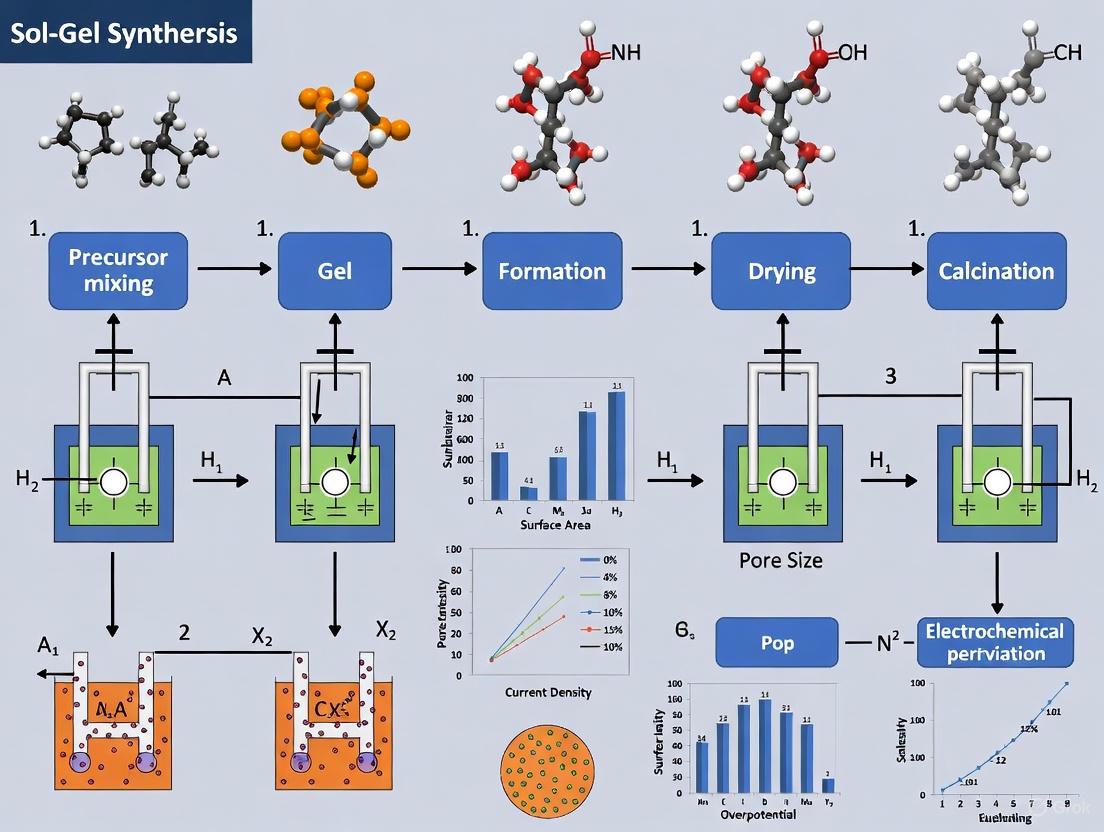
This article provides a comprehensive examination of sol-gel synthesis for developing advanced bimetallic oxide electrocatalysts, addressing the critical needs of researchers and scientists in materials science and energy applications.
Sol-Gel Synthesis of Bimetallic Oxide Electrocatalysts: A Comprehensive Guide from Fundamentals to Advanced Applications
Abstract
This article provides a comprehensive examination of sol-gel synthesis for developing advanced bimetallic oxide electrocatalysts, addressing the critical needs of researchers and scientists in materials science and energy applications. It explores the fundamental principles underpinning sol-gel chemistry and bimetallic synergies, details practical synthesis methodologies and advanced material engineering approaches, offers solutions for common optimization challenges, and establishes rigorous validation protocols for performance benchmarking. By integrating foundational science with practical implementation strategies, this work serves as an essential resource for designing next-generation electrocatalytic materials with enhanced activity, stability, and functionality for energy conversion and storage applications.
Fundamental Principles of Sol-Gel Chemistry and Bimetallic Oxide Systems
Fundamental Chemical Mechanisms
The sol-gel process is a versatile wet-chemical synthesis method for producing solid materials from small molecules, particularly metal oxides. This bottom-up approach enables the fabrication of ceramics, glasses, and nanocomposites with precise control over composition, structure, and porosity at relatively low temperatures [1] [2]. The process involves the transformation of a colloidal solution (sol) into an integrated network (gel) through controlled hydrolysis and polycondensation reactions [1].
The fundamental chemical reactions driving the sol-gel process are hydrolysis and polycondensation of molecular precursors, typically metal alkoxides (M(OR)ₙ) [3]. These sequential and parallel reactions facilitate the gradual formation of an inorganic polymer network that constitutes the final solid material.
Hydrolysis Reactions
Hydrolysis represents the initial step where alkoxide groups (OR) are replaced with hydroxyl groups (OH) through nucleophilic attack by water molecules [1] [4]:
-M-OR + H₂O ⇌ -M-OH + R-OH
This reaction is catalyzed by acids or bases and strongly influences the kinetics and structure of the resulting gel network [4]. The mechanism varies significantly between silicon alkoxides and metal alkoxides due to differences in electronegativity and chemical bonding [4].
Condensation Reactions
Following hydrolysis, condensation reactions occur where M-OH or M-OR groups link together through oxo (M-O-M) or hydroxo (M-OH-M) bridges, liberating water or alcohol as byproducts [1] [3]:
-M-OH + RO-M- → -M-O-M- + R-OH (alcohol condensation)
-M-OH + HO-M- → -M-O-M- + H₂O (water condensation)
These reactions build the three-dimensional metal oxide network through polycondensation, forming either discrete colloidal particles or continuous polymer networks [1].
Table 1: Comparative Reaction Mechanisms in Sol-Gel Chemistry
| Parameter | Silicon Alkoxides | Metal Alkoxides |
|---|---|---|
| Bond Character | Predominantly covalent [4] | Primarily ionic/electrostatic [4] |
| Hydrolysis Rate | Relatively slow [4] | Fast and reversible [4] |
| Coordination Change | Requires increased coordination number in basic catalysis [4] | Readily accommodates coordination changes |
| Typical Catalysts | Acids (HCl) or bases (NH₃) [4] | Acids or bases depending on desired structure |
Application in Bimetallic Oxide Electrocatalyst Synthesis
The sol-gel method offers distinct advantages for synthesizing bimetallic oxide electrocatalysts, enabling precise control over composition, homogeneous mixing at the molecular level, and tailored porosity for enhanced electrochemical performance [5] [6] [7].
Bimetallic System Case Studies
Recent research demonstrates the effectiveness of sol-gel processing for advanced bimetallic electrocatalysts:
SiO₂/C/Al₂O₃ Nanocomposites: Sol-gel synthesized bimetallic oxide-carbon composites demonstrate exceptional supercapacitor performance with specific capacitance of 1021.03 F g⁻¹ at 0.5 A g⁻¹ and 94% capacitance retention after 5000 cycles [5]. The graphite component effectively tunes the structure and morphology of SiO₂/C/Al₂O₃ particles, creating hierarchical porosity that enhances ion transport and charge storage [5].
NiO-Fe₂O₃-SiO₂/Al₂O³ Catalysts: Optimized sol-gel synthesis produces catalysts with particle size of 44 nm and specific surface area of 134.79 m²/g at reduced heat treatment temperature (400°C) [6]. The Ni/Fe ratio and heating rate during heat treatment were identified as critical parameters controlling active component distribution and catalytic activity in decane oxidation [6].
Cu-Ag Bimetallic Catalysts: Sol-gel synthesis creates controlled Cu-Ag interactions that enhance electrochemical CO reduction toward C₂₊ products. At optimal composition (Cu₀.₉Ag₀.₁), faradaic efficiency for C₂₊ products reaches 63% with suppressed H₂ evolution [7]. The formation of Ag-Cu core-shell structures and nanoalloy phases under reaction conditions creates synergistic interfacial sites that promote C-C coupling [7].
Table 2: Performance Metrics of Sol-Gel Synthesized Bimetallic Oxide Electrocatalysts
| Catalyst System | Application | Key Performance Metrics | Synthesis Advantages |
|---|---|---|---|
| SiO₂/C/Al₂O₃ [5] | Supercapacitors | Specific capacitance: 1021.03 F g⁻¹Cycle stability: 94% retention (5000 cycles)Coulombic efficiency: 71% | Homogeneous component distributionHierarchical porous networkEnhanced ion transport pathways |
| NiO-Fe₂O₃-SiO₂/Al₂O₃ [6] | Oxidation Catalysis | Surface area: 134.79 m²/gParticle size: 44 nmReduced treatment temperature: 400°C | Controlled Ni/Fe ratioUniform active site distributionElimination of expensive modifiers |
| Cu-Ag Bimetallic [7] | CO Electroreduction | C₂₊ faradaic efficiency: 63%Propanol FE: 18%Suppressed H₂ evolution: 23% FE | Enhanced Cu-Ag interactionsNanoalloy formationCore-shell structure control |
Experimental Protocols
Standard Sol-Gel Synthesis Protocol for Bimetallic Oxide Electrocatalysts
Principle: This protocol describes the synthesis of bimetallic oxide electrocatalysts through controlled hydrolysis and polycondensation of metal alkoxide precursors, adapted from methodologies for SiO₂/C/Al₂O₃ and NiO-Fe₂O₃ systems [5] [6].
Materials:
- Tetraethyl orthosilicate (TEOS, 99.99%) as silica source [5]
- Aluminium isopropoxide (≥98%) as alumina source [5]
- Ethanol (99.8%) as solvent [5]
- Graphite powder (99.99%) as conductive component [5]
- Acid catalyst (HCl, acetic acid) or base catalyst (NH₃) [1] [4]
- Deionized water for hydrolysis
Procedure:
Solution Preparation:
Catalyzed Hydrolysis:
- Slowly add acidified or basified water (molar ratio H₂O:alkoxide = 2:1 to 10:1) dropwise to the alkoxide solution under continuous stirring [1] [4].
- Maintain temperature at 25-60°C depending on precursor reactivity.
- Continue stirring for 1-24 hours to complete hydrolysis, monitoring solution transparency.
Condensation and Gelation:
Aging:
- Age the wet gel in mother liquor for 24-168 hours at 25-50°C to strengthen the network through continued condensation and syneresis [3].
Drying:
Thermal Treatment:
Advanced Protocol: Pechini Method for Complex Oxides
For systems involving multiple cations with differing hydrolysis rates (e.g., perovskite-type oxides), the Pechini process variant is recommended [1]. This method utilizes chelating agents (typically citric acid) to surround aqueous cations and sterically entrap them, followed by polyesterification with ethylene glycol to form a polymer network that immobilizes the cations [1]. Subsequent combustion removes the organic components, yielding homogeneous mixed oxides without phase segregation.
The Scientist's Toolkit: Essential Research Reagents
Table 3: Key Reagents for Sol-Gel Synthesis of Bimetallic Oxide Electrocatalysts
| Reagent Category | Specific Examples | Function in Synthesis |
|---|---|---|
| Metal Alkoxide Precursors | Tetraethyl orthosilicate (TEOS) [5]Aluminium isopropoxide [5]Titanium isopropoxide | Molecular sources for metal oxide frameworkUndergo hydrolysis and polycondensationDetermine final oxide composition |
| Solvents | Ethanol [5]IsopropanolTetrahydrofuran (THF) | Dissolve alkoxide precursorsControl reaction kineticsAdjust solution viscosity for processing |
| Catalysts | Hydrochloric acid (HCl) [4]Acetic acid [1]Ammonia (NH₃) [4] | Control hydrolysis and condensation ratesInfluence gel structure (linear vs. branched)Determine final material porosity |
| Structure-Directing Agents | Graphite powder [5]Surfactants (CTAB)Block copolymers | Provide conductive pathways in compositesTemplate mesoporous structuresControl particle morphology and size |
| Chelating Agents | Citric acid [1]Acetylacetone | Stabilize metal cations in Pechini processModify precursor reactivityPrevent premature precipitation |
| Doping Precursors | Cerium salts [8]Rare-earth alkoxides | Introduce catalytic active sitesEnhance structural stabilityModify electronic properties |
Critical Parameters and Optimization Strategies
Successful sol-gel synthesis of bimetallic oxide electrocatalysts requires precise control over numerous parameters that influence the structural, morphological, and electrochemical properties of the final material.
Key Optimization Parameters
Water-to-Alkoxide Ratio (R): Controls the extent of hydrolysis versus condensation, affecting gelation time and network density [1] [4]. Lower R values (2-4) typically favor more controlled condensation.
Catalyst Type and Concentration: Acid catalysts promote linear polymer formation, while base catalysts yield highly branched clusters [4]. Catalyst concentration affects reaction rates and pore size distribution.
Solution pH: Critically influences the relative rates of hydrolysis and condensation reactions [2] [4]. Acidic conditions (pH 2-5) favor hydrolysis, while basic conditions (pH 7-10) promote condensation.
Temperature Control: Affects reaction kinetics and gelation time [2]. Higher temperatures accelerate reactions but may reduce homogeneity.
Aging Conditions: Duration and temperature of aging determine gel strength and porosity through Ostwald ripening and continued condensation [3].
Drying Protocol: Conventional evaporation produces xerogels with some porosity collapse, while supercritical drying preserves the gel network to create aerogels [1].
Thermal Treatment Profile: Heating rate (optimal 1-5°C/min [6]), maximum temperature, and atmosphere control crystallinity, phase composition, and surface area.
Table 4: Troubleshooting Common Sol-Gel Synthesis Issues
| Problem | Potential Causes | Solutions |
|---|---|---|
| Rapid, Uncontrolled Gelation | Excessive water contentHigh catalyst concentrationReactive precursors | Reduce H₂O:alkoxide ratioDilute catalyst concentrationUse chelating agents to moderate reactivity |
| Phase Separation in Bimetallic Systems | Differing hydrolysis rates of precursorsInsufficient mixing | Employ Pechini method with chelating agents [1]Pre-hydrolyze less reactive precursorEnsure vigorous stirring during precursor mixing |
| Cracking During Drying | Rapid solvent evaporationLarge pore size distributionInsufficient aging | Control humidity during dryingUse surfactants to create uniform pores [3]Extend aging time to strengthen network |
| Low Surface Area | Excessive calcination temperatureRapid heating ratesCollapsed porosity | Optimize thermal treatment temperature [6]Implement controlled heating rates (1-5°C/min) [6]Consider supercritical drying for aerogels [1] |
| Poor Electrical Conductivity | Insufficient conductive pathwaysInappropriate carbon material integration | Optimize graphite content and distribution [5]Ensure homogeneous composite formationConsider carbonization in situ |
The sol-gel processing method, with its controlled hydrolysis and polycondensation mechanisms, provides a powerful platform for synthesizing advanced bimetallic oxide electrocatalysts with tailored compositions, structures, and functionalities. The protocols and parameters outlined herein enable researchers to design and optimize materials for specific electrochemical applications, from energy storage to catalytic transformations.
Sol-gel synthesis has emerged as a powerful and versatile wet-chemical method for the preparation of advanced inorganic and hybrid organic-inorganic materials. This technique is particularly valuable for fabricating bimetallic oxides, which are crucial for various advanced applications including electrocatalysis, energy storage, and sensing. The process typically involves the transition of a solution system from a liquid "sol" (colloidal suspension) into a solid "gel" phase, providing exceptional control over the chemical composition, structure, and texture of the final product at relatively low temperatures [9].
For bimetallic oxide systems, which often exhibit synergistic effects between the two metal components, the sol-gel method offers distinct advantages over conventional solid-state synthesis routes. These advantages include superior homogeneity, enhanced purity, and the ability to control processing temperatures—all critical parameters that directly influence the functional properties of the resulting materials. The method's flexibility allows for the production of various forms including nanoparticles, thin films, monoliths, and porous membranes, making it particularly suitable for designing tailored electrocatalysts [10] [11].
This article explores the fundamental advantages of sol-gel processing for bimetallic oxide synthesis, with a specific focus on its relevance to electrocatalyst development. Through structured data presentation, detailed protocols, and visual workflows, we provide researchers with a comprehensive resource for leveraging sol-gel chemistry in advanced materials research.
Core Advantages in Bimetallic Oxide Synthesis
The sol-gel method provides three fundamental advantages for synthesizing bimetallic oxides: exceptional homogeneity, high purity, and low-temperature processing. These characteristics are particularly beneficial for creating advanced electrocatalysts where precise control over composition and structure is essential for performance.
Superior Homogeneity and Compositional Control
The sol-gel process enables molecular-level mixing of precursors, resulting in exceptional homogeneity in the final bimetallic oxides, a critical factor for achieving uniform catalytic activity.
- Atomic-scale Mixing: Unlike solid-state methods that suffer from diffusion limitations, sol-gel chemistry allows for atomic-scale mixing of multiple cationic species in the solution phase before gelation. This leads to highly homogeneous doping and uniform distribution of both metal components throughout the material [10]. For instance, in NiO-Fe₂O₃-SiO₂/Al₂O₃ catalysts, a balanced 1:1 Ni/Fe ratio achieved through optimized sol-gel parameters resulted in a homogeneous structure with strong adhesion to the support and no distinct zones of excess of either element [6].
- Precise Stoichiometry Control: The solution-based nature of the process allows for precise control over the stoichiometry of bimetallic systems. Research on Ni-Fe catalysts has demonstrated that deviations from the optimal Ni/Fe ratio lead to phase separation, aggregation, and reduced catalytic efficiency [6].
- Morphological Control: Parameters such as precursor concentration, solvent type, pH, aging time, and thermal treatment can be tuned to control the morphology of the resulting bimetallic oxides, enabling the creation of nanospheres, nanorods, nanoflakes, and other architectures with high surface area [9].
Table 1: Homogeneity Advantages of Sol-Gel vs. Conventional Methods for Bimetallic Oxides
| Feature | Sol-Gel Method | Conventional Solid-State |
|---|---|---|
| Mixing Scale | Molecular/Atomic level | Micron to millimeter level |
| Dopant Distribution | Homogeneous throughout structure | Gradient distribution, surface enrichment |
| Phase Formation | Lower temperature, more homogeneous phases | Requires high temperatures, phase segregation |
| Reproducibility | High with controlled parameters | Variable due to diffusion limitations |
Enhanced Purity and Structural Control
Sol-gel synthesis offers significant advantages in producing high-purity bimetallic oxides with controlled structural properties, minimizing impurities that can arise from grinding media or high-temperature processing.
- Low-Temperature Processing: By avoiding the high temperatures typically required in solid-state reactions (often exceeding 1000°C), sol-gel methods minimize undesirable phase transformations, particle sintering, and the formation of inert mixed phases. For example, NiO-Fe₂O₃-SiO₂/Al₂O₃ catalysts can be successfully synthesized with heat treatment as low as 400°C [6].
- Avoidance of Contaminants: The process eliminates potential contamination from grinding media used in solid-state synthesis, leading to products with higher chemical purity [9].
- Control over Crystallinity and Texture: The low-temperature chemistry allows for the formation of materials with controlled crystallinity, from amorphous to highly crystalline, by manipulating heat treatment conditions. The specific surface area, pore size, and pore volume can be tailored through the selection of precursors and processing conditions. An optimized sol-gel process for NiO-Fe₂O₃ catalysts achieved a high specific surface area of 134.79 m²/g [6].
Low-Temperature Processing Advantages
The ability to process materials at low temperatures is a hallmark of the sol-gel method, providing multiple benefits for the synthesis of bimetallic oxides and their integration into functional devices.
- Energy Efficiency: Significantly lower energy consumption compared to high-temperature solid-state routes [9].
- Preservation of Structural Integrity: Low processing temperatures prevent the loss of material dispersion, reduce particle coarsening, and maintain high surface area, which is crucial for catalytic activity [6].
- Compatibility with Flexible Substrates and Temperature-Sensitive Materials: The low thermal budget enables the direct deposition of bimetallic oxide films on flexible polymer substrates and their coupling with other temperature-sensitive materials, such as organic semiconductors and conductive polymers, for hybrid device fabrication [12].
- Defect Engineering: Lower processing temperatures allow for the controlled formation and preservation of beneficial defects, such as oxygen vacancies, which can significantly enhance catalytic activity. In Ni-MgO systems prepared by sol-gel, abundant surface oxygen vacancies were identified as key for facilitating CO₂ adsorption and activation at low temperatures [13].
Table 2: Quantitative Benefits of Low-Temperature Sol-Gel Processing
| Parameter | Impact of Low-Temperature Processing | Example System |
|---|---|---|
| Specific Surface Area | Increased surface area for catalytic reactions | NiO-Fe₂O₃-SiO₂/Al₂O₃ (134.79 m²/g) [6] |
| Nanoparticle Size | Smaller, more active nanoparticles | Ni–MgO-SG (smaller Ni nanoparticles) [13] |
| Oxygen Vacancies | Enhanced formation and stability of active sites | Ni–MgO-SG (abundant surface vacancies) [13] |
| Phase Purity | Avoids formation of undesired inert phases | Prevents NiAl₂O₄ spinel in alumina-supported catalysts [6] |
Experimental Protocols
This section provides a generalized protocol for the sol-gel synthesis of bimetallic oxides, which can be adapted for specific metal systems with appropriate precursor selection.
Generic Workflow for Bimetallic Oxide Synthesis
The following diagram illustrates the general workflow for the sol-gel synthesis of bimetallic oxides, highlighting key steps and decision points that influence the final material properties.
Detailed Protocol: Sol-Gel Synthesis of Ni-Fe Oxide Catalysts
This protocol is adapted from studies on the development of efficient NiO-Fe₂O₃-SiO₂/Al₂O₃ catalysts for oxidation reactions [6].
Objective: To synthesize a homogeneous NiO-Fe₂O₃ bimetallic oxide catalyst supported on SiO₂/Al₂O₃ via the sol-gel method.
Materials:
- Metal Precursors: Nickel salt (e.g., nitrate or acetylacetonate) and Iron salt (e.g., nitrate or chloride), maintaining a 1:1 Ni/Fe atomic ratio.
- Support/Matrix Precursors: Tetraethoxysilane (TEOS) and Aluminium isopropoxide.
- Solvent: Ethanol or isopropanol.
- Reaction Catalyst: Acidic (e.g., dilute HCl) or basic (e.g., ammonia) catalyst, depending on the desired hydrolysis rate.
Procedure:
- Solution Preparation: Dissolve the nickel and iron salts in the solvent under vigorous stirring to form a clear solution.
- Pre-hydrolysis of TEOS: Slowly add TEOS to the alcoholic solvent containing a catalytic amount of water and acid. Stir for 30 minutes to partially hydrolyze the silicon precursor.
- Mixing: Add the solution of metal salts to the pre-hydrolyzed TEOS mixture under continuous stirring.
- Gelation: Adjust the pH if necessary and allow the mixture to gel at room temperature. This may take several hours.
- Aging: Age the resulting wet gel for 24 hours at room temperature in a sealed container to strengthen the network.
- Drying: Slowly dry the gel at 80-110°C for 12-24 hours to remove the solvent and obtain the xerogel.
- Heat Treatment (Calcination): Calcine the dried powder in a muffle furnace. Critical: Use a controlled heating rate of up to 5°C/min to avoid structural defects like microcracks. Heat to a final temperature of 400°C for 2-4 hours in air to crystallize the NiO and Fe₂O₃ phases without forming excessive undesired mixed phases [6].
Key Characterization:
- X-ray Diffraction (XRD): To identify crystalline phases (NiO, Fe₂O₃) and confirm the absence of segregated phases.
- Scanning Electron Microscopy (SEM) with EDS: To examine morphology and verify the homogeneous distribution of Ni and Fe elements.
- N₂ Physisorption (BET): To determine specific surface area, pore volume, and pore size distribution.
The Scientist's Toolkit: Essential Research Reagents
The following table lists key reagents and their functions in a typical sol-gel synthesis of bimetallic oxides for electrocatalytic applications.
Table 3: Essential Reagents for Sol-Gel Synthesis of Bimetallic Oxides
| Reagent Category | Specific Examples | Function in Synthesis |
|---|---|---|
| Metal Precursors | Metal alkoxides (e.g., Titanium(IV) butoxide, Aluminium isopropoxide), Metal salts (e.g., Nitrates, Chlorides, Acetylacetonates) | Source of metal cations in the final oxide network. Alkoxides are highly reactive; salts offer better stability and cost-effectiveness [12] [5]. |
| Solvents | Ethanol, Methanol, Isopropanol, 1-Butanol | Dissolve precursors to form a homogeneous sol and control the reaction kinetics [12]. |
| Reaction Catalysts | HCl, HNO₃, Acetic Acid, NH₄OH | Catalyze the hydrolysis and condensation reactions. Acidic conditions promote linear chains, while basic conditions favor branched clusters [9] [12]. |
| Structure-Directing Agents | Poly(acrylic acid) - PAA, Block copolymers (e.g., Pluronic series) | Control the morphology, stabilize the sol, introduce porosity, and act as a binding agent to ensure strong adhesion of active components to supports [6] [12]. |
| Support Materials | Carbon black (Vulcan XC72R), Magnéli-phase TiO₂, Al₂O₃, SiO₂ | Provide a high-surface-area support to disperse bimetallic oxide nanoparticles, enhance electrical conductivity, and prevent aggregation [14] [6]. |
Sol-gel synthesis stands as a superior methodology for the fabrication of bimetallic oxides, offering unparalleled control over homogeneity, purity, and processing conditions. The ability to achieve molecular-level mixing of precursors at low temperatures directly addresses the key challenges in developing advanced electrocatalysts, where compositional uniformity and tailored nanostructures are paramount for performance. By providing a flexible and scalable synthetic platform, the sol-gel method continues to enable the design of next-generation bimetallic oxide materials for a wide spectrum of energy and catalytic applications. The protocols and insights outlined in this article serve as a foundational guide for researchers aiming to leverage these advantages in their electrocatalyst development projects.
Bimetallic oxides represent an advanced class of materials where two distinct metal cations are incorporated into an oxide matrix, creating systems with properties superior to their single-metal counterparts. The fundamental advantage of these materials lies in the synergistic interactions between the different metal species, which can significantly enhance their electronic conductivity, redox activity, and structural stability [15]. These synergistic effects arise from the heterometallic bonding and electronic interactions that modify the local chemical environment, leading to unique properties not observed in monometallic systems [16].
In the context of sol-gel synthesis, these synergistic effects can be precisely engineered through molecular-level control over precursor interactions, gelation dynamics, and crystallization pathways [10]. The sol-gel method provides an ideal platform for creating bimetallic oxide electrocatalysts with controlled compositions, morphologies, and defect states at relatively low processing temperatures [10] [6]. This synthesis approach enables the production of homogeneous mixed-metal oxides with specific electronic and structural characteristics tailored for electrocatalytic applications, including enhanced oxygen evolution reaction (OER) activity, improved charge transfer capabilities, and superior corrosion resistance in aggressive electrochemical environments [8].
Fundamental Electronic and Structural Properties
Electronic Structure Modifications
The electronic properties of bimetallic oxides undergo significant modifications due to the interplay between different metal cations. These changes primarily manifest through alterations in oxygen vacancy formation, electron mobility, and band structure characteristics:
- Charge Transfer Effects: In CoCu/γ-Al₂O₃ systems, strong synergistic interactions between Cu and Co enhance redox performance, as evidenced by a distinct reduction peak at 190°C in H₂-TPR profiles, indicating improved electron transfer capabilities [16].
- Orbital Hybridization: The presence of transition metal ions with different electronic configurations (e.g., Ni²⁺ with occupied orbitals and high-valent molybdenum with empty orbitals) creates complementary electronic structures that enhance catalytic activity and ligand bonding reactions [17].
- Defect Engineering: Incorporation of cerium (Ce) into SrCoOₓ lattices creates multiple defects and vacancies that facilitate charge transfer during electrocatalytic reactions while mitigating competing reactions like chlorine evolution in saline environments [8].
Structural Characteristics and Phase Behavior
Bimetallic oxides exhibit diverse structural configurations that directly influence their functional properties:
- Spinel Structures: Materials like NiFe₂O₄ and NiCo₂O₄ form spinel architectures where different metal cations occupy specific tetrahedral and octahedral sites, creating defined electronic pathways and active sites [18].
- Perovskite Systems: Oxides such as La₁−ₓSrₓMnO₃ demonstrate how heterometallic coordination can be engineered for specific spintronic and electrocatalytic applications through controlled doping [10].
- Layered Double Hydroxides (LDHs): Materials like NiMo-LDH feature two-dimensional layered structures with tunable interlayer spacing, providing enhanced surface area and accessibility to active sites [17].
Table 1: Structural Configurations in Bimetallic Oxide Systems
| Structure Type | Example Materials | Key Features | Primary Applications |
|---|---|---|---|
| Spinel | NiFe₂O₄, CoFe₂O₄ | Mixed cation occupancy, high thermal stability | Magneto-electronics, Catalysis [10] [18] |
| Perovskite | La₁−ₓSrₓMnO₃, SrCoOₓ | Flexible stoichiometry, rich redox chemistry | Spintronics, Electrocatalysis [10] [8] |
| Layered Double Hydroxide | NiMo-LDH, NiFe-LDH | Tunable interlayer chemistry, high surface area | Oxygen Evolution Reaction, Supercapacitors [17] |
| Rock Salt | NiO-Fe₂O₃ | Solid solutions, defect tolerance | Catalytic combustion, Sensors [6] |
Quantitative Analysis of Synergistic Effects
Enhanced Electrocatalytic Performance
The synergistic effects in bimetallic oxides translate directly to measurable improvements in electrocatalytic performance:
- Oxygen Evolution Reaction: NiMo-LDH supported on reduced graphene oxide (rGO) demonstrates exceptional OER activity with an overpotential of only 230 mV and a Tafel slope of 60 mV·dec⁻¹ at 10 mA·cm⁻² in 1.0 M KOH, significantly outperforming monometallic counterparts [17].
- Corrosion Resistance: Ce-doped SrCoOₓ exhibits enhanced stability in saline environments with a low corrosion current of -1.10 μA·cm⁻² and high corrosion potential of 0.90 V versus RHE, demonstrating the protective synergistic effect of cerium incorporation [8].
- Catalytic Combustion: CoCu/γ-Al₂O₃ bimetallic catalysts show superior performance in toluene combustion compared to monometallic Co/γ-Al₂O₃ or Cu/γ-Al₂O₃ systems, with the bimetallic combination providing optimal redox properties and resistance to sulfur poisoning [16].
Energy Storage Applications
In supercapacitor applications, bimetallic oxides demonstrate remarkable synergistic enhancements:
- SiO₂/C/Al₂O₃ nanocomposites achieve a specific capacitance of 1021.03 F·g⁻¹ at 0.5 A·g⁻¹ with 94% capacitance retention after 5000 charge-discharge cycles, leveraging the complementary properties of all three components [5].
- The ternary system benefits from the mechanical stability of SiO₂, the high electrical conductivity of carbon, and the pseudocapacitive behavior of Al₂O₃, creating a hierarchical porous network that promotes efficient ion transport [5].
Table 2: Performance Metrics of Selected Bimetallic Oxide Systems
| Material System | Application | Key Performance Metric | Comparative Advantage |
|---|---|---|---|
| NiMo-LDH@rGO | Oxygen Evolution Reaction | 230 mV overpotential @ 10 mA·cm⁻² | Superior to noble metal catalysts at lower cost [17] |
| Ce-doped SrCoOₓ | Saline Water Electrolysis | Tafel slope: 81.7 mV·dec⁻¹ (vs. 121.0 for undoped) | Enhanced corrosion resistance in chloride media [8] |
| SiO₂/C/Al₂O₃ | Supercapacitor Electrode | Specific capacitance: 1021.03 F·g⁻¹ | Synergistic effect of ternary components [5] |
| CoCu/γ-Al₂O₃ | Catalytic Combustion | Complete toluene oxidation at lower temperatures | Enhanced sulfur resistance vs. monometallic catalysts [16] |
| NiO-Fe₂O₃-SiO₂/Al₂O₃ | Oxidation Catalyst | Surface area: 134.79 m²/g with 44 nm particles | Low-temperature processing (400°C) prevents sintering [6] |
Experimental Protocols for Sol-Gel Synthesis
Protocol 1: Sol-Gel Synthesis of NiO-Fe₂O₃-SiO₂/Al₂O₃ Catalysts
This protocol produces bimetallic oxide catalysts with controlled Ni/Fe ratios and optimized morphological properties [6].
Reagents and Materials
- Nickel nitrate hexahydrate (Ni(NO₃)₂·6H₂O)
- Iron nitrate nonahydrate (Fe(NO₃)₃·9H₂O)
- Tetraethoxysilane (TEOS, Si(OC₂H₅)₄) as silica source
- Aluminum isopropoxide (Al(O-iPr)₃) as alumina source
- Ethanol (absolute, 99.8%)
- Nitric acid (HNO₃, 0.1 M) as catalyst for hydrolysis
- Deionized water
Step-by-Step Procedure
Precursor Solution Preparation:
- Dissolve aluminum isopropoxide (0.1 mol) in ethanol (200 mL) with vigorous stirring at room temperature.
- Add nickel nitrate and iron nitrate in the desired molar ratio (optimized at 1:1 Ni/Fe) to the solution.
- Slowly add tetraethoxysilane (0.05 mol) to the mixture while maintaining continuous stirring.
Hydrolysis and Polycondensation:
- Add a mixture of deionized water (10 mL) and nitric acid (0.1 M, 2 mL) dropwise to initiate hydrolysis.
- Continue stirring for 24 hours at 50°C until a transparent sol forms.
- Age the sol for 48 hours at room temperature to facilitate gel formation.
Drying and Heat Treatment:
- Dry the gel at 100°C for 12 hours to remove solvent and form xerogel.
- Calcine the xerogel at 400°C for 4 hours using a controlled heating rate of 5°C/min to crystallize the oxide phases without excessive sintering.
Characterization and Validation
- XRD Analysis: Confirm the presence of NiO, Fe₂O₃, γ-Al₂O₃, and SiO₂ phases with characteristic reflections [6].
- SEM/TEM Imaging: Verify uniform distribution of active components with particle size of approximately 44 nm.
- Surface Area Measurement: BET analysis should show surface area of ~134.79 m²/g for optimal catalytic performance [6].
Protocol 2: Synthesis of Ce-Doped SrCoOₓ Electrocatalysts
This protocol produces corrosion-resistant bimetallic oxide electrocatalysts for oxygen evolution in saline environments [8].
Reagents and Materials
- Strontium nitrate (Sr(NO₃)₂)
- Cobalt nitrate hexahydrate (Co(NO₃)₂·6H₂O)
- Cerium nitrate hexahydrate (Ce(NO₃)₃·6H₂O)
- Citric acid (C₆H₈O₇) as complexing agent
- Ethylene glycol (C₂H₆O₂) as polymerization agent
- Ammonia solution (NH₄OH, 25%) for pH adjustment
Step-by-Step Procedure
Solution Preparation:
- Dissolve strontium nitrate, cobalt nitrate, and cerium nitrate in deionized water with Sr:Co:Ce molar ratio of 1:1:0.005 for 0.5% Ce doping.
- Add citric acid as a complexing agent at 1.5:1 molar ratio of citric acid to total metal ions.
- Adjust pH to 7-8 using ammonia solution to promote complex formation.
Gel Formation:
- Heat the solution at 80°C with continuous stirring to evaporate water and initiate polyesterification.
- Add ethylene glycol (citric acid:ethylene glycol = 1:1.2 molar ratio) to promote polymer network formation.
- Continue heating until a viscous gel forms.
Thermal Treatment:
- Dry the gel at 120°C for 12 hours to remove residual solvent.
- Calcinate at 600°C for 5 hours in air to form the crystalline perovskite phase.
- Slowly cool to room temperature at 2°C/min to minimize defect formation.
Electrochemical Validation
- Linear Sweep Voltammetry: Test OER activity in 1 M KOH with 0.5 M NaCl to simulate saline environment.
- Chronoamperometry: Assess stability over 45 hours at constant potential.
- Tafel Analysis: Measure kinetics with optimal samples showing ~81.7 mV·dec⁻¹ slope [8].
Research Reagent Solutions
Table 3: Essential Research Reagents for Sol-Gel Synthesis of Bimetallic Oxides
| Reagent | Function | Example Application | Key Considerations |
|---|---|---|---|
| Tetraethoxysilane (TEOS) | SiO₂ precursor, binding agent | NiO-Fe₂O₃-SiO₂/Al₂O₃ catalysts | Hydrolysis rate controlled by pH and H₂O/TEOS ratio [6] |
| Metal Alkoxides (e.g., Al(O-iPr)₃) | Oxide network formers | Al₂O₃-supported catalysts | Sensitivity to moisture requires anhydrous handling [5] |
| Metal Nitrates (e.g., Ni(NO₃)₂·6H₂O) | Active metal precursors | NiFe₂O₄, CoFe₂O₄ synthesis | Low cost and high solubility in common solvents [6] |
| Citric Acid | Complexing agent for homogeneous cation distribution | Ce-doped SrCoOₓ synthesis | Prevents cation segregation during gel formation [8] |
| Ethylene Glycol | Polymerization agent | Perovskite oxide synthesis | Forms polyester network with citric acid for cation immobilization [8] |
| Nitric Acid (HNO₃) | Hydrolysis catalyst | Controlled gelation of alkoxides | Concentration controls hydrolysis and condensation rates [6] |
Visualization of Synthesis Pathways and Electronic Effects
Sol-Gel Synthesis Workflow for Bimetallic Oxides
Electronic Structure Modification in Bimetallic Oxides
The strategic design of bimetallic oxide systems through sol-gel synthesis enables precise control over electronic and structural properties, resulting in materials with enhanced performance for electrocatalytic and energy storage applications. The synergistic effects arising from heterometallic interactions—including improved charge transfer, optimized redox properties, and enhanced structural stability—provide significant advantages over monometallic systems.
Future research directions should focus on advancing fundamental understanding of charge transfer mechanisms at atomic scales, developing novel bimetallic combinations for specific applications, and optimizing sol-gel parameters for scalable production. The integration of computational materials design with experimental synthesis presents a promising pathway for accelerating the discovery of next-generation bimetallic oxide materials with tailored electronic and catalytic properties [10]. As characterization techniques continue to improve, particularly in situ and operando methods, researchers will gain deeper insights into the dynamic structural changes that occur during electrocatalytic operation, enabling further optimization of these complex material systems.
The development of advanced functional materials is central to progress in fields ranging from energy conversion to environmental remediation. Among these, transition metal oxides (TMOs), perovskites, and high-entropy oxides (HEOs) represent three critical classes of materials with exceptional catalytic, electronic, and magnetic properties. When synthesized via sol-gel methods, these materials offer enhanced control over composition, morphology, and defect structure, making them particularly valuable for designing high-performance bimetallic oxide electrocatalysts. This document provides application notes and experimental protocols for the synthesis and utilization of these materials within a research framework focused on sol-gel derived electrocatalysts.
Transition Metal Oxides (TMOs)
Transition metal oxides are a versatile class of materials known for their redox activity, structural diversity, and tunable electronic properties. In the context of sol-gel synthesis, TMOs can be engineered as nanostructures with precise control over their textural characteristics, making them ideal for electrocatalytic applications. Sol-gel derived TMOs demonstrate promising multifunctional abilities in dye degradation, energy storage, and renewable energy applications [19]. Their integration with graphene oxide (GO) further enhances electrical conductivity and provides exceptional mechanical strength, creating advanced nanocomposites for catalytic systems [19].
Key Properties and Quantitative Data
Table 1: Characteristic Properties of Sol-Gel Derived Transition Metal Oxides for Electrocatalysis
| Material | Specific Surface Area (m²/g) | Key Functional Properties | Primary Electrocatalytic Applications |
|---|---|---|---|
| Co-doped ZnO | 50-120 [10] | Room-temperature ferromagnetism, tunable bandgap | Spintronic devices, magnetic sensors |
| Fe₃O₄ | 30-80 [10] | High spin polarization, superparamagnetic behavior | Magnetic memory devices, biosensors |
| NiFe₂O₄ | 40-100 [10] | Soft magnetic properties, high electrical resistance | Transformer cores, microwave devices |
| TiO₂ | 60-150 [10] | Photocatalytic activity, biocompatibility | Dye-sensitized solar cells, water splitting |
| TMO/GO nanocomposites | 100-400 [19] | Enhanced charge transport, synergistic catalytic effects | Dye degradation, supercapacitors, fuel cells |
Experimental Protocol: Sol-Gel Synthesis of TMO/GO Nanocomposites
Principle: This protocol describes the synthesis of transition metal oxide/graphene oxide nanocomposites via a sol-gel method, creating materials with enhanced electrocatalytic properties for applications in renewable energy and environmental remediation [19].
Materials:
- Transition metal precursors (e.g., metal nitrates, chlorides, or acetylacetonates)
- Graphene oxide suspension (commercially available or synthesized via modified Hummers' method)
- Solvent (ethanol, isopropanol, or deionized water)
- Chelating agent (citric acid or ethylene glycol)
- pH modifier (ammonia solution or acetic acid)
Procedure:
- Precursor Solution Preparation: Dissolve the selected transition metal salt (e.g., 10 mmol of cobalt nitrate) in 50 mL of ethanol under vigorous stirring.
- GO Dispersion: Prepare a homogeneous dispersion of graphene oxide (0.5-1.0 mg/mL) in the same solvent using ultrasonic treatment for 60 minutes.
- Mixing: Combine the transition metal precursor solution with the GO dispersion dropwise under continuous stirring.
- Gelation: Adjust the pH to 3-4 using acetic acid and add citric acid (molar ratio 1:1 to metal ions) as a chelating agent. Continue stirring until a viscous gel forms.
- Ageing: Allow the gel to age for 24 hours at room temperature in a sealed container.
- Drying: Dry the gel at 80°C for 12 hours to obtain a xerogel.
- Calcination: Heat the xerogel at 350-500°C for 2-4 hours in a muffle furnace to crystallize the TMO nanoparticles on the GO substrate.
Critical Parameters:
- Solvent choice affects nucleation and growth kinetics
- pH control crucial for gelation dynamics and nanoparticle size
- Calcination temperature and atmosphere determine crystal phase and oxidation state
Perovskite Oxides
Perovskite oxides (general formula ABO₃) represent a broad class of mixed oxides with exceptional structural flexibility and compositional tunability [20]. Their unique crystal structure, consisting of a lattice with larger A-site cations and smaller B-site cations in an octahedral arrangement, enables precise optimization of catalytic performance through elemental substitutions [21]. Sol-gel synthesis allows for the creation of nanostructured perovskites with enhanced surface area and catalytic efficiency, overcoming limitations of conventional solid-state methods [21]. These materials have demonstrated remarkable performance in oxygen evolution reaction (OER), hydrogen evolution reaction (HER), and carbon dioxide reduction (CO₂RR) [21].
Key Properties and Quantitative Data
Table 2: Performance Metrics of Nanostructured Perovskite Oxides in Electrocatalysis
| Perovskite Composition | Specific Surface Area (m²/g) | Electrocatalytic Application | Performance Metric |
|---|---|---|---|
| LaFeO₃ | 20-50 [21] | Oxygen evolution reaction (OER) | Overpotential: 350-450 mV @ 10 mA/cm² |
| SrTiO₃ | 30-100 [21] | Photocatalytic water splitting | H₂ production: 20-50 μmol/h/g |
| La₀.₈Sr₀.₂MnO₃ | 25-60 [10] | Spintronic applications | Room-temperature magnetoresistance |
| BiFeO₃ | 15-45 [21] | Multiferroic devices | Ferroelectric polarization |
| CsPbBr₃ | 40-90 [20] | CO₂ reduction | CO production rate: 50-100 μmol/g/h |
Experimental Protocol: Soft-Templating Synthesis of Mesoporous Perovskites
Principle: This protocol utilizes surfactant self-assembly to create mesoporous perovskite oxides with high surface area and controlled pore structure, enhancing their electrocatalytic performance by providing more active sites [21].
Materials:
- Metal precursors (nitrates, acetates, or alkoxides)
- Structure-directing agents (Pluronic F123, CTAB, or Brij surfactants)
- Solvents (ethanol, water)
- Chelating agents (citric acid)
- Gelling agents (ethylene glycol)
Procedure:
- Precursor Sol Preparation: Dissolve stoichiometric ratios of A-site and B-site metal precursors (e.g., lanthanum nitrate and iron nitrate) in ethanol/water mixture (1:1 v/v).
- Surfactant Addition: Add the selected surfactant (e.g., Pluronic F123, 5-10 wt% relative to metal oxides) to the solution with stirring until completely dissolved.
- Complexation: Add citric acid as a chelating agent (1:1 molar ratio to total metal ions) and ethylene glycol (1:2 molar ratio to citric acid).
- Evaporation-Induced Self-Assembly: Transfer the sol to a petri dish and allow slow solvent evaporation at 40°C for 48 hours to facilitate mesostructure formation.
- Thermal Treatment: Gradually heat the resulting gel to 350°C (1°C/min) and hold for 2 hours to remove the organic template.
- Crystallization: Calcine at 600-800°C for 4 hours with a heating rate of 2°C/min to form the crystalline perovskite phase.
Critical Parameters:
- Surfactant concentration controls pore size and ordering
- Evaporation rate determines mesostructure regularity
- Calcination temperature critical for phase purity and surface area
High-Entropy Oxides (HEOs)
High-entropy oxides represent an innovative class of materials comprising five or more principal cationic elements in near-equimolar proportions, forming single-phase crystal structures stabilized by configurational entropy [22]. These materials exhibit four core effects: high-entropy effect, severe lattice distortion, sluggish diffusion, and cocktail effect [22] [23]. The unique synergistic interactions between multiple elements in HEOs result in enhanced functional properties surpassing conventional metal oxides, making them promising candidates for advanced electrocatalysis, energy storage, and electronic devices [23]. Sol-gel methods are particularly suited for HEO synthesis due to their ability to achieve atomic-level mixing of multiple cations, which is crucial for forming homogeneous single-phase structures.
Key Properties and Quantitative Data
Table 3: Characteristic Properties and Applications of High-Entropy Oxides
| HEO Composition | Crystal Structure | Key Properties | Applications |
|---|---|---|---|
| (Mg,Co,Ni,Cu,Zn)O | Rock salt [22] | Enhanced Li storage performance | Lithium-ion battery anodes |
| Perovskite HEOs | Perovskite [22] | Tunable electronic structure, high OER activity | Electrocatalysis, solid oxide fuel cells |
| Spinel HEOs | Spinel [22] | Magnetic functionality, high hardness | Magnetic devices, protective coatings |
| Fluorite HEOs | Fluorite [22] | Ionic conductivity, radiation tolerance | Thermal barrier coatings, nuclear materials |
Experimental Protocol: Sol-Gel Synthesis of Rock-Salt HEOs
Principle: This protocol describes the synthesis of (Mg,Co,Ni,Cu,Zn)O high-entropy oxides with rock-salt structure using a citric acid-assisted sol-gel method, which ensures atomic-level homogenization of multiple cationic elements and facilitates the formation of entropy-stabilized single-phase oxides [22].
Materials:
- Metal precursors (nitrates of Mg, Co, Ni, Cu, Zn)
- Complexing agent (citric acid)
- Fuel (ethylene glycol)
- Solvent (deionized water)
- pH adjuster (ammonia solution)
Procedure:
- Solution Preparation: Dissolve equimolar quantities (0.02 mol each) of Mg(NO₃)₂·6H₂O, Co(NO₃)₂·6H₂O, Ni(NO₃)₂·6H₂O, Cu(NO₃)₂·6H₂O, and Zn(NO₃)₂·6H₂O in 100 mL deionized water.
- Complexation: Add citric acid (molar ratio 1:1 to total metal ions) to the solution with continuous stirring.
- Polyesterification: Add ethylene glycol (molar ratio 1:2 to citric acid) and heat the solution at 80°C with stirring to promote polyesterification and metal complexation.
- Gel Formation: Continue heating until a viscous gel forms (typically 2-4 hours).
- Auto-combustion: Increase temperature to 200°C to initiate self-propagating combustion, resulting in a fluffy precursor powder.
- Calcination: Calcine the resulting powder at 800-1000°C for 4-6 hours in a muffle furnace to form the single-phase HEO.
Critical Parameters:
- Strict control of cation stoichiometry is essential for entropy stabilization
- Calcination temperature must be sufficient to promote cation diffusion but prevent phase segregation
- Heating rate during combustion affects powder morphology and surface area
The Scientist's Toolkit: Essential Research Reagents
Table 4: Essential Research Reagent Solutions for Sol-Gel Synthesis of Oxide Materials
| Reagent | Function | Application Examples | Critical Considerations |
|---|---|---|---|
| Metal Alkoxides | Primary precursors for oxide formation | TiO₂, ZrO₂, Al₂O₃ synthesis [4] | High moisture sensitivity requires anhydrous conditions |
| Citric Acid | Chelating agent for cation homogenization | HEO synthesis, perovskite formation [22] [24] | Molar ratio to metal ions affects gelation behavior |
| Ethylene Glycol | Polymerization agent and fuel | Sol-gel auto-combustion synthesis [24] | Controls gel network density and combustion characteristics |
| Pluronic Surfactants | Structure-directing agents | Mesoporous material synthesis [21] | Concentration determines pore size and ordering |
| Metal Nitrates | Economical metal precursors | Large-scale synthesis of oxides | May require higher calcination temperatures than alkoxides |
Comparative Analysis and Material Selection Guidance
The choice between transition metal oxides, perovskites, and high-entropy oxides for bimetallic electrocatalyst applications depends on specific research goals and operational requirements:
Transition Metal Oxides offer the advantages of well-established synthesis protocols, cost-effectiveness, and good electrochemical activity, making them suitable for fundamental studies and applications where cost-benefit ratio is critical [10] [19].
Perovskite Oxides provide superior tunability of electronic structure and higher intrinsic catalytic activity for specific reactions like OER, making them ideal for performance-driven applications where specific catalytic activity is prioritized [20] [21].
High-Entropy Oxides deliver exceptional stability under harsh conditions and customizable properties through synergistic elemental interactions, representing the optimal choice for advanced applications requiring multi-functionality and long-term operational stability [22] [23].
For bimetallic oxide electrocatalysts specifically, the sol-gel approach enables precise control over metal stoichiometry and distribution, with the potential to create novel material combinations that leverage the advantages of each material class while mitigating their individual limitations.
In the research and development of bimetallic oxide electrocatalysts synthesized via sol-gel methods, a multifaceted characterization approach is indispensable for correlating synthetic parameters with the resulting material properties and electrochemical performance. These advanced materials, often comprising multiple metal cations in an oxide matrix, require precise interrogation of their crystal structure, texture, morphology, and elemental composition to understand their structure-property relationships fully. This protocol details the application of five critical characterization techniques—X-ray diffraction (XRD), Brunauer-Emmett-Teller (BET) surface area analysis, scanning electron microscopy (SEM), transmission electron microscopy (TEM), and X-ray photoelectron spectroscopy (XPS)—within the context of bimetallic oxide electrocatalyst research, providing standardized methodologies for researchers engaged in materials development for energy storage and conversion applications.
Experimental Protocols for Characterization Techniques
X-ray Diffraction (XRD) Analysis
Principle: XRD operates on the principle of Bragg's law, where X-rays scattered by crystal planes constructively interfere to produce diffraction patterns unique to specific crystalline phases. For bimetallic oxides, XRD identifies phase purity, crystal structure, and can estimate crystallite size through Scherrer's equation [5] [25].
Protocol for Bimetallic Oxide Analysis:
- Sample Preparation: Gently grind the calcined bimetallic oxide powder using an agate mortar and pestle to reduce particle aggregation. For quantitative analysis, ensure uniform packing in the sample holder to minimize preferred orientation.
- Instrument Setup: Configure the X-ray diffractometer with Cu-Kα radiation (λ = 1.5406 Å) operating at 40 kV and 30 mA. Set the scanning range (2θ) from 5° to 80° with a step size of 0.02° and a dwell time of 0.5-2 seconds per step [25].
- Data Collection: Acquire diffraction patterns under ambient conditions. For in-situ studies, employ specialized chambers to monitor phase evolution under controlled temperatures or atmospheres [26].
- Data Analysis: Identify crystalline phases by matching peak positions with reference patterns from the International Centre for Diffraction Data (ICDD) database. Calculate average crystallite size using the Scherrer equation: D = Kλ/(βcosθ), where K is the shape factor (~0.9), λ is the X-ray wavelength, β is the full width at half maximum (FWHM) in radians, and θ is the Bragg angle [27].
Table 1: XRD Analysis of Representative Bimetallic Oxides
| Material | Dominant Crystal Phases | Crystallite Size (nm) | Lattice Parameter (Å) | Citation |
|---|---|---|---|---|
| SiO₂/C/Al₂O₃ | Amorphous silica with crystalline Al₂O₃ domains | Not Specified | Not Specified | [5] |
| CoAl₂O₄ | Spinel-type structure | Not Specified | a₀ = 8.100 | [27] |
| CoMn₂O₄ | Spinel-type structure | Not Specified | Not Specified | [25] |
| NaNi₀.₄₈Mn₀.₄₉Sb₀.₀₁Al₀.₀₂O₂ | O3-type layered structure | High Crystallinity | Not Specified | [26] |
BET Surface Area and Porosity Analysis
Principle: The BET method quantifies specific surface area by measuring the physical adsorption of nitrogen gas molecules on a solid surface at liquid nitrogen temperature (-196°C). Complementary pore size distribution is derived from the adsorption isotherm using methods such as Barrett-Joyner-Halenda (BJH) [5] [27].
Protocol for Bimetallic Oxide Analysis:
- Sample Pre-treatment: Degas approximately 0.1-0.3 g of sample in a vacuum at 150-300°C for 3-12 hours to remove moisture and adsorbed contaminants. The temperature should be below the material's calcination temperature to prevent structural alteration.
- Analysis Procedure: Transfer the degassed sample to the analysis port. Immerse the sample cell in liquid nitrogen to maintain a constant temperature of 77 K. Measure the volume of N₂ gas adsorbed at various relative pressures (P/P₀), typically from 0.01 to 0.99.
- Data Calculation: Apply the BET equation to the adsorption data in the relative pressure range of 0.05-0.30 to calculate the specific surface area. Use the BJH method on the desorption branch of the isotherm to determine pore volume and pore size distribution [27].
Table 2: BET Surface Area and Porosity of Representative Bimetallic Oxides
| Material | BET Surface Area (m²/g) | Pore Volume (cm³/g) | Average Pore Size (nm) | Citation |
|---|---|---|---|---|
| SiO₂/C/Al₂O₃ | Not Specified | Not Specified | Not Specified | [5] |
| CoAl₂O₄ (Sol-Gel) | 235 | Not Specified | Not Specified | [27] |
| Al₂O₃-CoAl₂O₄ (1:4) | 365 | Not Specified | Not Specified | [27] |
| CoMn₂O₄ | Not Specified | Not Specified | Not Specified | [25] |
| Pt-Co/Al₂O₃ | 110.6 - 122.2 | Not Specified | Not Specified | [24] |
Scanning Electron Microscopy (SEM)
Principle: SEM generates high-resolution images of a sample's surface morphology by scanning it with a focused beam of electrons. The detected signals include secondary electrons (for topography) and backscattered electrons (for compositional contrast) [5] [25].
Protocol for Bimetallic Oxide Analysis:
- Sample Preparation: Disperse a small amount of powder onto a conductive carbon tape adhered to an aluminum stub. For poorly conducting samples, sputter-coat with a thin layer (5-20 nm) of gold or carbon to prevent charging under the electron beam.
- Imaging Parameters: Insert the sample into the microscope chamber and evacuate to high vacuum. Operate the electron beam at an accelerating voltage of 10-20 kV, balancing between resolution and minimizing beam penetration. Use both secondary electron and backscattered electron detectors for comprehensive analysis [5].
- Elemental Analysis (EDS): Coupled with SEM, Energy Dispersive X-ray Spectroscopy (EDS) provides elemental composition. Acquire spectra at multiple regions to confirm homogeneous distribution of bimetallic components [5].
Transmission Electron Microscopy (TEM)
Principle: TEM transmits a beam of electrons through an ultra-thin specimen to form an image based on the interaction of electrons with the material. It provides information on particle size, morphology, and crystal structure at near-atomic resolution, with selected area electron diffraction (SAED) revealing crystallinity [5] [25].
Protocol for Bimetallic Oxide Analysis:
- Sample Preparation (Crucial): Suspend the powder in a volatile solvent (e.g., ethanol) via ultrasonication for 10-30 minutes. Drop-cast a small volume of the suspension onto a lacey carbon-coated copper grid and allow it to dry thoroughly in air.
- Imaging and Diffraction: Insert the grid into the TEM holder. Operate the microscope at an accelerating voltage of 200 kV for optimal resolution. Acquire images in bright-field mode to observe particle morphology and size distribution. Obtain SAED patterns to confirm crystal structure and phase identification [25].
- High-Resolution TEM (HRTEM): For lattice imaging, use HRTEM mode to resolve atomic lattice fringes, which allows for direct measurement of interplanar spacings and observation of crystal defects [5].
X-ray Photoelectron Spectroscopy (XPS)
Principle: XPS probes the elemental composition, empirical formula, and chemical state of elements within a material by irradiating it with X-rays and measuring the kinetic energy of emitted photoelectrons. It is highly surface-sensitive, analyzing the top 1-10 nm of a sample [5] [25].
Protocol for Bimetallic Oxide Analysis:
- Sample Preparation: Prepare as for SEM, but avoid metallic coatings. Press powder onto an indium foil or use a dedicated powder holder. Ensure the sample is dry to minimize vacuum chamber contamination.
- Data Acquisition: Conduct analysis under ultra-high vacuum (typically < 10⁻⁸ mbar). Acquire a survey spectrum (0-1200 eV binding energy) to identify all elements present. Collect high-resolution spectra for core-level regions of interest (e.g., Co 2p, Mn 2p, O 1s, Al 2p, Si 2p) with a pass energy of 20-50 eV for better resolution [25].
- Data Processing and Quantification: Calibrate the spectra using the C 1s peak (adventitious carbon) at 284.8 eV. Use integrated peak areas and relative sensitivity factors to calculate atomic concentrations. Deconvolute high-resolution spectra into individual component peaks to identify different chemical states (e.g., Mn²⁺, Mn³⁺, Mn⁴⁺) [5] [25].
Integrated Workflow for Electrocatalyst Characterization
The characterization of sol-gel synthesized bimetallic oxides follows a logical progression from bulk to surface analysis. The diagram below illustrates this integrated workflow and the specific information gleaned from each technique at various stages of analysis.
Research Reagent Solutions for Sol-Gel Synthesis
The synthesis and characterization of bimetallic oxides via the sol-gel route require specific high-purity reagents and analytical instruments. The following table details essential materials and their functions in the experimental process.
Table 3: Essential Reagents and Instruments for Sol-Gel Synthesis and Characterization
| Category | Item | Specification/Example | Primary Function | Citation |
|---|---|---|---|---|
| Metal Precursors | Metal Alkoxides | Aluminium isopropoxide, Tetraethylorthosilicate (TEOS) | High-purity molecular precursors for oxide network formation via hydrolysis & condensation. | [5] [27] |
| Metal Nitrates | Co(NO₃)₂·6H₂O, Mn(NO₃)₂·4H₂O | Water-soluble, economical alternative metal sources. | [25] | |
| Sol-Gel Additives | Chelating Agent | Citric Acid, Glycine | Complexes metal ions, controls hydrolysis, and promotes gel formation. | [26] [25] |
| Solvent | Ethanol, Isopropanol | Homogenizes reactants, provides medium for sol formation. | [5] [27] | |
| Characterization Instruments | X-ray Diffractometer | Bruker D8-advanced | Identifies crystalline phases and determines structural parameters. | [5] [25] |
| Surface Area Analyzer | Micromeritics TriStar II | Measures specific surface area, pore volume, and pore size. | [25] | |
| Electron Microscopes | SEM (Quanta400FEG), TEM (JEM-2100F) | Visualizes morphology, particle size, and nanostructure. | [25] | |
| XPS Spectrometer | Thermo Scientific ESCALAB 250XI | Analyzes surface elemental composition and chemical states. | [25] |
The rigorous characterization of sol-gel derived bimetallic oxide electrocatalysts through the coordinated application of XRD, BET, SEM, TEM, and XPS provides a comprehensive picture of the material from bulk to surface. These techniques are not isolated but are deeply complementary. For instance, while XRD confirms the formation of a desired spinel structure like CoMn₂O₄ [25], XPS can verify the presence of Co²⁺ and Mn³⁺ oxidation states crucial for its catalytic activity [25]. Similarly, a high surface area quantified by BET analysis (e.g., 365 m²/g for Al₂O₃–CoAl₂O₄ [27]) finds its physical manifestation in the porous, high-surface-area morphology revealed by SEM and TEM [5]. By adhering to the detailed protocols outlined in this document, researchers can reliably synthesize the intricate structure-property-performance relationships that are fundamental to advancing the field of bimetallic oxide electrocatalysts for energy applications.
Advanced Synthesis Protocols and Electrocatalytic Applications
Sol-gel processing is a versatile wet-chemical technique widely used for the fabrication of advanced inorganic and organic-inorganic hybrid materials [3] [1]. For electrocatalysis research, particularly in the synthesis of bimetallic oxide catalysts, this method offers exceptional control over composition, structure, and texture at the molecular level [6] [28]. The process involves the transition of a system from a liquid "sol" (colloidal suspension of solid particles in a liquid) into a solid "gel" phase, followed by various post-processing steps to achieve the final material properties [3] [1]. The significant advantage of sol-gel synthesis for bimetallic electrocatalysts lies in its ability to create homogeneous mixed-metal oxides with high specific surface area and tailored porosity—critical parameters for enhancing electrocatalytic activity and stability [6] [29]. This protocol details a standardized sol-gel procedure optimized for the synthesis of bimetallic oxide electrocatalysts, with specific examples and parameters drawn from recent literature.
The Scientist's Toolkit: Essential Reagents and Materials
The following table catalogues the essential reagents and materials required for a typical sol-gel synthesis of bimetallic oxide electrocatalysts, along with their specific functions in the process.
Table 1: Key Research Reagent Solutions for Sol-Gel Synthesis
| Reagent/Material | Function/Explanation | Examples |
|---|---|---|
| Metal Alkoxide Precursors | Highly reactive molecular precursors that undergo hydrolysis and condensation to form the metal oxide network [30] [1]. | Tetraethyl orthosilicate (TEOS) [31], Titanium isopropoxide, Zirconium propoxide [30]. |
| Metal Salt Precursors | Alternative, often less sensitive, precursors for elements where alkoxides are unavailable or impractical [30] [3]. | Aluminum nitrate [3], Nickel nitrate, Iron nitrate [6]. |
| Solvent | Liquid medium to dissolve precursors and facilitate reactions; also influences reaction kinetics [3] [32]. | Ethanol [33] [31], Water [29]. |
| Catalyst | Acid or base used to control the rates of hydrolysis and condensation, dramatically affecting the gel structure [3] [1] [34]. | Hydrochloric acid (acid catalyst), Ammonia (base catalyst) [31]. |
| Chelating Agent | Organic ligand that complexes metal ions, stabilizing them against premature precipitation and ensuring atomic-level mixing in bimetallic systems [34]. | Citric acid (e.g., in the Pechini process) [1] [34]. |
| Surfactant (Template) | Used to structure the porosity of the final material by forming micelles around which the inorganic network condenses [31]. | Cetyltrimethylammonium bromide (CTAB), Pluronic F127 [31]. |
Experimental Protocol
Step 1: Precursor Selection and Sol Preparation
Principle: The foundation of a successful sol-gel synthesis is the formation of a stable, homogeneous sol—a colloidal suspension of solid particles in a liquid solvent [3] [1]. For bimetallic catalysts, the choice of precursors is critical to achieve uniform distribution of both metals.
Detailed Methodology:
- Precursor Selection: Metal alkoxides (e.g., M(OR)ₙ) are often preferred for their high reactivity and purity [30] [32]. For non-transition or rare-earth metals, metal salts (nitrates, chlorides) or acetylacetonates are suitable alternatives [30] [3]. In bimetallic Ni-Fe systems, for instance, aqueous solutions of nickel nitrate and iron nitrate can be used as starting materials [6].
- Sol Preparation: Dissolve the selected precursors in a common solvent, typically ethanol or water, under vigorous stirring. To ensure molecular-level homogeneity in bimetallic systems, a chelating agent like citric acid can be added. The Pechini process utilizes citric acid to chelate metal cations, followed by polyesterification with ethylene glycol to form a polymeric resin that immobilizes the metals in a homogeneous network [1] [34].
- Reaction Condition Control: Adjust parameters known to affect sol stability and final particle size. The hydrolysis reaction can be controlled by the water-to-precursor ratio and the use of acid or base catalysts. Acidic conditions (e.g., HCl) typically produce more linear, polymeric gels, while basic conditions (e.g., NH₄OH) favor the formation of colloidal particles [3] [1] [34].
Step 2: Gelation and Aging
Principle: The sol is transformed into a gel through hydrolysis and condensation reactions. Hydrolysis replaces alkoxide groups (OR) with hydroxyl groups (OH), while condensation links these hydrolyzed units through M-O-M bonds, forming a three-dimensional solid network that encapsulates the solvent [3] [1].
Detailed Methodology:
- Gelation: Allow the prepared sol to stand undisturbed under controlled temperature. The gel point is marked by a sharp increase in viscosity and the loss of fluidity, resulting in a wet, rigid gel [3]. This process can range from minutes to days, depending on precursor reactivity, temperature, and catalyst concentration [32].
- Aging (Syneresis): After gelation, the gel network is allowed to age in its mother liquor for a period typically ranging from hours to days [3]. During this critical step, condensation reactions continue, strengthening the gel network. Syneresis occurs, where the gel network shrinks and expels solvent [3] [34]. This process enhances the mechanical stability of the gel, reducing the risk of cracking during the subsequent drying step. Ostwald ripening may also occur, where smaller particles dissolve and re-deposit onto larger ones, leading to a more uniform structure [32].
Step 3: Drying
Principle: The liquid phase is removed from the interconnected pores of the gel network. The method of drying determines the final material's porosity and density [3] [1].
Detailed Methodology:
- Xerogel Formation (Conventional Drying): The wet gel is dried under ambient conditions or in an oven at moderate temperatures (e.g., 25-100°C). During this process, significant capillary stresses can develop, often leading to substantial shrinkage and potential cracking [3] [1]. The resulting dry product is called a xerogel.
- Aerogel Formation (Supercritical Drying): To preserve the highly porous network of the wet gel, supercritical drying is employed. The solvent is removed above its critical point (e.g., for ethanol, Tc = 243°C, Pc = 63 bar), where no liquid-gas interface exists, thereby eliminating destructive capillary forces [3] [1]. This yields an aerogel, a low-density, high-surface-area material.
Step 4: Heat Treatment (Calcination and Sintering)
Principle: Thermal treatment is performed to remove residual organics, complete polycondensation, and develop the desired crystalline phase and mechanical strength [3] [6].
Detailed Methodology:
- Calcination: The dried gel is heated in a furnace at temperatures typically between 400-800°C in an air or oxygen atmosphere [3] [34]. This step burns off organic species (solvent, chelating agents, surfactants) and facilitates further condensation of surface M-OH groups. The temperature and atmosphere are critical for developing the correct crystalline phase in the bimetallic oxide. For instance, a NiO-Fe₂O₃-SiO₂/Al₂O₃ catalyst was successfully formed after calcination at 400°C [6].
- Sintering (Optional): For applications requiring high mechanical density, the calcined material may be sintered at even higher temperatures. This process consolidates the gel skeleton by coalescing primary particles and eliminating the majority of the porosity, resulting in a dense solid [3].
The following workflow diagram summarizes the complete sol-gel synthesis process:
Optimization and Critical Parameters for Bimetallic Catalysts
Synthesizing high-performance bimetallic oxide electrocatalysts requires precise control over several synthesis parameters. The following table summarizes key optimization data for a model Ni-Fe oxide catalyst, illustrating the profound impact of synthesis variables on the final material's properties [6].
Table 2: Optimization Data for Sol-Gel Synthesized Ni-Fe Bimetallic Catalysts [6]
| Parameter Varied | Optimum Condition | Resulting Catalyst Properties | Performance Implication |
|---|---|---|---|
| Ni/Fe Molar Ratio | 1/1 | Homogeneous particles with solid structure; balanced surface distribution of Ni and Fe. | Prevents phase separation; enables synergistic effects for enhanced catalytic activity. |
| Heating Rate during Calcination | 5 °C/min | Stable microrelief with distinct texture; high homogeneity; no cracking. | Preserves structural integrity and active site accessibility. |
| Calcination Temperature | 400 °C | High material dispersion; specific surface area of 134.79 m²/g; particle size of 44 nm. | Maintains high surface area for reactions while achieving desired oxide phase. |
Troubleshooting and Common Challenges
Problem: Gelation does not occur.
Problem: Gel cracks excessively during drying.
Problem: Phase separation in bimetallic catalysts.
Problem: Low specific surface area after calcination.
- Potential Cause: Excessively high calcination temperature causes sintering and particle coarsening [3] [6].
- Solution: Optimize the calcination temperature and time to the minimum required to develop the target crystalline phase, as demonstrated by the successful 400°C calcination in recent research [6].
The sol-gel method is a cornerstone in the synthesis of advanced bimetallic oxide electrocatalysts, enabling precise control over composition, morphology, and ultimately, catalytic performance. This wet-chemical technique facilitates the fabrication of materials with high purity, excellent homogeneity, and tailored structural properties at relatively low processing temperatures [10] [35]. For researchers and scientists developing electrocatalysts for applications such as overall water splitting, the precise manipulation of synthesis parameters—specifically pH, temperature, and aging time—is critical to optimizing the desired electrochemical properties. These parameters directly influence the kinetics of hydrolysis and condensation reactions, the formation of the gel network, particle size, crystalline phase, and surface chemistry of the resulting materials [36] [37]. This protocol provides a standardized framework for systematically investigating and optimizing these key parameters to enhance the performance of bimetallic oxide electrocatalysts, with a particular focus on applications in renewable energy technologies like electrocatalytic water splitting.
The Scientist's Toolkit: Essential Research Reagents & Materials
The following table details key reagents and materials commonly employed in the sol-gel synthesis of bimetallic oxide electrocatalysts, along with their specific functions in the process.
Table 1: Essential Research Reagents and Materials for Sol-Gel Synthesis
| Reagent/Material | Function/Application | Key Considerations |
|---|---|---|
| Metal Precursors (e.g., Metal Nitrates, Chlorides, Alkoxides) | Source of metal cations (e.g., Ru, Co, Ni, Pt, Fe) for the bimetallic oxide framework [24] [38]. | Purity, solubility in solvent, and reactivity (hydrolysis rates) must be matched to ensure homogeneous doping [10]. |
| Chelating Agent (e.g., Citric Acid) | Forms complexes with metal ions, controlling hydrolysis rates and promoting atomic-level mixing for homogeneous products [24] [36]. | Molar ratio relative to metal ions (CA/M) is a critical parameter affecting gelation and final structure [24]. |
| Solvent (e.g., Ethanol, Deionized Water) | Liquid medium for dissolving precursors and facilitating sol formation [39] [37]. | Purity is essential to prevent contamination; can influence reaction kinetics and gel structure [37]. |
| pH Modifier (e.g., Ammonium Hydroxide (NH₄OH), HNO₃, HCl) | Catalyzes hydrolysis and polycondensation reactions, directly controlling the gelation mechanism and rate [35] [36] [37]. | The pH value is a primary optimization variable that dictates particle size and network structure [36] [37]. |
| Support Material (e.g., Al₂O₃, MgO) | High-surface-area carrier to stabilize and disperse active bimetallic oxide nanoparticles [40] [24]. | Strong metal-support interactions (SMSI) can enhance stability and electronic properties [40] [24]. |
Quantitative Parameter Effects on Material Properties
The following tables consolidate experimental data from the literature, summarizing the quantitative effects of key synthesis parameters on the structural and functional properties of various metal oxide systems.
Table 2: Optimization of pH and Calcination Temperature in Sol-Gel Synthesis
| Material System | pH Variation | Key Findings & Optimal Value | Calcination Temperature | Impact on Material Properties |
|---|---|---|---|---|
| SrFe₁₂O₁₉ [36] | 0 to 8 | Optimal: pH 0 - Highest density (∼4.80 g/cm³), saturation magnetization (44.19 emu/g), and coercivity (6403.6 Oe). Properties degraded with increasing pH. | 900 °C | Low-temperature sintering enabled at 900°C; higher pH increased porosity and reduced magnetic performance. |
| SiO₂–CaO/MgO [35] | Acidic (Slow) vs. Basic (Rapid) | Rapid gelation (basic) produced a silica network closer to melt-derived glasses and allowed more CaO/MgO incorporation without major network depolymerization. | 400 °C to 800 °C | 400°C was insufficient for nitrate removal; 600°C for 6h was effective. Higher temperatures decreased surface area. |
| SnO₂ Thin Films [37] | 1.4 to 1.53 | Critical point: pH 1.49 - Transition from surface to volumetric structure formation. Drastic changes in transparency and electrical resistance occurred. | 400 °C | Crystallized SnO₂ films. Higher pH in the initial solution led to increased film resistance at room temperature. |
Table 3: Optimization of Aging Time, Reagent Ratios, and Thermal Treatment
| Parameter Class | Material System | Optimal Condition / Variation | Impact on Catalytic Performance & Material Properties |
|---|---|---|---|
| Reagent Ratio | Pt-Co/Al₂O₃ [24] | EG/CA/M = 6:3:1 | Highest acetic acid conversion (97.6%) and H₂ yield (96.6%) during steam reforming. Optimal ratio tuned metal dispersion, reducibility, and basic sites. |
| Thermal Aging | Pd/MgO [40] | Prompt Thermal Aging (PTA) up to 1000 °C | Deactivation via Pd agglomeration and migration into MgO bulk forming solid solutions. Initial Pd oxidation state and dispersion determined high-temperature stability. |
| Synthesis Method | RuO₂-Co₃O₄ [38] | Calcination of Ru-incorporated MOF-derivatives | Excellent bifunctional OER/HER activity (1.54 V cell voltage @ 10 mA/cm²). Electronic structure optimization via strong Ru-Co coupling enhanced activity and stability. |
Experimental Protocols for Key Parameter Optimization
Protocol 1: Systematic Investigation of pH-Dependent Gelation
Objective: To synthesize strontium ferrite (SrFe₁₂O₁₉) nanoparticles and determine the effect of precursor solution pH on structural and magnetic properties [36].
Materials:
- Strontium nitrate anhydrous (Sr(NO₃)₂, 98%)
- Iron(III) nitrate (Fe(NO₃)₃, 99%)
- Citric acid (C₆H₈O₇, 99%)
- Ammonium hydroxide (NH₄OH, 25%)
- Deionized water
Procedure:
- Solution Preparation: Dissolve appropriate stoichiometric amounts of Sr(NO₃)₂ and Fe(NO₃)₃ in 100 mL of deionized water at 60°C with constant stirring at 250 rpm.
- Chelation: Add citric acid to the solution at a citrate-to-nitrate (C/N) molar ratio of 0.75. Raise the temperature to 80°C.
- pH Adjustment: Divide the solution into several aliquots. Under continuous stirring, carefully add NH₄OH to each aliquot to achieve a pH range from 0 to 8. Measure the pH accurately using a calibrated pH meter.
- Gel Formation: Continue heating and stirring at 90°C until a green, sticky gel forms in each sample.
- Combustion & Calcination: Increase the hotplate temperature to 200°C to initiate combustion and dehydrate the gels. The resulting powders should be calcined in a muffle furnace at 900°C for 6 hours using a heating rate of 5°C/min.
Characterization & Analysis:
- Structural: Use X-ray diffraction (XRD) to confirm phase formation and crystallite size.
- Morphological: Analyze grain size and distribution via Field Emission Scanning Electron Microscopy (FESEM).
- Magnetic Properties: Measure saturation magnetization (Ms) and coercivity (Hc) using a Vibrating Sample Magnetometer (VSM). Correlate the magnetic properties with the pH-dependent microstructural changes.
Protocol 2: Optimizing Reagent Ratios for Bimetallic Catalysts
Objective: To prepare bimetallic Pt-Co/Al₂O₃ catalysts via sol-gel auto-combustion and evaluate the effect of ethylene glycol (EG) to citric acid (CA) to metal ions (M) ratio on catalytic performance for hydrogen production [24].
Materials:
- Cobalt(II) nitrate hexahydrate (Co(NO₃)₂·6H₂O, AR, 99%)
- Hydrogen hexachloroplatinate(IV) (H₂PtCl₆, ∼8 wt% in H₂O)
- Citric Acid (CA, AR)
- Ethylene Glycol (EG, AR)
- Gamma-alumina (γ-Al₂O₃) support
Procedure:
- Precursor Solution: Dissolve 2.3 g of Co(NO₃)₂·6H₂O and 1.0 g of H₂PtCl₆ in 18 g of deionized water.
- Complexation: Add stoichiometric quantities of CA and EG to the metal solution according to the desired EG/CA/M molar ratio (e.g., 6:3:1, 9:3:1, 3:3:1). Stir until all components are fully dissolved.
- Support Introduction: Add the gamma-Al₂O₃ support to the mixture.
- Gelation & Combustion: Heat the mixture at 90°C with constant stirring until a viscous gel forms. Further increase the temperature to initiate a self-propagating combustion process, resulting in a fluffy powder.
- Calcination: Calcine the resulting powder in a muffle furnace at a predetermined temperature (e.g., 650°C) for several hours to obtain the final catalyst.
Characterization & Analysis:
- Textural Properties: Determine specific surface area (BET), pore volume, and pore size distribution via N₂ physisorption.
- Metal Dispersion: Use temperature-programmed reduction (TPR) to assess reducibility and metal-support interactions.
- Catalytic Testing: Evaluate performance in the target reaction (e.g., acetic acid steam reforming) in a fixed-bed reactor. Key metrics include reactant conversion and H₂ yield.
Protocol 3: Assessing Thermal Stability via Prompt Thermal Aging (PTA)
Objective: To evaluate the high-temperature stability and deactivation mechanisms of Pd/MgO catalysts under prompt thermal aging conditions [40].
Materials:
- Pre-synthesized Pd/MgO catalysts (prepared via sol-gel with different methods: ambient-pressure dried (AP), supercritical dried (XP), wet-impregnated (WI))
- Reaction gas mixture (CO, C₃H₆, C₃H₈, NO, O₂, N₂ balance)
Procedure:
- Catalyst Loading: Place the catalyst in a suitable reactor (e.g., a fixed-bed flow reactor).
- Prompt Thermal Aging (PTA) Test: Subject the catalyst to multiple heating-cooling cycles (e.g., 11 cycles) with a step-wise increase of the final temperature in each cycle (e.g., up to 1000°C). Use a gas mixture simulating realistic exhaust conditions.
- Activity Monitoring: Measure the catalytic activity (e.g., CO conversion percentage) at intervals during the PTA test to generate light-off curves for each cycle.
Characterization & Analysis:
- Post-mortem Analysis: Characterize the aged catalysts using:
- Transmission Electron Microscopy (TEM): To observe Pd particle size and distribution changes (agglomeration).
- X-ray Photoelectron Spectroscopy (XPS): To determine the chemical state of Pd.
- UV-vis Spectroscopy: To identify the formation of Pd-MgO solid solutions.
- Deactivation Mechanism: Correlate the loss of catalytic activity with observed structural changes, such as metal sintering and/or solid solution formation.
Experimental Workflow and Parameter Interplay Visualization
The following diagram illustrates the sequential workflow for a sol-gel synthesis project and the complex interrelationships between key synthesis parameters and the final material properties.
Sol-Gel Synthesis Parameter Interplay This workflow delineates the logical progression from parameter control through synthesis steps to the final catalyst performance, highlighting the non-linear interactions (dashed lines) that must be optimized.
The integration of carbon materials with metal oxides (MO–C composites) has emerged as a pivotal strategy in advanced materials science, particularly for designing electrocatalysts with enhanced electrical conductivity and catalytic performance. These composites combine the captivating chemical, physical, optical, and electrical properties of both components, leading to numerous potential applications in energy conversion and storage devices [41]. Within the broader context of thesis research on sol-gel-synthesized bimetallic oxide electrocatalysts, the strategic design of composite architectures addresses critical challenges such as charge recombination, low electrical conductivity, and poor charge transfer kinetics inherent in many single-component metal oxide systems [14] [42]. The sol-gel method, renowned for its precise control over particle size, composition, and surface area at the molecular level, provides an ideal platform for creating these sophisticated composite structures with tailored properties [14] [43].
For electrocatalytic applications, particularly in anion exchange membrane unitized regenerative fuel cells (AEM-URFCs), the ideal electrocatalyst must exhibit high activity for both oxygen evolution (OER) and oxygen reduction (ORR) reactions while maintaining a low bifunctionality index (BI) [14]. The incorporation of carbon supports into bimetallic oxide systems significantly enhances electron transfer, prevents electrocatalyst sintering, and improves overall conductivity, thereby contributing to improved round-trip efficiency in energy conversion devices [14]. This document provides detailed application notes and experimental protocols for the synthesis, characterization, and evaluation of carbon-metal oxide composite architectures, with a specific focus on enhancing electrical conductivity for advanced electrocatalytic applications.
Research Reagent Solutions and Essential Materials
The synthesis of carbon-metal oxide composites requires carefully selected precursors, supports, and reagents to achieve the desired structural and electrochemical properties. The table below details key research reagent solutions and their specific functions in composite formation.
Table 1: Essential Research Reagents for Carbon-Metal Oxide Composite Synthesis
| Reagent Category | Specific Examples | Function in Composite Synthesis |
|---|---|---|
| Metal Precursors | Bismuth nitrate pentahydrate, Titanium butoxide, Zirconium acetylacetonate, Cobalt and Nickel salts [14] [44] [45] | Provide metal cation sources for formation of metal oxide nanostructures; alkoxides enable controlled hydrolysis in sol-gel processes. |
| Carbon Supports | Carbon Black (Vulcan XC72R), Activated Carbon (AC), Graphene Oxide (GO), Carbon Nanofibers (CNFs) [14] [46] [47] | Create conductive network, provide high surface area for metal oxide dispersion, prevent particle aggregation, enhance electron transfer. |
| Solvents & Reaction Media | Isopropanol, Toluene, N-methyl-2-pyrrolidone (NMP), Water [14] [44] [47] | Dissolve precursors, facilitate sol formation, mediate self-assembly processes, and provide medium for hydrolysis and condensation reactions. |
| Structure-Directing Agents | Heterometallic alkoxides (e.g., [FeCl{Ti₂(OPri)₉}]) [44] | Act as single-source precursors for bimetallic oxides, ensuring molecular-level homogeneity and confined growth of nanostructures. |
| Precipitating & Gelling Agents | Ammonium hydroxide (NH₄OH), Sodium hydroxide (NaOH) [45] [48] | Control hydrolysis rates, induce gelation, and determine final pH, which influences particle size and morphology. |
Quantitative Performance Data of Composite Systems
The electrical and electrochemical performance of carbon-metal oxide composites is critically influenced by the intrinsic conductivity, content, chemical nature of the supported phases, and the heat treatment temperature. The following tables summarize key quantitative data from research studies to enable comparative analysis.
Table 2: Electrical Conductivity of Carbon-Metal Oxide Composites under Compression
| Composite Material | Heat Treatment Temperature (°C) | Electrical Conductivity (S·m⁻¹) | Key Influencing Factors |
|---|---|---|---|
| Activated Carbon (AC) Reference [46] | 200 | 251 | Serves as baseline; conductivity stems from carbon matrix. |
| AC–Al₂O₃ Nanocomposite [46] | 200 | 138 | Supported nanoparticles hinder effective electron transport between AC cores. |
| AC–Fe₂O₃ Nanocomposite [46] | 200 | 113 | Lower conductivity due to semiconductor nature of Fe₂O₃. |
| AC–TiO₂ Nanocomposite [46] | 200 | 158 | Intermediate behavior; TiO₂ can act as an electrical switch. |
| AC–ZnO Nanocomposite [46] | 200 | 163 | Similar to TiO₂; semiconductor properties limit conductivity. |
| Bismuth Oxide/AC Composite [45] | Hydrothermal (110°C) | 2.40 × 10⁻³ | Successful formation of composite in 8 mmol Bi precursor variation. |
| General Trend for AC-MO Composites [46] | 850 (vs. 200) | Values increase | Higher temperature increases crystallite size, can form elemental metals and carbides. |
Table 3: Electrocatalytic Performance of Sol-Gel Synthesized Bimetallic/Carbon Composites
| Electrocatalyst Composition | Support Material | Key Electrochemical Performance Metrics | Primary Application |
|---|---|---|---|
| Pt₂₅-Co₇₅ [14] | Carbon Black (XC72R) | Promising bifunctional activity for OER/ORR. | AEM-URFCs |
| Pt₇₅-Co₂₅ [14] | Magnéli-phase Titania (N82) | Promising bifunctional activity for OER/ORR. | AEM-URFCs |
| Transition Metal Oxide/GO (e.g., Fe-doped Co₃O₄/GO) [42] | Graphene Oxide (GO) | Specific capacitance of 588.5 F·g⁻¹; Bandgap reduced to ~2.0 eV. | Supercapacitors & Photocatalysis |
| N-butyllithium-treated Ti₃C₂Tx MXene [42] | - | Specific capacitance of 523 F·g⁻¹ at 2 mV·s⁻¹; 96% capacity retention after 10,000 cycles. | Supercapacitors |
| WO₃·0.5H₂O / rGO [42] | Reduced Graphene Oxide (rGO) | Capacitance 241-306 F·g⁻¹; ~90% retention after 10,000 cycles. | Supercapacitors |
Experimental Protocols for Synthesis and Characterization
Protocol 1: Sol-Gel Synthesis of Pt-Co/XC72R Electrocatalysts
This protocol details the synthesis of bimetallic Pt-Co electrocatalysts supported on carbon black (Vulcan XC72R) using a sol-gel method, adapted from the study by researchers at the Bulgarian Academy of Sciences [14].
Materials and Precursors:
- Metal precursors: Chloroplatinic acid (H₂PtCl₆) and Cobalt nitrate (Co(NO₃)₂)
- Carbon support: Vulcan XC72R carbon black
- Solvent: Isopropanol
- Gelling agent: To be optimized (e.g., propylene oxide)
- Purified water for hydrolysis
Step-by-Step Procedure:
- Precursor Solution Preparation: Dissolve appropriate molar ratios of H₂PtCl₆ and Co(NO₃)₂ in isopropanol under constant stirring to form a homogeneous solution. For a Pt₂₅-Co₇₅ composition, use a 1:3 molar ratio of Pt:Co precursors.
- Support Functionalization: Pre-treat Vulcan XC72R carbon black with a mild oxidizing agent (e.g., nitric acid solution) to introduce surface functional groups for enhanced metal anchoring. Dry the functionalized carbon at 80°C for 12 hours.
- Support Dispersion: Disperse the functionalized carbon black in isopropanol using ultrasonic agitation for 60 minutes to achieve a homogeneous suspension.
- Sol Formation: Gradually add the metal precursor solution to the carbon suspension under vigorous stirring. Continue stirring for 2-4 hours to allow for initial adsorption of metal ions onto the carbon surface.
- Gelation Inducement: Add a controlled amount of gelling agent (e.g., propylene oxide) to the sol to initiate the gelation process. The system will transition from a colloidal sol to a solid gel network.
- Aging: Allow the gel to age in a closed container for 24 hours at room temperature to complete the polymerization process and strengthen the gel structure.
- Drying: Slowly dry the gel at 80°C for 24 hours to remove the solvent, resulting in a xerogel.
- Thermal Treatment: Calcinate the xerogel in an inert atmosphere (e.g., N₂ or Ar) at a temperature range of 300-500°C for 2-4 hours to reduce the metal precursors to their metallic state and crystallize the composite.
Critical Parameters:
- Precursor Concentration: Impacts metal loading and nanoparticle size.
- Pt:Co Molar Ratio: Crucial for determining the final composition and catalytic properties.
- Gelation Conditions (pH, Temperature): Control the kinetics of hydrolysis and condensation, affecting pore structure and surface area.
- Calcination Atmosphere and Temperature: Determines the crystallinity, phase composition, and reduction degree of the bimetallic nanoparticles.
Protocol 2: Hydrothermal Synthesis of Bismuth Oxide/Activated Carbon Composites
This protocol describes the synthesis of bismuth oxide/activated carbon composites for battery anode applications, utilizing a hydrothermal method as reported by Astuti et al. [45].
Materials and Precursors:
- Metal precursor: Bismuth nitrate pentahydrate (Bi(NO₃)₃·5H₂O)
- Carbon support: Rice husk-based activated carbon (AC)
- Precipitating agents: Sodium sulfate (Na₂SO₄) and Sodium hydroxide (NaOH)
- Solvent: Deionized water
Step-by-Step Procedure:
- Precursor Dissolution: Dissolve a specific mole variation (e.g., 8 mmol) of bismuth nitrate pentahydrate in deionized water.
- Support Integration: Add a fixed mass of rice husk-based activated carbon to the precursor solution.
- Solution Mixing: Introduce fixed compositions of sodium sulfate and sodium hydroxide precursors to the mixture.
- Hydrothermal Reaction: Transfer the mixture to a Teflon-lined stainless-steel autoclave. Seal the autoclave and maintain it at 110°C for 5 hours.
- Cooling and Washing: After the reaction, allow the autoclave to cool naturally to room temperature. Collect the resulting solid product by filtration and wash thoroughly with deionized water and ethanol to remove residual ions and by-products.
- Drying: Dry the final composite in an oven at 60-80°C for 12 hours.
Critical Parameters:
- Mole of Bismuth Precursor: Directly influences the loading and formation of bismuth oxide within the composite (optimal at 8 mmol in the reference study).
- Hydrothermal Temperature and Time: Critical for crystallinity and phase formation.
- Activated Carbon Source and Properties: The porosity and surface chemistry of the AC (e.g., derived from rice husk) affect the dispersion of metal oxide and the composite's conductivity.
Workflow and Architectural Diagrams
The following diagrams illustrate the logical workflow for composite synthesis and the architectural concept of conductivity enhancement in the composite.
Diagram Title: Composite Development Workflow
Diagram Title: Composite Conductivity Mechanism
Characterization Techniques for Composite Materials
Rigorous characterization is essential to correlate the synthesis parameters with the structural, electrical, and catalytic properties of the resulting composites.
Key Characterization Methods:
- Structural and Phase Analysis:
- X-ray Diffraction (XRD): Identifies crystalline phases, unit cell structure, and can detect amorphous phases by the absence of distinct peaks. Used to confirm the presence of Pt crystals with a cubic structure and the absence of separate Co peaks, suggesting amorphous formation or fine dispersion [14].
- Raman Spectroscopy: Provides information on carbon graphitization (D and G bands) and metal oxide phases.
- Scanning Electron Microscopy (SEM) and Transmission Electron Microscopy (TEM): Reveals morphology, particle size distribution, and dispersion of metal oxides on the carbon support. TEM is crucial for visualizing nanoparticles embedded in a matrix [14] [44].
Surface Area and Porosity Analysis:
- BET Surface Area Analysis: Quantifies specific surface area using nitrogen adsorption-desorption isotherms. Mesoporous Mn₃O₄ hexagons can achieve a surface area of 91.68 m²·g⁻¹ [48].
- BJH Pore Size Distribution: Determines pore volume and average pore diameter (e.g., ~28 nm for Mn₃O₄, ~16 nm for CuO sheets) [48].
Electrical and Electrochemical Characterization:
- Four-Probe DC Electrical Conductivity: Measures bulk electrical conductivity of compressed pellets at room temperature, confirming semiconductor behavior (e.g., 2.40 × 10⁻³ S·m⁻¹ for Bi₂O₃/AC) [46] [45].
- Cyclic Voltammetry (CV) and Linear Sweep Voltammetry (LSV): Evaluates electrocatalytic performance, including OER/ORR activity and bifunctionality in alkaline media [14].
- Specific Capacitance Measurements: Assesses performance in supercapacitor applications via galvanostatic charge-discharge or CV [42].
Application in Oxygen Evolution/Reduction Reactions (OER/ORR)
Bimetallic oxide electrocatalysts synthesized via the sol-gel method have emerged as a prominent class of materials for driving the oxygen evolution reaction (OER) and oxygen reduction reaction (ORR). These reactions are pivotal for the efficiency of energy conversion and storage technologies, including fuel cells, metal-air batteries, and water electrolyzers. The sol-gel technique is particularly advantageous for fabricating these catalysts, as it allows for precise control over stoichiometry, the creation of homogeneous mixed-metal oxide phases, and the tuning of textural properties like surface area and porosity at the nanoscale. This application note details the performance metrics, provides standardized experimental protocols, and outlines the characterization methodologies for a representative bimetallic oxide electrocatalyst within this research domain.
Performance Data for Bimetallic Oxide Electrocatalysts
The following tables summarize key performance metrics for a family of dysprosium-doped nickel ferrite (NiDyxFe2–xO4) catalysts, highlighting how controlled B-site doping enhances bifunctional activity for both OER and ORR in alkaline media [49].
Table 1: ORR Performance of NiDyxFe2–xO4 Electrocatalysts in Alkaline Medium
| Catalyst Notation | Dy Content (x) | Onset Potential (V vs. RHE) | Current Density (mA/cm²) | Electron Transfer Number (n) |
|---|---|---|---|---|
| NDFO-0.05 | 0.05 | 0.844 | 5.6 | ~4 |
| NDFO-0.025 | 0.025 | Data not specified in source | Data not specified in source | Data not specified in source |
| NDFO-0.075 | 0.075 | Data not specified in source | Data not specified in source | Data not specified in source |
| NDFO-0.1 | 0.1 | Data not specified in source | Data not specified in source | Data not specified in source |
Table 2: OER Performance of NiDyxFe2–xO4 Electrocatalysts in Alkaline Medium
| Catalyst Notation | Dy Content (x) | Onset Potential (V vs. RHE) | Current Density (mA/cm²) |
|---|---|---|---|
| NDFO-0.05 | 0.05 | 1.59 | 36 |
| NDFO-0.025 | 0.025 | Data not specified in source | Data not specified in source |
| NDFO-0.075 | 0.075 | Data not specified in source | Data not specified in source |
| NDFO-0.1 | 0.1 | Data not specified in source | Data not specified in source |
Among the tested catalysts, NDFO-0.05 (with a dysprosium content of x = 0.05) was identified as the optimal bifunctional electrocatalyst. It demonstrated superior kinetics and activity for both ORR and OER, alongside long-term stability that surpassed that of a commercial Pt/C benchmark [49].
Experimental Protocols
Sol-Gel Synthesis of Dy-Doped NiFe₂O₄ Nanoparticles
This protocol describes the glycine-assisted sol-gel synthesis for preparing NiDyxFe2–xO4 spinel catalysts [49].
Title: Sol-Gel Synthesis and Combustion Workflow
Procedure:
- Precursor Solution Preparation: Dissolve stoichiometric amounts of ferric nitrate nonahydrate (Fe(NO₃)₃·9H₂O), dysprosium nitrate (Dy(NO₃)₃·H₂O), and nickel nitrate (Ni(NO₃)₂·6H₂O) in 25 mL of double-deionized water to form a homogeneous solution [49].
- Fuel Addition: Add glycine to the solution as a complexing agent and fuel. The typical molar ratio of total metal ions to glycine is 1:3 [49].
- Gel Formation: Heat the resulting mixture on a hot plate at approximately 80°C under continuous stirring. The solution will progressively evaporate, forming a viscous gel [49].
- Auto-combustion: Transfer the beaker containing the gel to a preheated muffle furnace at around 300°C. The gel will undergo self-ignition, leading to a fluffy, solid powder [49].
- Post-annealing: Collect the as-combusted powder and anneal it in a furnace at 600°C for 4 hours to crystallize the spinel oxide phase [49].
Protocol for Electrochemical OER/ORR Measurement
This protocol outlines the steps for evaluating the electrocatalytic activity of the synthesized materials, incorporating key considerations for reliable measurements [50].
3.2.1. Electrode Preparation (Catalyst Ink and Deposition)
- Prepare a catalyst ink by dispersing 5 mg of the synthesized catalyst powder in a solution containing 475 µL of ethanol and 25 µL of Nafion solution (5 wt%). The Nafion acts as a binder and proton conductor [49].
- Sonicate the mixture for at least 30 minutes to form a homogeneous ink.
- Using a micropipette, deposit a precise volume (e.g., 5-10 µL) of the ink onto a polished glassy carbon electrode (GCE), resulting in a uniform catalyst film with a known loading (e.g., 0.2 - 0.5 mg/cm²).
- Allow the coated electrode to dry at room temperature.
3.2.2. Electrochemical Testing in Alkaline Medium
- Utilize a standard three-electrode electrochemical cell: the catalyst-coated GCE as the working electrode, a platinum wire or mesh as the counter electrode, and a reversible hydrogen electrode (RHE) or Hg/HgO as the reference electrode.
- Use 0.1 M KOH or 1.0 M KOH solution as the alkaline electrolyte, saturated with oxygen for ORR measurements and with nitrogen for OER measurements [49].
- Perform Cyclic Voltammetry (CV) in a nitrogen-saturated electrolyte to characterize the electrochemical surface area.
- For ORR Activity: Conduct linear sweep voltammetry (LSV) using the Rotating Disk Electrode (RDE) technique in an oxygen-saturated electrolyte. Record polarization curves at a rotation speed (e.g., 1600 rpm) and a slow scan rate (e.g., 5-10 mV/s) to extract kinetic information [49] [50].
- For OER Activity: Perform LSV in a nitrogen-saturated electrolyte within the relevant potential window (e.g., 1.2 V to 1.8 V vs. RHE) at a slow scan rate [50].
- Record Tafel plots by plotting overpotential (η) vs. log(current density) from the LSV data to gain insight into the reaction kinetics.
Title: Electrode Prep and Testing Pathways
The Scientist's Toolkit: Research Reagent Solutions
Table 3: Essential Materials for Sol-Gel Synthesis and Electrocatalysis
| Reagent / Material | Function / Role | Application Note |
|---|---|---|
| Metal Nitrates (e.g., Ni(NO₃)₂·6H₂O, Fe(NO₃)₃·9H₂O) | Oxide precursor cations providing the primary metals for the bimetallic oxide matrix. | High purity (>98%) is recommended to minimize unintended dopants that can alter catalyst performance [49]. |
| Dopant Salts (e.g., Dy(NO₃)₃·H₂O) | Introduces rare-earth metal dopants to modify the electronic structure and enhance catalytic activity. | The concentration (x) must be precisely controlled, as optimal performance is often found at specific low doping levels (e.g., x=0.05) [49] [51]. |
| Glycine (C₂H₅NO₂) | Acts as a complexing agent and fuel in the sol-gel combustion process. | The metal-to-glycine ratio is critical for controlling the combustion energy and the resulting powder morphology [49]. |
| Nafion Solution (5 wt%) | Binder for catalyst ink; facilitates proton transport and adhesion to the electrode surface. | Must be well-dispersed via sonication. Excessive amounts can block active sites [49]. |
| Potassium Hydroxide (KOH) | Standard alkaline electrolyte for OER/ORR testing (e.g., 0.1 M or 1.0 M). | High-purity KOH and deionized water are essential to avoid contamination from impurities that can poison active sites [49] [50]. |
Characterization Techniques for Bimetallic Oxide Catalysts
A multi-technique approach is essential to correlate the catalyst's physical and chemical properties with its electrochemical performance. Key characterization methods include [49]:
- Structural & Crystalline Phase: X-ray Diffraction (XRD) confirms the formation of the desired crystalline spinel structure (e.g., cubic NiFe₂O₄) and identifies any secondary phases.
- Morphological Analysis: Scanning Electron Microscopy (SEM) and Transmission Electron Microscopy (TEM) reveal the particle size, shape, and agglomeration state of the synthesized nanoparticles.
- Surface Chemistry: X-ray Photoelectron Spectroscopy (XPS) determines the elemental composition on the surface and the valence states of the constituent metals (e.g., Ni, Fe, Dy), which is crucial for understanding active sites.
- Textural Properties: The Brunauer-Emmett-Teller (BET) method measures the specific surface area and pore size distribution, which directly influences reactant access to active sites.
- Bonding Information: Fourier Transform Infrared Spectroscopy (FT-IR) helps identify metal-oxygen bonds characteristic of the spinel structure.
The advancement of sustainable energy storage technologies is critical for the global transition to renewable energy. Among the most promising systems are supercapacitors, known for their high power density and long cycle life, and zinc-air batteries (ZABs), valued for their high theoretical energy density and safety. A key innovation driving the performance of these devices is the application of bimetallic oxide electrocatalysts synthesized via the sol-gel method. This versatile technique allows for precise control over material composition, morphology, and porosity at the nanoscale, leading to enhanced electrochemical properties. These catalysts are pivotal in improving key reactions such as the oxygen evolution reaction (OER) and oxygen reduction reaction (ORR) in ZABs, and in providing high pseudocapacitance in supercapacitors [52] [53]. This article details the application and experimental protocols for these advanced materials within a research context focused on sol-gel synthesis.
Bimetallic Oxide Electrocatalysts in Supercapacitors
In supercapacitors, bimetallic oxides leverage synergistic effects between two metal cations to achieve higher specific capacitance and superior cycling stability compared to their single-metal counterparts.
Application Note: SiO₂/C/Al₂O₃ Nanocomposite for High-Performance Supercapacitors
A prime example is a bimetallic SiO₂/C/Al₂O₃ nanocomposite, designed to combine the mechanical stability of SiO₂, the high electrical conductivity of carbon, and the pseudocapacitive behavior of Al₂O₃ [5].
- Performance Data: Electrochemical testing in 6 M KOH electrolyte demonstrated exceptional performance, as summarized in Table 1.
- Key Advantage: The sol-gel derived composite forms a hierarchical porous network that facilitates efficient ion transport and provides numerous active sites, addressing common issues like low conductivity and volume expansion in metal oxides [5].
Table 1: Electrochemical Performance of SiO₂/C/Al₂O₃ Nanocomposite [5]
| Performance Metric | Value | Test Condition |
|---|---|---|
| Specific Capacitance | 1021.03 F g⁻¹ | Current density of 0.5 A g⁻¹ |
| Cycling Stability | 94% capacitance retention | After 5,000 charge-discharge cycles |
| Coulombic Efficiency | 71% | After 5,000 cycles |
| Energy Density | 89.61 Wh kg⁻¹ | - |
| Power Density | 6532.51 W kg⁻¹ | - |
Experimental Protocol: Sol-Gel Synthesis of SiO₂/C/Al₂O₃ Nanocomposite
Objective: To synthesize a bimetallic SiO₂/C/Al₂O₃ nanocomposite electrode material via the sol-gel method [5].
Research Reagent Solutions:
| Reagent / Material | Function in the Synthesis |
|---|---|
| Tetraethylorthosilicate (TEOS) | Silicon (SiO₂) precursor |
| Aluminium isopropoxide | Aluminium (Al₂O₃) precursor |
| Graphite Powder | Carbon source for enhanced conductivity |
| Ethanol | Solvent for the reaction |
| Citric Acid | Complexing agent (common in sol-gel) |
Methodology:
- Solution Preparation: Dissolve stoichiometric amounts of Tetraethylorthosilicate (TEOS) and Aluminium isopropoxide in an ethanol solvent under magnetic stirring (250 rpm for 30 min).
- Gelation: Introduce graphite powder and a complexing agent (e.g., citric acid) to the solution. Continue stirring at 350 rpm for 2 hours at 70°C to form a homogeneous gel.
- Aging and Drying: Age the gel at room temperature for 24 hours, then dry it in an oven at 100°C to remove the solvent and form a xerogel.
- Calcination: Heat the dried powder in a furnace at a high temperature (e.g., 900°C) for 2 hours in an inert atmosphere (e.g., Argon) to crystallize the metal oxides and form the final composite structure.
Characterization:
- Structural: Use X-ray diffraction (XRD) to confirm phase structure and Transmission Electron Microscopy (TEM) to analyze surface morphology.
- Chemical: Perform X-ray photoelectron spectroscopy (XPS) and Energy-dispersive X-ray spectroscopy (EDS) for elemental composition.
- Thermal: Employ Thermogravimetric Analysis (TGA) to determine thermal stability.
- Electrochemical: Evaluate performance via Cyclic Voltammetry (CV), Galvanostatic Charge-Discharge (GCD), and Electrochemical Impedance Spectroscopy (EIS) in a 6 M KOH electrolyte [5].
Bimetallic Oxide Electrocatalysts in Zinc-Air Batteries
Zinc-air batteries require efficient bifunctional electrocatalysts to drive the ORR during discharge and the OER during charge. Bimetallic catalysts, particularly those incorporating 3d-5d metal pairs, have shown remarkable performance.
Application Note: Fe-N₄/W-N₄ Dual-Atom Catalyst for Long-Life ZABs
A breakthrough in this area is a Fe,W-N-C catalyst with Fe-N₄/W-N₄ diatomic sites.
- Performance Data: The ZAB with this catalyst demonstrated an exceptional cycling stability of over 10,000 hours, with an ORR half-wave potential of 0.90 V [54].
- Key Advantage: The 5d tungsten atom modulates the electronic state of the adjacent iron site, optimizing the adsorption/desorption of oxygen intermediates and preventing Fe leaching, thereby drastically enhancing both activity and durability [54].
Table 2: Performance of Advanced Bimetallic Catalysts in Energy Storage Devices
| Device Type | Catalyst Material | Key Performance Metric | Value |
|---|---|---|---|
| Zinc-Air Battery | Fe-N₄/W-N₄ diatomic sites [54] | Cycle Life | > 10,000 hours |
| ORR Half-wave Potential | 0.90 V | ||
| Supercapacitor | NiO/Mn₂O₃ [5] | Specific Capacitance | ~754 F g⁻¹ |
| Cycling Stability | 92% retention (5,000 cycles) | ||
| Supercapacitor | CoS–CoFe₂O₄–rGO [5] | Specific Capacitance | ~1381 F g⁻¹ |
Experimental Protocol: Synthesis of Fe-N₄/W-N₄ Dual-Atom Catalyst
Objective: To construct a 3d-5d hybrid Fe,W-N-C catalyst with Fe-N₄/W-N₄ diatomic sites for oxygen electrocatalysis in ZABs [54].
Research Reagent Solutions:
| Reagent / Material | Function in the Synthesis |
|---|---|
| Iron Phthalocyanine (FePc) | Source of Fe-N₄ sites |
| Phthalocyanine (H₂Pc) | Macrocyclic trap for W atoms |
| Carbon Black | Conductive support |
| Tungsten Carbide (WC) Milling Balls | Source of W atoms via ball milling |
Methodology:
- High-Energy Ball Milling: Subject a mixture of Carbon Black, FePc, and H₂Pc to ball milling using Tungsten Carbide balls. The shear forces release W atoms from the balls, which are trapped by the N₄ cavities of H₂Pc, forming W-N₄ sites adjacent to Fe-N₄ from FePc.
- Pyrolysis: Anneal the ball-milled powder at 900°C for 2 hours in an Argon atmosphere to stabilize the diatomic sites.
Characterization:
- Structural & Elemental: Use Aberration-corrected HAADF-STEM coupled with EELS to confirm the presence and proximity of Fe and W single atoms.
- Electrochemical: Evaluate ORR activity using Rotating Disk Electrode (RDE) measurements in alkaline media. Assemble a ZAB to test cycling stability and power density [54].
The integration of bimetallic oxide electrocatalysts, engineered through precise sol-gel and other synthetic routes, is a cornerstone for the next generation of high-performance energy storage devices. The protocols outlined herein provide a framework for synthesizing materials that significantly enhance the energy density, power density, and longevity of both supercapacitors and zinc-air batteries. Continued research into novel bimetallic combinations and scalable synthesis methods will be crucial for their commercialization and impact on sustainable energy solutions.
Application Notes: Performance of Sol-Gel Synthesized Electrocatalysts
Sol-gel synthesis has emerged as a powerful technique for producing bimetallic oxide electrocatalysts with high uniformity, controlled composition, and enhanced interactions between metal components. These catalysts demonstrate significant potential in advancing CO₂ reduction and fuel cell technologies. The tables below summarize the performance of various sol-gel-synthesized catalysts in key electrochemical reactions.
Table 1: Performance of Bimetallic Electrocatalysts for the CO₂/CO Reduction Reaction (CORR)
| Catalyst Composition | Synthesis Method | Key Performance Metrics (Faradaic Efficiency, FE) | Reference / Model Study |
|---|---|---|---|
| Cu₀.₉Ag₀.₁ | One-pot sol-gel | C₂₊ FE: 63% (vs. 54% for Cu-only); H₂ FE: 23%; notably high propanol FE of 18% [7]. | [7] |
| Cu-only (Reference) | Sol-gel | C₂₊ FE: 54%; H₂ FE: 31% [7]. | [7] |
| Cu₀.₉Ag₀.₁ | Galvanic exchange | Used to confirm the role of enhanced Cu-Ag interactions in improving C₂₊ product formation [7]. | [7] |
Table 2: Performance of Electrocatalysts for Oxygen Evolution/Reduction Reactions in Fuel Cells
| Catalyst Composition | Support Material | Application & Key Performance Metrics | Reference / Model Study |
|---|---|---|---|
| Pt₂₅-Co₇₅ | Vulcan XC72R Carbon | Demonstrated promising bifunctional activity for both Oxygen Evolution Reaction (OER) and Oxygen Reduction Reaction (ORR) in AEM-URFCs [14]. | [14] |
| Pt₇₅-Co₂₅ | Magnéli-phase Titania (N82) | Demonstrated promising bifunctional activity for both OER and ORR in AEM-URFCs [14]. | [14] |
| CdTiO₃ | - | Bifunctional water splitting: OER overpotential: 270 mV; HER overpotential: 320 mV (at 10 mA cm⁻²); Tafel slopes: 63 mV dec⁻¹ (OER), 79 mV dec⁻¹ (HER) [55]. | [55] |
| 0.5% Ce-doped SrCoOₓ | - | OER in saline water: Tafel slope: 81.7 mV dec⁻¹ (vs. 121.0 mV dec⁻¹ for undoped); excellent corrosion resistance [8]. | [8] |
Experimental Protocols
Protocol 1: Sol-Gel Synthesis of Cu-Ag Bimetallic Catalysts for CORR
This protocol details the synthesis of bimetallic Cu-Ag catalysts, optimized for enhanced selectivity toward multi-carbon (C₂₊) products from CO reduction [7].
Research Reagent Solutions
| Reagent / Material | Function in the Synthesis |
|---|---|
| Copper Salt Precursor (e.g., Cu(NO₃)₂) | Provides the source of Cu ions for the catalyst matrix. |
| Silver Salt Precursor (e.g., AgNO₃) | Provides the source of Ag ions for the bimetallic composition. |
| Sol-Gel Agent (e.g., Ethylene Glycol) | Acts as a complexing and gelation agent to form the metal-organic network. |
| Nitric Acid (HNO₃) | Catalyzes the hydrolysis and condensation reactions of the sol-gel process [55]. |
| Isopropanol / Ethanol | Serves as a solvent for the precursor solution. |
Step-by-Step Procedure:
- Precursor Solution Preparation: Dissolve appropriate molar ratios of copper and silver salt precursors (e.g., for Cu₀.₉Ag₀.₁) in a mixture of ethylene glycol and isopropanol under constant stirring [7] [55].
- Gelation: Add a drop of nitric acid to the homogeneous solution to catalyze the sol-gel reactions. Place the solution in an ultrasonic bath for 60 minutes to ensure thorough mixing and initiation of the gel network [55].
- Aging and Drying: Allow the solution to age at room temperature (e.g., 25 °C) for 24 hours until a gel forms. Subsequently, dry the gel at a moderate temperature (e.g., 40 °C) for 5 hours to remove excess solvent [55].
- Calcination: Transfer the dried gel to a furnace and calcine it at a specified temperature (e.g., 550 °C) in air for several hours (e.g., 5 hours) to decompose the organic matrix and form the final crystalline metal oxide catalyst [7] [55].
Diagram: Sol-Gel Synthesis and Activation Workflow
Protocol 2: Electrochemical CORR Performance Evaluation
This protocol describes the standard procedure for evaluating the CORR performance of the synthesized catalysts [7].
Step-by-Step Procedure:
- Electrode Preparation: Prepare a catalyst ink by dispersing the catalyst powder in a mixture of solvent (e.g., water/isopropanol) and a binder (e.g., Nafion). The ink is then deposited onto a carbon-based gas diffusion layer and dried [7].
- Electrochemical Cell Setup: Use a standard H-cell or flow cell. The prepared electrode serves as the working electrode, with a Pt mesh or rod as the counter electrode and a reference electrode (e.g., Ag/AgCl or RHE) [7] [55].
- Electrolyte and Feeding: Use a strongly alkaline electrolyte (e.g., 3 M KOH). Continuously feed CO gas into the cathode compartment while maintaining a constant flow rate to ensure sufficient CO supply to the catalyst surface [7].
- Performance Testing: Apply a series of constant potentials (e.g., -0.4 V to -0.6 V vs. RHE) and analyze the gaseous and liquid products using gas chromatography (GC) and nuclear magnetic resonance (NMR) spectroscopy, respectively. Calculate the Faradaic Efficiency (FE) for each product [7].
The Scientist's Toolkit: Characterization Techniques
Understanding the structure-activity relationship in bimetallic electrocatalysts requires a suite of characterization techniques to probe their physical and electronic structure under various conditions.
Diagram: Catalyst Characterization and Activation Pathway
Table 3: Essential Characterization Techniques for Bimetallic Electrocatalysts
| Technique | Application & Information Obtained | Key Insight from Literature |
|---|---|---|
| Operando X-ray Absorption Spectroscopy (XAS) | Determines the oxidation state and local coordination of metal atoms under actual reaction conditions [7]. | Confirmed the complete reduction of CuO to metallic Cu (Cu⁰) during CORR [7]. |
| In-situ Wide-Angle X-ray Scattering (WAXS) | Monitors crystal phase formation and structural reordering in real-time during catalyst activation and reaction [7]. | Revealed the formation of a Cu-Ag nanoalloy phase in bimetallic samples during reduction [7]. |
| Quasi-in-situ X-ray Photoelectron Spectroscopy (XPS) | Analyzes the surface composition and chemical states of elements after reaction, with minimal air exposure [7]. | Demonstrated the complete reduction of the catalyst and provided evidence of Cu-Ag interactions [7]. |
| Scanning/Transmission Electron Microscopy with EDX (STEM-EDX) | Probes the morphology, particle size, and elemental distribution at the nanoscale [7] [56]. | Showed the formation of Ag-Cu core-shell structures in the optimal Cu₀.₉Ag₀.₁ catalyst [7]. |
| X-ray Diffraction (XRD) | Identifies the crystalline phases, crystal structure, and average crystallite size of the synthesized material [57] [14] [56]. | Used to confirm the tetragonal structure of spinel oxides and phase purity of synthesized electrocatalysts [57] [55]. |
Overcoming Synthesis Challenges and Performance Optimization Strategies
Controlling Phase Separation and Ensuring Compositional Uniformity
The sol-gel method is a versatile, solution-based synthesis technique for producing advanced catalytic materials, including bimetallic oxides, with a high degree of structural and compositional homogeneity [58]. This process involves the transition of a system from a colloidal solution ("sol") into an integrated, porous network ("gel") across the entire vessel [59] [58]. For bimetallic oxide electrocatalysts, the primary challenge lies in concertedly controlling the phase separation to create desired macroporous structures while ensuring molecular-level mixing of the metallic precursors to achieve compositional uniformity [60] [58].
Phase separation, particularly via spinodal decomposition, is a spontaneous thermodynamic process that can generate interconnected, co-continuous porous structures within the evolving gel network [60] [59]. The driving force for phase separation in a sol-gel system is governed by the thermodynamics of the polymerizing mixture. The Flory-Huggins theory describes the Gibbs free energy change of mixing (ΔGm) using the equation [60]:
ΔGm ∝ RT(ϕ1/P1 * lnϕ1 + ϕ2/P2 * lnϕ2 + χ12 * ϕ1 * ϕ2)
where ϕi and Pi are the volume fractions and degrees of polymerization of the components, and χ12 is the Flory interaction parameter describing compatibility between components [60]. As polymerization proceeds, the entropy term decreases while the enthalpy term often increases due to polarity differences, potentially driving ΔGm positive and providing the thermodynamic driving force for phase separation [60]. The key to successful material synthesis is the precise kinetic control over the timing of gelation relative to phase separation, ensuring the gelation event captures the transient, interconnected morphology created by spinodal decomposition [60] [59].
Experimental Protocols and Methodologies
Sol-Gel Synthesis with Controlled Phase Separation for Bimetallic Oxides
Protocol 1: Epoxide-Mediated Sol-Gel for Divalent Metal Oxide Monoliths
This protocol, adapted for bimetallic systems, uses epoxides to achieve homogeneous pH increase, preventing precipitation of divalent metal precursors [59].
- Objective: To synthesize hierarchically porous monoliths of bimetallic oxides containing Ni, Co, Mn, Fe, or other transition metals.
- Materials:
- Precursors: Chloride or nitrate salts of the desired bimetallic ions (e.g., NiCl₂, CoCl₂, FeCl₃).
- Gelation Agent: Propylene oxide.
- Solvent: Ethanol or water.
- Complexing Agent (optional): Citric acid or ethylene glycol.
- Procedure:
- Solution Preparation: Dissolve stoichiometric amounts of the two metal salts in a suitable solvent (e.g., ethanol) to achieve a total metal ion concentration of 0.5–1.0 M.
- Mixing: Add the gelation agent, propylene oxide, in a molar ratio of 2:1 to 10:1 relative to the total metal ions, under vigorous stirring.
- Gelation: Seal the container. Gelation typically occurs within minutes to hours at room temperature as the epoxide slowly hydrolyzes, uniformly raising the pH.
- Aging: Age the wet gel for 24 hours at 40°C.
- Drying: Dry the gel slowly under ambient conditions or in an oven at 60°C to form a xerogel.
- Calcination: Thermally treat the xerogel in air at 400–600°C for 2–4 hours to obtain the crystalline bimetallic oxide.
- Key Control Parameters:
- The type of solvent (e.g., water/ethanol ratio) significantly influences the phase separation morphology [59].
- The concentration of propylene oxide controls the rate of pH increase and the resulting gelation time.
- The metal salt concentration and stoichiometry determine the final oxide composition.
Protocol 2: Surfactant-Assisted Synthesis for Exposed Phase Interfaces
This protocol leverages surfactants to control morphology and dispersion, facilitating the creation of exposed phase interfaces in bimetallic oxides, as demonstrated for Cu₂O@MnO₂ [61].
- Objective: To prepare a bimetallic oxide composite with non-continuously dispersed particles of one phase anchored on a second oxide phase, maximizing the exposure of phase interfaces.
- Materials:
- Precursors: Metal salts (e.g., Mn(Ac)₂, Cu(NO₃)₂).
- Structure-Directing Agent: Polyethylene glycol (PEG-6000) or sodium dodecyl sulfate (SDS).
- Solvent: Deionized water.
- Procedure:
- Synthesis of Primary Oxide: Synthesize the first metal oxide (e.g., MnO₂ nanoflowers) via a primary reaction, such as electrochemical deposition or hydrothermal synthesis [61].
- Secondary Reaction Setup: Disperse the primary oxide in an aqueous solution containing the second metal salt and the surfactant (e.g., 0.1–0.5 wt% PEG-6000).
- Controlled Deposition/Gelation: Induce the formation of the second oxide phase (e.g., Cu₂O) via a controlled reaction, such as electrochemical deposition, sol-gel condensation, or reduction. The surfactant modifies surface tension and controls particle size and dispersion.
- Washing and Collection: Filter and wash the composite thoroughly with water and ethanol.
- Thermal Treatment: Anneal the product at a mild temperature (e.g., 200–300°C) to improve crystallinity and interface contact without causing significant phase inter-diffusion.
- Key Control Parameters:
Characterization Techniques for Phase and Composition
A multi-technique approach is essential to confirm successful control over phase separation and compositional uniformity.
- X-ray Diffraction (XRD): Determines the crystallographic phases present and can confirm the formation of a single-phase bimetallic compound or composite. The absence of extra peaks indicates phase purity [62] [63].
- Scanning Electron Microscopy with Energy-Dispersive X-ray Spectroscopy (SEM-EDS): Visualizes the macroporous morphology (e.g., co-continuous structure) and provides elemental mapping to verify the homogeneous distribution of both metals throughout the material [62] [64].
- X-ray Photoelectron Spectroscopy (XPS): Probes the surface chemistry and oxidation states of the metals, confirming the presence of intended species and identifying any surface segregation [65].
The Scientist's Toolkit: Essential Reagents and Materials
Table 1: Key Research Reagent Solutions for Sol-Gel Synthesis of Bimetallic Oxides.
| Reagent/Material | Function | Example Usage |
|---|---|---|
| Metal Alkoxides (e.g., Ti(OiPr)₄, Si(OEt)₄) | Molecular precursors for the oxide network; allow for low-temperature processing [58]. | Synthesis of TiO₂ and SiO₂-based matrices [60]. |
| Metal Salts (e.g., NiCl₂, FeCl₃, AlCl₃·6H₂O) | Inexpensive and versatile precursors, especially for divalent and trivalent metals [59]. | Epoxide-mediated synthesis of Al₂O₃, NiO, or Fe₂O₃ monoliths [59]. |
| Propylene Oxide | Homogeneous gelation agent; slowly raises pH via ring-opening reaction to avoid precipitation [59]. | Preparation of monolithic aerogels and HPMs from metal salt solutions [59]. |
| Complexing Agents (e.g., Citric Acid, Ethylene Glycol) | Chelate metal ions, moderating their reactivity and promoting molecular-level mixing [62] [58]. | Synthesis of multicomponent oxides like BiBaO₃ perovskite [62]. |
| Surfactants (e.g., PEG, SDS) | Structure-directing agents; control particle size, morphology, and dispersion during synthesis [65] [61]. | Achieving exposed phase interfaces in Cu₂O@MnO₂ composites [61]. |
Data Presentation and Analysis
Table 2: Quantitative Data from Representative Bimetallic and Metal Oxide Systems Synthesized via Controlled Phase Separation.
| Material System | Synthesis Method | Key Synthesis Parameters | Resulting Structure/Properties |
|---|---|---|---|
| Au-Ni Bimetal [65] | Co-reduction & annealing (Phase Separation Mechanism) | HAuCl₄ & NiCl₂ with SDS surfactant, annealed at 750°C. | Core-shell nanospheres (Au-core, Ni-shell). Saved 25% Au while enhancing ORR activity [65]. |
| Fe₂O₃/SiO₂ Monolith [64] | Modified Sol-Gel | 5-30 wt% Fe₂O³, thermal decomposition of volatile species. | Hierarchical pores: mesopores (8–15 nm), macropores (10–100 μm). 15 wt% Fe₂O₃ was optimal for catalytic activity [64]. |
| Cu₂O@MnO₂ [61] | Two-step electrodeposition with surfactant. | Varying Cu₂O electrodeposition time (15–240 min) with PEG-6000. | Cu₂O nanospheres anchored on MnO₂ nanoflowers. Optimal dispersion at 60 min deposition; enhanced HCHO removal (97.2%) and pathogen inactivation [61]. |
| BiBaO₃ Perovskite [62] | Aqueous Sol-Gel | Bi(NO₃)₃ & BaCO₃, with ethylene glycol/citric acid, calcined. | Single-phase perovskite; uniform grain morphology; semiconducting and weak ferromagnetic properties [62]. |
Workflow and Pathway Visualizations
Sol-Gel and Phase Separation Workflow
Figure 1: The integrated sol-gel and phase separation workflow. The critical concert between phase separation and gelation determines the final hierarchical porous structure.
Phase Separation Thermodynamic Pathway
Figure 2: The thermodynamic pathway from a homogeneous mixture to a phase-separated gel.
Application in Electrocatalysis
The precise control over structure and composition afforded by these protocols directly translates to enhanced performance in electrocatalytic applications, particularly for bimetallic systems. For instance, in the hydrogen evolution reaction (HER), bimetallic NiCo alloy nanoparticles derived from metal-organic complexes exhibit exceptional activity, with an optimized Ni₁Co₃@NC catalyst achieving a low overpotential of 28 mV at 10 mA/cm² and long-term durability [66]. The synergistic effect between the two metals, where Ni improves hydrogen adsorption and Co facilitates favorable electronic states, is crucial for this performance [66].
Similarly, in the hydrogen oxidation reaction (HOR) for alkaline fuel cells, a family of bimetallic catalysts (e.g., RuIr, PtRu) was designed with controlled surface atomic arrangements [67]. The superior activity of RuIr was attributed to a strong synergistic effect where Ir provides a high electron-accepting tendency and strong H₂ adsorption, while Ru contributes strong OH* adsorption, collectively accelerating the HOR kinetics [67]. These examples underscore that the sol-gel and phase separation protocols outlined herein are powerful tools for fabricating next-generation bimetallic oxide electrocatalysts with tailored properties for sustainable energy conversion technologies.
Strategies for Dopant Distribution and Preventing Particle Agglomeration
The sol-gel method has emerged as a powerful synthetic route for producing advanced bimetallic oxide electrocatalysts, enabling molecular-level mixing of precursors and facilitating the creation of homogeneous, high-performance materials. This technique involves the transformation of a solution (sol) of molecular precursors into a solid, three-dimensional network (gel) through hydrolysis and condensation reactions [68] [34]. The exceptional control over composition, morphology, and structural properties at near-room temperature makes sol-gel processing particularly advantageous for synthesizing complex oxide materials with tailored functionalities [69] [10]. For electrocatalytic applications, specifically in emerging energy technologies such as direct methanol fuel cells (DMFCs) and water electrolysis, the performance of bimetallic oxide catalysts is critically dependent on two fundamental aspects: achieving uniform dopant distribution to create synergistic active sites and preventing nanoparticle agglomeration to maintain high surface area and accessibility [70] [71]. This application note provides a comprehensive framework of strategies and detailed protocols to address these challenges within the context of bimetallic oxide electrocatalyst research.
Strategic Approaches for Enhanced Dopant Distribution
Precursor Selection and Chemical Homogeneity
The foundation for achieving atomic-level dopant distribution in sol-gel synthesis lies in the careful selection and design of molecular precursors. Metal alkoxides represent the most common precursor class, with their reactivity governed by the electronegativity differences in the M–O bond and the electron-donating/withdrawing characteristics of the alkoxy group [34]. For bimetallic systems, the significant challenge of differing hydrolysis rates between metal centers can be mitigated through several advanced approaches:
Single-Source Precursors: The synthesis of bi- and tri-metallic alkoxides provides a revolutionary solution to the homogeneity challenge. These molecularly defined precursors contain multiple metal centers in a fixed ratio, ensuring their co-hydrolysis and condensation, which leads to exceptional atomic-level mixing in the resulting oxide network [34].
Chelating Agents: The strategic implementation of complexing agents such as citric acid, acetylacetone, or ethylene glycol represents a highly effective method to moderate hydrolysis rates. These ligands coordinate to more electrophilic metal centers, effectively reducing their susceptibility to hydrolysis and aligning reaction rates between dissimilar metals. The widely employed "citrate sol-gel" method exemplifies this approach, where citric acid chelates metal cations in aqueous solution, forming a polymeric resin upon heating that maintains cationic homogeneity before oxide formation [34] [72].
Processing Parameters for Optimal Distribution
pH Control: The catalysis mechanism profoundly influences the gel structure and, consequently, dopant distribution. Acid-catalyzed conditions (pH < 5) typically promote faster hydrolysis of alkoxides, resulting in linear polymer chains that are more susceptible to phase separation. In contrast, base-catalyzed conditions (pH > 7) favor faster condensation rates, producing highly branched clusters that can trap metals in a more homogeneous distribution [69] [34].
Solvent Systems: Recent advances demonstrate that solvent polarity and surface adhesion properties can direct nanocrystal growth and self-assembly. A base-catalyzed sol-gel approach combined with solvent-driven self-assembly in various oil-water systems (e.g., water/toluene) has successfully produced shape-controlled, highly crystalline nanostructures of manganese oxide (Mn₃O₄), copper oxide (CuO), and magnesium hydroxide (Mg(OH)₂) with uniform composition [69].
Table 1: Optimization Parameters for Enhanced Dopant Distribution
| Parameter | Optimal Condition | Impact on Distribution |
|---|---|---|
| Precursor Type | Heterometallic alkoxides or chelated complexes | Ensures molecular-level mixing of metal centers |
| Catalyst Type | Base catalysis (for most transition metals) | Promotes branched networks that trap homogeneous distribution |
| Water:Precursor Ratio | Controlled stoichiometry (varies by system) | Precludes premature precipitation or incomplete hydrolysis |
| Solvent System | Water/toluene or aqueous-ethanol mixtures | Directs nanocrystal self-assembly and growth morphology |
| Temperature | Low temperature aging (<80°C) | Slows reaction kinetics to favor homogeneous incorporation |
Advanced Strategies Against Particle Agglomeration
Surfactant-Based Stabilization
The strategic incorporation of surfactants during synthesis represents one of the most effective approaches to prevent agglomeration by providing steric and/or electrostatic stabilization to nascent nanoparticles. A comprehensive study on TiO₂ nanoparticle synthesis systematically compared three surfactant classes and demonstrated their profound impact on morphological control [73] [74]:
Cationic Surfactants: Cetyltrimethylammonium bromide (CTAB) emerged as the most effective agglomeration prevention agent, producing the smallest TiO₂ nanoparticles with significantly reduced particle size compared to non-surfactant samples. The mechanism involves electrostatic interactions with negatively charged particle surfaces during growth, with the faster hydrolysis rate associated with CTAB additionally contributing to the formation of the rutile phase rather than anatase [73].
Anionic Surfactants: Sodium dodecyl sulfate (SDS) provided effective stabilization through electrostatic repulsion between negatively charged head groups adsorbed on particle surfaces, resulting in intermediate particle sizes between CTAB and PEG-stabilized nanoparticles [73].
Non-ionic Surfactants: Polyethylene glycol (PEG) functioned primarily through steric stabilization mechanisms, with polymer chains creating a physical barrier against particle approach. While effective at reducing agglomeration, PEG-TiO₂ samples exhibited larger particle sizes compared to those stabilized with ionic surfactants [73].
Table 2: Comparative Performance of Surfactants in Agglomeration Prevention
| Surfactant | Mechanism | Relative Particle Size | Additional Effects |
|---|---|---|---|
| CTAB (Cationic) | Electrostatic stabilization | Smallest | Promotes rutile phase; faster hydrolysis |
| SDS (Anionic) | Electrostatic repulsion | Intermediate | -- |
| PEG (Non-ionic) | Steric hindrance | Largest | -- |
| Sodium Citrate | Electrostatic & steric | ~100-200 nm agglomerates | Biocompatibility; aqueous stability [75] |
Surface Modification and Coating Strategies
The application of inert coatings creates a physical barrier that prevents direct contact between nanoparticle surfaces, thereby mitigating agglomeration both during synthesis and in subsequent processing. Research on magnetite (Fe₃O₄) nanoparticles demonstrates that surface modification with various coatings significantly reduces agglomerate sizes to the 100-200 nm range while enhancing suspension stability [75]:
Silica Coatings: The sol-gel derived silica coating from tetraethyl orthosilicate (TEOS) via the acid route produces a highly effective protective layer. The mechanism involves interaction between silanol groups (Si-OH) and hydroxylated groups on the magnetite surface, forming Fe-O-Si bonds that anchor a growing silica network. The resulting core-shell structure provides exceptional colloidal stability at physiological pH (7.4), making it particularly suitable for biomedical applications [75].
Inorganic Stabilizers: Sodium metasilicate and sodium citrate provide alternative stabilization pathways through surface charge modification. Zeta potential measurements confirm that these coatings increase the net negative surface charge, enhancing electrostatic repulsion between particles and consequently improving suspension stability [75].
Experimental Protocols
Protocol 1: Surfactant-Assisted Sol-Gel Synthesis of Bimetallic Oxide Nanoparticles
This protocol outlines the synthesis of bimetallic Ni-Mo nanoparticles supported on carbon nanofibers (CNFs) as a model system for methanol oxidation electrocatalysis, demonstrating effective agglomeration control and homogeneous metal distribution [70].
Research Reagent Solutions:
Table 3: Essential Reagents for Bimetallic Oxide Synthesis
| Reagent | Function | Specifications |
|---|---|---|
| Nickel Acetate Tetrahydrate | Nickel precursor | ≥99% purity |
| Ammonium Heptamolybdate Tetrahydrate | Molybdenum precursor | 99% purity |
| Poly(Vinyl Alcohol) (PVA) | Polymer matrix for electrospinning | MW = 65,000 g/mol |
| Cetyltrimethylammonium Bromide (CTAB) | Surfactant for agglomeration control | ≥99% purity |
| Deionized Water | Solvent | Resistivity >18 MΩ·cm |
| Anhydrous Ethanol | Solvent & washing | ≥99.8% purity |
Step-by-Step Procedure:
Precursor Solution Preparation: Dissolve 10% w/w nickel acetate and corresponding ammonium heptamolybdate in deionized water to achieve the desired Ni:Mo atomic ratio (optimal performance at Ni₀.₆Mo₀.₄) [70].
Surfactant Incorporation: Add CTAB surfactant at a concentration of 0.1-0.3 M to the precursor solution with vigorous stirring to ensure complete dissolution and molecular dispersion.
Polymer Addition and Electrospinning: Incorporate 10% w/w poly(vinyl alcohol) into the solution and stir continuously for 12 hours to form a homogeneous viscous sol. Transfer to an electrospinning apparatus and generate nanofibers at 15-25 kV with a controlled feed rate of 0.5-1.0 mL/h [70].
Calcination and Thermal Processing: Subject the electrospun nanofibers to a step-wise calcination process under nitrogen atmosphere:
- Ramp to 280°C at 2°C/min, hold for 2 hours (polymer degradation)
- Increase to 750°C at 5°C/min, hold for 3 hours (carbonization and oxide formation)
- Cool gradually to room temperature at 1-2°C/min [70].
Product Characterization: Analyze resulting Ni-Mo/CNFs by SEM/TEM to verify nanoparticle dispersion (average size ~9.02 nm) and evaluate electrochemical performance for methanol oxidation (current density of 43.89 mA/cm² at 0.75 V vs. Ag/AgCl) [70].
Protocol 2: Surface Modification with Silica Coating
This protocol describes the application of a silica coating to magnetic nanoparticles to prevent agglomeration and enhance colloidal stability, adaptable for various metal oxide systems [75].
Step-by-Step Procedure:
Base Nanoparticle Synthesis: Synthesize magnetite (Fe₃O₄) nanoparticles (~7-10 nm) via fast injection co-precipitation method using FeCl₃·6H₂O and FeSO₄·7H₂O in a 2:1 molar ratio with ammonium hydroxide catalyst [75].
Surface Activation: Wash nanoparticles repeatedly with deionized water until neutral pH (7.0) is achieved, ensuring a hydroxylated surface for subsequent silane bonding.
Silica Coating Solution Preparation: Prepare a solution of tetraethyl orthosilicate (TEOS) in ethanol (2% v/v) with controlled acidification using HCl to pH ~3-4 to promote the acid-catalyzed sol-gel process.
Coating Process: Disperse the activated nanoparticles in the TEOS/ethanol solution and stir continuously for 4-6 hours at room temperature. The acid-catalyzed conditions promote rapid formation of silanol groups that condense with surface hydroxyls and form a continuous silica shell via Si-O-Si bond formation [75].
Stability Verification: Characterize coated nanoparticles by DLS for agglomerate size (target: 100-200 nm) and zeta potential for colloidal stability (increased negative potential indicates successful coating) [75].
Workflow and Mechanism Visualization
Sol-Gel Synthesis and Agglomeration Control Workflow
The following diagram illustrates the integrated workflow for sol-gel synthesis of bimetallic oxides with simultaneous agglomeration control strategies:
Sol-Gel Synthesis with Agglomeration Control
Surfactant Stabilization Mechanisms
The following diagram illustrates the fundamental mechanisms by which different surfactant classes prevent particle agglomeration:
Surfactant Stabilization Mechanisms
The strategic integration of advanced precursor design, controlled processing parameters, and multifunctional stabilization approaches enables the synthesis of bimetallic oxide electrocatalysts with optimal dopant distribution and minimal particle agglomeration. The protocols and methodologies outlined in this application note provide a robust framework for researchers developing next-generation materials for energy conversion applications. By implementing these strategies—including the use of single-source precursors, chelating agents, surfactant stabilization, and inorganic coatings—scientists can achieve the structural precision required for high-performance electrocatalytic systems while maintaining the practical processability essential for scale-up and commercial implementation.
Surface Area and Porosity Enhancement through Template-Assisted Methods
The pursuit of electrocatalysts with high surface area and optimal porosity is a cornerstone of advanced materials research, particularly for applications in energy conversion and storage. Within the context of sol-gel synthesis of bimetallic oxide electrocatalysts, template-assisted methods provide a powerful strategy for engineering these critical morphological properties. These techniques enable precise control over pore architecture and active site distribution, directly influencing mass transport, reactant accessibility, and catalytic activity [76] [77]. This Application Note details protocols for integrating template strategies with sol-gel chemistry to fabricate structured bimetallic oxides, with a specific focus on applications in electrocatalysis such as water electrolysis and nitrate reduction [53] [78].
Key Principles and Mechanisms
Template-assisted synthesis employs a sacrificial material around which the desired inorganic structure forms. Subsequent removal of the template yields a material with a complementary porous structure. The mechanism hinges on the precise replication of the template's morphology by the sol-gel precursor. In the case of ion-exchange resin templates, the process involves a two-step mechanism: first, the electrostatic uptake of metal cations or oxyanions into the functionalized polymer network, and second, the thermal decomposition of the organic template which simultaneously induces oxide formation and creates a hollow, porous replica [76]. For colloidal crystal templates, the interstitial spaces are filled with the sol-gel solution, leading after calcination to an inverse opal structure with highly ordered, interconnected macroporosity [77].
The synergy between the sol-gel process and the template is critical. The sol-gel chemistry allows for molecular-level mixing of metal precursors (e.g., Ni, Co, Fe acetates or nitrates), ensuring homogeneous distribution of elements in the resulting bimetallic oxide [53] [78]. The template then dictates the higher-order architecture, enabling the formation of structures ranging from macroporous networks to hollow spheres that are difficult to achieve by other means.
Table 1: Quantitative Impact of Template-Assisted Synthesis on Material Properties
| Material System | Synthesis Method | Specific Surface Area (m²/g) | Pore Characteristics | Enhanced Application Performance |
|---|---|---|---|---|
| TiO2-SiO2 Spheres [76] | Ion-Exchange Resin Template | 205 - 495 | Macroporous | Higher photocatalytic activity for phenol decomposition vs. P25 TiO2 |
| NiO-Fe2O3-SiO2/Al2O3 [6] | Sol-Gel (Optimized) | 134.8 | Not Specified | Effective catalyst for decane oxidation |
| MgCoMnO4 NPs [79] | Green Sol-Gel | 49.3 | Mesoporous | High hydrogen storage capacity (6000 mAh g⁻¹) |
| Macroporous Support [77] | Polymeric Template | High (Not Specified) | 3D Uniform Macroporous | Uniform nanocrystal coating for catalytic applications |
Experimental Protocols
Protocol A: Synthesis Using Ion-Exchange Resin Templates
This protocol is adapted from methodologies for producing macro-sized hollow spherical metal oxide materials [76].
Research Reagent Solutions
- Template: Strongly acidic cation-exchange resin (e.g., styrene-divinylbenzene matrix with sulfonic acid groups) or strongly basic anion-exchange resin, depending on the precursor ion charge.
- Metal Precursors: Salts of the target metals (e.g., Ni(NO₃)₂·6H₂O, Co(CH₃COO)₂·4H₂O, Fe(NO₃)₃·9H₂O).
- Solvents: Deionized water, ethanol.
- Post-processing: Furnace capable of controlled temperature ramping.
Procedure
- Template Pretreatment: Wash the ion-exchange resin beads (typically 50-700 µm in diameter) sequentially with deionized water and ethanol to remove impurities. Convert cation exchangers to H⁺ form and anion exchangers to Cl⁻ form using appropriate acids/bases.
- Saturation with Metal Ions: Immerse the washed resin in a concentrated aqueous solution of the metal salt precursors for 12-24 hours with constant agitation to ensure complete ion exchange and saturation.
- Washing and Drying: Retrieve the saturated resin beads and rinse gently with deionized water to remove superficially adsorbed ions. Dry the beads at 60-80°C for 6-12 hours.
- Thermal Decomposition (Calcination): Transfer the dried beads to a furnace for controlled heat treatment. Use a slow heating rate (e.g., 1-5°C/min) to a target temperature (e.g., 400-600°C, depending on the oxide) with a hold time of 1-4 hours. This step pyrolyzes the organic template and converts the trapped metal ions into the corresponding crystalline oxide, replicating the spherical morphology and forming a hollow, porous structure.
- Optional Post-synthesis Reduction: For metallic catalysts, reduce the oxide beads in a H₂/Ar atmosphere at a suitable temperature [53].
Protocol B: Synthesis Using Polymeric Sacrificial Templates
This protocol describes the creation of 3D macroporous supports uniformly coated with catalytic nanocrystals [77].
Research Reagent Solutions
- Template: Monodisperse polymer microspheres (e.g., PMMA, PS) assembled into a colloidal crystal.
- Sol-Gel Precursor: Metal alkoxides or salts (e.g., titanium isopropoxide, silicon ethoxide, metal acetates).
- Complexing Agent: Citric acid.
- Solvents: Ethanol, water.
- Post-processing: Furnace, Muffle.
Procedure
- Template Assembly: Deposit an aqueous suspension of monodisperse polymer microspheres onto a substrate and allow them to self-assemble into a close-packed colloidal crystal (artificial opal) through controlled evaporation.
- Sol-Gel Infiltration: Prepare a sol-gel solution by dissolving the bimetallic precursors (e.g., Ni and Co acetates) in a water/ethanol mixture, with citric acid as a complexing agent [53]. Drop-cast the sol-gel solution onto the colloidal crystal template, allowing it to infiltrate the interstitial voids via capillary forces.
- Gelation and Aging: Let the infiltrated template stand under controlled humidity and temperature to promote gelation and aging of the inorganic network.
- Template Removal: Place the composite material in a furnace and calcine. Use a controlled heating ramp (e.g., 1°C/min) to slowly decompose and remove the polymer template, while simultaneously crystallizing the bimetallic oxide framework into an inverse opal structure.
- Nanocrystal Decoration (Optional): The high-surface-area macroporous support can be further functionalized with catalytic nanocrystals (e.g., Pt, Pd) using additional deposition techniques [77].
Characterization and Analysis
Rigorous characterization is essential to confirm the success of the synthesis and correlate structural features with performance.
- Surface Area and Porosity: Use N₂ physisorption (BET-BJH) analysis to determine the specific surface area, pore volume, and pore size distribution. Target materials are often mesoporous with surface areas >50 m²/g, extending to >130 m²/g for optimized systems [79] [6].
- Morphological Analysis: Scanning Electron Microscopy (SEM) is critical for visualizing the overall macroporous or spherical morphology, confirming the hollow structure, and assessing structural integrity [76] [6]. Field-Emission SEM (FESEM) provides higher resolution for nanoparticle analysis [79].
- Structural and Phase Analysis: X-ray Diffraction (XRD) identifies the crystalline phases present and can confirm the formation of bimetallic oxides or spinel structures (e.g., NiCo₂O₄) [79] [6].
- Elemental Composition: Energy Dispersive X-ray Spectroscopy (EDS) coupled with SEM verifies the homogeneous distribution of the constituent metals (e.g., Ni, Fe, Co) throughout the material [6].
Table 2: Essential Research Reagent Solutions and Their Functions
| Reagent Category | Specific Examples | Function in Synthesis |
|---|---|---|
| Templates | Ion-Exchange Resins (Cationic/Anionic) [76] | Defines spherical macroporous or hollow morphology via ion exchange and sacrificial decomposition. |
| Polymer Microspheres (PMMA, PS) [77] | Creates 3D ordered macroporous structures (inverse opals) upon sacrificial removal. | |
| Metal Precursors | Acetates (Ni, Co, Fe) [53] | Common, soluble sources of metal cations for sol-gel and ion-exchange processes. |
| Nitrates (Bi, Co, Ni) [78] | Provides metal cations; nitrate anion decomposes cleanly during calcination. | |
| Complexing Agents | Citric Acid [53] | Chelates metal ions in sol-gel precursor, promoting homogeneity and delaying precipitation. |
| Ethylene Glycol [78] | Serves as a solvent and complexing agent in sol-gel processes, influencing gel structure. |
Applications in Electrocatalysis
The enhanced surface area and tailored porosity achieved through these methods directly translate to superior performance in various electrocatalytic reactions relevant to a thesis on bimetallic oxides.
- Water Electrolysis for Green H₂ Production: Bimetallic oxides like NiCo- and NiFe-oxides synthesized via sol-gel and subsequent thermal processing are excellent catalysts for the Oxygen Evolution Reaction (OER) in Anion Exchange Membrane Water Electrolyzers (AEMWE). The high surface area provides numerous active sites, while the porous structure facilitates electrolyte access and gas release. Optimized NiFe-based anodes have demonstrated stable performance at 1 A cm⁻² for over 150 hours [53].
- Nitrate Electroreduction to Ammonia (NO3RR): Bimetallic oxide catalysts, such as Bi-Co oxides, benefit significantly from optimized structure. The multiple active sites, including metal centers (Bi⁰, Co oxide) and oxygen vacancies, work synergistically. A porous architecture ensures efficient nitrate access to these sites, leading to high ammonia yield rates (e.g., 2.95 mg h⁻¹ cm⁻²), significantly outperforming single metal oxides [78].
- Electrochemical Hydrogen Storage: Mesoporous trimetallic spinel oxides (e.g., MgCoMnO₄) synthesized via green sol-gel methods exhibit high specific capacitance and exceptional discharge capacities (6000 mAh g⁻¹), making them promising electrode materials. Their performance is linked to their nanoscale particle size and porous structure, which favor hydrogen adsorption/desorption [79].
Troubleshooting and Optimization
- Low Mechanical Strength: If the hollow oxide spheres or macroporous networks are fragile, the thermal decomposition rate is likely too rapid. Solution: Implement a slower heating rate during calcination (e.g., 1°C/min) to allow gradual template removal and densification of the oxide walls without fracture [76] [6].
- Poor Replication of Template Structure: Incomplete infiltration of the sol-gel solution into the template can cause structural collapse. Solution: Ensure the sol viscosity is low enough for complete pore filling. For colloidal crystals, use vacuum-assisted infiltration if necessary [77].
- Non-uniform Metal Distribution: This can occur if the ion-exchange step is incomplete or if precipitation happens during sol-gel preparation. Solution: Extend the ion-exchange saturation time and use complexing agents like citric acid to maintain homogeneity in the sol-gel precursor [53] [78].
Improving Electrical Conductivity and Charge Transfer Kinetics
The performance of electrocatalysts in advanced energy and environmental technologies is fundamentally governed by their electrical conductivity and charge transfer kinetics. Within the context of a broader thesis on sol-gel synthesized bimetallic oxide electrocatalysts, this application note provides detailed protocols and experimental data for the synthesis, characterization, and performance evaluation of these materials. The sol-gel method offers distinct advantages for creating such catalysts, including molecular-level homogeneity, precise control over stoichiometry, and the ability to form complex oxide structures with tailored electronic properties [10] [80]. These characteristics are paramount for enhancing electrical conductivity and facilitating rapid charge transfer, which are critical for applications ranging from fuel cells and supercapacitors to electrocatalytic wastewater treatment [5] [81] [67]. This document serves as a comprehensive guide for researchers and scientists aiming to optimize these key properties in bimetallic oxide systems.
Performance Data for Bimetallic Oxide Electrocatalysts
The following tables summarize the electrochemical performance and characteristics of selected sol-gel-derived bimetallic oxide electrocatalysts, highlighting their efficacy in improving conductivity and charge transfer.
Table 1: Electrocatalytic Performance of Bimetallic Oxides
| Catalyst Material | Application | Key Performance Metrics | Synergistic Effect & Role of Bimetallic Centers |
|---|---|---|---|
| SiO₂/C/Al₂O₃ [5] | Supercapacitor | Specific capacitance: 1021.03 F g⁻¹ at 0.5 A g⁻¹; Capacitance retention: 94% after 5000 cycles; Coulombic efficiency: 71%. | Carbon enhances electronic conductivity; Al₂O₃ provides pseudocapacitance; SiO₂ contributes to structural stability, creating a hierarchical porous network for efficient ion transport. |
| Cu₁Co₁O₄@TiO₂ [81] | Nitrate to Ammonia Electrocatalysis | NH₃ production rate: 3.68 mg h⁻¹ cm⁻²; Faradaic Efficiency: 96.83% at -0.5 V. | Cu and Co bimetallic active sites enable charge transfer and structural reconfiguration; the spinel CuxCoyO4 enhances the conductivity of the TiO₂ support. |
| NiMo-LDH@rGO [17] | Water Splitting (OER) | Overpotential: 230 mV @ 10 mA cm⁻²; Tafel slope: 60 mV dec⁻¹. | Ni provides occupied orbitals with lone pair electrons; high-valent Mo supplies empty orbitals; rGO enhances electrical conductance and charge separation. |
Table 2: Charge Transfer and Conductivity Properties
| Material | Property | Value / Outcome | Attributed Mechanism |
|---|---|---|---|
| CuO Nanoparticles [82] | Electron Trapping | 29% increase in dielectric breakdown voltage. | Deep trap formation and interfacial polarization effects. |
| CuxCoyO₄ [81] | Charge Transfer Efficiency | Enhanced conductivity of TiO₂ support. | Improved electron transfer between bimetallic sites and support structure. |
| NiMo-LDH@rGO [17] | Charge Transfer Resistance | Low charge transport resistance at electrode interface. | Synergistic effects between rGO and NiMo-LDH, improving charge separation and transfer. |
| RuIr Bimetallic Catalyst [67] | Electron-Accepting Tendency | Superior HOR activity and durability. | Strong synergistic effect: Ir provides strong H₂ adsorption, while Ru offers strong OH* adsorption. |
Experimental Protocols
Synthesis Protocol: Sol-Gel Derived SiO₂/C/Al₂O₃ Nanocomposite Electrode
This protocol details the synthesis of a bimetallic oxide-carbon composite for enhanced supercapacitor performance [5].
- Objective: To synthesize a ternary SiO₂/C/Al₂O₃ nanocomposite via a sol-gel route, combining the pseudocapacitive behavior of Al₂O₃ with the high conductivity of carbon and the structural stability of SiO₂.
- Materials:
- Tetraethylorthosilicate (TEOS, 99.99%)
- Aluminium isopropoxide (≥98%)
- Graphite powder (99.99%)
- Ethanol (99.8%)
- Organic compounds (e.g., 4-aminophenol, catechol, resorcinol)
- 3-n-propylpyridinium chloride
- Procedure:
- Sol Preparation: Dissolve stoichiometric amounts of TEOS and aluminium isopropoxide in anhydrous ethanol under vigorous stirring to form a clear sol.
- Gelation: Add graphite powder and the organic compounds to the sol. Continue stirring until a homogeneous gel is formed.
- Aging: Allow the gel to age for 24 hours at room temperature to complete the polymerization process and strengthen the network.
- Drying: Dry the gel in an oven at 80°C for 12 hours to remove the solvent.
- Calcination: Heat the dried powder in a furnace at 500°C for 3 hours in an inert atmosphere to crystallize the metal oxides and integrate the carbon component.
- Characterization:
- Structural: X-ray diffraction (XRD) to confirm the hybrid crystalline-amorphous structure.
- Morphological: Scanning Electron Microscopy (SEM) and Transmission Electron Microscopy (TEM) to analyze the flake-like structure and porous network.
- Surface Area: Brunauer-Emmett-Teller (BET) analysis to determine surface area and pore size distribution.
- Electrochemical: Cyclic Voltammetry (CV), Galvanostatic Charge-Discharge (GCD), and Electrochemical Impedance Spectroscopy (EIS) in a 6 M KOH electrolyte to evaluate capacitive performance and charge transfer kinetics.
Synthesis Protocol: CuxCoyO₄@TiO₂ Heterostructure on Titanium Mesh
This protocol describes the creation of a bimetallic oxide heterostructure for electrocatalytic applications [81].
- Objective: To fabricate a CuxCoyO₄@TiO₂/TM (titanium mesh) nanobelt array electrocatalyst with an optimized Cu/Co ratio for efficient nitrate reduction to ammonia.
- Materials:
- Titanium Mesh (TM)
- Sodium Hydroxide (NaOH)
- Hydrochloric Acid (HCl)
- Copper(II) chloride dihydrate (CuCl₂·2H₂O)
- Cobalt(II) chloride hexahydrate (CoCl₂·6H₂O)
- Urea
- Procedure:
- Synthesis of TiO₂/TM:
- Clean the titanium mesh sequentially in diluted HCl, ethanol, and high-purity water via ultrasonication for 10 minutes each.
- Place the cleaned TM in a Teflon-lined autoclave with 0.5 M NaOH solution and hydrothermally react at 180°C for 24 hours.
- After reaction, clean with water and immerse in dilute HCl for 3 hours for ion exchange.
- Dry the material and calcine at 500°C for 2 hours in an argon atmosphere.
- Synthesis of CuxCoyO₄@TiO₂/TM:
- Subject the prepared TiO₂/TM to a second hydrothermal reaction with CuCl₂·2H₂O, CoCl₂·6H₂O, and urea in water for 6 hours. The molar ratio of Cu:Co should be tuned (e.g., 1:1 for optimal performance).
- After the reaction, wash and dry the product.
- Finally, calcine the material at 450°C for 2 hours to form the crystalline CuxCoyO₄ spinel structure on the TiO₂ nanobelts.
- Synthesis of TiO₂/TM:
- Characterization:
- Structural/Morphological: XRD, SEM.
- Electronic State: X-ray Photoelectron Spectroscopy (XPS) to confirm the presence and states of Cu and Co.
- Electrochemical Performance: Linear Sweep Voltammetry (LSV) and Chronoamperometry in a 0.1 M NaOH and 200 ppm NaNO₃ solution to assess ammonia production rate and Faradaic efficiency.
Workflow and Mechanism Diagrams
Sol-Gel Synthesis and Charge Transfer Workflow
Bimetallic Synergy in Electrocatalysis
The Scientist's Toolkit: Research Reagent Solutions
Table 3: Essential Reagents for Sol-Gel Synthesis of Bimetallic Oxide Electrocatalysts
| Reagent / Material | Function / Role | Example Use Case |
|---|---|---|
| Metal Alkoxides (e.g., Tetraethylorthosilicate/TEOS, Aluminium isopropoxide) | Act as molecular precursors for the oxide network. Undergo hydrolysis and polycondensation to form the sol-gel matrix. [5] [83] | SiO₂ and Al₂O₃ network formers in SiO₂/C/Al₂O₃ composite [5]. |
| Transition Metal Salts (e.g., CuCl₂, CoCl₂, NiCl₂) | Source of magnetic or catalytically active dopant cations (Cu, Co, Ni, Fe, Mn). Enable homogeneous incorporation at molecular level. [10] [81] [17] | Providing Cu and Co for CuxCoyO₄ spinel formation [81]. |
| Carbon Materials (e.g., Graphite powder, Graphene Oxide/rGO) | Enhance electrical conductivity and surface area. Provide support to prevent nanoparticle agglomeration and facilitate electron transport. [5] [17] | Graphite in SiO₂/C/Al₂O₃; rGO in NiMo-LDH@rGO for improved charge transfer [5] [17]. |
| Solvents (e.g., Ethanol, Anhydrous Dichloromethane) | Liquid medium for dissolving precursors and facilitating the sol-gel reactions. Affects reaction kinetics and final material porosity. [5] [84] | Used in the initial sol preparation for SiO₂/C/Al₂O₃ [5]. |
| Structure-Directing Agents / Fuels (e.g., Urea, Catechol, Resorcinol) | Control pH, act as fuel for combustion, and assist in forming complex architectures (e.g., porous networks). Can act as carbon sources in-situ. [5] [81] [83] | Urea used in the synthesis of CuxCoyO₄@TiO₂ [81]. |
| Substrates / Supports (e.g., Titanium Mesh, FTO/ITO glass) | Provide a conductive mechanical support for the catalyst, facilitating integration into electrochemical devices and current collection. [81] | Titanium mesh (TM) for CuxCoyO₄@TiO₂ electrode [81]. |
The widespread deployment of advanced electrocatalysts in energy conversion devices is critically limited by material degradation during operation. For bimetallic oxide electrocatalysts synthesized via sol-gel methods, understanding and mitigating corrosion and degradation mechanisms is paramount for achieving commercial viability. This application note provides a comprehensive framework for evaluating stability enhancement strategies, featuring standardized testing protocols, quantitative performance assessment, and detailed experimental methodologies tailored for researchers developing next-generation electrocatalytic materials.
The sol-gel synthesis approach enables precise control over composition and structure at the molecular level, facilitating the creation of bimetallic oxides with enhanced catalytic properties. However, these materials face significant durability challenges under operational conditions, including nanoparticle dissolution, support corrosion, and structural transformation. This document systematically addresses these challenges through standardized assessment methodologies and stabilization strategies, with particular focus on materials for fuel cells and water electrolysis applications.
Quantitative Stability Performance of Electrocatalyst Systems
Table 1: Comparative stability performance of bimetallic electrocatalysts under various degradation conditions
| Catalyst System | Synthesis Method | Stress Test Protocol | Initial Activity | Stability Metric | Retention (%) | Key Degradation Mechanisms | Ref |
|---|---|---|---|---|---|---|---|
| PtCu/C-N | Liquid-phase, surfactant-free | DOE AST (30,000 cycles) | ORR: 1.4 A/mgPt | Mass activity | 67% | NP dissolution, Ostwald ripening | [85] |
| PtCu/C-N | Liquid-phase, surfactant-free | Various AST protocols | NP size: 2.9 nm | Morphological stability | ~86% (0.4 nm size variation) | Minimal NP growth | [85] |
| Ti(1-x)SnxO2-C/Pt (x: 0.1-0.3) | Sol-gel (Route B) | Electrochemical cycling | ECSA: ~60-80 m²/gPt | Corrosion resistance | Improved vs. undoped | Enhanced CO tolerance, corrosion resistance | [86] |
| CdTiO3 | Low-temperature sol-gel | Continuous operation (1.0 M KOH) | OER: 270 mV @10 mA/cm² HER: 320 mV @10 mA/cm² | Long-term operation | Stable performance | Structural robustness | [55] |
| Spinel Co3O4-based | Various | Acidic OER (pH 0) | Theoretical activity comparable to RuO2 | Dissolution resistance | Poor (accelerated Co dissolution) | Proton-induced ligand exchange, lattice disruption | [87] |
Experimental Protocols for Stability Assessment
Sol-Gel Synthesis of Stabilized Bimetallic Oxide Electrocatalysts
Protocol 1: Synthesis of PtCu/C-N Bimetallic Catalyst
Objective: To prepare a highly uniform bimetallic PtCu catalyst on nitrogen-doped carbon support with enhanced stability characteristics.
- Reagents: Platinum precursor (e.g., chloroplatinic acid), copper precursor (e.g., copper chloride), melamine as nitrogen source, highly porous carbon support (e.g., KetjenBlack EC600-JD), appropriate solvents [85]
- Procedure:
- Functionalize the carbon support through nitrogen doping using melamine as nitrogen source, achieving approximately 5 at% nitrogen content [85]
- Simultaneously deposit Pt and Cu precursors onto the N-doped carbon support using a facile, surfactant-free liquid-phase method
- Control nanoparticle size and distribution through careful manipulation of precursor concentration, temperature, and pH conditions
- Achieve average nanoparticle diameter of 2.9 nm with excellent uniformity attributed to nitrogen intercalation into the carbon support [85]
- Perform post-synthesis thermal treatment to optimize metal-support interaction and alloy formation
Protocol 2: Synthesis of Sn-Doped Mixed Oxide-Carbon Composite Supports
Objective: To create corrosion-resistant support materials for Pt electrocatalysts through Sn-doping of TiO2-carbon composites.
- Reagents: Tin precursor (e.g., SnCl4), titanium precursor (e.g., titanium alkoxide), carbon support (e.g., Vulcan XC72R), complexing agents (e.g., citric acid) [86]
- Procedure:
- Employ simultaneous introduction of Ti and Sn precursors (Route B) for enhanced homogeneity without segregated SnO2 phases [86]
- Utilize sol-gel methodology with controlled hydrolysis and condensation reactions
- Achieve Ti(1-x)SnxO2–C composites with different mixed oxide/carbon ratios (25-75 wt% carbon)
- Ensure homogeneous mixed oxide distribution over carbon backbone
- Perform Pt loading on composite support using appropriate reduction methods
- Characterize successful incorporation of tin into TiO2-rutile unit cell by XRD and Raman spectroscopy [86]
Accelerated Stress Testing (AST) Methodologies
Protocol 3: Degradation Mechanism Analysis via Identical Location TEM (IL-TEM)
Objective: To directly observe and quantify nanoscale degradation processes in bimetallic electrocatalysts under different stress conditions.
- Equipment: Identical location transmission electron microscope (IL-TEM) with scanning TEM and secondary electron imaging capabilities, electrochemical workstation with three-electrode configuration [85]
- Procedure:
- Prepare catalyst-coated TEM grids with marked locations for identical position analysis
- Acquire initial high-resolution images of catalyst nanoparticles, noting size, distribution, and morphology
- Subject samples to electrochemical stress testing using standardized protocols:
- Re-image exact same locations after stress testing to identify specific degradation mechanisms
- Quantify changes in nanoparticle size, distribution, density, and support structure
- Correlate structural changes with electrochemical performance metrics
Protocol 4: Electrochemical Stability Assessment for Acidic OER
Objective: To evaluate the stability of spinel Co3O4-based catalysts under harsh acidic oxygen evolution reaction conditions.
- Equipment: PEM electrolyzer test station or three-electrode electrochemical cell with acidic electrolyte (e.g., 0.5 M H2SO4), potentiostat capable of long-term stability testing, reference electrode (e.g., RHE), counter electrode [87]
- Procedure:
- Prepare catalyst ink and deposit on appropriate substrate (e.g., carbon paper, glassy carbon)
- Perform initial electrochemical characterization including cyclic voltammetry and electrochemical impedance spectroscopy
- Apply constant potential or current density relevant to practical operating conditions (typically >1.47 VRHE)
- Monitor performance degradation over extended operation (24+ hours)
- Quantify metal ion dissolution through periodic electrolyte sampling and elemental analysis (ICP-MS)
- Characterize post-test catalysts to identify structural changes, phase transformation, and surface reconstruction
- Implement strategies to enhance stability:
- Construct protective surface layers
- Modulate reaction pathways away from lattice oxygen participation
- Control cobalt redox dynamics
- Tune cobalt-oxygen covalency
- Stabilize lattice oxygen [87]
Degradation Mechanisms and Stabilization Strategies
Primary Degradation Pathways in Bimetallic Electrocatalysts
Bimetallic oxide electrocatalysts undergo several distinct degradation processes during electrochemical operation. For Pt-based systems, the primary mechanisms include nanoparticle dissolution through electrochemical oxidation and detachment, Ostwald ripening where smaller particles dissolve and redeposit on larger particles, and particle migration and coalescence [85]. Support corrosion represents another critical failure mode, particularly in acidic environments where carbon oxidation to CO2 compromises structural integrity. For oxide-based catalysts such as spinel Co3O4, degradation in acidic media occurs primarily through proton-induced ligand exchange that weakens metal-oxygen bonds, dissolution of high-valence metal species formed during operation, and structural collapse due to oxygen vacancy formation and cation dissolution [87].
The sol-gel synthesis method provides unique opportunities to mitigate these degradation pathways through precise control of material properties at the nanoscale. The ability to achieve atomic-level homogeneity in bimetallic compositions, create strong metal-support interactions, and incorporate stabilizing dopants makes sol-gel processing particularly valuable for stability enhancement.
Stabilization Through Support Engineering
Carbon support modification represents a powerful strategy for enhancing electrocatalyst stability. Nitrogen doping of carbon supports significantly improves corrosion resistance while enhancing nanoparticle dispersion and uniformity [85]. The incorporation of nitrogen atoms into the carbon lattice creates anchoring sites for metal nanoparticles, reduces support oxidation, and improves electron transfer characteristics. Composite supports combining metal oxides with carbon materials offer synergistic benefits, with the oxide component providing stability against corrosion and the carbon ensuring adequate electronic conductivity [86].
Table 2: Research Reagent Solutions for Stability-Enhanced Electrocatalyst Development
| Reagent Category | Specific Examples | Function in Stability Enhancement | Application Notes |
|---|---|---|---|
| Nitrogen Precursors | Melamine | Creates anchoring sites on carbon support, improves NP uniformity, enhances corrosion resistance | Achieves ~5 at% incorporation in carbon support [85] |
| Transition Metal Dopants | SnCl4, Cu salts | Enhances CO tolerance, modifies Pt electronic structure, improves corrosion resistance | Prevents segregated phase formation through controlled synthesis [86] |
| Carbon Supports | KetjenBlack EC600-JD, Vulcan XC72R | High surface area, electrical conductivity, tunable functionalization | Nitrogen doping significantly enhances stability [85] |
| Mixed Oxide Supports | Ti(1-x)SnxO2, Magnéli-phase titania | Corrosion resistance, strong metal-support interaction, promotes stability | Sol-gel Route B provides superior homogeneity [86] |
| Complexing Agents | Citric acid, ethylene glycol | Controls precursor hydrolysis, enables molecular-level mixing, prevents phase segregation | Critical for achieving homogeneous bimetallic distribution [53] |
Visualization of Experimental Workflows
Experimental Workflow for Electrocatalyst Stability Assessment
Degradation Mechanisms and Corresponding Stabilization Strategies
This application note has established comprehensive protocols for enhancing stability and addressing corrosion mechanisms in sol-gel synthesized bimetallic oxide electrocatalysts. The integrated approach combining advanced synthesis methods with standardized accelerated stress testing and nanoscale characterization provides researchers with a systematic framework for developing durable electrocatalytic materials. Critical to success is the implementation of support engineering strategies, particularly nitrogen doping and composite formation, coupled with precise control of bimetallic compositions through optimized sol-gel processing. The protocols and methodologies presented enable direct correlation between synthetic parameters, material properties, and operational stability, facilitating the rational design of next-generation electrocatalysts with enhanced durability for commercial energy applications.
The integration of machine learning (ML) and high-throughput screening methodologies is fundamentally transforming the development of advanced functional materials. Within the specific research context of sol-gel synthesis for bimetallic oxide electrocatalysts, these accelerated optimization approaches enable researchers to navigate vast, complex experimental parameter spaces with unprecedented efficiency. This paradigm shift moves materials discovery beyond traditional trial-and-error methods, instead establishing data-driven workflows where computational predictions guide targeted experimental validation. The application of these integrated frameworks is particularly valuable for optimizing sol-gel derived nanomaterials, where final properties are highly sensitive to numerous synthesis variables including precursor chemistry, catalyst ratios, aging conditions, and thermal treatment parameters. This document provides detailed application notes and experimental protocols to implement these accelerated approaches effectively within electrocatalyst research and development pipelines.
Machine Learning Applications in Materials Design
Machine learning algorithms excel at identifying complex, non-linear relationships within high-dimensional materials data, enabling predictive design and virtual screening of novel compositions before resource-intensive experimental work.
Predictive Model Development for Electrocatalysts
Protocol 2.1.1: Developing ML Models for Bimetallic Catalyst Screening
- Objective: Train machine learning models to predict key electrocatalyst performance properties, such as adsorption energies, activity descriptors, and stability metrics.
- Data Collection:
- Computational Inputs: Utilize density functional theory (DFT) calculations to generate training data for adsorption energies of key intermediates (e.g., *CO, *OH) on bimetallic surfaces [88] [89].
- Feature Engineering: Compute electronic structure descriptors (e.g., d-band center, sp-band characteristics) and geometric descriptors for active sites [88].
- Dataset Construction: Assemble a comprehensive dataset containing fingerprint features of active sites and target properties; initial models can be built using ∼1000 idealized alloy surfaces [88].
- Model Training & Validation:
- Algorithm Selection: Implement artificial neural networks (ANNs) capable of capturing non-linear adsorbate/metal interactions [88]. Alternative tree-based methods like XGBoost have also demonstrated high performance for materials property prediction [90].
- Validation: Employ k-fold cross-validation and hold-out test sets. Target a root mean square error (RMSE) of approximately 0.2 eV for adsorption energy predictions [88].
- Feature Analysis:
- Perform feature importance analysis to identify physical origins of catalytic performance and break traditional energy-scaling constraints [88].
Table 1: Key Descriptors for ML-Based Electrocatalyst Screening
| Descriptor Category | Specific Examples | Relevance to Catalytic Performance |
|---|---|---|
| Electronic Structure | d-band center, sp-band characteristics [88] | Determines adsorbate-binding strength and reaction pathway activation barriers [89]. |
| Geometric | Coordination number, atomic radius, interatomic distance [88] | Influences the arrangement and accessibility of active sites. |
| Elemental | Electronegativity, valence electron number [88] | Governs charge transfer and heteroatom synergistic effects in bimetallics. |
| Thermodynamic | Adsorption energies (*CO, *OH) [88] [89] | Serves as direct reactivity descriptors for predicting catalytic activity and selectivity. |
ML-Accelerated Screening of Complex Material Systems
Beyond idealized surfaces, ML models can screen more complex systems. For mixed-matrix membranes, an XGBoost model was trained on a dataset of 456,872 samples, combining high-throughput computational data and experimental results to reveal structure-performance relationships [90]. Similar approaches can be adapted for porous electrocatalyst supports.
High-Throughput Experimental Methodologies
High-throughput experimentation (HTE) enables rapid, parallel synthesis and characterization of numerous material variants, generating high-quality data for ML model training and validation.
Automated Sol-Gel Synthesis of Bimetallic Oxides
Protocol 3.1.1: High-Throughput Sol-Gel Synthesis Using Open-Source Automation
- Objective: Implement an automated workflow for parallel synthesis of bimetallic oxide sol-gel libraries to explore parameter space efficiently.
- Equipment Setup:
- Automation Platform: Utilize the open-hardware Science-Jubilee platform for liquid handling [31] [91].
- Liquid Handling Tools: Employ the Digital Pipette tool with modified 3D-printed components and glass syringes (e.g., Hamilton) for reagents incompatible with plastics [31].
- Sample Management: Use a modified NIST Autonomous Formulations Laboratory (AFL) sample loading module for automated transfer to characterization instruments [31].
- Synthesis Procedure:
- Precursor Preparation: Dissolve metal salts (e.g., Co(NO₃)₂·6H₂O, H₂PtCl₆) in deionized water. Add stoichiometric quantities of complexing agents (e.g., citric acid) and ethylene glycol to the solution [24].
- Automated Dispensing: Program the Jubilee platform to dispense precursors into multi-well plates, systematically varying molar ratios (e.g., ethylene glycol:citric acid:metal ions) [24].
- Gelation & Combustion: Subject plates to controlled heating to initiate sol-gel auto-combustion, yielding catalyst powders [24].
- Quality Control: Include replicate syntheses to quantify reproducibility, a critical step often overlooked in manual methods [31].
Integrated Structural Characterization
Protocol 3.1.2: In Situ Characterization via Automated Small-Angle X-Ray Scattering
- Objective: Rapidly characterize structural properties (particle size, porosity, pore-phase order) of sol-gel synthesized materials.
- Workflow Integration:
- Data Acquisition:
- Acquire scattering patterns over seconds to minutes per sample.
- SAXS provides volume-averaged structural information across multiple length scales, from mesopores to particle size and aggregation [31].
Table 2: High-Throughput Screening Data for Bimetallic Pt-Co/Al₂O₃ Catalysts
| Molar Ratio (EG:CA:M) | Surface Area (m²/g) | Acetic Acid Conversion (%) | H₂ Yield (%) | Primary Finding |
|---|---|---|---|---|
| 6:3:1 [24] | 122.2 [24] | 97.6 [24] | 96.6 [24] | Optimal performance with high metal dispersion. |
| 4.5:3:1 [24] | 117.3 [24] | 85.2 [24] | 83.1 [24] | Suboptimal activity. |
| 3:3:1 [24] | 110.6 [24] | 78.5 [24] | 76.8 [24] | Lowest performance in the series. |
Integrated Workflow for Electrocatalyst Optimization
The greatest acceleration in development timelines is achieved by tightly integrating ML and HTE into a single, closed-loop workflow. This creates a virtuous cycle of prediction, synthesis, testing, and learning.
Unified ML-HTE Workflow Protocol
Protocol 4.1.1: Closed-Loop Optimization for Sol-Gel Electrocatalysts
- Phase 1: Initial Design:
- Phase 2: High-Throughput Synthesis & Characterization:
- Execute the automated sol-gel synthesis (Protocol 3.1.1) for the proposed library.
- Perform rapid structural characterization using integrated SAXS (Protocol 3.1.2) and other high-throughput methods (e.g., XRD, XPS).
- Phase 3: High-Throughput Performance Screening:
- Employ automated electrochemical testing (e.g., using multi-channel potentiostats) to measure key performance metrics (activity, stability) for all library members [92].
- Phase 4: Model Retraining & Iteration:
The Scientist's Toolkit: Essential Research Reagents & Materials
Successful implementation of these accelerated approaches requires specific reagents and hardware. The following table details key components for automated sol-gel synthesis of bimetallic electrocatalysts.
Table 3: Essential Research Reagents and Materials for High-Throughput Sol-Gel Electrocatalyst Synthesis
| Category | Specific Example | Function in Synthesis |
|---|---|---|
| Metal Precursors | Co(NO₃)₂·6H₂O, H₂PtCl₆ [24] | Source of catalytic active metals (Cobalt, Platinum). |
| Complexing Agents | Citric Acid (CA) [24] | Chelates metal ions, moderates hydrolysis/condensation in sol-gel process. |
| Gelling Agent | Ethylene Glycol (EG) [24] | Promotes gel network formation; molar ratio (EG:CA:M) tunes texture [24]. |
| Support Material | γ-Al₂O₃ [24] | High-surface-area support to maximize active site dispersion and stability. |
| Silica Precursor | Tetraethyl orthosilicate (TEOS) [31] | Silicon alkoxide for creating silica-supported or silica-based catalyst structures. |
| Surfactant Template | Cetyltrimethylammonium bromide (CTAB) [31] | Template for creating ordered mesopores in silica supports. |
| Base Catalyst | Ammonium Hydroxide (NH₄OH) [31] | Catalyzes hydrolysis and condensation reactions in silica sol-gel synthesis. |
The strategic integration of machine learning and high-throughput experimentation, as detailed in these application notes and protocols, provides a powerful and robust framework for accelerating the discovery and optimization of sol-gel synthesized bimetallic oxide electrocatalysts. These methodologies enable a systematic, data-driven exploration of complex synthesis parameter spaces that would be intractable through conventional approaches. By implementing the described workflows—from ML-guided virtual screening to automated sol-gel synthesis and integrated characterization—research teams can significantly compress development cycles, enhance reproducibility through automation, and uncover novel structure-property relationships. This integrated, accelerated paradigm represents the future of functional materials design, offering a clear path to addressing urgent challenges in sustainable energy and catalysis.
Performance Benchmarking and Comparative Analysis of Electrocatalytic Materials
Electrochemical characterization is indispensable for developing and evaluating advanced electrocatalysts. For researchers focused on sol-gel synthesized bimetallic oxide electrocatalysts, techniques such as Cyclic Voltammetry (CV), Electrochemical Impedance Spectroscopy (EIS), and Galvanostatic Charge-Discharge (GCD) provide critical insights into reaction mechanisms, charge transfer kinetics, and stability. These methods enable the correlation of synthetic parameters—such as precursor ratios and thermal treatment—with electrochemical performance, guiding the optimization of materials for applications including water splitting, supercapacitors, and fuel cells [24] [72].
This application note details standardized protocols for CV, EIS, and GCD, framing them within the context of bimetallic oxide electrocatalysts. It includes quantitative performance data from recent studies, experimental workflows, and a catalog of essential research reagents to ensure reproducibility and rigor in electrocatalytic research.
Fundamental Principles and Applications
Cyclic Voltammetry (CV)
Cyclic Voltammetry measures the current response of an electrochemical cell under a linearly scanned potential, providing information on redox potentials, electron transfer kinetics, and reaction mechanisms. For bimetallic oxides, CV is crucial for identifying the redox couples of transition metals (e.g., Co²⁺/Co³⁺, Ni²⁺/Ni³⁺) and determining the electrochemically active surface area (ECSA) via double-layer capacitance (Cdl) measurements [93] [94].
The voltammetric profile of bimetallic oxides often reveals synergistic effects between metal cations, such as shifted redox potentials indicating modified electronic structures. For instance, in Bi-Cu bimetallic electrocatalysts, CV showed that the incorporation of Cu modulates the local electronic environment of Bi atoms, regulating the reaction pathway for CO₂ reduction [93].
Electrochemical Impedance Spectroscopy (EIS)
EIS measures the impedance of an electrochemical system over a range of frequencies, elucidating charge transfer resistance, double-layer capacitance, and mass transport phenomena. Data are typically modeled using equivalent electrical circuits, where the solution resistance (R𝑠), charge transfer resistance (R𝑐𝑡), and constant phase element (CPE) are key fitting parameters [95] [96].
For bimetallic oxides, a reduced R𝑐𝑡 often indicates improved electrical conductivity and faster reaction kinetics due to synergistic metal interactions. Studies on Mn-Ce bimetallic oxides confirmed that MnO2 introduction enhances the conductivity of CeO2, a finding validated by EIS [96].
Galvanostatic Charge-Discharge (GCD)
GCD applies a constant current to measure the charge and discharge times of an electrode, making it the primary technique for evaluating specific capacitance, energy density, power density, and cycling stability in supercapacitor research [95] [96].
The specific capacitance (C𝑠𝑝) from GCD is calculated as: C𝑠𝑝 = (I × Δt) / (m × ΔV) where I is the current, Δt is the discharge time, m is the active mass, and ΔV is the potential window. The shape of the GCD curve reveals charge storage mechanisms: symmetric triangular profiles indicate ideal capacitive behavior, while distortions suggest pseudocapacitance from Faradaic reactions [95].
Performance Data for Bimetallic Oxides
Table 1: Electrochemical Performance of Selected Sol-Gel Derived Bimetallic Oxides
| Material | Application | Specific Capacitance / Current Density | Key Findings | Citation |
|---|---|---|---|---|
| Co({0.7)V({0.3)O(_{x) | Supercapacitor | 299 F g⁻¹ @ 0.5 A g⁻¹ | 93% Coulombic efficiency; synergistic effect minimizes crystal lattice distortion | [95] |
| Mn-Ce Oxide | Supercapacitor | 163.7 F g⁻¹ @ 1 A g⁻¹ | 78.4% capacity retention after 3000 cycles; MnO2 enhances CeO2 conductivity | [96] |
| FeCo Nanocarbide (15-20% Fe) | Oxygen Evolution Reaction (OER) | Overpotential: 0.42 V @ 10 mA cm⁻² | Optimal Fe content maximizes activity; oxide surface reconstruction affects performance | [94] |
| Bi({3)Cu({1) | CO₂ to Formate | Faradaic Efficiency: 95.1% @ -0.75 V vs. RHE | Maintained 89.4% FE after 20 hours; enhanced current density in flow cell | [93] |
Table 2: EIS Parameters for Bimetallic Oxide Electrocatalysts
| Material | Application | Charge Transfer Resistance (Rₑₜ) | Notes on Performance | Citation |
|---|---|---|---|---|
| Co({0.7)V({0.3)O(_{x) | Supercapacitor | Lower Rₑₜ vs. other Co/V ratios | Faster ion diffusion and electron transfer | [95] |
| Mn-Ce Oxide | Supercapacitor | Lower Rₑₜ vs. monometallic oxides | MnO2 improves conductivity and creates oxygen vacancies | [96] |
| High Entropy Oxides (NEHEOs) | Water Oxidation | High k° = 7.98 cm s⁻¹ | Favorable charge transfer kinetics | [72] |
Experimental Protocols
Standard Three-Electrode Cell Setup
Equipment and Materials:
- Potentiostat/Galvanostat
- Electrochemical Cell
- Working Electrode (WE): Glassy Carbon (GC) electrode (e.g., 3 mm diameter)
- Counter Electrode (CE): Platinum wire or foil
- Reference Electrode (RE): Ag/AgCl (in saturated KCl) or Hg/HgO (in alkaline media); all potentials report against RHE (Reversible Hydrogen Electrode)
- Electrolyte: 0.5 M KOH for OER studies [94] or 0.5 M KHCO₃ for CO₂ reduction [93]
Working Electrode Preparation:
- Catalyst Ink: Weigh 5 mg of the bimetallic oxide powder. Add 1 mL of ethanol (or a 3:1 v/v water/ethanol mixture [95]) and 20-50 µL of Nafion binder (5 wt% [95]). Sonicate the mixture for 30-60 minutes to form a homogeneous ink.
- Drop-Casting: Using a micropipette, deposit a measured volume (e.g., 5-10 µL) of the catalyst ink onto the polished surface of the GC electrode.
- Drying: Allow the electrode to dry at room temperature or under an infrared lamp, forming a uniform catalyst film. The typical catalyst loading is 0.2-1.0 mg cm⁻².
Protocol for Cyclic Voltammetry (CV)
Procedure:
- Place the prepared WE, CE, and RE into the electrolyte solution. Purge the cell with inert gas (N₂ or Ar) for 20 minutes to remove dissolved oxygen.
- Set the potentiostat to CV mode. Define the potential window (e.g., 0 to 0.6 V vs. Ag/AgCl for supercapacitor studies [95]) and a scan rate (typically 20-100 mV s⁻¹).
- Run multiple cycles until the voltammogram stabilizes, indicating a steady-state surface condition.
- Vary the scan rate (e.g., from 10 to 100 mV s⁻¹) to probe the charge storage mechanism. Plot the log(peak current) vs. log(scan rate); the slope (b-value) reveals the process (0.5 for diffusion-controlled, 1.0 for capacitive) [95].
Data Analysis:
- Electroactive Surface Area (ECSA): Perform CV in a non-Faradaic potential region (e.g., 0.1-0.2 V vs. OCP) at different scan rates. Plot the current difference (Δj = jₐ - j꜀) at the center of the window against the scan rate. The slope is twice the double-layer capacitance (Cdl), which is proportional to the ECSA [94].
Protocol for Electrochemical Impedance Spectroscopy (EIS)
Procedure:
- Stabilize the system at the open-circuit potential (OCP) for 5-10 minutes.
- Set the potentiostat to EIS mode. Apply a sinusoidal potential wave with a small amplitude (5-10 mV RMS) over a frequency range from 100 kHz to 10 mHz.
- Run the measurement and collect the impedance data.
Data Analysis:
- Plot the data as a Nyquist plot (-Z'' vs. Z').
- Fit the data to an appropriate equivalent circuit, such as R(QR)(QR), using the potentiostat's software. The circuit typically includes R𝑠 (solution resistance), R𝑐𝑡 (charge transfer resistance), and CPE (constant phase element) to account for double-layer capacitance and surface inhomogeneity [96].
Protocol for Galvanostatic Charge-Discharge (GCD)
Procedure:
- Set the potentiostat to GCD mode.
- Define the potential window based on the CV results and the stability window of the electrolyte.
- Apply a constant current for charge and discharge cycles. The specific current is often set based on the active mass (e.g., 1 A g⁻¹ [96]).
- Run the test for hundreds or thousands of cycles to assess stability.
Data Analysis:
- Specific Capacitance: Calculate from the discharge curve using the formula: C𝑠𝑝 = (I × Δt) / (m × ΔV), where I is the discharge current, Δt is the discharge time, m is the mass of the active material, and ΔV is the potential window [95] [96].
- Coulombic Efficiency: Calculate as (discharge time / charge time) × 100% for each cycle [95].
The Scientist's Toolkit: Research Reagent Solutions
Table 3: Essential Materials for Electrode Fabrication and Testing
| Reagent/Material | Function | Example Specifications & Notes |
|---|---|---|
| Metal Nitrate Salts | Sol-gel precursors for bimetallic oxides | E.g., Co(NO₃)₂·6H₂O, Ni(NO₃)₂·6H₂O; provide metal cations for the oxide matrix [24] [72]. |
| Citric Acid (CA) | Chelating agent in sol-gel synthesis | Forms complexes with metal ions, promoting atomic-level mixing in bimetallic oxides [24] [72]. |
| Ethylene Glycol (EG) | Polymerizing agent in sol-gel synthesis | Reacts with CA to form a polyester network, controlling gel structure and porosity [24]. |
| Nafion Binder | Polymer binder for electrode preparation | 5 wt% solution in mixture of lower aliphatic alcohols and water; provides adhesion and proton conductivity [93] [95]. |
| Potassium Hydroxide (KOH) | Electrolyte for alkaline conditions | 0.1 M - 1 M concentration; high ionic conductivity favors OER kinetics [93] [94]. |
| Potassium Bicarbonate (KHCO₃) | Electrolyte for CO₂ reduction studies | 0.5 M concentration; common electrolyte for converting CO₂ to formate [93]. |
Advanced Data Interpretation
Correlating Synthetic and Electrochemical Data
The performance of sol-gel bimetallic oxides is intrinsically linked to their synthesis conditions. For instance, in Pt-Co/Al₂O₃ catalysts, the molar ratio of ethylene glycol to citric acid to metal ions (EG/CA/M) was found to critically tune the catalyst's textural properties, reducibility, and active metal dispersion, directly impacting its activity in acetic acid steam reforming [24]. Similarly, in Co-V oxides, the Co/V molar ratio determined the pseudocapacitive storage mechanism and specific capacitance, with Co₀.₇V₀.₃ exhibiting the highest performance [95].
Electrochemical characterization provides the essential link between these synthetic parameters and the resulting material properties:
- CV and Reaction Kinetics: A lower potential separation between oxidation and reduction peaks in CV indicates faster, more reversible electron transfer, often a result of improved conductivity or synergistic effects in bimetallic systems [93].
- EIS and Charge Transfer: A lower fitted R𝑐𝑡 value from EIS signifies less resistance to charge transfer at the electrode-electrolyte interface, which can be engineered through optimized synthesis [96].
- GCD and Stability: The longevity of an electrode material, evidenced by high capacitance retention over thousands of GCD cycles, is a direct measure of its structural and electrochemical stability, a key advantage of many sol-gel derived mixed oxides [95] [96].
The standardized application of CV, EIS, and GCD is fundamental to advancing the field of sol-gel derived bimetallic oxide electrocatalysts. The protocols and data interpretation frameworks outlined here provide a roadmap for researchers to systematically quantify and compare critical performance metrics such as catalytic activity, charge transfer efficiency, and cycling stability. By rigorously applying these techniques and correlating the electrochemical data with synthesis parameters, scientists can derive structure-property relationships that guide the rational design of next-generation electrocatalysts for energy conversion and storage technologies.
In the development of advanced energy storage and conversion systems, the sol-gel synthesis of bimetallic oxide electrocatalysts has emerged as a prominent research focus. The performance of these materials is quantitatively evaluated through three fundamental metrics: specific capacitance, which measures charge storage capacity; overpotential, which reflects reaction energy losses; and the Tafel slope, which reveals reaction kinetics. These parameters provide critical insights for optimizing bimetallic oxides—such as NiCo₂O₄, ZnFe₂O₄, CuMn₂O₄, and MnMoO₄—for applications in supercapacitors and electrocatalysts [97].
Understanding the interplay between these metrics guides the rational design of bimetallic oxides. The synergistic effect between two metal cations in these materials enhances redox activity, electrical conductivity, and structural stability compared to their single-metal counterparts [97]. This application note details standardized protocols for measuring these key performance indicators within the context of bimetallic oxide electrocatalysts synthesized via sol-gel methods.
Metric Definitions and Significance
Table 1: Fundamental Performance Metrics for Bimetallic Oxide Electrocatalysts
| Metric | Definition | Significance | Ideal Value Range |
|---|---|---|---|
| Specific Capacitance | Charge stored per unit mass or area under a given potential [97]. | Primary indicator of energy storage capacity for supercapacitors; higher values enable more compact devices. | Varies by material; >424.8 F g⁻¹ reported for NiMoO₄ nanorods [98]. |
| Overpotential (η) | Extra potential beyond the thermodynamic requirement to drive a reaction at a specific rate [99] [94]. | Direct measure of electrocatalyst efficiency; lower values indicate faster reaction kinetics and reduced energy loss. | e.g., 0.304 V @ 10 mA cm⁻² for OER with NiCo₂O₄ [99]. |
| Tafel Slope | Potential increase needed to raise the current density by one order of magnitude [99] [100]. | Reveals the reaction mechanism and rate-determining step; lower slopes signify more favorable kinetics. | e.g., 38 mV dec⁻¹ for OER with mesoporous NiCo₂O₄ [99]. |
Interrelationship of Metrics in Bimetallic Oxides
The structural and electronic properties of sol-gel synthesized bimetallic oxides directly and interdependently influence these three key metrics. A high specific capacitance relies on a large electrochemically active surface area and rich redox chemistry, both enhanced by the synergistic effect of two metal cations [97]. Similarly, a low overpotential and a small Tafel slope are facilitated by the optimized adsorption energies of reaction intermediates on bimetallic sites, which accelerate reaction kinetics [99] [67]. For instance, a data-driven study on metal oxide oxygen evolution reaction (OER) electrocatalysts identified specific surface area as a critical parameter for achieving a low Tafel slope, as it balances active site exposure and interfacial impedance [99].
Experimental Protocols for Metric Evaluation
Protocol for Measuring Specific Capacitance
Principle: The specific capacitance of a bimetallic oxide electrode is determined by applying a constant current and measuring the voltage change over time during charging and discharging, leveraging the material's pseudocapacitive behavior from faradaic redox reactions [97] [5].
Procedure:
- Electrode Preparation: Mix active bimetallic oxide material (e.g., 80 wt%), conductive carbon (e.g., 10 wt%), and a polymeric binder (e.g., PVDF, 10 wt%) in a suitable solvent to form a homogeneous slurry. Coat the slurry onto a current collector (e.g., nickel foam) and dry thoroughly, typically at 60-100°C under vacuum [98].
- Electrochemical Cell Assembly: Construct a three-electrode system with the prepared electrode as the working electrode, a platinum mesh or foil as the counter electrode, and a standard reference electrode (e.g., Hg/HgO for alkaline electrolytes). Use an aqueous electrolyte such as 6 M KOH [98].
- Galvanostatic Charge-Discharge (GCD): On an electrochemical workstation, charge and discharge the electrode at a series of constant current densities (e.g., 0.5 to 10 A g⁻¹) between a fixed potential window.
- Data Analysis: Calculate the specific capacitance ((Cs)) from the discharge curve using the formula: ( Cs = \frac{I \times \Delta t}{m \times \Delta V} ) where (I) is the discharge current (A), (\Delta t) is the discharge time (s), (m) is the mass of active material (g), and (\Delta V) is the potential window during discharge (V) [98] [5].
Protocol for Measuring Overpotential and Tafel Slope
Principle: The overpotential for a reaction like the OER is determined from steady-state polarization data. The Tafel slope is then derived by plotting the overpotential against the logarithm of the current density, which provides insight into the reaction mechanism [99] [100].
Procedure:
- Electrode Preparation & Cell Assembly: Prepare a thin-film working electrode with the bimetallic oxide catalyst on a rotating disk electrode (RDE) to ensure consistent mass transport. Assemble a standard three-electrode cell with a catalyst-coated RDE, a counter electrode, and a reference electrode. Use a 0.1 M KOH solution as the electrolyte for the OER [99].
- Polarization Curve Measurement: Perform linear sweep voltammetry (LSV) at a slow scan rate (e.g., 5 mV s⁻¹) to obtain a steady-state polarization curve. Ensure iR compensation is applied to correct for solution resistance.
- Data Analysis:
- Overpotential (η): Calculate the overpotential at a specific current density (e.g., 10 mA cm⁻²) using the equation: ( \eta = E{measured} - E{equilibrium} ) where (E{measured}) is the applied potential and (E{equilibrium}) is the thermodynamic potential for the reaction (e.g., 1.23 V vs. RHE for OER) [99].
- Tafel Slope: Plot the overpotential (η) versus the log of the current density (log j). Fit the linear region of this Tafel plot. The Tafel slope (mV dec⁻¹) is the slope of this fitted line [99] [100].
Diagram 1: Electrochemical Characterization Workflow for Bimetallic Oxide Electrodes. This flowchart outlines the parallel paths for evaluating capacitive (CV, GCD) and electrocatalytic (LSV) properties, leading to the calculation of the three key performance metrics.
Case Studies and Data Analysis
Table 2: Performance of Various Bimetallic Oxide-Based Materials
| Material | Specific Capacitance | Overpotential | Tafel Slope | Application & Context |
|---|---|---|---|---|
| NiMoO₄ Nanorods [98] | 424.8 F g⁻¹ @ 1 A g⁻¹ | - | - | Supercapacitor electrode. |
| SiO₂/C/Al₂O₃ Nanocomposite [5] | 1021.03 F g⁻¹ @ 0.5 A g⁻¹ | - | - | Supercapacitor electrode. |
| 3D Mesoporous NiCo₂O₄ [99] | - | 0.304 V @ 10 mA cm⁻² | 38 mV dec⁻¹ | OER Electrocatalyst. |
| FeCo Nanocarbides (15-20% Fe) [94] | - | ~0.42 V (Geometric) | - | OER Pre-catalyst. |
Analysis of Performance Trends
The data in Table 2 highlights how material design directly impacts performance metrics. The exceptionally high specific capacitance of the SiO₂/C/Al₂O₃ nanocomposite is attributed to its hybrid design, which combines the pseudocapacitive behavior of the oxides with the superior conductivity and surface area of carbon, creating a synergistic effect that enhances charge storage [5]. Similarly, for electrocatalytic performance, the 3D mesoporous NiCo₂O₄ achieves a low overpotential and Tafel slope due to its high specific surface area (132.3 m² g⁻¹), which provides numerous active sites and facilitates efficient charge/mass transport [99]. This aligns with machine learning insights identifying an optimal specific surface area window (100–200 m² g⁻¹) for achieving low Tafel slopes in metal oxide OER catalysts [99].
The Scientist's Toolkit: Research Reagent Solutions
Table 3: Essential Materials for Sol-Gel Synthesis and Electrode Fabrication
| Reagent/Material | Function | Example Use Case |
|---|---|---|
| Metal Salts (e.g., Ni(NO₃)₂·6H₂O, Na₂MoO₄·7H₂O) [98] | Precursors providing the metal cations for the bimetallic oxide framework. | Hydrothermal synthesis of NiMoO₄ nanorods [98]. |
| Structure-Directing Agents (e.g., Polyvinylpyrrolidone (PVP)) [98] | Controls morphology and particle size during synthesis. | Used as a surfactant in the synthesis of NiMoO₄ to form nanorod structures [98]. |
| Sol-Gel Precursors (e.g., Tetraethylorthosilicate (TEOS), Aluminium isopropoxide) [5] | Forms the metal oxide network through hydrolysis and condensation reactions. | Synthesis of the SiO₂/C/Al₂O₃ nanocomposite via the sol-gel method [5]. |
| Conductive Additives (e.g., Graphite, Carbon Black) [5] | Enhances the electronic conductivity of the composite electrode. | Incorporated into the SiO₂/C/Al₂O₃ composite to improve charge transfer [5]. |
| Polymeric Binders (e.g., Polyvinylidene fluoride (PVDF)) [98] | Binds active material particles to each other and the current collector. | Fabrication of stable electrode films for supercapacitor testing [98]. |
| Alkaline Electrolytes (e.g., KOH, 6 M) [98] [5] | Provides the ionic medium for charge transport and participates in redox reactions. | Standard electrolyte for testing supercapacitive and OER performance of metal oxides. |
Diagram 2: Interplay Between Material Design, Properties, and Key Metrics. This diagram visualizes the logical relationship showing how specific material design strategies influence fundamental material properties, which in turn determine the values of the three key performance metrics.
Rigorous and standardized measurement of specific capacitance, overpotential, and Tafel slope is indispensable for advancing sol-gel synthesized bimetallic oxide electrocatalysts. As demonstrated, these metrics are profoundly influenced by material characteristics such as specific surface area, electrical conductivity, and the synergistic effects between metal cations. The provided protocols and case studies offer a framework for researchers to consistently evaluate and optimize these advanced materials, accelerating the development of next-generation energy storage and conversion technologies. Future work should focus on establishing even more unified testing standards to facilitate direct comparison across different studies and material systems.
For researchers developing bimetallic oxide electrocatalysts via sol-gel synthesis, assessing durability is as critical as evaluating initial activity. These materials, promising for applications in fuel cells and other energy conversion devices, must maintain their performance over thousands of hours of operation under harsh electrochemical conditions. This document provides detailed application notes and protocols for standardized assessment of cyclic stability and long-term performance, specifically tailored for sol-gel derived bimetallic oxide electrocatalysts.
The sol-gel method provides exceptional control over composition and morphology at the molecular level, enabling the synthesis of bimetallic catalysts such as RuIr, PtRu, and Pt-Pd alloys, which have demonstrated superior activity and durability [67] [43]. However, their complex nanostructured nature necessitates rigorous and standardized testing to understand degradation mechanisms, which include nanoparticle agglomeration, support corrosion, and elemental dissolution [67] [101].
Key Metrics for Durability Assessment
A comprehensive durability assessment moves beyond simple activity measurements to track a suite of performance indicators over time. The key metrics are summarized in the table below.
Table 1: Key Quantitative Metrics for Electrocatalyst Durability Assessment
| Metric Category | Specific Metric | Definition & Significance |
|---|---|---|
| Electrochemical Activity | Electrochemically Active Surface Area (ECSA) | Tracks the available catalytic surface area; a decrease indicates loss of active sites. |
| Mass Activity / Specific Activity | Measures catalytic activity normalized by mass or ECSA; indicates intrinsic performance loss. | |
| Performance Retention | Percentage Activity Retention | (Final Activity / Initial Activity) * 100; the primary measure of stability. |
| Voltage Degradation Rate | Increase in overpotential or operating voltage per unit time or cycle. | |
| Structural & Material Stability | Metal Leaching / Dissolution | Concentration of metal ions in electrolyte post-testing, indicating catalyst dissolution. |
| Particle Size Growth | Increase in average nanoparticle size (via TEM/XRD), indicating agglomeration or sintering. |
Experimental Protocols
This section outlines detailed methodologies for accelerated stress tests (ASTs) and long-term endurance tests that simulate operational conditions.
Accelerated Stress Testing (AST) for Cyclic Stability
3.1.1. Principle AST subjects the electrocatalyst to harsh, accelerated conditions (e.g., rapid potential cycling) to simulate long-term degradation in a short time frame, revealing failure mechanisms related to component dissolution and support corrosion [101].
3.1.2. Protocol: Potential Cycling for ORR Catalysts This protocol is designed for evaluating catalysts for the Oxygen Reduction Reaction (ORR).
- Working Electrode Preparation: Prepare an ink by dispersing the sol-gel synthesized catalyst powder in a mixture of ultrapure water, isopropanol, and Nafion ionomer. Sonicate to form a homogeneous suspension. Deposit a calculated volume onto a polished glassy carbon rotating disk electrode (RDE) to achieve a known catalyst loading (e.g., 20-60 µgₚₜ/cm²) and dry at room temperature.
- Electrochemical Cell Setup: Use a standard three-electrode cell with the catalyst-coated RDE as the working electrode, a reversible hydrogen electrode (RHE) as the reference, and a graphite rod or Pt coil as the counter electrode. The electrolyte is typically 0.1 M HClO₄ or 0.5 M H₂SO₄, saturated with high-purity N₂ or O₂ as required.
- Accelerated Stress Test (AST):
- Initial Characterization: Record Cyclic Voltammograms (CVs) in an inert atmosphere (N₂-saturated) to determine the initial ECSA. Record ORR polarization curves in an O₂-saturated electrolyte to determine initial activity.
- Stress Phase: Cycle the electrode potential between pre-defined limits (e.g., 0.6 V to 1.0 V vs. RHE for Pt-based catalysts) at a high scan rate (e.g., 500 mV/s) for a set number of cycles (e.g., 5,000 to 30,000 cycles). Maintain electrolyte temperature at 25±1 °C.
- Intermittent Characterization: Periodically pause the cycling (e.g., every 5,000 cycles) to repeat the CV and ORR measurements as in Step 1, using fresh electrolyte to avoid contamination.
- Data Analysis: Calculate the ECSA from the hydrogen desorption charge in the CV. Determine the mass activity at a specific potential (e.g., 0.9 V vs. RHE) from the ORR curves. Plot the percentage retention of ECSA and mass activity as a function of cycle number.
Long-Term Endurance (Soak) Testing
3.2.1. Principle Endurance testing evaluates the catalyst's stability under a constant, prolonged load. This is crucial for identifying slow degradation processes like metal ion migration, steady-state dissolution, and support corrosion that are not apparent in short-term ASTs [102].
3.2.2. Protocol: Chronopotentiometry for HOR Catalysts This protocol is designed for evaluating catalysts for the Hydrogen Oxidation Reaction (HOR), relevant to fuel cell anodes [67].
- Test Setup: Similar to the AST setup, using a three-electrode RDE configuration with H₂-saturated electrolyte.
- Endurance Test:
- Initial Characterization: Record CVs and HOR polarization curves to establish baseline performance.
- Stress Phase: Apply a constant current density relevant to the target application (e.g., 2 mA/cm²) and monitor the electrode potential over an extended period (e.g., 24-100 hours). The stability of the potential is a direct indicator of catalyst durability.
- Monitoring: Continuously track the electrode potential and electrolyte temperature. Periodically interrupt the test for brief electrochemical characterization without removing the electrode from the cell.
- Post-Test Analysis:
- Electrochemical: Record final CV and polarization curves to quantify performance loss.
- Physical Characterization: Analyze the electrode and/or electrolyte using Inductively Coupled Plasma Mass Spectrometry (ICP-MS) to measure dissolved metal species and ex-situ TEM/XPS to examine morphological and chemical state changes.
The following workflow diagram illustrates the interconnected stages of a comprehensive durability assessment, from initial catalyst synthesis to final analysis.
Post-Test Material Characterization
Correlating electrochemical performance decay with physical and chemical changes in the catalyst is essential. The following characterization techniques are critical for understanding degradation root causes.
Table 2: Essential Post-Test Characterization Techniques
| Technique | Information Gained | Role in Durability Assessment |
|---|---|---|
| Transmission Electron Microscopy (TEM) | Nanoparticle size distribution, morphology, and dispersion. | Identifies agglomeration, sintering, Ostwald ripening, and detachment from support. |
| X-Ray Photoelectron Spectroscopy (XPS) | Surface elemental composition and chemical states (oxidation states). | Detects surface oxidation, leaching of one metal component from a bimetallic system, and support corrosion. |
| Inductively Coupled Plasma Mass Spectrometry (ICP-MS) | Quantitative analysis of trace metal concentrations in the electrolyte. | Provides direct evidence of catalyst dissolution (e.g., Pt, Ir, Ru leaching). |
| X-Ray Diffraction (XRD) | Crystalline phase identification, crystallite size, and lattice parameter changes. | Monitors phase stability, particle growth, and alloy structure preservation. |
The Scientist's Toolkit: Research Reagent Solutions
The following table details key reagents and materials essential for conducting the experiments described in these protocols.
Table 3: Essential Research Reagents and Materials for Electrocatalyst Durability Testing
| Item | Typical Specification / Example | Function & Importance |
|---|---|---|
| Precursor Salts | Metal alkoxides (e.g., Zr(OPrⁱ)₄), Chlorides, Nitrates (e.g., H₂PtCl₆, RuCl₃, Pd(NO₃)₂) | Molecular precursors in sol-gel synthesis; purity is critical for achieving target composition and avoiding impurities. |
| Electrocatalyst Ink | Catalyst powder, Nafion ionomer, High-purity isopropanol & water (18.2 MΩ·cm). | Creates a conductive, three-phase boundary for electrochemical reaction; ionomer content and dispersion are key for performance. |
| Electrolyte | 0.1 M HClO₄, 0.5 M H₂SO₄ (Ultra-high purity). | The conductive medium for half-cell testing; purity is paramount to avoid poisoning from impurities like chloride ions. |
| Electrodes | Glassy Carbon RDE, Pt Counter Electrode, Reversible Hydrogen Electrode (RHE). | RDE enables controlled mass transport; RHE provides a stable, accurate reference potential in acidic media. |
| Gases | High-purity N₂ (99.999%), O₂ (99.99%), H₂ (99.99%). | N₂ for deaeration and inert atmosphere, O₂ for ORR studies, H₂ for RHE and HOR studies. |
| Analysis Standards | ICP-MS multi-element standard solutions. | Used for quantitative calibration to accurately measure dissolved metal concentrations in the electrolyte. |
A rigorous and multi-faceted approach to durability assessment, combining accelerated stress tests with long-term endurance evaluations and thorough post-mortem characterization, is indispensable for advancing sol-gel derived bimetallic oxide electrocatalysts. The protocols outlined herein provide a standardized framework that enables researchers to generate comparable, high-quality data, ultimately guiding the synthesis of more robust and durable materials for the next generation of electrochemical energy technologies.
The pursuit of high-performance electrocatalysts is a central theme in advancing sustainable energy technologies. Among the various material classes, metal oxides synthesized via sol-gel methods offer exceptional control over composition, structure, and morphology at the nanoscale. This application note provides a comparative analysis of monometallic and bimetallic oxide performance within the context of a broader thesis on sol-gel synthesis for electrocatalytic applications. We focus specifically on key energy conversion reactions, including the oxygen evolution reaction (OER) and hydrogen production, highlighting how architectural control at the atomic level directly influences catalytic efficiency, selectivity, and stability [103] [53].
The sol-gel process, characterized by hydrolysis and condensation reactions of molecular precursors, enables the creation of materials with tailored properties. Its superiority lies in achieving excellent homogeneity and precise dopant distribution at relatively low processing temperatures, which is crucial for developing complex oxide systems with enhanced functionality [10] [34]. This note details direct experimental comparisons, provides reproducible synthesis protocols, and offers data-driven insights to guide researcher selection and development of oxide catalysts for specific applications.
Performance Comparison & Data Tables
Quantitative comparisons reveal that bimetallic oxides generally outperform their monometallic counterparts due to synergistic electronic effects and enhanced surface reactivity.
Table 1: Comparative OER Performance of Selected Mono- and Bimetallic Oxides
| Material Class | Specific Catalyst | Performance Metric (Current Density) | Conditions | Key Advantage |
|---|---|---|---|---|
| Monometallic Oxide | CQDs/A/R–TiO₂ NR | 2.71 mA cm⁻² @ 1.23 V vs. RHE [103] | - | Baseline Performance |
| Monometallic Oxide | Vo-Fe−Pi/Vo-Fe₂O₃ | 2.76 mA cm⁻² @ 1.23 V vs. RHE [103] | - | Oxygen Vacancies |
| Bimetallic Oxide | Black BiVO₄/TiO₂₋ₓ | 6.12 mA cm⁻² @ 1.23 V vs. RHE [103] | - | Superior Activity |
| Bimetallic Oxide | NiCo-Oxide (85:15) | 1.78 A cm⁻² @ 2.2 V (Full Cell) [53] | AEM Water Electrolyzer | High Current Density |
Table 2: Performance in Other Catalytic Reactions
| Material Class | Specific Catalyst | Application | Key Performance Metric | Note |
|---|---|---|---|---|
| Monometallic Oxide | Cr(S) | Hg⁰ Capture | >88% Hg⁰ removal efficiency (150-250°C) [104] | Sol-gel synthesis |
| Bimetallic Oxide | Pt-Co/Al₂O₃ | Acetic Acid Steam Reforming | 97.6% HOAc conversion, 96.6% H₂ yield [24] | Bimetallic Synergy |
| Bimetallic Oxide | CuO–ZnO-derived | CO₂ Electroreduction | Suppressed C₂H₄ formation, favors CO/H₂ [105] | Altered Selectivity |
Experimental Protocols
Representative Sol-Gel Synthesis of Bimetallic NiCo-Oxide OER Catalysts
This protocol is adapted from the synthesis of high-performance, cost-effective catalysts for anion exchange membrane water electrolyzers (AEMWE) [53].
3.1.1 Research Reagent Solutions
Table 3: Essential Materials for Sol-Gel Synthesis
| Reagent/Material | Function in Synthesis |
|---|---|
| Nickel (II) acetate tetrahydrate | Nickel metal precursor |
| Cobalt (II) acetate tetrahydrate | Cobalt metal precursor |
| Monohydrate Citric Acid (C₆H₈O₇·H₂O) | Complexing agent to homogenize metals |
| Deionized Water | Solvent for the reaction |
3.1.2 Step-by-Step Procedure
- Precursor Solution Preparation: Dissolve stoichiometric amounts of nickel acetate and cobalt acetate in 60 g of deionized water using magnetic stirring at 250 rpm for 30 minutes. A typical Ni/Co molar ratio is 85:15 or 50:50 [53].
- Complexation: Add 6 g of citric acid to the metal salt solution. Increase the stirring rate to 350 rpm and heat the mixture to 70°C for 2 hours to form a homogeneous sol.
- Gelation and Drying: Continue heating at 70°C until the solution transforms into a viscous gel. Subsequently, dry the gel in an oven at 120°C for 12 hours.
- Calcination: Calcine the resulting dry gel powder in a muffle furnace in air. A temperature of 400°C is suitable for producing catalysts with high phase purity and fine crystal size, which are critical for achieving high current densities in OER [53].
Sol-Gel Synthesis of Monometallic CrOx for Hg⁰ Capture
This protocol outlines the synthesis of a highly effective monometallic Cr(S) adsorbent, demonstrating the versatility of the sol-gel method for single-metal systems [104].
3.2.1 Research Reagent Solutions
Table 4: Essential Materials for CrOx Synthesis
| Reagent/Material | Function in Synthesis |
|---|---|
| Cr(NO₃)₃·9H₂O | Chromium metal precursor |
| Citric Acid (C₆H₈O₇) | Capping ligand |
| Deionized Water | Solvent |
3.2.2 Step-by-Step Procedure
- Sol Preparation: Dissolve chromium nitrate nonahydrate [Cr(NO₃)₃·9H₂O] and citric acid in deionized water using a molar ratio of 1:2 (Cr³⁺ to citric acid). Stir until a dark-green solution is obtained.
- Aging and Gelation: Age the resultant solution at 80°C in an air atmosphere for 16 hours to form a gel.
- Calcination: Anneal the obtained dry gel powder at 500°C in air for 5 hours to form the final CrOx adsorbent [104].
Underlying Mechanisms and Pathways
The superior performance of bimetallic oxides can be attributed to fundamental electronic and structural synergies between the two metal cations.
The performance disparity is rooted in the structural and electronic modifications induced by combining two distinct metals. For instance, in NiFe-based oxides used for OER, the presence of Fe modulates the electronic environment of Ni, leading to the formation of more active sites [53]. Similarly, in CuO-ZnO systems for CO₂ reduction, the intimate contact stabilizes cationic Cu species, which suppresses ethylene formation and favors CO production [105]. Furthermore, the addition of a dopant, such as Ce in SrCoOₓ, can create multiple defects and vacancies that sacrificially facilitate the OER while mitigating competing corrosive reactions like chlorine evolution in saline environments [8].
The experimental data and protocols presented confirm that bimetallic oxides, engineered through precise sol-gel synthesis, offer a versatile platform for optimizing catalyst performance across a wide range of applications.
- For Oxygen Evolution Reaction (OER): Bimetallic oxides like NiCo and NiFe demonstrate significantly higher current densities and stability compared to monometallic NiO, making them ideal for advanced water electrolyzers [53].
- For Selective CO₂ Reduction: CuO-ZnO catalysts derived from sol-gel precursors allow for tuning of product selectivity, favoring CO over ethylene, which is valuable for syngas production [105].
- For Corrosive Environments: Doping bimetallic matrices (e.g., Ce-doped SrCoOₓ) enhances corrosion resistance, a critical factor for applications like seawater electrolysis [8].
In conclusion, the transition from monometallic to bimetallic oxides represents a paradigm shift in electrocatalyst design. The sol-gel method stands out as a powerful and scalable technique to realize the atomic-level mixing required to harness the full synergistic potential of bimetallic systems. Future research should focus on exploring novel metal combinations, optimizing calcination parameters, and integrating these advanced materials into commercial-scale energy conversion devices.
Noble metal catalysts, primarily those based on platinum (Pt), palladium (Pd), and iridium (Ir), represent the performance benchmark for critical electrocatalytic reactions, including the hydrogen evolution reaction (HER) and oxygen evolution reaction (OER). Their exceptional activity stems from optimal surface properties and electronic structures that facilitate reaction kinetics. However, their extreme cost and limited natural abundance present significant barriers to the widespread commercialization of technologies like water electrolyzers for green hydrogen production [106] [107]. This document provides application notes and protocols for benchmarking novel sol-gel-synthesized bimetallic oxide electrocatalysts against these noble metal standards, focusing on both activity metrics and economic viability.
The global noble metal catalyst market, valued at $7.7 billion in 2021 and projected to reach $15.2 billion by 2033, underscores their economic significance [108]. In applications such as Proton Exchange Membrane Water Electrolyzers (PEMWE), the catalyst cost can constitute a major portion of the overall system expense. Therefore, a rigorous benchmarking protocol must evaluate not just catalytic activity but also the cost-per-performance metric, which is crucial for scaling clean energy technologies [106] [109].
Performance Benchmarking: Quantitative Activity Comparison
Benchmarking catalytic activity requires a standardized comparison of key electrochemical performance indicators against noble metal references. The following data synthesizes performance metrics for both established noble metal catalysts and emerging bimetallic alternatives, many fabricated via sol-gel methods.
Table 1: Performance Benchmarking of HER Electrocatalysts
| Catalyst Material | Overpotential @ -10 mA/cm² (mV) | Tafel Slope (mV/dec) | Stability Test Conditions | Key Performance Features |
|---|---|---|---|---|
| Pt/C (Benchmark) | ~0 (Reference) | ~30 | N/A | Benchmark for HER, high cost [106] |
| ZnPt₀.₀₈Pd₀.₀₈Co₁.₈₄O₄ | 55 | 23 | N/A | Bimetallic doping in spinel oxide [110] |
| Cost-effective NiCo-based | Requires ~2.15 V for 1 A/cm² (Full Cell) | N/A | 150 hours | AEMWE full cell, near-noble performance [53] |
| Pt-Pd/ZnCo₂O₄ | Low overpotential | N/A | N/A | DFT shows synergistic adsorption [110] |
For the more kinetically challenging Oxygen Evolution Reaction (OER), the benchmark materials are typically IrO₂ or RuO₂. The search for alternatives is even more critical given Iridium's scarcity.
Table 2: Performance Benchmarking of OER and Bifunctional Electrocatalysts
| Catalyst Material | Overpotential @ 10 mA/cm² (mV) | Application/Reaction | Stability | Key Performance Features |
|---|---|---|---|---|
| IrO₂ / RuO₂ (Benchmark) | Low (Reference) | OER | N/A | Benchmark for OER, high cost [53] |
| Pt₂₅-Co₇₅/XC72R | N/A | Bifunctional (OER/ORR) | N/A | Low BI, for AEM-URFCs [111] |
| Pt₇₅-Co₂₅/N82 | N/A | Bifunctional (OER/ORR) | N/A | Low BI, for AEM-URFCs [111] |
| NiCo- & NiFe-oxides | Performance at cell voltage 2.15 V | OER in AEMWE | >150 hours | Sol-gel synthesized, calcined [53] |
Cost-Benefit Analysis: The Economic Driver
The primary driver for replacing noble metal catalysts is cost reduction without significant sacrifice in performance or durability. Platinum and iridium prices are subject to volatility due to geopolitical and supply chain constraints, with recent pressures from South African energy instability and Russian export uncertainty [109]. A detailed cost analysis is essential for a complete benchmark profile.
Table 3: Cost and Scalability Analysis of Catalyst Materials
| Catalyst Category | Relative Cost | Scalability for Mass Production | Key Economic Considerations |
|---|---|---|---|
| Pt, Ir, Ru-based | Very High | Limited by noble metal availability | Price volatility; Pt ~$1,000/oz, Pd spiked to $1,600/oz [109] |
| Bimetallic Oxides (Ni, Co, Fe) | Low | High, earth-abundant precursors | Potential for >90% cost reduction vs. noble metals [53] [106] |
| Noble Metal-Doped Oxides | Medium | Moderate | Reduces noble metal loading (e.g., <8% Pt/Pd) [110] |
Research indicates that simple hybrid materials can now match platinum efficiency for large-scale hydrogen production, a critical milestone for economic viability [106]. The emerging Anion Exchange Membrane Water Electrolysis (AEMWE) technology is particularly amenable to these cost-effective catalysts, as it allows for the use of non-noble metals while maintaining a compact system design [53] [106].
Experimental Protocols for Synthesis and Benchmarking
Protocol 1: Sol-Gel Synthesis of Bimetallic Oxide Catalysts
This protocol outlines the synthesis of nanostructured NiCo- and NiFe-based oxides, adapted from published procedures [53].
Research Reagent Solutions:
- Metal Precursors: Nickel(II) acetate tetrahydrate, Cobalt(II) acetate tetrahydrate, Iron(II) acetate.
- Complexing Agent: Citric acid monohydrate.
- Solvent: Deionized water.
Procedure:
- Solution Preparation: Dissolve stoichiometric amounts of metal acetates (e.g., for Ni:Co ratio of 50:50 or 85:15) in 60 g of deionized water under magnetic stirring (250 rpm for 30 min).
- Gelation: Add citric acid (6 g) as a complexing agent. Stir the resulting mixture at 350 rpm for 2 hours at 70°C to promote gel formation.
- Drying and Calcination: Dry the gel overnight at 120°C. Subsequently, calcine the solid powder in a muffle furnace in air. The calcination temperature is critical; typical conditions are 400°C or 800°C for 4 hours to study the effect of crystal size and phase purity.
- Cathode Catalyst Preparation: To use the synthesized oxides for the HER, reduce a portion of the calcined powder in a H₂/Ar atmosphere (e.g., 5% H₂) at 500°C for 1-2 hours to create a metallic phase.
The workflow for this synthesis and testing pathway is as follows:
Protocol 2: Electrochemical Benchmarking and Characterization
This protocol details the electrochemical characterization of synthesized catalysts to benchmark their activity against noble metal standards.
Research Reagent Solutions:
- Electrolyte: 1.0 M Potassium Hydroxide (KOH) solution.
- Reference Electrode: Hg/HgO (in alkaline media) or Saturated Calomel Electrode (SCE).
- Counter Electrode: Platinum wire or graphite rod.
- Working Electrode: Catalyst layer coated on Ni Foam (NF) or Glassy Carbon Electrode (GCE).
Procedure:
- Electrode Preparation (Ni Foam):
- Cut Ni foam to a defined area (e.g., 1 cm x 1 cm).
- Clean ultrasonically in 3 M HCl, ethanol, and deionized water successively to remove surface oxides and impurities.
- Deposit the catalyst slurry (catalyst powder, conductive carbon, and binder like PTFE or ionomer) onto the Ni foam.
- Press the electrode under high pressure (e.g., 5-10 MPa) to ensure good adhesion.
Three-Electrode Cell Setup:
- Assemble the electrochemical cell with the prepared working electrode, a reference electrode, and a counter electrode in the KOH electrolyte.
- Purge the electrolyte with an inert gas (N₂ or Ar) for at least 30 minutes prior to measurements to remove dissolved oxygen.
Cyclic Voltammetry (CV):
- Perform CV in a non-Faradaic potential window (e.g., 0.1 - 0.2 V vs. RHE) at different scan rates (20-200 mV/s) to estimate the electrochemical surface area (ECSA) via double-layer capacitance (Cdl) measurements.
Linear Sweep Voltammetry (LSV):
- Perform LSV for HER (e.g., -0.2 to -1.2 V vs. RHE) and OER (e.g., 1.0 to 1.8 V vs. RHE) at a slow scan rate (e.g., 5 mV/s) to obtain polarization curves.
- Record the overpotential required to achieve a current density of 10 mA/cm², which is a standard metric for solar water-splitting devices.
Tafel Analysis:
- Plot the overpotential (η) against the log of the current density (log |j|) from the LSV data.
- Fit the linear region to the Tafel equation (η = a + b log j). The Tafel slope (b) indicates the reaction mechanism and kinetics.
Stability Testing (Chronopotentiometry):
- Apply a constant current density (e.g., 10 mA/cm² or higher) and record the potential change over time (e.g., 24-150 hours) to assess operational durability.
The Scientist's Toolkit: Essential Research Reagents
Table 4: Key Research Reagents for Sol-Gel Synthesis and Benchmarking
| Reagent / Material | Function/Application | Brief Explanation |
|---|---|---|
| Nickel/Cobalt/Iron Acetates | Metal precursors for bimetallic oxides | Earth-abundant metal sources forming active catalytic phases; ratio tuning optimizes performance [53]. |
| Citric Acid | Complexing agent in sol-gel | Chelates metal ions, facilitating homogeneous mixing at the molecular level and forming gel network [53]. |
| Platinum/Carbon (Pt/C) | Benchmark catalyst for HER | Industry standard for HER performance comparison; typically 20-40 wt% Pt on Vulcan carbon [106]. |
| Iridium Oxide (IrO₂) | Benchmark catalyst for OER | Industry standard for OER performance comparison; high activity but expensive and scarce [53]. |
| Ni Foam (NF) | Electrode support/substrate | 3D porous conductive substrate providing high surface area for catalyst loading and efficient gas bubble release [110]. |
| Vulcan XC72R Carbon | Catalyst support | Conductive carbon black with high surface area, used to disperse catalyst nanoparticles and enhance electron transfer [111]. |
| KOH Electrolyte | Alkaline electrolyte for testing | Creates the alkaline environment for HER/OER testing in AEMWE-simulated conditions [53]. |
Benchmarking studies conclusively show that sol-gel-synthesized bimetallic oxides, particularly those based on Ni, Co, and Fe, present a viable pathway to reducing or eliminating dependence on noble metal catalysts. Their performance, especially in alkaline environments like AEMWE, is approaching that of noble metals, while their cost advantage is substantial [53] [106]. Future research should focus on optimizing the sol-gel process to further enhance the intrinsic activity of these materials through defect engineering, controlled porosity, and the creation of synergistic bimetallic sites. The ultimate goal is to achieve a balanced portfolio of catalysts that meet the stringent activity, stability, and cost requirements for the global scale-up of a green hydrogen economy.
This application note details protocols for establishing structure-performance correlations in bimetallic oxide electrocatalysts synthesized via sol-gel methods, framed within a broader thesis on advanced electrocatalyst design. The sol-gel process enables precise control over material composition, morphology, and structure at the nanoscale, which directly determines electrocatalytic activity in applications such as oxygen evolution reaction (OER), hydrogen evolution reaction (HER), and CO₂ reduction reaction (CO2RR) [5] [6]. Understanding these correlations is fundamental to designing high-performance electrocatalysts for sustainable energy conversion and storage systems. This document provides researchers with standardized methodologies for synthesizing, characterizing, and evaluating bimetallic oxide electrocatalysts, with emphasis on quantifying synthesis-structure-performance relationships through integrated experimental protocols.
Performance Comparison of Bimetallic Oxide Electrocatalysts
The electrochemical performance of bimetallic oxide electrocatalysts varies significantly based on their composition, structure, and synthesis parameters. The table below summarizes key performance metrics for representative systems documented in recent literature.
Table 1: Electrocatalytic Performance of Representative Bimetallic Oxide Systems
| Catalyst System | Application | Key Performance Metrics | Synthesis Method | Reference |
|---|---|---|---|---|
| SiO₂/C/Al₂O₃ | Supercapacitor | Specific capacitance: 1021.03 F g⁻¹ at 0.5 A g⁻¹; Cycling retention: 94% after 5000 cycles; Coulombic efficiency: 71% | Sol-gel | [5] |
| CuO-Sb₂O₃ | CO₂ Reduction | CO Faradaic efficiency: 96.2% at -1.05 V vs. RHE; Current density: 12.4 mA cm⁻² at -1.15 V vs. RHE | Hydrothermal | [112] |
| ZnSnO₃ | Gas Sensing | CO₂ response: 75% at 250°C; NO₂ response: 70% at 300°C; Stability: >95% retention after 50 cycles | Modified sol-gel | [33] |
| Ce-doped SrCoOₓ | OER in Saline Water | Tafel slope: 81.7 mV/dec; Corrosion current: -1.10 μA·cm⁻²; Corrosion potential: 0.90 V vs. RHE | Doping-modified synthesis | [8] |
| CuFe₁.₂Al₀.₈O₄ | Methanol Steam Reforming | Hydrogen production: 0.077 mol/min/gcat; Methanol conversion: >95%; H₂ selectivity: 99% | Optimized sol-gel | [113] |
Experimental Protocols
Sol-Gel Synthesis of SiO₂/C/Al₂O₃ Nanocomposite Electrode
Materials and Equipment
- Precursors: Tetraethylorthosilicate (TEOS, 99.99%), aluminium isopropoxide (≥98%), graphite powder (99.99%)
- Solvents and additives: Ethanol (99.8%), 4-aminophenol (98%), catechol (98%), resorcinol, 3-n-propylpyridinium chloride
- Equipment: Magnetic stirrer with heating, drying oven, muffle furnace, pH meter
Step-by-Step Procedure
- Solution Preparation: Dissolve 0.1M TEOS in ethanol under continuous stirring at 300 rpm.
- Carbon Integration: Add graphite powder (20 wt% relative to total metal oxide content) and disperse ultrasonically for 30 minutes.
- Alumina Precursor Addition: Slowly add aluminium isopropoxide (molar ratio Si:Al = 1:1) while maintaining temperature at 60°C.
- Gelation: Adjust pH to 3-4 using dilute HCl and continue stirring for 4 hours until gel formation occurs.
- Aging: Allow the gel to age at room temperature for 24 hours in a sealed container.
- Drying: Transfer to oven and dry gradually from 60°C to 110°C over 12 hours.
- Thermal Treatment: Calcine in muffle furnace at 500°C for 4 hours with heating rate of 2°C/min [5].
Critical Parameters
- Heating Rate: Controlled heating at 2°C/min prevents crack formation and ensures structural integrity
- pH Control: Critical for controlling hydrolysis and condensation rates
- Precursor Concentration: Impacts particle size and distribution in final nanocomposite
Orthogonal Optimization of Synthesis Parameters
The table below illustrates an orthogonal experimental design for optimizing sol-gel synthesis parameters, based on the L9(3⁴) orthogonal array.
Table 2: Orthogonal Experiment Design for Sol-Gel Synthesis Optimization
| Experiment | Copper Source | Complexing Agent | Calcination Temperature (°C) | Calcination Time (h) | Performance Output |
|---|---|---|---|---|---|
| 1 | Copper hydroxide | Ethanol | 600 | 2 | Hydrogen production (mol/min/gcat) |
| 2 | Copper hydroxide | Ethylene glycol | 700 | 3 | |
| 3 | Copper hydroxide | Citric acid | 800 | 4 | |
| 4 | Copper nitrate | Ethanol | 700 | 4 | |
| 5 | Copper nitrate | Ethylene glycol | 800 | 2 | |
| 6 | Copper nitrate | Citric acid | 600 | 3 | |
| 7 | Copper acetate | Ethanol | 800 | 3 | |
| 8 | Copper acetate | ethylene glycol | 600 | 4 | |
| 9 | Copper acetate | Citric acid | 700 | 2 |
Range Analysis Procedure:
- Conduct all 9 experiments in randomized order
- Measure performance metric (e.g., hydrogen production rate)
- Calculate average performance for each factor at each level
- Determine optimal level for each factor (highest average performance)
- Identify factor significance order based on performance range [113]
Structural Characterization Protocols
X-ray Diffraction (XRD) Analysis
- Sample Preparation: Grind powder to fine consistency using agate mortar and pestle
- Instrument Settings: Cu Kα radiation (λ = 1.5406 Å), 40 kV voltage, 40 mA current
- Scan Parameters: 2θ range 10-80°, step size 0.02°, scan speed 2°/min
- Phase Identification: Compare with JCPDS database references
- Crystallite Size Calculation: Apply Scherrer equation to major peaks [5] [6]
Electron Microscopy Analysis
- SEM Sample Preparation: Disperse powder on carbon tape, sputter-coat with gold for 60 seconds
- SEM Imaging: Accelerating voltage 10-20 kV, working distance 8-10 mm
- TEM Sample Preparation: Disperse in ethanol, ultrasonicate 15 min, drop-cast on copper grid
- TEM/HRTEM Imaging: Accelerating voltage 200 kV, select areas for diffraction patterns
- EDS Mapping: Collect elemental distribution maps for all metal components [5] [6]
Surface Area and Pore Analysis (BET)
- Sample Pre-treatment: Degas at 150°C for 6 hours under vacuum
- Analysis Conditions: N₂ adsorption at 77 K, relative pressure range 0.01-0.99
- Surface Area Calculation: Apply BET equation to linear region (P/P₀ = 0.05-0.30)
- Pore Size Distribution: Calculate using BJH method from adsorption branch [5]
Electrochemical Evaluation Protocols
Electrode Preparation for Three-Electrode System
- Ink Formulation: Mix 5 mg catalyst powder with 750 μL ethanol, 250 μL DI water, and 20 μL Nafion solution
- Sonication: Sonicate mixture for 60 minutes to form homogeneous ink
- Electrode Coating: Deposit 10 μL ink on glassy carbon electrode (diameter 3 mm), achieving loading of ~0.4 mg/cm²
- Drying: Air-dry for 30 minutes followed by infrared drying for 5 minutes [5]
Cyclic Voltammetry (CV) Measurements
- Electrolyte: 6 M KOH for supercapacitor applications; 0.1 M KHCO₃ for CO2RR
- Potential Window: Determine based on application (-0.2 to 0.8 V vs. Ag/AgCl for supercapacitors)
- Scan Rates: 5-100 mV/s to study kinetics and capacitive behavior
- Data Analysis: Calculate specific capacitance from CV integration [5] [112]
Galvanostatic Charge-Discharge (GCD) Testing
- Current Densities: Range from 0.5 to 10 A/g for supercapacitor materials
- Cycle Count: Minimum 5000 cycles for stability assessment
- Data Recording: Monitor potential versus time throughout cycling
- Performance Calculation: Determine specific capacitance, energy density, power density from discharge curves [5]
Electrochemical Impedance Spectroscopy (EIS)
- Frequency Range: 100 kHz to 10 mHz
- Amplitude: 5 mV sinusoidal perturbation at open circuit potential
- Data Fitting: Use equivalent circuit models to extract charge transfer resistance, solution resistance, and constant phase elements [5]
Structure-Performance Relationship Diagrams
Diagram 1: Synthesis-Structure-Performance Relationship Framework
Diagram 2: Optimized Sol-Gel Synthesis Workflow with Critical Control Points
The Scientist's Toolkit: Research Reagent Solutions
Table 3: Essential Research Reagents for Sol-Gel Synthesis of Bimetallic Oxide Electrocatalysts
| Reagent Category | Specific Examples | Function in Synthesis | Considerations for Performance |
|---|---|---|---|
| Metal Precursors | Tetraethylorthosilicate (TEOS), Aluminium isopropoxide, Copper nitrate, Antimony chloride | Provide metal sources for oxide formation; control hydrolysis rates | Purity affects crystallinity; molecular structure influences gelation kinetics |
| Carbon Additives | Graphite powder, Reduced graphene oxide | Enhance electrical conductivity; provide structural support | Particle size distribution affects composite homogeneity; surface functionality impacts interfacial bonding |
| Complexing Agents | Ethanol, Ethylene glycol, Citric acid, 4-aminophenol | Control hydrolysis rates; prevent premature precipitation; modify gel structure | Selection affects metal ion chelation and distribution; influences pore structure |
| Solvents | Ethanol, Deionized water | Reaction medium for hydrolysis and condensation; affect sol stability | Purity critical for avoiding contaminants; affects viscosity and drying behavior |
| Structure Directors | Resorcinol, Catechol, 3-n-propylpyridinium chloride | Template porous structures; control morphology | Concentration affects pore size distribution; thermal stability determines structure retention |
| pH Modifiers | HCl, NH₄OH, Nitric acid | Catalyze hydrolysis and condensation reactions; control reaction rates | Concentration critically impacts gelation time and network structure |
This application note establishes robust protocols for correlating synthesis parameters with structural properties and electrochemical performance in bimetallic oxide electrocatalysts. The integrated experimental approach enables researchers to systematically optimize catalyst design for specific applications. Key findings indicate that precise control of sol-gel parameters—particularly precursor ratio, heating rate, and calcination conditions—directly governs critical structural features such as crystallite size, surface area, and elemental distribution, which ultimately determine electrocatalytic performance. The standardized methodologies presented herein provide a framework for advancing bimetallic oxide electrocatalysts through targeted structure-performance optimization.
Conclusion
Sol-gel synthesis represents a versatile and powerful methodology for designing advanced bimetallic oxide electrocatalysts with tailored properties for energy applications. The integration of multiple metal components creates synergistic effects that enhance electrocatalytic activity, stability, and conductivity beyond what is achievable with single-metal oxides. Through precise control of synthesis parameters and compositional engineering, researchers can optimize material architectures for specific applications including oxygen electrocatalysis, energy storage, and fuel cells. Future research directions should focus on developing greener synthesis routes, exploring high-entropy oxide configurations, advancing in situ characterization techniques, and integrating machine learning for accelerated materials discovery. The continued refinement of sol-gel derived bimetallic oxides holds significant promise for advancing sustainable energy technologies and addressing global energy challenges through improved efficiency and reduced reliance on precious metals.
References
- 1. Sol–gel process [https://en.wikipedia.org/wiki/Sol%E2%80%93gel_process]
- 2. Recent advances and future perspectives of sol–gel ... [https://pmc.ncbi.nlm.nih.gov/articles/PMC9056785/]
- 3. Sol-Gel Processing - an overview [https://www.sciencedirect.com/topics/materials-science/sol-gel-processing]
- 4. Molecular mechanisms of the metal oxide - sol and their... gel process [https://link.springer.com/article/10.1007/s10971-023-06120-y]
- 5. Electrochemical investigation of bimetallic oxide-carbon ... [https://www.sciencedirect.com/science/article/abs/pii/S3050475925006827]
- 6. Sol–Gel Synthesis of NiO-Fe2O3-SiO2/Al2O3 Catalysts with ... [https://pmc.ncbi.nlm.nih.gov/articles/PMC12655306/]
- 7. Cu–Ag interactions in bimetallic Cu–Ag catalysts enhance C 2 ... [https://pubs.rsc.org/en/content/articlehtml/2025/ta/d4ta04263h]
- 8. Surficial reconstruction in bimetallic oxide SrCoO x through ... [https://www.sciopen.com/article/10.26599/NRE.2025.9120162]
- 9. Facile Methodology of Sol-Gel Synthesis for Metal Oxide ... [https://www.intechopen.com/chapters/55242?jwsource=cl]
- 10. Sol–Gel-Synthesized Metal Oxide Nanostructures [https://www.mdpi.com/2310-2861/11/8/657]
- 11. Sol–gel-derived nanostructured electrocatalysts for oxygen ... [https://pubs.rsc.org/en/content/articlelanding/2024/ta/d4ta01442a]
- 12. Mild Sol–Gel Conditions and High Dielectric Contrast - PMC [https://pmc.ncbi.nlm.nih.gov/articles/PMC9073830/]
- 13. Ni–MgO catalyst prepared by a sol-gel method for low ... [https://www.sciencedirect.com/science/article/pii/S0360319924013168]
- 14. Sol–Gel-Synthesized Pt, Ni and Co-Based Electrocatalyst ... [https://www.mdpi.com/2310-2861/11/4/229]
- 15. Recent developments and application of bimetallic based ... [https://www.sciencedirect.com/science/article/pii/S2667010021003796]
- 16. Comprehensive Analysis of the Synergistic Effects ... [https://pmc.ncbi.nlm.nih.gov/articles/PMC11901707/]
- 17. Bimetallic layered-double hydroxides anchored on reduced ... [https://pubs.rsc.org/en/content/articlehtml/2025/ra/d5ra04536c]
- 18. Preparation of Bimetal Oxides with Applications in ... [https://www.sciopen.com/article/10.13957/j.cnki.tcxb.2022.02.004]
- 19. Multifunctional transition metal oxide/graphene ... [https://pubs.rsc.org/en/content/articlelanding/2025/ra/d5ra04806k]
- 20. Advances in perovskite nanomaterials: Synthesis and ... [https://www.sciencedirect.com/science/article/abs/pii/S0360319925017379]
- 21. Recent Advances in Nanostructured Perovskite Oxide ... - PMC [https://pmc.ncbi.nlm.nih.gov/articles/PMC11944381/]
- 22. Synthesis, properties, and applications of high-entropy ... [https://www.sciencedirect.com/science/article/pii/S092583882301993X]
- 23. High-Entropy Oxides: Pioneering the Future of ... [https://pubmed.ncbi.nlm.nih.gov/39666001/]
- 24. Sol-gel auto-combustion synthesis of bimetallic Pt-Co/Al 2 ... [https://www.sciencedirect.com/science/article/abs/pii/S2213343724008881]
- 25. CoMn2O4 Catalyst Prepared Using the Sol-Gel Method for ... [https://pmc.ncbi.nlm.nih.gov/articles/PMC6567013/]
- 26. Bimetallic co-doping strategy for layered oxides in high ... [https://www.sciencedirect.com/science/article/abs/pii/S002197972502377X]
- 27. Sol–gel method for preparing high surface area CoAl2O4 ... [https://www.sciencedirect.com/science/article/abs/pii/S0167577X98002092]
- 28. Bimetallic Ni–Co catalysts supported on Mn–Al oxide for ... [https://pubs.rsc.org/en/content/articlelanding/2018/cy/c7cy02555f]
- 29. The Sol–Gel Process, a Green Method Used to Obtain ... [https://pmc.ncbi.nlm.nih.gov/articles/PMC11507187/]
- 30. Precursors for sol-gel preparations [https://www.sciencedirect.com/science/article/pii/002230938890004X]
- 31. Accelerated sol–gel synthesis of nanoporous silica via ... [https://pubs.rsc.org/en/content/articlehtml/2025/dd/d5dd00274e]
- 32. Key Steps in the Sol-Gel Process for Nanoparticle Synthesis [https://www.azonano.com/article.aspx?ArticleID=6857]
- 33. A modified sol-gel synthesis protocol for high-quality ... [https://www.sciencedirect.com/science/article/pii/S221501612500473X]
- 34. The evolution of 'sol–gel' chemistry as a technique for ... [https://pubs.rsc.org/en/content/articlehtml/2016/mh/c5mh00260e]
- 35. Effect of pH dependent gelation time and calcination ... [https://www.sciencedirect.com/science/article/abs/pii/S0022309314006620]
- 36. Influence of pH Adjustment Parameter for Sol–Gel ... [https://pmc.ncbi.nlm.nih.gov/articles/PMC5966351/]
- 37. The Effect of pH Solution in the Sol–Gel Process on ... [https://www.mdpi.com/2227-9717/10/6/1116]
- 38. An effective bimetallic oxide catalyst of RuO 2 -Co 3 O 4 for ... [https://link.springer.com/article/10.1007/s12274-023-6316-4]
- 39. Highly selective catalytic pathway utilizing metal oxide ... [https://pubs.rsc.org/en/content/articlehtml/2025/ra/d4ra06524g]
- 40. High-Temperature Behavior of Pd/MgO Catalysts Prepared ... [https://pmc.ncbi.nlm.nih.gov/articles/PMC11593542/]
- 41. Metal oxide–carbon composite: synthesis and properties ... [https://www.sciencedirect.com/science/chapter/edited-volume/abs/pii/B9780128226940000211]
- 42. Multifunctional transition metal oxide/graphene oxide ... [https://pubs.rsc.org/en/content/articlehtml/2025/ra/d5ra04806k?page=search]
- 43. Sol–Gel-Synthesized Metal Oxide Nanostructures [https://pmc.ncbi.nlm.nih.gov/articles/PMC12385869/]
- 44. Sol–gel processing of a bimetallic alkoxide precursor ... [https://www.sciencedirect.com/science/article/abs/pii/S0021979706000889]
- 45. Enhancement of electrical conductivity of bismuth oxide ... [https://scientiairanica.sharif.edu/article_22682.html]
- 46. Electrical conductivity of activated carbon–metal oxide ... [https://pubs.rsc.org/en/content/articlelanding/2014/cp/c4cp03952a]
- 47. Synergistic Effect of Metal Oxide and Carbon Nanoparticles ... [https://pmc.ncbi.nlm.nih.gov/articles/PMC10223102/]
- 48. A sol–gel synthesis to prepare size and shape-controlled ... [https://pubs.rsc.org/en/content/articlelanding/2020/ra/d0ra01778g]
- 49. An efficient bifunctional electrocatalyst toward ORR/OER [https://www.sciencedirect.com/science/article/abs/pii/S1002072125001115]
- 50. Recommended electrochemical measurement protocol for ... [https://www.sciencedirect.com/science/article/pii/S2949881325000113]
- 51. Rare earth metal-based oxygen electrocatalysts: insights from ... [https://pubs.rsc.org/en/content/articlehtml/2025/qi/d5qi01040c?page=search]
- 52. Photo-assisted Li/Zn-air batteries and supercapacitors [https://www.sciencedirect.com/science/article/pii/S2772834X25000521]
- 53. Cost-Effective Bimetallic Catalysts for Green H2 Production ... [https://www.mdpi.com/2079-4991/15/13/1042]
- 54. Ten thousand hour stable zinc air batteries via Fe and W ... [https://www.nature.com/articles/s41467-025-63540-w]
- 55. Exploring the electrocatalytic potential of CdTiO 3 for ... [https://www.nature.com/articles/s41598-025-11358-3]
- 56. Synthesis and Characterization of Various Bimetallic ... [https://www.mdpi.com/2673-3501/4/1/1]
- 57. A comparative study of sol-gel and green synthesized ... [https://www.sciencedirect.com/science/article/abs/pii/S0360319924038825]
- 58. “Traditional” Sol-Gel Chemistry as a Powerful Tool for the ... [https://pmc.ncbi.nlm.nih.gov/articles/PMC6416638/]
- 59. Synthesis of Hierarchically Porous Metal Oxide Monoliths ... [https://www.frontiersin.org/journals/chemical-engineering/articles/10.3389/fceng.2021.787788/full]
- 60. Macroporosity Control by Phase Separation in Sol-Gel ... [https://www.mdpi.com/1996-1944/14/15/4247]
- 61. Bimetallic oxide Cu2O@MnO2 with exposed phase ... [https://pmc.ncbi.nlm.nih.gov/articles/PMC10044645/]
- 62. Sol–Gel Synthesis and Comprehensive Study of Structural, ... [https://www.mdpi.com/2310-2861/11/6/450]
- 63. General synthesis of nanostructured phase-pure bimetallic ... [https://pubs.rsc.org/en/content/articlehtml/2025/nr/d5nr03254g]
- 64. Sol-gel mediated synthesis and characterization of ... [https://www.sciencedirect.com/science/article/pii/S1566736723000882]
- 65. A detailed study of Au–Ni bimetal synthesized by the phase ... [https://www.sciencedirect.com/science/article/abs/pii/S0378775314010258]
- 66. Structural and compositional optimization of bimetallic ... [https://www.sciencedirect.com/science/article/pii/S0378775324015933]
- 67. Exploring a bimetallic catalyst family for hydrogen oxidation ... [https://www.nature.com/articles/s41467-025-65503-7]
- 68. TiO2 Nanostructures by Sol - Gel Processing | IntechOpen [https://www.intechopen.com/chapters/87067]
- 69. A sol–gel synthesis to prepare size and shape-controlled ... [https://pmc.ncbi.nlm.nih.gov/articles/PMC9051609/]
- 70. Fabrication of highly dispersed bimetallic Ni-Mo@CNFs by ... [https://www.sciencedirect.com/science/article/abs/pii/S0925838823012598]
- 71. Dual Doping in Precious Metal Oxides: Accelerating Acidic ... [https://pmc.ncbi.nlm.nih.gov/articles/PMC11855536/]
- 72. Sol-Gel Synthesized High Entropy Metal Oxides as ... [https://pmc.ncbi.nlm.nih.gov/articles/PMC9504205/]
- 73. Prevention of particle agglomeration in sol-gel synthesis ... [https://ui.adsabs.harvard.edu/abs/2024JNR....26...45R/abstract]
- 74. Prevention of particle agglomeration in sol–gel synthesis of TiO2 ... [https://www.semanticscholar.org/paper/Prevention-of-particle-agglomeration-in-sol%E2%80%93gel-of-Rachmaniar-Nugraha/95cb39d5856153ad8770c66bae98f435faf340a6]
- 75. How to decrease the agglomeration of magnetite ... [https://www.sciencedirect.com/science/article/abs/pii/S0927775719303206]
- 76. Template assisted synthesis and application of hollow ... [https://www.sciencedirect.com/science/article/abs/pii/S2352940725000678]
- 77. Template assisted preparation of high surface area ... [https://pubs.rsc.org/en/content/articlelanding/2019/nr/c8nr07762b]
- 78. Insights into the multiple active sites in Bi-Co bimetallic ... [https://www.sciencedirect.com/science/article/abs/pii/S1383586624031642]
- 79. Green sol-gel synthesis and characterization of trimetallic ... [https://www.sciencedirect.com/science/article/abs/pii/S2352152X25015920]
- 80. Metal oxides nanoparticles via sol – gel method: a review on synthesis ... [https://link.springer.com/article/10.1007/s10854-020-02994-8]
- 81. Green Synthesis of Cu/Co Bimetallic Oxide Catalyst and Its ... [https://www.sciencedirect.com/science/article/abs/pii/S030438942502076X]
- 82. Sol–gel synthesis of copper oxide nanoparticles for the enhancement ... [https://link.springer.com/10.1007/s10971-025-06819-0]
- 83. Sol-gel technology for the synthesis of metal oxide nanostructures - ScienceDirect [https://www.sciencedirect.com/science/article/abs/pii/B9780128243534000117]
- 84. 14.7.2 Preparation of bimetallic nanopowder via oxide – sol ... gel [https://www.oreilly.com/library/view/emerging-nanotechnologies-for/9780323296434/chapter-179.html]
- 85. Unveiling degradation mechanisms in PtCu/C–N bimetallic ... [https://www.sciencedirect.com/science/article/abs/pii/S0013468625011041]
- 86. Sn-doping of the mixed oxide–carbon composite support [https://www.sciencedirect.com/science/article/pii/S0920586124002827]
- 87. Advances in Stabilizing Spinel Cobalt Oxide‐Based ... [https://pmc.ncbi.nlm.nih.gov/articles/PMC12463066/]
- 88. High-throughput screening of bimetallic catalysts enabled ... [https://pubs.rsc.org/en/content/articlelanding/2017/ta/c7ta01812f]
- 89. Advancing electrocatalyst discovery through the lens of ... [https://www.sciencedirect.com/science/article/pii/S0021951725002271]
- 90. Machine learning accelerates high throughput design and ... [https://www.sciencedirect.com/science/article/abs/pii/S0376738824012067]
- 91. Accelerated sol–gel synthesis of nanoporous silica via ... [https://pubs.rsc.org/en/content/articlelanding/2025/dd/d5dd00274e]
- 92. High throughput computational and experimental methods ... [https://pubs.rsc.org/en/content/articlelanding/2025/ta/d5ta00331h]
- 93. Bi-Cu bimetallic electrocatalysts prepared using ... [https://www.sciencedirect.com/science/article/abs/pii/S0957582021007072]
- 94. Electrocatalytic activity and surface oxide reconstruction of ... [https://pmc.ncbi.nlm.nih.gov/articles/PMC10644102/]
- 95. Influence of the Molar Ratio of Co and V in Bimetallic ... [https://pmc.ncbi.nlm.nih.gov/articles/PMC9730493/]
- 96. Fabrication of Mn-Ce Bimetallic Oxides as Electrode ... [https://link.springer.com/article/10.1007/s11664-021-08791-1]
- 97. Bimetallic oxide-conducting polymer composites for robust ... [https://www.sciencedirect.com/science/article/abs/pii/S2352152X25008953]
- 98. Nanorod-like Bimetallic Oxide for Enhancing the Performance ... [https://pmc.ncbi.nlm.nih.gov/articles/PMC11007860/]
- 99. Data-driven design of metal oxide electrocatalysts with low ... [https://www.sciencedirect.com/science/article/abs/pii/S0925838825025253]
- 100. Insight on Tafel slopes from a microkinetic analysis of ... [https://www.nature.com/articles/srep13801]
- 101. Enhanced Mass Activity and Durability of Bimetallic Pt-Pd ... [https://pmc.ncbi.nlm.nih.gov/articles/PMC11085642/]
- 102. The Ultimate Endurance Testing Guide in 2025 by QASource [https://blog.qasource.com/a-complete-guide-to-endurance-testing]
- 103. Mono- and bimetallic oxides as photo-electrocatalysts for ... [https://www.sciencedirect.com/science/article/abs/pii/S0022369722002967]
- 104. Revealing insights into the correlations between structure ... [https://www.sciencedirect.com/science/article/abs/pii/S1743967123000144]
- 105. Synthesis and Catalytic Performance of Bimetallic Oxide ... [https://pmc.ncbi.nlm.nih.gov/articles/PMC11264205/]
- 106. From lab to market: Economic viability of modern hydrogen ... [https://www.sciencedirect.com/science/article/abs/pii/S0016236125009524]
- 107. Recent achievements in noble metal-based oxide ... [https://pubs.rsc.org/en/content/articlelanding/2025/mh/d4mh01315h]
- 108. Noble Metal Catalyst Market Report 2025 (Global Edition) [https://www.cognitivemarketresearch.com/noble-metal-catalyst-market-report]
- 109. Precious Metal Catalysts Market Size & Share Analysis [https://www.mordorintelligence.com/industry-reports/precious-metal-catalysts-market]
- 110. Synergistic electronic tuning and active site optimization in ... [https://www.sciencedirect.com/science/article/abs/pii/S0021979725026414]
- 111. Sol–Gel-Synthesized Pt, Ni and Co-Based Electrocatalyst ... [https://pmc.ncbi.nlm.nih.gov/articles/PMC12026799/]
- 112. Bimetallic oxide electrocatalyst with interfacial structure for ... [https://www.sciencedirect.com/science/article/abs/pii/S0925838824017791]
- 113. Optimization of the sol gel synthesis process parameters by ... [https://link.springer.com/article/10.1007/s10971-023-06136-4]