Stabilizing Your Stripping Voltammetry: A Practical Guide to Troubleshooting Signal Drift in Solid Electrode Systems
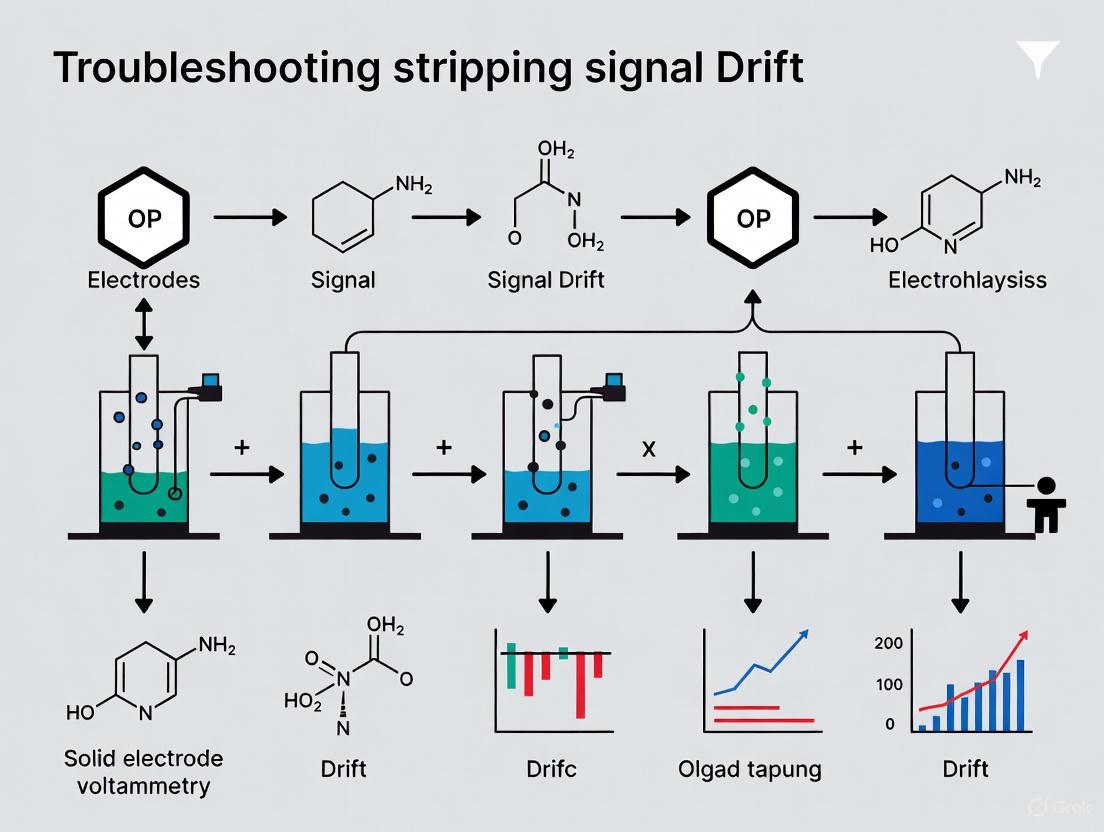
Signal drift in solid-electrode stripping voltammetry poses a significant challenge to the reproducibility and accuracy of trace metal analysis in biomedical and pharmaceutical research.
Stabilizing Your Stripping Voltammetry: A Practical Guide to Troubleshooting Signal Drift in Solid Electrode Systems
Abstract
Signal drift in solid-electrode stripping voltammetry poses a significant challenge to the reproducibility and accuracy of trace metal analysis in biomedical and pharmaceutical research. This article provides a comprehensive, evidence-based guide for scientists tackling this issue. We explore the fundamental causes of drift, from electrode fouling to interfacial changes, and present robust methodological strategies, including advanced electrode materials like bismuth and gold. The core of this guide details a systematic troubleshooting and optimization protocol, covering electrode preconditioning, experimental parameter refinement using design-of-experiment approaches, and interference management. Finally, we discuss validation techniques and comparative analyses to ensure data reliability, empowering researchers to achieve stable and precise measurements in complex matrices like biological fluids and drug compounds.
Understanding Signal Drift: Root Causes and Fundamental Principles in Solid Electrode Systems
Understanding Signal Drift
Signal drift is a gradual change in the baseline signal or instrument response over time, unrelated to the actual analyte concentration. In the context of solid electrode stripping voltammetry, this manifests as shifting baselines or alterations in peak current and potential, which directly compromise the accuracy and precision essential for reliable trace analysis [1].
Impacts on Key Analytical Figures of Merit
The consequences of unaddressed signal drift permeate every aspect of data quality, fundamentally undermining the reliability of analytical results.
- Accuracy: Drift introduces a systematic error, causing measured values to consistently deviate from the true value. This is particularly critical in trace analysis, where results close to method detection limits can become significantly biased [2].
- Precision: Increasing random scatter in replicate measurements degrades precision. You may observe rising relative standard deviation (RSD) values, indicating deteriorating method reproducibility [1].
- Detection Limit: Elevated baseline noise directly increases the method's detection limit (LOD), reducing your ability to detect and quantify low-concentration analytes [1].
- Reliability: Gradual, unnoticed drift creates a high risk of reporting erroneous data, leading to incorrect scientific conclusions or flawed quality control decisions [3].
Troubleshooting Guide: A Systematic Approach
Follow this structured workflow to efficiently diagnose and resolve signal drift issues in your voltammetric setup.
Step 1: Visual Inspection & System Preparation
Begin with a thorough physical examination of your electrochemical cell and components.
- Electrode Inspection: Examine the solid working electrode surface for scratches, fouling, or trapped air bubbles. Even minor physical defects can cause significant drift and slow response times [2].
- Connection Check: Ensure all cables and connectors are secure. Loose connections can cause erratic signals and drift. Look for signs of corrosion on contacts [2].
- Solution State: Confirm your supporting electrolyte is clean, free of precipitation, and properly degassed. Oxygen interference is a common source of baseline drift in voltammetry.
Step 2: Diagnostic Experiments
Perform these key tests to isolate the root cause, using a standard solution of known concentration.
- Blank Run: Execute a full voltammetric procedure using only the supporting electrolyte. The appearance of unexpected peaks (ghost peaks) or a drifting baseline indicates system contamination or electrolyte issues [4].
- Standard Analysis: Analyze a fresh standard solution. Compare the peak current, potential, and shape to historical data from the same standard. Significant deviations confirm a performance issue beyond normal variance [4].
- Precision Test: Run five to seven replicate measurements [1]. Calculate the RSD. An RSD exceeding your method's historical performance benchmark (e.g., >5%) indicates poor precision potentially caused by drift [1].
Step 3: Interpret Results and Implement Corrections
Based on your diagnostic findings, apply targeted solutions.
- Contamination (Ghost Peaks): Thoroughly clean the entire system. Replace the supporting electrolyte. Implement more rigorous cleaning protocols between samples [4].
- Poor Precision (High RSD): This often points to an unstable electrode surface. Follow the electrode maintenance procedures outlined below, such as polishing or applying a regeneration protocol [1].
- Consistently Low/High Signal: This suggests a change in analytical sensitivity. Re-calibrate your instrument. If issues persist, the electrode may be passivated or require rejuvenation [2].
Experimental Protocol: Monitoring and Correcting for Drift
Incorporate this procedure into your routine to proactively manage signal drift.
Method for Quantifying Signal Drift in DPASV
This protocol uses a stable internal standard to monitor and correct for drift during a sequence of analyses.
1. Principle: The peak current of an internal standard added to all samples and standards is monitored throughout an analytical run. The relative change in its response is used to correct the analyte signals.
2. Materials & Reagents: * Solid working electrode (e.g., Au, Bi) * Reference electrode (Ag/AgCl) and Pt counter electrode * Potentiostat * Supporting electrolyte (e.g., 0.1 M acetate buffer, pH 4.6) * Standard solutions of analyte and internal standard
3. Procedure: * Step 1: Prepare all calibration standards and samples with a consistent, low concentration of an internal standard. The standard must be stable, well-resolved from the analyte, and not interfere with the analysis. * Step 2: Run your sequence of standards and samples as per your validated DPASV method. * Step 3: For each measurement, record the peak currents for both the analyte (Ipanalyte) and the internal standard (IpIS).
4. Data Calculation:
* Calculate the drift correction factor (DCF) for each run i:
DCF_i = Ip_IS(initial) / Ip_IS(i)
* Where Ip_IS(initial) is the peak current of the internal standard in the first standard of the sequence, and Ip_IS(i) is the peak current in the current run.
* Apply the correction to the analyte signal:
Ip_analyte(corrected) = Ip_analyte(measured) * DCF_i
5. Acceptance Criteria: The internal standard response should not vary by more than ±20% over the entire sequence. A greater change indicates significant instability, and the data should be treated with caution, or the analysis repeated after troubleshooting the system [1].
Frequently Asked Questions (FAQs)
Q1: What is the difference between signal drift and data drift in machine learning? While both involve change over time, they affect different systems. Signal drift is a physical phenomenon affecting analytical instruments, where the baseline or response of a sensor changes. Data drift is a computational concept in machine learning where the statistical properties of the input data change, causing model performance to decay [5] [3].
Q2: My baseline is very noisy and drifting. What is the first thing I should check? The most common cause is a contaminated or degraded electrode. First, clean and polish your solid working electrode according to the manufacturer's instructions. If the problem persists, check for air bubbles trapped on the electrode surface and ensure your solvent/supporting electrolyte is clean and fresh [2].
Q3: How often should I re-calibrate my method to account for drift? There is no universal rule. The frequency should be determined by your system's stability. During method development, run a calibration standard at the beginning, middle, and end of an analytical sequence. The observed variation will inform your re-calibration schedule. Implementing an internal standard, as described in the protocol above, can significantly extend the time between full re-calibrations [1].
Q4: Can signal drift ever be beneficial to detect? Yes. A sudden, significant drift can be an early warning signal for instrument failure or a critical issue with your experimental conditions (e.g., cooling system failure, reagent degradation). Monitoring for drift is a key part of quality control [3].
The Scientist's Toolkit: Essential Research Reagents & Materials
| Item | Function in Experiment | Specification & Handling |
|---|---|---|
| Solid Gold Electrode | Working electrode for ASV; provides a surface for analyte deposition and stripping. | Rotating disk preferred for some applications [6]. Clean by gentle mechanical polishing (e.g., 0.05 µm alumina slurry) and electrochemical activation [1]. |
| Bismuth Microelectrode Array | Environmentally friendly alternative to mercury electrodes; amplifies currents and resists interference. | Solid bismuth offers long-term use without needing Bi(III) in solution [1]. |
| High-Purity Buffer Salts | Provides consistent ionic strength and pH for supporting electrolyte. | Use 99%+ purity to minimize contamination. Prepare daily or store aliquots to prevent microbial growth [1]. |
| Ultra-Pure Water | Diluent and solvent for preparing all standards and electrolytes. | Resistivity ≥18.2 MΩ·cm. Essential to prevent introduction of trace metals or organics that cause baseline drift [2]. |
| Internal Standard Solution | Added to samples/standards to monitor and correct for signal drift. | Must be electroactive, stable, and not present in samples (e.g., Ti(I) for some systems). Concentration must be identical in all vials [1]. |
Troubleshooting Guides
Rapid Performance Degradation and Increased Energy Consumption
Problem: Your electrocoagulation (EC) process shows decreased contaminant removal efficiency alongside a noticeable increase in energy consumption and circuit resistance.
Investigation & Solution:
- Check Electrode Surface: Inspect for build-up of solid materials. Fouling layers decrease coagulant production and increase ohmic resistance [7].
- Identify Fouling Type: Determine if the foulant is a chemical by-product (e.g., metal hydroxides, Ca/Mg minerals) or a biological substance (e.g., proteins) [7] [8].
- Apply Mitigation Strategy:
- For Al Electrodes: Implement Polarity Reversal (PR). This can diminish electrode fouling, reduce energy consumption, and maintain high coagulant production. The optimal frequency is critical [7].
- For Fe Electrodes: Polarity Reversal may be ineffective and can even reduce Faradaic efficiency to as low as 10%. Consider alternative strategies [7].
- Use a Stable Cathode: A novel strategy involves using a Ti-IrO₂ cathode. Fouling on this cathode can be avoided by periodically switching the current direction [7].
Signal Drift and Peak Voltage Shifts in Electrochemical Sensing
Problem: Your Fast-scan Cyclic Voltammetry (FSCV) measurements for neurotransmitter detection exhibit decreasing sensitivity and shifts in oxidation/reduction peaks.
Investigation & Solution:
- Diagnose the Electrode:
- Carbon Fiber Micro-Electrode (CFME): Fouling from biomolecules (biofouling) or analyte by-products (chemical fouling) decreases sensitivity and causes peak shifts [8].
- Ag/AgCl Reference Electrode: A peak voltage shift is often linked to a decrease in its open circuit potential (OCP). This is frequently caused by sulfide ion (S²⁻) contamination from the environment or implantation [8].
- Apply Mitigation Strategy:
- For CFMEs: Apply antifouling surface coatings like PEDOT:Nafion or PEDOT-PC to reduce biomolecule accumulation [8].
- For Ag/AgCl Reference Electrodes: Protect the electrode from sulfide ions. In environments where this is impossible, plan for more frequent calibration or replacement of the reference electrode [8].
Continuous Capacity Decay in Solid-State Batteries
Problem: Your Si-based all-solid-state battery shows continuous capacity fade, but impedance measurements indicate stable interfacial resistance.
Investigation & Solution:
- Re-evaluate the Failure Mechanism: The problem may not be high interfacial impedance. A sustainable interfacial side reaction between the electrode and solid electrolyte (e.g., Li₁₀GeP₂S₁₂, LGPS) can deplete the active lithium source, causing capacity decay even without a dramatic resistance increase [9].
- Analyze the Interface: Use cryo-TEM to characterize the interphase layer. A thick interface (e.g., 10 μm) with needle-shaped Li₂S indicates a severe continuous reaction [9].
- Apply Mitigation Strategy: Select a more chemically compatible solid electrolyte. For silicon anodes, Li₁₀Si₀.₃PS₆.₇Cl₁.₈ (LSPSC) forms a thin (100-200 nm), stable interphase layer that prevents sustained lithium consumption and ensures good cyclability [9].
Frequently Asked Questions (FAQs)
Q1: What is the fundamental difference between "fouling" and "passivation"? While both terms describe phenomena that degrade electrode performance, passivation typically refers to the formation of a protective, often oxide, layer that makes the surface less reactive and is sometimes desirable [10]. Fouling is generally an undesired process where foreign materials (e.g., minerals, biomolecules, reaction products) accumulate on the electrode, leading to increased resistance and signal drift [7] [8] [10].
Q2: Does polarity reversal always help mitigate electrode fouling? No, the effectiveness of polarity reversal (PR) is highly dependent on the electrode material. For Al electrodes, PR can effectively reduce fouling and energy use. However, for Fe electrodes, PR often fails to mitigate fouling and can significantly reduce Faradaic efficiency, making it counterproductive [7].
Q3: Why does my reference electrode fail in chronic in vivo implants? Chronic implantation of Ag/AgCl reference electrodes often leads to fouling by sulfide ions (S²⁻) present in the biological environment. These ions react with the electrode, forming a silver sulfide layer that decreases the open circuit potential, which manifests as a voltage shift in your measurements [8].
Q4: In battery research, if my interface impedance is stable, does that mean the interface is stable? Not necessarily. Recent studies on silicon-based all-solid-state batteries show that a stable impedance does not preclude failure. The capacity can still decay continuously due to sustained chemical/electrochemical reactions at the interface that consume the active lithium, even without a significant increase in measured resistance [9].
The table below summarizes key quantitative findings from recent research on mitigating electrode surface phenomena.
Table 1: Summary of Experimental Data for Electrode Phenomena Mitigation
| Phenomenon | Mitigation Strategy | Key Experimental Parameter | Performance Outcome | Source |
|---|---|---|---|---|
| Fouling in Fe-EC | Polarity Reversal (PR) | PR Frequency: 0.5 min | Faradaic efficiency dropped to ~10% | [7] |
| Fouling in Al-EC | Polarity Reversal (PR) | Applied PR mode | Reduced fouling & energy consumption; high coagulant production | [7] |
| Fouling in SERS | Electrochemical Regeneration | +1.5 V (ox, 10 s), -0.80 V (red, 5 s) | SERS signal reproducible over 30 cycles (~5% RSD) | [11] |
| Instability in Si-Anode ASSBs | Electrolyte Swap (LGPS to LSPSC) | 300 cycles | Capacity retention: 9.5% (LGPS) vs. 81.5% (LSPSC) | [9] |
Detailed Experimental Protocols
Protocol: Mitigating Electrode Fouling in Electrocoagulation via Polarity Reversal
This protocol is adapted from studies on treating contaminated water streams with electrocoagulation (EC) [7].
1. Objectives:
- To systematically investigate the effect of polarity reversal (PR) frequency and current density on electrode fouling.
- To compare the performance of Fe (Fe-EC) and Al (Al-EC) sacrificial anodes under PR mode.
2. Materials and Reagents:
- Electrode Assembly: Sacrificial Fe and Al anodes; Cathode (e.g., stainless steel or Ti-IrO₂).
- Power Supply: Programmable DC power supply capable of automated polarity reversal.
- Reactor Cell: Electrochemical reactor with known electrode spacing and volume.
- Test Solution: Synthetic wastewater or target contaminated water, with characterized ionic composition (e.g., Ca²⁺, Mg²⁺, Cl⁻).
- Analytical Equipment: Inductively Coupled Plasma (ICP) spectrometer or Atomic Absorption Spectrometer (AAS) for metal coagulant quantification.
3. Step-by-Step Procedure:
1. Setup: Arrange the electrode pairs in the reactor cell filled with the test solution. Connect the power supply, ensuring the setup allows for automated current reversal.
2. Baseline (DC-EC): Run the EC process in standard DC mode at a fixed current density (e.g., 10-50 A/m²) for a set duration. Measure the concentration of dissolved Fe or Al ions to determine the baseline Faradaic efficiency.
3. Polarity Reversal (PR-EC):
a. Set the power supply to alternate the current direction at a specific frequency (e.g., 0.5, 2, 5 minutes).
b. Run the EC process for the same duration as the baseline, using the same current density.
c. Measure the concentration of dissolved metal ions.
4. Analysis: Calculate the Faradaic efficiency (ϕ) for both DC and PR modes using the formula:
ϕ = (Actual coagulant produced / Theoretical coagulant from charge passed) * 100%.
5. Comparison: Compare energy consumption, electrode surface condition (via visual inspection or SEM), and contaminant removal efficiency between DC and PR modes for both Fe and Al electrodes.
4. Expected Outcomes:
- Al-EC operated in PR mode is expected to show reduced electrode fouling, lower energy consumption, and maintained high Faradaic efficiency.
- Fe-EC operated in PR mode is expected to show significantly lower Faradaic efficiency, with minimal reduction in fouling.
Protocol: In Situ Electrochemical Regeneration of SERS Substrates
This protocol describes a method to regenerate fouled Surface-Enhanced Raman Spectroscopy (SERS) substrates, enabling their reuse [11].
1. Objectives:
- To remove adsorbates (foulants) from gold nanoparticle (AuNP) SERS substrates electrochemically.
- To precisely regenerate the nanogap hotspots to restore SERS activity for repeated use.
2. Materials and Reagents:
- SERS Substrate: Thin-film of AuNP monolayers or aggregates, deposited on a conductive support (e.g., FTO-coated glass).
- Molecular Scaffold: Cucurbit[5]uril (CB[5]) in buffer solution (1 mM).
- Electrochemical Cell: A three-electrode flow cell, with the SERS substrate as the working electrode, an Ag/AgCl reference electrode, and a Pt counter electrode.
- Potentiostat: To control the applied potential.
- Raman Spectrometer: For in-situ monitoring of SERS signals.
3. Step-by-Step Procedure: 1. Initial Detection: Place the SERS substrate in the flow cell and introduce the analyte. Acquire the SERS spectrum. 2. Oxidative Cleaning: Flush the cell with a clean buffer (e.g., 50 mM potassium phosphate, pH 7.0). Apply an oxidizing potential of +1.5 V (vs. Ag/AgCl) for 10 seconds. This step strips adsorbates and forms a thin gold oxide layer. 3. Reductive Regeneration & Re-scaffolding: Switch the solution to buffer containing 1 mM CB[5]. Apply a reducing potential of -0.80 V (vs. Ag/AgCl) for 5 seconds. This reduces the oxide layer and re-adsorbs the CB[5] scaffold, reforming the nanogap hotspots. 4. Verification: Flush with clean buffer and acquire a new SERS background signal to confirm the removal of the analyte. 5. Reuse: The substrate is now regenerated and ready for a new detection cycle. Steps 1-4 can be repeated multiple times.
4. Expected Outcomes:
- The SERS substrate can be regenerated in situ within seconds.
- The SERS enhancement factor (≈10⁶) should be reproducibly restored, allowing for reuse over at least 30 cycles with a low relative standard deviation (≈5%) in signal intensity.
Visualization of Processes
Electrode Fouling Mitigation via Polarity Reversal
This diagram illustrates the mechanism of how polarity reversal (PR) can mitigate fouling in an electrocoagulation system, particularly for aluminum electrodes.
This diagram outlines the logical troubleshooting path for identifying the source of signal drift and peak shifts in electrochemical sensing, such as FSCV.
The Scientist's Toolkit: Research Reagent Solutions
Table 2: Key Reagents and Materials for Investigating Electrode Surface Phenomena
| Reagent / Material | Function / Application | Technical Notes |
|---|---|---|
| Cucurbit[5]uril (CB[5]) | A molecular scaffold to define and stabilize sub-nm gaps in gold nanoparticle SERS substrates, enabling precise regeneration [11]. | Its rigid structure controls interparticle spacing. Critical for the electrochemical regeneration protocol. |
| PEDOT:Nafion / PEDOT-PC | Conductive polymer coatings for carbon fiber microelectrodes (CFMEs) to impart ultra-low fouling properties against biomolecules [8]. | Reduces acute in vivo biofouling. PEDOT-PC mimics cell membranes to minimize biomacromolecule accumulation. |
| Ti-IrO₂ Electrode | Used as a stable, non-fouling cathode in electrocoagulation systems. Its fouling can be cleared with periodic polarity reversal [7]. | Offers an alternative material strategy to mitigate scaling on the cathode side of an EC reactor. |
| Li₁₀Si₀.₃PS₆.₇Cl₁.₈ (LSPSC) | A sulfide-based solid electrolyte for all-solid-state batteries that forms a stable, thin interphase with silicon anodes [9]. | Prevents sustained lithium consumption, unlike other electrolytes like LGPS, leading to superior cycle life. |
| Citric Acid Passivation Solution | An environmentally friendly, less toxic alternative to nitric acid for passivating stainless steel surfaces [10]. | Effectively removes exogenous iron and promotes the formation of a protective chromium oxide layer. |
FAQs on Electrode Material Selection and Troubleshooting
Q1: What are the primary advantages of using bismuth-based electrodes over traditional mercury electrodes? Bismuth-based electrodes are celebrated as an environmentally friendly alternative to mercury electrodes. They offer a compelling combination of low toxicity and electroanalytical performance that is comparable to mercury, including a wide negative potential window, high hydrogen overpotential, and the ability to form alloys with heavy metals, which leads to well-defined stripping signals and low background currents [12] [13] [14].
Q2: My bismuth-film electrode shows unstable baseline and signal drift. What could be the cause? Baseline drift can originate from several sources. A common issue is poor electrical contact, particularly at the working electrode connection [15]. Furthermore, the instability of the bismuth film itself can be a factor. Ex situ-plated films may suffer from insufficient attachment to the substrate, affecting sensor lifespan and performance. Using an in situ plating method, where bismuth ions are added directly to the sample solution, can often yield more stable and reproducible results [16].
Q3: Why is the simultaneous detection of multiple metals sometimes problematic on bismuth electrodes? While bismuth electrodes are excellent for detecting metals like Cd(II), Pb(II), and Zn(II), their accessible potential window (typically from about -1.2 V to -0.2 V) may not cover all metals. For instance, the determination of copper can be challenging, and bismuth itself cannot be detected on a bismuth-film electrode [12]. The presence of interferences, such as a ten-fold excess of Cu(II) or Ni(II), can also suppress the signals of target metals like Cd and Pb [16].
Q4: What are the benefits of using a gold ultramicroelectrode array (UMEA) as a substrate? Gold UMEAs offer several advantages. Their small dimensions enhance the mass transfer of analyte to the electrode surface, improve the signal-to-noise ratio, and reduce the ohmic drop (iR drop), allowing for use in solutions with low ionic strength [16]. When operating in parallel, the array amplifies the current output, overcoming the limitation of weak signals from individual microelectrodes and leading to lower detection limits [16] [17].
Q5: I am observing an unexpected peak in my voltammogram. How can I identify its source? Unexpected peaks are frequently due to impurities in the chemicals, solvent, or electrolyte used to prepare the solution [15]. To diagnose this, run a background scan using only the supporting electrolyte without the analyte. If the peak persists, it confirms the presence of a system impurity. Peaks can also appear if the scanning potential approaches the edge of the electrolyte's potential window [15].
Material Selection Guide and Performance Data
The following table summarizes key characteristics of bismuth, gold, and carbon electrode substrates to guide material selection.
Table 1: Comparison of Electrode Substrates for Anodic Stripping Voltammetry
| Feature | Bismuth-Film Electrode | Gold Ultramicroelectrode Array (UMEA) | Solid Bismuth Microelectrode Array | Carbon Substrate (for Bi coating) |
|---|---|---|---|---|
| Typical Substrate | Glassy carbon, carbon fiber [12] | Silicon chip [16] | Packed capillaries [17] | Glassy carbon, carbon fiber [12] |
| Primary Advantage | "Mercury-free," eco-friendly, high performance [12] [14] | Enhanced mass transfer, low iR drop, high signal-to-noise [16] | No film plating required, spherical diffusion, reusable [17] | Conductive, common substrate for film electrodes [12] |
| Detection Limits (Example) | Pb(II): 0.3 ppb (10 min deposition) [12] | Pb(II): 5 µg/L, Cd(II): 7 µg/L [16] | Pb(II): 0.89 nM, Cd(II): 2.3 nM [17] | N/A (Acts as a substrate) |
| Key Metals Detected | Cd, Pb, Zn, Tl [12] | Cd, Pb [16] | Cd, Pb [17] | N/A (Acts as a substrate) |
| Common Issues | Film stability, potential window limits [12] [16] | Fabrication complexity, cost | Construction and packing of micro-capillaries | Requires a film (e.g., Bi) for optimal stripping performance |
Detailed Experimental Protocols
Protocol 1: In Situ Preparation of a Bismuth-Film Carbon Electrode
This method simplifies electrode preparation by co-depositing bismuth and the target metals onto the substrate.
Research Reagent Solutions:
- Supporting Electrolyte: Acetate buffer (0.1 M, pH ~4.6) is commonly used [17].
- Bismuth Stock Solution: 1000 mg/L Bi(III) in 1% (v/v) HNO₃, prepared from Bi(NO₃)₃·5H₂O [16].
- Analyte Standard Solutions: Standard solutions (e.g., 1000 mg/L) of target metals like Cd(II) and Pb(II).
Methodology:
- Electrode Preparation: Polish the glassy carbon working electrode with 0.05 µm alumina slurry, then rinse thoroughly with deionized water [15].
- Solution Preparation: Transfer a known volume of the sample or standard solution into the electrochemical cell. Add the supporting electrolyte and bismuth stock solution to achieve a final Bi(III) concentration of typically 400 µg/L [12].
- Preconcentration/Deposition: Immerse the working, reference, and counter electrodes in the solution. Stir the solution and apply a deposition potential (e.g., -1.2 V vs. Ag/AgCl) for a set time (e.g., 2-10 minutes) to reduce and co-deposit Bi and target metals onto the electrode surface [12].
- Stripping Scan: After a brief equilibration period, initiate the anodic stripping scan. For square-wave ASV, the parameters used for a Bi-coated gold UMEA were optimized at a frequency of 14.76 Hz, amplitude of 50.10 mV, and step potential of 8.76 mV [16]. The scan proceeds from negative to positive potentials, oxidizing the metals and generating characteristic current peaks.
The workflow for this protocol is illustrated below:
Protocol 2: Troubleshooting Signal Drift and Baseline Issues
This procedure provides a systematic approach to diagnose the source of unstable signals.
Research Reagent Solutions:
- Standard Redox Couple: A solution of 1 mM potassium ferricyanide (K₃[Fe(CN)₆]) in 1 M potassium chloride (KCl).
- Electrode Polishing Slurry: 0.05 µm alumina powder in deionized water.
- Electrode Cleaning Solution: 1 M H₂SO₄ for Pt electrodes [15].
Methodology:
- Inspect Electrical Connections: Ensure all cables (working, reference, counter) are securely connected. Check for broken wires or loose connections with an ohmmeter if available [15].
- Test with a Resistor: Disconnect the cell and connect a 10 kΩ resistor between the working electrode terminal and the combined reference/counter terminals. Run a linear scan (e.g., from -0.5 V to +0.5 V). The resulting plot should be a straight line obeying Ohm's law (V=IR). A non-linear or noisy response indicates a problem with the potentiostat or cables [15].
- Check the Reference Electrode: A blocked frit or air bubbles in the reference electrode is a frequent cause of drift [15]. Test this by connecting the reference cable to the counter electrode (creating a two-electrode setup) and running a linear sweep. If a normal voltammogram is obtained (though shifted in potential), the reference electrode is likely the issue. Try using a fresh quasi-reference electrode (e.g., a bare silver wire) as a substitute.
- Clean/Re-polish the Working Electrode: Surface fouling can cause hysteresis and a non-flat baseline [15]. Re-polish the electrode according to the manufacturer's instructions (e.g., with 0.05 µm alumina). For Pt electrodes, electrochemical cleaning by cycling in 1 M H₂SO₄ between the potentials for H₂ and O₂ evolution can be effective [15].
- Verify Electrolyte and Solvent Purity: Run a background scan of your pure supporting electrolyte. Any unexpected peaks indicate impurities in the electrolyte, solvent, or contamination from the atmosphere [15].
The logical troubleshooting path is as follows:
Frequently Asked Questions (FAQs)
FAQ 1: How do surfactants in my sample matrix cause signal drift in my voltammetric analysis? Surfactants are amphiphilic molecules that can spontaneously form self-assembled structures, like micelles, when their concentration exceeds the critical micelle concentration (CMC) [18]. In solid electrode stripping voltammetry, these micelles can adsorb onto the electrode surface, creating a physical barrier that alters the electrochemical interface. This adsorption can either inhibit or enhance the transport of your target analyte to the electrode, leading to unpredictable signal drift over successive measurements as the surface coverage changes. The heterogeneous environment of the micelles provides multiple interaction sites that can trap or release analytes, further complicating the signal response [18].
FAQ 2: Can complexing agents present in the sample affect the deposition step of stripping voltammetry? Yes, complexing agents can significantly interfere with the deposition step. These agents form complexes with metal ions, changing their electrochemical properties and reduction potentials [19]. For instance, a complexing agent might shift the reduction potential of your target metal ion to a more negative value, potentially outside your optimized deposition potential window. This results in incomplete plating onto the solid electrode, directly causing a negative drift in the stripping signal. Furthermore, strong complexation can remobilize heavy metals from sediments or soils, introducing unexpected interferents into your sample matrix [19].
FAQ 3: Why do organic substances from biological or environmental samples lead to electrode fouling? Organic substances, such as humic acids in environmental samples or proteins in biological fluids, can irreversibly adsorb onto the solid electrode surface. This non-specific adsorption passivates the electrode, effectively reducing its active surface area. This fouling layer increases the impedance of electron transfer and can block the access of the analyte to the electrode. The consequence is a progressive decline in signal intensity—a classic signal drift—as the fouling layer builds up over multiple analysis cycles. The composition and concentration of the organic matrix determine the rate and severity of this fouling.
FAQ 4: What is a quick method to diagnose if my signal drift is matrix-related? A robust diagnostic method is the standard addition technique. Split your sample and spike known, increasing concentrations of your target analyte into these aliquots. If the calibration curve from the standard additions is linear but the original sample signal drifts, the issue is likely related to the electrode surface (e.g., fouling). If the response to the standard additions is also non-linear or erratic, it strongly indicates a matrix effect, such as complexation or surfactant interference, that is altering the electrochemistry of the analyte itself.
Troubleshooting Guide: Common Issues and Solutions
The table below summarizes specific problems, their underlying causes, and detailed corrective actions.
| Observed Problem | Potential Root Cause | Recommended Troubleshooting Action |
|---|---|---|
| Progressive decrease in peak current | Electrode fouling by organic substances or surfactant adsorption. | Implement an intermediate electrode cleaning protocol between measurements (e.g., 30-second polish on microcloth with 0.05 µm alumina slurry). Use a surfactant-modified sorbent in solid-phase extraction (SPE) to remove interferents prior to analysis [18]. |
| Irreproducible stripping signals | Uncontrolled complexation altering analyte speciation. | Buffer your sample to a consistent pH to stabilize complexation equilibria. Add a known, strong complexing agent to mask interferents or break weak complexes. Employ a supramolecular solvent-based extraction to isolate the analyte from the complexing matrix [18]. |
| Shift in peak potential | Change in analyte speciation due to complexing agents or pH shift. | Standardize and tightly control the sample pH. Perform a speciation calculation to predict the new formal potential. Use electrochemical impedance spectroscopy (EIS) to monitor changes in the low-frequency capacitance of the electrode interface, which correlates with ionic activity [20]. |
| High background current | Surfactants causing capacitive changes at the electrode-solution interface. | Dilute the sample to below the surfactant's CMC. Use cloud point extraction (CPE) to pre-concentrate the analyte while leaving surfactants in the dilute phase [18]. Consider using a different electrode material (e.g., Au vs. Glassy Carbon) which may have different catalytic activity and surface interactions [20]. |
| Poor standard addition recovery | Strong matrix effects (both complexation and surface effects). | Apply a more extensive sample clean-up, such as dispersive SPE with surface-modified sorbents. If possible, switch to a method less susceptible to matrix effects, like potentiometry with a highly selective ionophore [21]. |
Experimental Protocols for Matrix Effect Investigation
Protocol 1: Investigating Surfactant Interference via CMC Determination
Objective: To determine the critical micelle concentration (CMC) of a surfactant in your supporting electrolyte and its impact on analyte signal.
- Preparation of Surfactant Solutions: Prepare a series of at least 10 solutions with a fixed concentration of your target analyte and a supporting electrolyte, but with the surfactant (e.g., Triton X-114) concentration varying from well below to above its expected CMC (e.g., 0.001 mM to 2 mM).
- Voltammetric Measurement: Run your optimized stripping voltammetry method for each solution in triplicate.
- Data Analysis: Plot the obtained stripping peak current against the logarithm of the surfactant concentration. The CMC will be identified as the inflection point where the signal trend changes sharply (e.g., from stable to decreasing). This identifies the safe operating concentration for the surfactant.
Protocol 2: Evaluating Complexation Strength
Objective: To assess the strength of complexation between the target metal ion and matrix components and its effect on the stripping signal.
- Sample Splitting: Split your sample into two portions.
- UV Digestion: Vigorously oxidize one portion via UV digestion in the presence of hydrogen peroxide (H₂O₂) to destroy organic complexing agents.
- Comparative Analysis: Analyze both the digested and the original sample using your standard voltammetric method and the standard addition method.
- Interpretation: A significantly higher signal in the digested sample compared to the original indicates substantial complexation in the native matrix. The ratio of signals provides a semi-quantitative measure of complexation strength.
Workflow and Signaling Pathways
The following diagram illustrates the logical decision-making process for troubleshooting signal drift caused by the analytical matrix.
Troubleshooting Signal Drift Workflow
The Scientist's Toolkit: Key Research Reagent Solutions
This table details essential reagents and materials referenced in the troubleshooting guides and protocols for mitigating matrix effects.
| Reagent/Material | Function / Mechanism of Action |
|---|---|
| Supramolecular Solvents | Used in liquid-phase microextraction. They form a coacervate phase (colloid-rich) that separates from the bulk, efficiently extracting analytes away from surfactants and complex matrices based on multiple interactions (hydrophobic, hydrogen bonding) [18]. |
| Surface-Modified Sorbents | Sorbents for Solid-Phase Extraction (SPE) whose surface is coated with surfactants. The surfactant layer alters the surface properties and chemistry, tailoring it for selective extraction of target analytes and improved dispersion [18]. |
| Ion-Selective Ionophores | Neutral carriers used in potentiometric sensors. These molecules (e.g., calixarenes, podands) selectively bind to specific ions, providing a highly selective detection method that can bypass complexation interference in voltammetry. Examples include podands for Ag(I) and calix[4]thiomorpholide for Pb(II) [21]. |
| Deep Eutectic Solvents (DES) | Environmentally friendly solvents that can be combined with surfactants. They influence the micellization behavior of surfactants and can be used in green cloud-point extraction techniques to preconcentrate analytes while minimizing organic solvent use [18]. |
| Conducting Polymers (e.g., PAAQ) | Materials like polyaminoanthraquinone (PAAQ) used as microparticles in polymeric membranes. They can act as ion-to-electron transducers or ionophores themselves, improving sensor performance, dynamic range, and detection limits for ions like Pb(II) [21]. |
This guide details the role of underpotential deposition (UPD) and overpotential deposition (OPD) in solid electrode stripping voltammetry, with a specific focus on troubleshooting signal drift. Signal drift degrades measurement accuracy and precision over time, posing a significant challenge for reliable analysis. UPD describes the electrochemical formation of a monolayer of a metal (M) on a foreign substrate (S) at a potential more positive than its thermodynamic Nernst potential. This occurs due to a stronger M–S bond compared to the M–M bond. In contrast, OPD, or bulk deposition, occurs at potentials more negative than the Nernst potential, leading to the formation of a bulk metal phase [22] [23] [24]. Understanding and controlling these processes is fundamental to optimizing sensor stability and data quality.
Fundamental Concepts: UPD vs. OPD
Comparative Analysis Table
The table below summarizes the core differences between UPD and OPD.
| Feature | Underpotential Deposition (UPD) | Overpotential Deposition (OPD) |
|---|---|---|
| Deposition Potential | More positive than the Nernst potential (E > E⁰) [24] |
More negative than the Nernst potential (E < E⁰) [24] |
| Product & Morphology | Monolayer or submonolayer of ad-atoms [22] [24] | Bulk metal phase with cluster formation [24] |
| Driving Force | Formation of a surface compound/alloy; stronger substrate-adsorbate interaction [22] [23] | Driving force for bulk phase formation [24] |
| Typical Electrode Coverage | Low (e.g., 0.01–0.1% of surface) [24] | High, can form multilayers and thick films |
| Primary Analytical Strengths | High sensitivity for trace analysis, sharp stripping peaks, reduced interferences, good surface reproducibility [24] | Wider linear range, higher total signal intensity [24] |
| Common Electrode Materials | Noble metals (e.g., Au, Ag) [22] [24] | Mercury, Bismuth, Gold [25] [24] [26] |
Relationship Diagram
The following diagram illustrates the sequential relationship between UPD and OPD during an electrochemical deposition experiment and connects these processes to common sources of signal drift.
Troubleshooting Guide: Signal Drift in Stripping Voltammetry
FAQ: Addressing Common Experimental Issues
Q1: My sensor's signal continuously decreases during a measurement run in a complex medium like blood or serum. What is the primary cause? A1: Signal drift in biological fluids is often biphasic. The initial, rapid exponential drift is typically caused by surface fouling from proteins and other biomolecules, which adsorb to the electrode and hinder electron transfer. A subsequent, slower linear drift is frequently due to electrochemically driven desorption of the self-assembled monolayer (SAM) that anchors your receptor (e.g., a DNA aptamer) to the gold electrode surface [27].
Q2: How can I determine if signal loss is due to fouling or monolayer desorption? A2: You can perform a medium-complexity test.
- Procedure: Run your electrochemical protocol in a simple buffer (e.g., PBS) and then in the complex medium (e.g., whole blood).
- Interpretation: If the rapid exponential drift phase disappears in PBS, it confirms that fouling is the primary cause of that phase. If a slower linear drift persists in PBS, it is likely due to electrochemical desorption of the SAM. Washing a fouled electrode with a solubilizing agent like concentrated urea can recover a significant portion of the signal, confirming the role of fouling [27].
Q3: Why does the choice between UPD and OPD matter for my sensor's stability? A3: UPD and OPD lead to different physical states of the deposited material, which impacts surface reproducibility.
- UPD: Forms a stable, ordered monolayer. This process is less likely to cause significant changes to the electrode's morphology, leading to better reproducibility between measurement cycles and less inherent drift from surface roughening [24].
- OPD: Forms a bulk, multi-layer deposit. This can cause nanoscale roughening and structural changes to the electrode surface with each deposition/stripping cycle. This evolving surface area and morphology is a direct source of signal drift [22]. In some cases, OPD can also lead to irreversible alloy formation, permanently altering the electrode [22].
Q4: How can I minimize electrochemical desorption of my SAM? A4: The stability of thiol-on-gold SAMs is highly dependent on the applied electrochemical potential.
- Strategy: Use the narrowest possible potential window that still encompasses your redox reporter's reaction. Thiol SAMs undergo reductive desorption at very negative potentials (below ~-0.5 V) and oxidative desorption at very positive potentials (above ~1.0 V). By limiting your window, you can avoid these destructive regimes [27]. For example, using methylene blue (E⁰ ≈ -0.25 V) allows for operation in a very stable potential window [27].
Q5: I am using a UPD method, but I still see interference from other metal ions. How can I improve selectivity? A5: The use of a complexing medium can be an effective strategy.
- Example: For the determination of Thallium (Tl(I)) using UPD on a gold film electrode, interference from Pb(II) and Cd(II) ions was successfully eliminated by switching the supporting electrolyte from nitric acid to a citrate medium [24]. The citrate complexes the interferents, shifting their deposition potentials and resolving the overlapping stripping peaks.
Troubleshooting Flowchart for Signal Drift
Follow this logical workflow to diagnose and address the root causes of signal drift in your experiments.
Detailed Experimental Protocols
Protocol: Investigating Drift Mechanisms in Biological Media
This protocol is adapted from studies investigating the stability of electrochemical aptamer-based (EAB) sensors [27].
Objective: To systematically determine the contributions of electrochemical desorption and biological fouling to signal drift.
Materials:
- Working Electrode: Gold electrode modified with a thiol-based SAM and a redox reporter (e.g., methylene blue)-modified DNA sequence.
- Solutions: Phosphate Buffered Saline (PBS), Undiluted whole blood (or other complex biofluid).
- Instrumentation: Potentiostat capable of Square-Wave Voltammetry (SWV).
Method:
- Sensor Preparation: Fabricate the EAB sensor by immobilizing a thiolated, MB-modified DNA sequence onto a gold electrode via SAM formation.
- Initial Measurement: Place the sensor in PBS at 37°C and acquire a stable SWV voltammogram. Record the peak current as the initial signal.
- PBS Drift Test: Continuously interrogate the sensor with SWV scans (e.g., 200-500 scans) in PBS at 37°C. Pause the electrochemical scanning periodically to determine if signal loss continues without applied potential.
- Whole Blood Drift Test: Use a fresh sensor. Place it in undiluted whole blood at 37°C and perform the same continuous SWV interrogation as in Step 3.
- Fouling Recovery Test: After ~2.5 hours in blood, wash the electrode with a concentrated urea solution (e.g., 6-8 M) and re-measure the signal in PBS.
- Potential Window Test: In PBS, repeat the interrogation using different SWV potential windows to observe the effect on the linear drift rate.
Data Interpretation:
- Exponential Drift in Blood: Attributable to fouling. Confirmed if the signal is recovered after urea wash.
- Linear Drift in PBS: Attributable to electrochemical SAM desorption. Confirmed if the drift rate is dependent on the applied potential window.
- Paused Scanning: If signal loss halts when scanning is paused, it confirms an electrochemical (rather than chemical) mechanism for the linear drift.
Protocol: UPD-based Determination of Thallium(I) on a Gold Film Electrode
This protocol outlines a method for trace metal analysis leveraging the selectivity of UPD [24].
Objective: To determine trace concentrations of Tl(I) in water samples using anodic stripping voltammetry (ASV) in the UPD regime.
Materials:
- Working Electrode: Rotating Gold Film Electrode (AuFE) electrodeposited on a glassy carbon substrate.
- Supporting Electrolyte: 10 mM HNO₃ + 10 mM NaCl. For samples with Pb/Cd interference, use a citrate medium.
- Standard Solutions: Tl(I) stock solution for standard additions.
Method:
- Electrode Preparation: Electrodeposit a gold film onto a polished glassy carbon electrode from a 1 mM H[AuCl₄] solution at -0.30 V (vs. Ag/AgCl) for 300 seconds.
- Accumulation: In the supporting electrolyte containing the sample/standard, apply a deposition potential (e.g., -0.50 V) for a set time (e.g., 210 s) with electrode rotation. This potential is carefully selected to be in the UPD region for Tl on Au.
- Stripping: After a quiet equilibration period (e.g., 10 s), record the anodic stripping peak using Square-Wave ASV by scanning to more positive potentials.
- Calibration: Use the method of standard additions to build a calibration curve. The peak height (current) is proportional to the Tl(I) concentration.
Troubleshooting:
- Overlapping Peaks: If Pb(II) or Cd(II) are present and cause interference, switch the supporting electrolyte to a citrate-based medium.
- Low Sensitivity: Optimize accumulation time and potential. Ensure the electrode rotation rate is constant.
Research Reagent Solutions
The following table lists key materials and their functions in experiments involving UPD/OPD and stripping voltammetry.
| Reagent / Material | Function / Explanation |
|---|---|
| Gold Electrode / Gold Film | A common, inert substrate for UPD studies and biosensor fabrication due to its well-defined electrochemistry and ease of functionalization with thiols [27] [24]. |
| Bismuth Microelectrode | An environmentally friendly ("green") alternative to mercury electrodes for stripping voltammetry. Offers a wide potential window and low toxicity [25] [26]. |
| Self-Assembled Monolayer (SAM) | A layer of organic molecules (e.g., alkanethiols) that forms on a gold surface. It serves as a scaffold for attaching recognition elements (e.g., DNA aptamers) and blocks non-specific adsorption [27]. |
| Methylene Blue | A redox reporter used in many biosensors. Its moderate formal potential allows for operation within a potential window that minimizes damage to thiol-on-gold SAMs [27]. |
| Citrate Medium | A complexing agent used in supporting electrolytes to mask interfering metal ions (e.g., Pb, Cd) by shifting their deposition potentials, thereby improving analytical selectivity [24]. |
| Acetate Buffer | A common supporting electrolyte for voltammetric determinations, particularly with bismuth-based electrodes, providing optimal pH and ionic strength [25] [26]. |
| Urea | A denaturant used in washing steps to remove non-covalently adsorbed proteins and other foulants from electrode surfaces, helping to recover signal loss from fouling [27]. |
Advanced Methodologies and Electrode Applications for Enhanced Signal Stability
Troubleshooting Guides
Troubleshooting Signal Drift in Solid Electrode Stripping Voltammetry
Signal drift is a common challenge that can compromise the accuracy and reproducibility of your stripping voltammetry results. The table below outlines frequent symptoms, their potential causes, and recommended solutions.
| Symptom | Potential Cause | Recommended Solution |
|---|---|---|
| Gradual decrease in peak current over multiple measurements | Bismuth Electrode: Passivation of the bismuth surface due to oxide formation [17] [1]. | Implement a consistent activation step: Apply a potential of -2.75 V for 2 seconds before each measurement to reduce oxides to the metallic state [1]. |
| Unstable baseline or shifting peak potentials | Gold Film Electrode: Unoptimized or degraded surface morphology, leading to inconsistent electron transfer [28]. | Apply a surface treatment prior to film plating. Sulfuric acid treatment has been shown to provide superior stability and lower detection limits for gold electrodes [28]. |
| Inconsistent signals between different electrode batches | Gold Film Electrode: Variation in film plating conditions, affecting thickness and uniformity. | Standardize the film plating procedure. For nanoporous gold electrodes, use a sputtering protocol with a defined thickness (e.g., 35 nm) for consistency [29]. |
| High background noise obscuring analytical signal | General: Electrical interference or unstable reference electrode. | For solid-state systems, ensure use of a stable reference electrode like a Solid Reservoir Reference Electrode (SRRE) to provide a stable potential [30]. |
Frequently Asked Questions (FAQs)
Q1: Why is a bismuth microelectrode array considered more advantageous than a single bismuth microelectrode?
Bismuth microelectrode arrays amplify the recorded analytical current while making it more resistant to noise interference [17] [1]. Research has demonstrated an approximate nine-fold amplification of the cadmium signal and a five-fold amplification of the lead signal compared to a single microelectrode [17]. This signal enhancement improves the sensitivity and reliability of measurements.
Q2: My bismuth electrode results are inconsistent. What is the most critical step I might be missing?
The most commonly overlooked step is the pre-measurement activation [17] [1]. This brief, high-negative-potential pulse cleans the electrode surface by reducing any bismuth oxides that form upon exposure to air or the solution. Consistent application of this step (e.g., -2.75 V for 2 s) is crucial for achieving reproducible surface states and stable signals [1].
Q3: For environmental monitoring of trace metals, what is a key advantage of using a solid bismuth microelectrode array over a traditional mercury electrode?
The key advantage is its eco-friendly property. The sensor is reusable and eliminates the need to add toxic Bi(III) ions to the supporting electrolyte, thereby simplifying the procedure and reducing the generation of hazardous waste [17] [31]. Its microelectrode characteristics also allow for measurements in unstirred solutions, which can simplify fieldwork [17].
Q4: What surface treatment for gold electrodes provides the best performance for sensitive detection?
A comparative study on dopamine detection found that sulfuric acid-treated gold electrodes outperformed those treated with plasma or self-assembled monolayers (SAMs). They achieved a lower detection limit (13.4 nM), higher sensitivity (3.7 μA·mM⁻¹·cm⁻²), and improved reproducibility [28]. This optimized surface provides a superior foundation for subsequent modifications, such as the deposition of gold nanoparticles.
Experimental Protocols
Detailed Methodology: Preparation and Activation of a Solid Bismuth Microelectrode Array
The following protocol is adapted from research for the determination of heavy metals and azo dyes [17] [1].
1. Electrode Construction:
- The array is constructed by packing forty-three single capillaries, each with an inner diameter of approximately 10 µm, with metallic bismuth into a single casing [17].
- This design ensures a high surface-area-to-volume ratio and makes the sensor reusable [17].
2. Surface Activation Procedure:
- Purpose: To reduce surface bismuth oxides and ensure a clean, electroactive surface before each measurement [1].
- Step 1: Place the electrode in the supporting electrolyte (e.g., 0.05 M acetate buffer, pH 4.6 for metals, or pH 9.7 for Sunset Yellow dye) [17] [1].
- Step 2: Apply an activation potential of -2.75 V (vs. Ag/AgCl) for an activation time of 2 seconds [1].
- Note: The optimal activation potential may vary slightly. A systematic study should be conducted by changing the activation potential from -1.0 V to -3.25 V to find the maximum response for your specific analyte [1].
3. Measurement Cycle:
- After activation, immediately proceed with the preconcentration (deposition) and stripping steps of your voltammetric procedure without removing the electrode from the solution.
Detailed Methodology: Optimization of a Gold Film Electrode for Trace Analysis
This protocol synthesizes best practices for creating a reliable gold film sensor [28] [29].
1. Surface Pre-Treatment:
- Purpose: To clean and optimize the underlying substrate (e.g., glassy carbon) or the gold surface itself for improved film adhesion and electrochemical performance.
- Procedure: Treat the electrode surface with sulfuric acid. This method has been shown to yield lower detection limits and better reproducibility compared to plasma treatment or SAMs [28].
2. Gold Film Formation or Nanostructuring:
- Option A (Sputtering): For a consistent nano-layer, sputter a ~35 nm thick gold film onto a substrate. Using a nanoporous membrane (e.g., PAA-g-PVDF) as a substrate can create a high-surface-area nanostructured electrode that enhances preconcentration [29].
- Option B (Electroplating): Electroplate gold from a suitable gold salt solution onto a pre-treated substrate. The concentration, potential, and duration of plating must be rigorously controlled to ensure a uniform and reproducible film.
3. Performance Verification:
- Characterize the electrode using cyclic voltammetry in a standard solution like potassium ferricyanide to confirm enhanced electron transfer kinetics and low background current.
The Scientist's Toolkit: Key Research Reagent Solutions
The table below lists essential materials used in the preparation and operation of bismuth and gold film electrodes.
| Item | Function/Benefit |
|---|---|
| Metallic Bismuth | Filling material for solid bismuth microelectrodes; eco-friendly alternative to mercury [17] [1]. |
| Acetate Buffer (pH 4.6) | A common supporting electrolyte for the determination of heavy metals like Cd(II) and Pb(II) using bismuth electrodes [17]. |
| Sulfuric Acid (H₂SO₄) | A pre-treatment solution for gold electrodes; enhances surface morphology for lower detection limits and improved reproducibility [28]. |
| Gold Sputtering Target | Used in physical vapor deposition to create thin, uniform, and nanostructured gold films on various substrates [29]. |
| Poly(acrylic acid)-grafted-PVDF Membrane | A nanoporous substrate for sputtered gold electrodes; traps metal ions passively, enhancing preconcentration [29]. |
| Sodium Hydroxide (NaOH) | Used to adjust the pH of the supporting electrolyte to optimal levels (e.g., pH 9.7 for Sunset Yellow determination) [1]. |
| Solid Reservoir Reference Electrode (SRRE) | Provides a stable reference potential in various solvents; crucial for minimizing signal drift in miniaturized or solid-state systems [30]. |
Signal Stability Workflow
The diagram below outlines the logical workflow for diagnosing and resolving signal drift in stripping voltammetry.
Electrode Preparation Pathways
The following diagram illustrates the key preparation pathways for bismuth microelectrode arrays and gold film electrodes.
Critical Activation and Pre-treatment Protocols for Electrode Surface Renewal
Troubleshooting Guides & FAQs
Frequently Asked Questions
Q1: My electrode sensitivity has dropped significantly after multiple experiments. What is the fastest way to restore it? A1: Electrochemical treatment in KOH is a highly effective and rapid restoration method. Applying a constant potential (e.g., +1.5 V) for several minutes in 1 M KOH can regenerate a new carbon surface by etching away fouled layers and introducing beneficial oxygen functional groups. This process has been shown to completely restore electrode sensitivity after biofouling [32].
Q2: What is the fundamental cause of signal drift in solid electrode stripping voltammetry? A2: Signal drift often stems from electrode surface fouling, where biomolecules or polymerized reaction products adsorb onto the active surface, blocking electron transfer sites. This leads to a gradual decrease in sensitivity and an increase in background noise over time. Consistent surface pre-treatment helps mitigate this [32] [21].
Q3: I am using a 3D-printed carbon electrode. Which surface treatment is most effective? A3: For 3D-printed carbon-black/PLA electrodes, a chemical treatment in a basic medium has been demonstrated to be highly effective. Immersing the electrode in 1.0 M NaOH for 30 minutes was found to be the most appropriate treatment, as it effectively exposes more conductive material and active sites, thereby improving electrochemical performance [33].
Q4: How can I reactivate a platinum electrode that has been poisoned by reaction intermediates? A4: For Pt electrodes, a recovery strategy involving potential cycling or pulsed electrolysis can clean the poisoned surface. Adjusting the lower and upper cell voltage in a system can optimize surface cleaning and inhibit further poisoning by adsorbed species like O/OHads or Nads. This method helps restore the catalyst's original activity [34].
Troubleshooting Common Problems
| Problem | Likely Cause | Recommended Solution |
|---|---|---|
| Decreased Sensitivity | Electrode fouling or passivation from adsorbed species. | Perform electrochemical pre-treatment in KOH (e.g., +1.5 V for 3 min) [32]. |
| Poor Reproducibility | Inconsistent electrode surface history and properties between uses. | Implement a standardized pre-treatment protocol before every measurement session [32] [33]. |
| High Background Current | Contaminated electrode surface or non-ideal surface oxide formation. | Mechanically polish the electrode (e.g., with alumina slurry) and/or use electrochemical cleaning in a suitable potential window [15] [35]. |
| Signal Drift in Pt-based AOR | Catalyst poisoning by strongly adsorbed nitrogen species (Nads). | Incorporate periodic electrochemical recovery conditions (pulsed potentials) to clean the Pt surface [34]. |
| Unstable Baseline | Charging currents from the electrode-solution interface acting as a capacitor. | Reduce the scan rate, increase analyte concentration, or use a working electrode with a smaller surface area [15]. |
Quantitative Data on Surface Treatments
The following table summarizes key performance data for various electrode renewal protocols, providing a basis for selecting the most appropriate method.
Table 1: Comparison of Electrode Surface Renewal Protocols
| Electrode Material | Treatment Method | Key Performance Metrics | Outcome and Application |
|---|---|---|---|
| Carbon-Fiber Microelectrode (CFME) | Electrochemical in 1 M KOH at +1.5 V for 3 min [32] | Etching rate: 37 nm/min; LOD for DA: 9 ± 2 nM (vs. 14 ± 4 nM for untreated) | Rapidly renews surface, introduces O2 groups, restores sensitivity after biofouling. Ideal for neurotransmitter detection. |
| 3D-Printed Carbon Electrode | Chemical immersion in 1.0 M NaOH for 30 min [33] | Improved electron transfer kinetics and increased electroactive area compared to acid, solvent, and electrochemical treatments. | Most effective treatment for this lab-made electrode; exposes conductive material and active sites. |
| Platinum Electrode (for AOR) | Electrochemical activation & recovery cycles [34] | Peak current density: 74.2 mA cm⁻²; Stability maintained over 3 hours with pulsed recovery. | Mitigates Nads poisoning, enhances stability for ammonia oxidation and hydrogen production. |
| Carbon-Fiber Microelectrode (CFME) | Electrochemical in other solutions (KCl, H₂O₂, HCl) [32] | Etching rate: ~3.7 nm/min (10x slower than KOH). | Slower surface renewal process, less effective than KOH treatment. |
Detailed Experimental Protocols
Protocol 1: Electrochemical Pre-treatment of Carbon-Fiber Microelectrodes in KOH
This protocol is designed to renew and activate carbon-fiber surfaces for enhanced sensitivity and stability in neurochemical detection [32].
Research Reagent Solutions:
| Reagent / Material | Function / Specification |
|---|---|
| Potassium Hydroxide (KOH) | Electrolyte for anodic etching, 1 M concentration. |
| Phosphate Buffered Saline (PBS) | Stabilization and testing buffer, pH 7.4. |
| Carbon-Fiber Microelectrode (CFME) | Working electrode, typically 7-10 µm diameter. |
| Ag/AgCl Reference Electrode | Provides a stable reference potential. |
| Pt Wire Counter Electrode | Completes the electrical circuit for current flow. |
Step-by-Step Procedure:
- Initial Stabilization: Place the CFME in a standard PBS buffer (pH 7.4). Apply a regular FSCV waveform (e.g., -0.4 V to 1.3 V, 400 V/s at 10 Hz) until the background current is stable (approximately 15 minutes).
- Pre-treatment Baseline: Record the electrode's response to a standard solution (e.g., 1 µM dopamine) to establish pre-treatment sensitivity.
- KOH Treatment: Replace the PBS with 1 M KOH solution. Apply a constant potential of +1.5 V vs. Ag/AgCl to the CFME for a defined period, typically 3 minutes.
- Post-Treatment Stabilization: Return the electrode to the PBS buffer. Re-stabilize the surface by applying the FSCV waveform until the background current is stable again (approximately 5 minutes).
- Validation: Re-measure the response to the standard dopamine solution. A successful treatment is indicated by restored or improved sensitivity.
Protocol 2: Chemical Activation of 3D-Printed Carbon Electrodes
This protocol details the chemical surface treatment of lab-made 3D-printed electrodes to improve their electrochemical performance [33].
Step-by-Step Procedure:
- Fabrication & Polishing: Fabricate the working electrode using a conductive carbon-black/PLA filament. Mechanically polish the electrode surface with 320-grit wet sandpaper to achieve a smooth and uniform surface.
- Base Treatment: Immerse the polished electrode in a 1.0 M Sodium Hydroxide (NaOH) solution for 30 minutes.
- Rinsing and Drying: After treatment, thoroughly rinse the electrode with ethanol to remove any residual base. Allow the electrode to air-dry at room temperature for 12 hours.
- Electrochemical Characterization: Characterize the treated electrode using Cyclic Voltammetry (CV) and Electrochemical Impedance Spectroscopy (EIS) in a solution containing a redox probe (e.g., 5.00 mmol L⁻¹ ferricyanide/ferrocyanide in 0.10 M KCl) to confirm the enhancement in electroactive area and electron transfer kinetics.
Advanced Recovery Strategy for Catalyst Poisoning
A critical challenge in electrocatalysis, such as the Ammonia Oxidation Reaction (AOR) on platinum, is catalyst poisoning by strongly adsorbed intermediates (e.g., Nads). The following workflow illustrates an integrated strategy combining initial activation with periodic in-situ recovery to ensure sustained performance [34].
In solid electrode stripping voltammetry, the precision of quantitative analysis is fundamentally linked to the stability of the electrochemical signal. Signal drift, a phenomenon where the sensor signal decreases over time, poses a significant obstacle to achieving reliable, long-term measurements, particularly in complex media such as biological fluids or environmental samples [27]. A major source of this instability can be traced to suboptimal deposition potential and deposition time during the analyte pre-concentration step. The improper selection of these parameters can lead to inconsistent analyte deposition, inefficient plating, or even accelerated degradation of the electrode surface. This guide provides a systematic, evidence-based framework for optimizing these critical voltammetric parameters to minimize drift, enhance measurement reproducibility, and ensure the accuracy of your stripping voltammetry research.
Systematic Optimization Methodologies
Optimizing voltammetric parameters in an ad-hoc manner is inefficient and often fails to identify true optimal conditions. Employing structured experimental designs is crucial for understanding parameter interactions and ensuring robust analytical methods.
Response Surface Methodology (RSM) and Experimental Design
Response Surface Methodology (RSM) is a powerful statistical technique for developing, improving, and optimizing processes. In voltammetry, it is used to model and analyze the relationship between several influential experimental variables (like deposition potential and time) and the response of interest (such as peak current or signal-to-noise ratio) [36] [37] [38].
A common and efficient design within RSM is the Box-Behnken Design (BBD). This design is ideal for fitting a second-order surface model without requiring a full factorial experiment, thus reducing the number of experimental runs needed [36] [38]. For example, in the development of a sensor for Sunset Yellow, a BBD was successfully employed to optimize square wave voltammetry parameters, leading to a highly sensitive analytical method [37].
The general workflow for implementing RSM is as follows:
- Identify Key Factors: Select the independent variables to optimize (e.g., deposition potential, deposition time, scan rate, pulse amplitude).
- Define Response Variable: Choose the dependent variable that indicates performance (e.g., peak current, peak shape, signal stability over multiple runs).
- Design and Execute Experiments: Run the experiments as dictated by the chosen design (e.g., Box-Behnken).
- Model and Analyze Data: Use statistical software to fit a quadratic model to the data and identify significant factors and interactions.
- Validate the Model: Confirm the predicted optimal parameters with experimental verification runs.
"Built-in" Internal Standardization
Another powerful strategy to enhance precision and correct for run-to-run variations is the use of an internal standard. A particularly innovative approach uses the electrode material itself as a "built-in" internal standard [39].
This method is applicable to in situ plated film electrodes, such as bismuth-film electrodes. In this setup, the deposition of both the target analyte (e.g., lead) and the bismuth electrode material is subject to the same variations in mass transport, surface area, and other physical parameters. The oxidation peak of the bismuth layer serves as an invariant reference. The concentration of the target analyte is then proportional to the ratio of the analyte peak current to the bismuth peak current ((i{An}/i{Bi})) [39].
This strategy corrects for signal drift caused by factors like slight changes in electrode surface area or solution convection, obviating the need for lengthy standard addition or calibration procedures for every measurement [39].
Troubleshooting Guide: FAQs on Deposition Parameters and Signal Drift
Q1: My anodic stripping voltammetry signal decreases consistently over multiple runs. How can deposition parameters be the cause? This is a classic symptom of signal drift. If the deposition potential is set too positive or negative of the analyte's ideal reduction potential, it can lead to incomplete or irregular deposition. Over time, this inconsistency is magnified. Furthermore, an excessively long deposition time can sometimes lead to the formation of a thick or non-uniform analyte layer on the electrode, which may be partially lost during the stripping step or may block active sites, reducing the efficiency of subsequent depositions [27].
Q2: What is the systematic procedure for finding the initial range for deposition potential and time? Begin with a preliminary scan, such as a cyclic voltammogram, to identify the approximate reduction potential of your target analyte. For deposition time, start with a short duration (e.g., 30-60 seconds) and observe the signal. The general principle is to use the shortest deposition time that yields a measurable and reproducible signal, as this minimizes total analysis time and reduces the risk of surface fouling.
Q3: After optimizing deposition, I still experience signal loss in complex matrices like blood or serum. What else should I investigate? Signal drift in complex biological fluids is often multifactorial. While deposition parameters are crucial, other mechanisms become dominant in these environments. Research indicates that the primary sources of signal loss in such conditions are:
- Fouling by blood components: Proteins and cells can adsorb to the electrode surface, physically blocking electron transfer and reducing the signal. This often causes an initial, rapid (exponential) signal decay [27].
- Electrochemically driven desorption: The repeated potential scanning, especially if the window is too wide, can cause the desorption of the self-assembled monolayer (SAM) that anchors your sensing element to the electrode. This typically results in a slower, linear signal decay over time [27]. Mitigation strategies include using narrower potential windows, incorporating enzyme-resistant oligonucleotides (e.g., 2'O-methyl RNA), and employing antifouling coatings on the electrode surface [27].
Q4: How can I differentiate between signal drift caused by deposition issues and drift caused by a failing electrode? Implement a diagnostic protocol. First, test your system with a standard redox probe like ferro/ferricyanide. If the signal for this known standard is also unstable, the problem likely lies with the electrode surface or the instrument. If the standard is stable but your analyte signal drifts, the issue is specific to your analytical method, pointing towards suboptimal deposition/stripping conditions or analyte-specific interferences. The general troubleshooting procedure suggested by A.J. Bard and L.R. Faulkner, which involves disconnecting the cell and testing the potentiostat with a resistor, can also help isolate electronic faults [15].
Optimized Experimental Protocols
Protocol: Optimization of Deposition Time and Potential using RSM
This protocol outlines the steps for systematically optimizing deposition parameters for the determination of total polyphenolic content in wine samples, adapted from a published study [36].
- Objective: To determine the optimal combination of buffer pH, deposition time (td), and scan rate (sr) that maximizes the differential pulse voltammetry (DPV) current signal for catechin.
- Sensor Used: Glassy carbon electrode (GCE) modified with polyphenol oxidase from green apple [36].
- Experimental Design: A Box-Behnken design with 3 factors and 15 randomized experimental runs.
- Fixed Parameters:
- Deposition potential: 0.2 V
- Oxidation potential window: -0.2 V to 0.6 V
- Analyte: Catechin standard [36]
- Variables and Ranges:
- Buffer pH: (e.g., 6.5 - 8.5)
- Deposition time, td (s): (e.g., 15 - 45)
- Scan rate, sr (mV/s): (e.g., 10 - 50)
- Procedure:
- Prepare solutions and modify the GCE as described in your methodology.
- Set up the potentiostat for DPV measurements with the fixed parameters listed above.
- Run the 15 experiments in a fully randomized order as specified by the Box-Behnken design matrix.
- For each run, record the DPV peak current for catechin as the response.
- Input the data into statistical software to fit a quadratic model and generate response surfaces.
- Analyze the model to find the parameter values that maximize the peak current.
- Outcome: The study identified the optimum conditions as a phosphate buffer of pH 7.65, a deposition time of 29.8 s, and a scan rate of 25.0 mV/s [36].
Protocol: Quantification using a Built-in Internal Standard
This protocol details the use of a bismuth-film electrode where the bismuth signal serves as an internal standard for the quantification of trace lead, simplifying the analytical process and improving precision [39].
- Objective: To perform trace measurements of lead using anodic stripping voltammetry (ASV) with the bismuth electrode material as an internal standard.
- Sensor Used: In situ plated bismuth-film on a glassy carbon working electrode [39].
- Electrochemical Cell:
- Working Electrode: Bismuth-film coated glassy carbon disk.
- Reference Electrode: Ag/AgCl (3 M NaCl).
- Counter Electrode: Platinum wire [39].
- Procedure:
- Prepare a solution containing the target analyte (lead) and bismuth ions (e.g., in an acetate buffer, pH 4.5).
- Apply a deposition potential (e.g., -1.2 V) for a fixed time. Both lead and bismuth are co-deposited onto the electrode surface as an alloy.
- Follow the deposition with a square-wave anodic stripping scan.
- Record the voltammogram, which will show a distinct stripping peak for lead and another for bismuth.
- Measure the peak currents for lead ((i{Pb})) and bismuth ((i{Bi})).
- Quantification: The concentration of lead is proportional to the current ratio (i{Pb}/i{Bi}). This ratio automatically corrects for variations in experimental parameters between runs. A calibration curve can be constructed by plotting (i{Pb}/i{Bi}) against lead concentration [39].
The Scientist's Toolkit: Key Research Reagent Solutions
The following table details essential materials and their functions as derived from the optimized protocols cited in this guide.
| Item | Function in Voltammetric Analysis | Example from Literature |
|---|---|---|
| Glassy Carbon Electrode (GCE) | A widely used solid working electrode with a wide potential window and chemical inertness, suitable for modification. | Used as the base electrode for biosensor development in polyphenolic content determination [36]. |
| Bismuth Film Electrode (BiFE) | A non-toxic alternative to mercury electrodes for stripping voltammetry; the bismuth can also act as a "built-in" internal standard. | Employed for trace lead measurements, using the bismuth oxidation peak as an internal reference [39]. |
| Polyphenol Oxidase | An enzyme used to modify the electrode surface, providing selectivity towards phenolic compounds. | Sourced from green apple to create a biosensor for wine analysis [36]. |
| Purpald (4-Amino-5-hydrazino-1,2,4-triazole-3-thiol) | An organic molecule that can be electrodeposited on a GCE to create a modified sensor with enhanced properties for specific analytes. | Used to create a sensor for the detection of the food dye Sunset Yellow [37]. |
| 2-Amino Nicotinamide (2-AN) | A modifier that provides a π-conjugated structure and functional groups for strong interactions with target analytes, enhancing sensor sensitivity. | Electropolymerized on a GCE to create a sensor for the hazardous pollutant 2-nitrophenol [38]. |
| Screen-Printed Electrodes (SPE) | Disposable, portable electrodes that integrate working, reference, and counter electrodes on a single chip, ideal for field analysis. | Used with commercial cyclic voltammetry systems for educational and diagnostic tests [40]. |
Workflow Diagram for Systematic Optimization
The following diagram outlines the logical workflow for systematically troubleshooting and optimizing voltammetric parameters to combat signal drift.
Leveraging Microelectrode Arrays and Novel Solid Bismuth Designs
Frequently Asked Questions (FAQs)
Q1: What are the primary advantages of using novel solid bismuth microelectrodes over traditional mercury electrodes? Solid bismuth microelectrodes offer an eco-friendly, non-toxic alternative to mercury electrodes while maintaining excellent analytical performance. They eliminate the generation of toxic mercury waste and do not require the addition of Bi(III) ions to the solution for film formation, simplifying the procedure. These electrodes exhibit high hydrogen overpotential, which suppresses noise during measurements at negative potentials, and can form alloys with various heavy metals, making them suitable for stripping voltammetry [17] [41] [42]. Their reusability and simple construction are additional significant benefits [17].
Q2: My analytical signal is decreasing over successive measurement cycles. What could be causing this signal drift? Signal drift can originate from several sources. In solid bismuth electrodes, surface passivation through the formation of an oxide layer (Bi₂O₃) is a common cause, which can be remedied with a proper electrochemical activation step [17] [42]. More broadly, signal loss can be attributed to:
- Fouling: The adsorption of blood components, proteins, or other sample matrix interferents on the electrode surface, which can reduce electron transfer rates [27].
- Monomer Desorption: Electrochemically driven desorption of self-assembled monolayers from gold electrode surfaces, especially when operational potential windows are too wide [27].
- Surface Blocking: Adsorption of surfactants or humic substances from environmental samples, which can be mitigated using additives like XAD-7 resin [43].
Q3: How can I confirm that my solid bismuth microelectrode array is functioning as a true microelectrode? True microelectrode behavior is characterized by mass transport dominated by spherical diffusion rather than linear diffusion. You can verify this by comparing the analytical signals (e.g., for cadmium and lead) recorded from stirred and unstirred solutions during the deposition step. If the signal from the unstirred solution is significant (e.g., only 2 to 5 times lower than from the stirred solution), it confirms the presence of microelectrode properties where spherical diffusion is sustaining the current even without convection [17].
Q4: I am encountering unstable baselines and unusual peaks in my voltammograms. What should I check? Unstable baselines and unexpected peaks often point to issues with the experimental setup.
- Reference Electrode: Check that the reference electrode's frit is not blocked and that no air bubbles are trapped. You can test this by temporarily replacing it with a bare silver wire quasi-reference electrode [15].
- Working Electrode Connection: A poor connection to the working electrode can result in a very small, noisy current [15].
- Impurities: Peaks can be caused by impurities in chemicals, the atmosphere, or from component degradation. Always run a background scan in your supporting electrolyte without the analyte to identify these [15].
- Hysteresis: A reproducible hysteresis in the baseline is often due to capacitive charging currents. This can be reduced by decreasing the scan rate or using a working electrode with a smaller surface area [15].
Troubleshooting Guides
Troubleshooting Signal Drift
Signal drift is a critical issue for obtaining reliable quantitative data. The table below summarizes the common causes and their respective solutions.
Table 1: Troubleshooting Guide for Signal Drift in Solid Electrode Stripping Voltammetry.
| Symptom | Potential Cause | Recommended Solution |
|---|---|---|
| Gradual signal decrease over time in biological fluids (e.g., blood). | Biofouling from proteins or cells adsorbing to the electrode surface. | Use surface coatings or hydrogels to improve biocompatibility [44]. Incorporate regular cleaning steps with urea or mild detergents to reversibly remove foulants [27]. |
| Signal loss during electrochemical interrogation, especially with wide potential windows. | Electrochemically driven desorption of the self-assembled monolayer (on gold substrates). | Narrow the operational potential window to avoid reductive (below -0.4 V) and oxidative (above 0.0 V vs. Ag/AgCl) desorption thresholds [27]. |
| Low and irreproducible signals after electrode storage. | Passivation layer formation (e.g., bismuth oxide on solid Bi electrodes). | Implement a standardized electrochemical activation procedure before measurements (e.g., -2.5 V for 30 s in acetate buffer) [42] [43]. |
| Signal decay in complex environmental samples. | Surface blocking by matrix components like surfactants or humic substances. | Add a matrix-cleaning agent like XAD-7 resin to the sample to absorb interfering substances before analysis [43]. |
| General long-term signal instability post-implantation. | Foreign Body Response (FBR) and glial scar formation (for neural applications). | Optimize MEA flexibility and reduce stiffness to better match brain tissue (Young's modulus in kPa range) and minimize micromotion [44]. |
The following diagram illustrates the primary mechanisms of signal drift and the logical flow for identifying the cause.
General Voltammetry Setup and Electrode Maintenance
Table 2: General Troubleshooting for Common Voltammetric Issues.
| Problem | Possible Reason | Troubleshooting Action |
|---|---|---|
| Voltage compliance error. | Counter electrode disconnected or quasi-reference electrode touching the working electrode. | Ensure all electrodes are properly connected and submerged, and that no electrodes are touching [15]. |
| Current compliance error / potentiostat shuts down. | Working and counter electrodes are touching, causing a short circuit. | Check electrode positions and separation within the cell [15]. |
| Unusual, distorted voltammogram. | Reference electrode not in electrical contact with the solution. | Check for blocked frits or air bubbles in the reference electrode [15]. |
| Very small, noisy current detected. | Working electrode is not properly connected. | Verify the connection to the working electrode [15]. |
| Poor signal-to-noise ratio for trace metal detection. | Sub-optimal deposition parameters or electrode state. | Optimize accumulation potential and time. Polish and electrochemically activate the solid bismuth electrode before use [42] [43]. |
Experimental Protocols
Protocol: Activation of a Solid Bismuth Microelectrode
Purpose: To remove the native bismuth oxide passivation layer and ensure a clean, electroactive surface for highly sensitive and reproducible determinations [42] [43].
Materials:
- Solid Bismuth Microelectrode (SBiµE), e.g., Ø = 25 µm [42].
- Potentiostat and three-electrode cell.
- Acetate buffer (0.05 mol L⁻¹, pH = 4.6) [17] [43].
- Polishing paper (e.g., 2500 grit silicon carbide) and ultrasonic bath [42].
Procedure:
- Mechanical Polishing: Begin each measurement day by gently polishing the electrode surface on 2500 grit polishing paper. Rinse thoroughly with distilled water [42].
- Ultrasonic Cleaning: Place the electrode in an ultrasonic bath for 30 seconds to remove any residual polishing material [42].
- Electrochemical Activation: Immerse the electrode in the acetate buffer solution. Apply an activation potential of -2.5 V for 30 seconds while stirring the solution [42]. Note: Alternative protocols suggest -1.8 V for 6 seconds, depending on the target analyte [43].
- The electrode is now activated and ready for the accumulation step in the stripping voltammetry procedure.
Protocol: Verification of Microelectrode Array Properties
Purpose: To confirm that the fabricated solid bismuth microelectrode array exhibits characteristic microelectrode behavior [17].
Materials:
- Solid Bismuth Microelectrode Array.
- Potentiostat and three-electrode cell.
- Standard solution containing known concentrations of Cd(II) and Pb(II) (e.g., 5 × 10⁻⁸ mol L⁻¹).
- Acetate buffer (0.05 mol L⁻¹, pH = 4.6) as supporting electrolyte [17].
Procedure:
- Place the standard solution and supporting electrolyte into the electrochemical cell.
- Run an Anodic Stripping Voltammetry (ASV) procedure for Cd and Pb under standard conditions with solution stirring during the deposition step. Record the peak currents.
- Run an identical ASV procedure for Cd and Pb without stirring the solution during the deposition step. Record the peak currents.
- Comparison: Compare the peak currents from the stirred and unstirred experiments. A microelectrode array will show a significant signal in the unstirred solution (e.g., only 2-5 times lower for Cd and Pb, respectively) due to dominant spherical diffusion, confirming its microelectrode properties [17].
The Scientist's Toolkit: Essential Research Reagents & Materials
Table 3: Key Reagents and Materials for Experiments with Solid Bismuth Microelectrodes.
| Item | Function / Application |
|---|---|
| Solid Bismuth Microelectrode (Ø = 25 µm) | The core sensing element. Used for the eco-friendly determination of trace metals (Cd, Pb, Ga, Tl) via ASV with low detection limits [42]. |
| Acetate Buffer (pH 3.4 - 4.6) | A common supporting electrolyte that provides the optimal pH and ionic strength for the determination of many heavy metal ions like Pb(II) and Cd(II) [17] [42]. |
| XAD-7 Resin | Used as a matrix modifier in environmental sample analysis. It absorbs surfactants and humic substances, preventing them from blocking the electrode surface and causing a negative matrix effect [43]. |
| Triton X-100 (Surfactant) | Often used in interference studies to evaluate the electrode's resilience to surface-active compounds that can cause fouling and signal suppression [43]. |
| Urea Solution (e.g., 6-8 M) | A cleaning agent used to remove proteinaceous foulants from electrode surfaces in a non-destructive manner, helping to recover signal after exposure to complex media like blood [27]. |
FAQs: Addressing Common Challenges in Complex Matrix Analysis
FAQ 1: What are the primary causes of signal drift during voltammetric analysis in complex biological samples like blood? Signal drift in complex biological samples, such as whole blood, is primarily driven by two key mechanisms working over different timescales. When a sensor is deployed in these conditions, an initial, rapid exponential signal decrease occurs over approximately 1.5 hours, followed by a slower, linear signal decrease that persists. Research has demonstrated that the exponential phase is predominantly caused by biofouling, where blood components like cells and proteins adsorb to the sensor surface, hindering electron transfer. The subsequent linear phase is attributed to electrochemically driven desorption of the self-assembled monolayer (SAM) from the electrode surface, a process accelerated by the applied potential scans during measurement [27].
FAQ 2: What sample preparation techniques can help mitigate matrix interferences? Effective sample preparation is crucial for reducing matrix effects and improving analytical accuracy. Key techniques include:
- Solid-Phase Extraction (SPE): Useful for preconcentrating analytes, removing interferences, or desalting samples. It is particularly valuable for aqueous environmental matrices where analytes are present at low concentrations [45].
- Derivatization: This technique can "trap" reactive analytes, making them more amenable to analysis by techniques like gas chromatography (GC) and improving method precision [45].
- Protein Precipitation: Commonly used for biological samples plagued with large biomolecules and proteins. This helps prevent instrumentation from being compromised [45].
- Liquid-Liquid Extraction (LLE): Another established method for separating analytes from complex matrix components [45].
FAQ 3: How can I correct for matrix effects encountered during mass spectrometric detection? To correct for matrix effects, particularly ionization suppression or enhancement during electrospray ionization, the use of stable isotopically labeled internal standards is highly recommended. These internal standards co-elute almost perfectly with the target analyte, experience the same ionization effects, and thus can effectively correct the analyte response. Nitrogen-15 (15N) and carbon-13 (13C) labeled internal standards are often preferred over deuterated standards to avoid deuterium isotope effects, which can alter chromatographic retention [45].
FAQ 4: Why is particle recovery lower in complex environmental matrices like sediment, and how can this be addressed? The extraction of analytes, such as microplastics, from complex environmental matrices like sediment is notoriously challenging. Studies show that percent recovery is highly particle size dependent. For example, recovery can be as high as 60–70% for particles larger than 212 μm but drop to just 2% for particles smaller than 20 μm. Extraction from sediment is particularly problematic, with recoveries at least one-third lower than from cleaner matrices like drinking water. These challenges are due to the additional processing steps required, such as chemical digestion to remove organic matter and density separation. The greatest opportunities for method improvement lie in increasing accuracy and reducing the extensive sample processing times, which can be up to 16 times longer than for simple matrices [46].
Troubleshooting Guides
Guide 1: Troubleshooting Signal Drift in Biological Fluids
Problem: Significant signal decay during voltammetric measurements in whole blood or serum.
| Symptom | Possible Cause | Investigation Method | Corrective Action |
|---|---|---|---|
| Rapid initial signal loss (~1.5 hours) | Biofouling from proteins/cells | Pause electrochemical interrogation; if drift stops, fouling is likely [27]. | Implement surface passivation strategies. Use enzyme-resistant oligonucleotide backbones (e.g., 2'O-methyl RNA) [27]. |
| Slow, persistent signal loss | SAM desorption | Test sensor in PBS; if linear drift continues, SAM desorption is occurring [27]. | Narrow the applied potential window to avoid reductive (< -0.4 V) or oxidative (> 0.0 V) desorption thresholds [27]. |
| Signal suppression & poor precision | Matrix effects during ionization (MS detection) | Post-extraction spike-in experiments to quantify suppression [45]. | Use a stable isotopically labeled internal standard [45]. Optimize sample preparation (e.g., SPE, LLE) [45]. |
| Unreliable data, co-elution | Chromatographic interferences | Review chromatographic separation and MRM transitions [45]. | Improve sample clean-up. Use multiple reaction monitoring (MRM) transitions to gain specificity [45]. |
Guide 2: Troubleshooting Poor Analyte Recovery from Environmental Matrices
Problem: Low or variable recovery of target analytes from soil, sediment, or surface water.
| Symptom | Possible Cause | Investigation Method | Corrective Action |
|---|---|---|---|
| Low recovery, especially for small particles | Inefficient extraction from complex matrix | Analyze recovery by particle size fraction [46]. | Optimize density separation or digestion steps. For sediments, methods require significant improvement [46]. |
| High background interference | Incomplete removal of organic/inorganic matter | Method blanks and positive controls. | Incorporate additional clean-up steps (e.g., filtration, centrifugation, SPE) tailored to the matrix [45]. |
| Long sample processing times | Cumbersome multi-step extraction | Time each step of the protocol. | Automate where possible. Combine extraction techniques (e.g., online SPE, SFE-SFC-MS) to streamline workflow [45]. |
| Clogged columns or dirty instruments | Particulate matter or biomolecules in final extract | Visual inspection of lines and post-analysis column performance. | Use precipitation (for LC), filtration, or centrifugation as a final step before instrumental analysis [45]. |
Experimental Protocols for Key Investigations
Protocol 1: Investigating the Mechanisms of Signal Drift
Objective: To determine the relative contributions of biofouling and monolayer desorption to signal drift in whole blood [27].
Materials:
- Electrochemical workstation
- Gold working electrodes with thiol-on-gold SAMs
- MB-modified, single-stranded DNA constructs (e.g., a 37-base proxy, "MB37")
- Undiluted whole blood, anticoagulated
- Phosphate Buffered Saline (PBS), pH 7.4
- Thermostatted cell holder maintained at 37°C
Procedure:
- Sensor Preparation: Immobilize the MB-modified DNA construct onto the gold electrode via thiol-gold chemistry.
- Blood Challenge: Place the functionalized electrode in undiluted whole blood at 37°C and initiate electrochemical interrogation using square-wave voltammetry (SWV) with a defined potential window (e.g., -0.4 V to -0.2 V) to minimize SAM desorption. Monitor the SWV signal over 2.5 hours.
- Fouling Recovery Test: After 2.5 hours in blood, wash the electrode with a concentrated urea solution (e.g., 6-8 M) for 10-15 minutes. Remeasure the SWV signal to assess signal recovery.
- SAM Desorption Control: Deploy a separate sensor in PBS at 37°C under identical electrochemical interrogation conditions. Monitor the signal over 10 hours to characterize the linear drift component in the absence of biological fouling.
- Potential Window Test: In PBS, systematically vary the positive and negative limits of the SWV potential window to identify thresholds for increased signal loss (observed when the positive limit exceeds 0.0 V or the negative limit falls below -0.4 V).
Protocol 2: Multiclass SPE for Exposome Analysis in Urine
Objective: To simultaneously extract and analyze diverse classes of environmental chemicals and metabolites from human urine for exposomics research [47].
Materials:
- Samples: Human urine samples.
- Reagents: Internal standard mixture (e.g., 13C or 15N labeled analogs), enzyme for deconjugation (e.g., β-glucuronidase), SPE solvents (methanol, water, acetonitrile, possibly with acid or base modifiers).
- Consumables: 96-well SPE plates (e.g., with mixed-mode reversed-phase/anion exchange sorbent).
- Instrumentation: UHPLC system coupled to a tandem mass spectrometer (MS/MS).
Procedure:
- Sample Pre-treatment: Thaw urine samples on ice. Centrifuge to remove any particulates. Spike with the internal standard mixture.
- Enzymatic Deconjugation: Incurate an aliquot of urine with the enzyme to hydrolyze phase II metabolites.
- Solid-Phase Extraction:
- Conditioning: Condition the SPE sorbent with methanol followed by water.
- Loading: Load the pretreated urine sample onto the SPE plate.
- Washing: Wash with a water or a mild aqueous buffer to remove highly polar interferences.
- Elution: Elute the target analytes using an organic solvent like methanol or acetonitrile, potentially with a volatile acid or base.
- Analysis: Reconstitute the eluent in a mobile phase-compatible solvent and analyze by UHPLC-MS/MS. The method should be validated for recovery (aiming for 60-130%), matrix effects, inter-/intra-day precision (<30%), and sensitivity [47].
Visualized Workflows and Mechanisms
The Scientist's Toolkit: Research Reagent Solutions
| Item | Function & Application | Key Considerations |
|---|---|---|
| Stable Isotopically Labeled Internal Standards (e.g., 13C, 15N) | Correct for matrix effects and variability during MS analysis; essential for accurate quantification [45]. | Prefer over deuterated standards to avoid chromatographic isotope effects. Check availability and cost [45]. |
| Mixed-Mode SPE Sorbents | Simultaneously extract diverse chemical classes (acidic, basic, neutral) from complex samples for exposomics [47]. | Allows multi-class analysis without separate workflows, saving time, cost, and sample volume [47]. |
| Enzyme-Resistant Oligonucleotides (e.g., 2'O-methyl RNA) | Improve the stability of DNA-based sensors (e.g., EAB sensors) against nuclease degradation in biological fluids [27]. | Despite nuclease resistance, sensors may still be susceptible to fouling, requiring complementary strategies [27]. |
| Urea Solution (6-8 M) | A denaturant used to wash sensor surfaces and recover signal lost due to reversible protein fouling [27]. | Effective for recovering signal after biofouling without disrupting the performance of some EAB-type devices [27]. |
A Systematic Troubleshooting and Optimization Protocol for Signal Stabilization
This guide provides a systematic approach to diagnosing and resolving signal drift in solid electrode stripping voltammetry, a common challenge that can compromise data quality in electrochemical research and development.
Diagnostic Workflow for Signal Drift
Follow this logical troubleshooting sequence to efficiently identify the source of signal drift in your voltammetric system.
Environmental and Setup Issues
- Temperature Fluctuations: Drift occurs when systems are placed in thermally unstable environments or exposed to direct sunlight, heater radiation, or air currents [48]. Maintain a stable laboratory temperature and use instrument enclosures where necessary.
- Electrical Interference: Ground loops or improper grounding cause both regular and irregular baseline noise [49]. Ensure proper grounding of all electrochemical equipment and use dedicated power lines where possible.
- Mechanical Vibrations: External vibrations from building equipment or nearby machinery can induce signal instability. Use vibration-dampening platforms and relocate sensitive equipment away from vibration sources.
Electrode-Related Problems
- Electrode Fouling: Absorption of species from solution or fouling by blood components (proteins, cells) significantly contributes to signal loss [27] [49]. Clean electrodes by polishing with 0.05 μm alumina or using appropriate chemical treatments [15] [49].
- Reference Electrode Issues: Blocked frits, air bubbles, or depleted reference electrodes cause unstable potential measurements [15]. Check for blockages and replace depleted electrodes.
- Working Electrode Degradation: Poor electrical contacts, scratched surfaces, or broken seals lead to high resistivity, noise, or sloping baselines [15]. Inspect electrodes for physical damage and replace if necessary.
Solution and Chemical Factors
- Mobile Phase Instability: Changing solvent properties over time, particularly the amount of water in organic solvents, causes baseline drift [48]. Use fresh, stabilized solvents and ensure consistent mobile phase preparation.
- Contamination: Microbial metabolites, buffer decomposition products, or introduced contaminants increase background signal [49]. Prepare fresh mobile phase and clean the system with appropriate solvents.
- Metal Ion Interference: Oxidation of metal ions such as Fe²⁺ to Fe³⁺ at the electrode surface elevates background [49]. Add metal chelators (e.g., 1 mM EDTA) to the mobile phase to mitigate this effect.
Experimental Protocols for Drift Investigation
Electrode Stability Testing Protocol
Purpose: Determine whether signal loss originates from electrochemical or biological mechanisms [27].
- Prepare test solutions: Phosphate buffered saline (PBS) and undiluted whole blood
- Employ single-stranded DNA sequences attached via thiol-on-gold chemistry to a gold electrode
- Run square-wave voltammetry measurements in both solutions at 37°C
- Compare signal loss profiles:
- Biphasic loss in blood suggests both biological and electrochemical mechanisms
- Loss only in PBS indicates primarily electrochemical mechanisms
- Pause electrochemical interrogation; if drift stops, confirms electrochemical mechanism [27]
Potential Window Optimization Experiment
Purpose: Identify whether drift results from monolayer desorption or irreversible redox reactions [27].
- Fix the negative side of the potential window at -0.4V while varying the positive limit
- Fix the positive side at -0.2V while varying the negative limit
- Monitor degradation rates across different window parameters
- Interpret results:
- Strong dependence on window width suggests monolayer desorption
- Minimal dependence indicates irreversible redox reporter reactions
- Optimal stability typically observed between -0.4V to -0.2V for methylene blue-based systems [27]
Surface Fouling Characterization Method
Purpose: Quantify and identify fouling mechanisms affecting electron transfer rates [27].
- Deploy sensors in challenging environments (e.g., whole blood at 37°C)
- Determine square-wave voltammetry frequency where maximum charge transfer occurs
- Monitor frequency shifts over time:
- Decreasing electron transfer rate suggests fouling impedes reporter approach to electrode
- Minimal shift indicates preservation of electron transfer dynamics
- Test fouling reversibility by washing with concentrated urea; signal recovery confirms fouling rather than permanent degradation [27]
Research Reagent Solutions for Drift Mitigation
| Reagent | Function | Application Notes |
|---|---|---|
| Alumina Polish (0.05 μm) | Removes adsorbed species and rejuvenates electrode surface | Use for routine electrode maintenance between experiments [15] |
| Ethylenediaminetetraacetic acid (EDTA) | Metal chelator reduces interference from metal oxidation | Add at 1 mM concentration to mobile phase [49] |
| Urea (concentrated) | Disrupts non-covalent fouling without damaging SAMs | Use to recover signal loss from biofouling [27] |
| 2'O-methyl RNA | Enzyme-resistant oligonucleotide backbone | Reduces nuclease-mediated degradation in biological samples [27] |
| Freshly Degassed Mobile Phase | Prevents bubble formation and outgassing in flow cells | Essential for maintaining stable baselines in flow systems [48] [49] |
FAQs on Signal Drift Troubleshooting
Why does my signal drift persist even after changing the mobile phase? The issue may lie with residual contamination in your system. After flushing with fresh solvents, purge both sample and reference cells with pure HPLC-grade water overnight, potentially using the recycling function [48]. Repeat testing after this extensive cleaning protocol.
How can I distinguish between electrochemical and biological fouling mechanisms? Compare signal loss profiles in controlled (PBS) versus complex (whole blood) matrices. Biphasic signal loss (exponential followed by linear decrease) in blood with only linear decrease in PBS indicates both biological fouling and electrochemical mechanisms are active [27].
What is the most effective way to reduce charging currents that cause hysteresis? Decrease the scan rate, increase analyte concentration, or use a working electrode with smaller surface area [15]. Additionally, ensure your working electrode doesn't have internal faults such as poor contacts or broken seals that contribute to excess capacitance.
Why do I get different drift patterns when using different redox reporters? The stability of alkane-thiol-on-gold monolayers is highly dependent on applied potential. Reporters with redox potentials outside the narrow window of monolayer stability (-0.4V to -0.2V) cause significantly faster signal degradation due to monolayer desorption [27].
Frequently Asked Questions (FAQs)
FAQ 1: What is the primary advantage of using a Box-Behnken Design (BBD) over a Central Composite Design (CCD)?
The primary advantage of a Box-Behnken Design is that it avoids combining all factors at their extreme high or low levels simultaneously, thus excluding corner points and star points that are present in a CCD [50]. This is particularly beneficial when testing at these extreme points is impractical, expensive, or even dangerous [50]. The BBD places all experimental points on a sphere within the process space, with points located on the midpoints of the edges of the experimental cube, which can feel 'safer' as the points are not as extreme [50].
FAQ 2: My experimental region is non-spherical, and I cannot explore extreme factor settings. Is BBD still a good choice?
Yes. The Box-Behnken design is specifically advantageous when your region of operation is defined by a box-like constraint and you need to avoid the extreme vertices of that region [51] [50]. The design structure naturally fits this experimental space as its points are located at the midpoints of the edges of the cube, not at the corners [52].
FAQ 3: How many experimental runs do I need for a Box-Behnken Design with 3 or 4 factors?
The number of runs required for a Box-Behnken Design depends on the number of factors (k). The base formula for the number of runs is 2k × (k – 1) + nₚ, where nₚ is the number of center points [53]. The table below summarizes the typical number of runs for different factors:
Table: Box-Behnken Design Run Requirements
| Number of Factors (k) | Base Runs (without center points) | Typical Total with Center Points | Number of Coefficients in Quadratic Model |
|---|---|---|---|
| 3 | 12 | 15, 17 | 10 |
| 4 | 24 | 27, 29 | 15 |
| 5 | 40 | 46, 48 | 21 |
Source: Adapted from Wikipedia on Box-Behnken designs [54]
For a 3-factor BBD with one center point, the calculation is 2 × 3 × (3 – 1) + 1 = 13 runs [53]. Note that different sources may show slight variations in total runs based on the number of center points included.
FAQ 4: I am observing signal drift in my voltammetric measurements. How can RSM help address this?
While RSM itself is an optimization tool, its proper application can help identify and mitigate factors causing signal drift. By systematically varying factors like pH, preconcentration potential, and preconcentration time in a designed experiment, you can build a model that shows which factors significantly influence your signal response (e.g., peak current) [55]. If these factors are found to be critical, the model can then identify their optimal, stable ranges to ensure a robust and reliable analytical signal. Furthermore, using a BBD helps you explore the experimental space without relying on extreme factor settings that might exacerbate drift issues.
Troubleshooting Guides
Issue 1: Poor Model Fit or Inadequate Quadratic Response Surface
Problem: After running your BBD and analyzing the data, the quadratic model shows a poor fit (e.g., low R², significant lack-of-fit).
Solution:
- Verify Center Points: Ensure you have included a sufficient number of center points in your design. Center points are crucial for estimating pure error and checking for curvature [56]. A typical 3-factor BBD often includes 3 to 5 center points [54] [50].
- Check Model Adequacy: Use statistical tests like Analysis of Variance (ANOVA), lack-of-fit tests, and R-squared values to validate your model [57]. Examine residual plots to ensure there are no obvious patterns, which would violate model assumptions [56].
- Confirm Factor Ranges: Ensure that the ranges you selected for your factors (e.g., low, medium, high) are wide enough to detect a change in the response. If the ranges are too narrow, the system may appear to have no curvature.
Issue 2: Uncontrolled Variance in Responses
Problem: The variance of your measured response is not stable across the experimental region, which can happen if the design is not rotatable.
Solution:
- Understand Design Properties: Recognize that Box-Behnken designs are either rotatable or near-rotatable [51]. A design is rotatable if the prediction variance depends only on the distance of a point from the center of the design, ensuring uniform precision of prediction [50].
- Leverage Center Points: The number of center points in a BBD is chosen so that the variance of the predicted response is reasonably stable both in the middle and on the outside of the design space [50]. If your variance is unstable, consider augmenting your design with additional center points to better estimate this variance.
Issue 3: Integrating Electrochemical Analysis with an RSM Framework
Problem: Difficulty in effectively incorporating the specific parameters of stripping voltammetry (e.g., from a study on a palladized aluminum electrode for copper analysis) into the structure of an RSM experiment.
Solution:
- Identify Critical Factors: From voltammetric literature, key factors to consider as your independent variables (Xᵢ) include: supporting electrolyte pH, preconcentration potential, preconcentration time, and convection intensity (e.g., stirring rate) [55].
- Define Your Response: Clearly define your dependent response variable (Y). In stripping voltammetry, this is typically the peak current or the charge associated with the stripping of the target analyte, which relates to its concentration [55].
- Follow the RSM Workflow: Systematically implement the RSM process, from design to optimization, as outlined in the workflow diagram below.
Diagram: RSM Implementation Workflow
Essential Research Reagent Solutions
When applying BBD and RSM to optimize a voltammetric method using a solid electrode, the following materials and reagents are typically essential.
Table: Key Reagents and Materials for Voltammetric RSM Optimization
| Item | Function/Description | Example from Literature |
|---|---|---|
| Solid Electrode | The working electrode where the electrochemical reaction and signal generation occur. | Palladized Aluminum (Pd/Al) electrode [55]. |
| Supporting Electrolyte | Provides ionic conductivity, controls pH, and influences the electrochemical reaction and deposition efficiency. | 0.5 M KNO₃ solution, with pH adjusted to 2 [55]. |
| Standard Analytic Solution | A solution of known concentration of the target analyte, used for calibration and response measurement. | A standard solution of Cu(II) at a known concentration (e.g., 10 µM) [55]. |
| Chemical Modifiers | Substances used to modify the electrode surface to enhance sensitivity, selectivity, and stability. | Metallic palladium deposited on an aluminum substrate [55]. |
| pH Buffers | Solutions used to precisely adjust and maintain the pH of the supporting electrolyte, a critical factor. | Solutions of acid (e.g., HNO₃) or base (e.g., KOH) to adjust electrolyte pH [55]. |
| Purifying Gas | An inert gas used to remove dissolved oxygen from the solution, which can interfere with the voltammetric signal. | Nitrogen or Argon gas for deaeration [55]. |
FAQs: Core Concepts and Troubleshooting
Q1: What is the primary advantage of using internal standardization over external standardization?
Internal standardization (IS) is particularly beneficial when the sample preparation process involves many steps or where volumetric losses are likely. It compensates for physical sample losses by tracking the ratio of the analyte to the internal standard rather than the absolute area or response of the analyte. This ratio should remain constant despite uncontrolled sample loss or dilution during complex preparation, such as with biological samples involving several transfer steps, evaporation, and reconstitution [58]. In contrast, external standardization, which relies on the absolute response of the analyte, is more susceptible to errors from such losses.
Q2: How do I handle a sample whose concentration is above the calibration curve (over-curve) when using an internal standard?
Simply diluting the prepared sample and re-injecting it will not work for IS methods, as it reduces the analyte and IS responses proportionally, leaving their ratio unchanged [58]. Two effective strategies are:
- Dilute the sample with blank matrix before adding the internal standard. This ensures the analyte is diluted relative to the IS [58].
- Add a more concentrated internal standard solution to the undiluted sample. This effectively decreases the analyte-to-IS ratio [58]. Crucially, any dilution procedure must be validated beforehand to demonstrate accuracy and documented in the method [58].
Q3: When should I consider using the standard addition method instead of a normal calibration curve?
The standard addition method is essential when analyzing samples with a complex or variable matrix that can enhance or suppress the analyte's signal, a phenomenon known as the matrix effect [59] [60]. This method is ideal when it is difficult or impossible to match the matrix of your calibration standards to that of your unknown samples. By adding known quantities of analyte directly to the sample, the matrix effect is accounted for in the calibration, leading to more accurate results [59].
Q4: Why is a multi-point calibration curve preferred over a single-point calibration?
A single-point calibration assumes a linear relationship and a constant response factor across all concentrations, which is often not true and can lead to significant errors, especially if the response changes with concentration [60]. A multi-point calibration brackets the expected concentration range of unknowns and establishes the actual calibration relationship, which may be non-linear. This minimizes the effect of any error in a single standard and does not assume a constant response factor [60].
Troubleshooting Guides
Internal Standardization: Problems and Solutions
| Problem | Root Cause | Solution |
|---|---|---|
| Inaccurate Quantification After Dilution | Diluting a sample after the internal standard has been added does not change the analyte-to-IS ratio [58]. | Dilute the sample with blank matrix before adding the IS, or add a more concentrated IS to the undiluted sample [58]. |
| Poor Reproducibility in Sample Preparation | Volumetric losses during multiple transfer, evaporation, or reconstitution steps [58]. | Use an internal standard that is added at the very beginning of sample preparation. It will track and correct for these volumetric variances [58]. |
| Inconsistent Internal Standard Response | Pipetting errors, IS degradation, or instability in the IS stock solution [61]. | Use proper pipetting technique, ensure regular equipment calibration [61], and perform stability studies on IS working solutions [61]. |
Standard Addition: Problems and Solutions
| Problem | Root Cause | Solution |
|---|---|---|
| Inaccurate Extrapolation of Concentration | Using an insufficient number of standard additions or an inappropriate volume of spike, leading to poor linear regression [59]. | Use multiple standard additions (at least 3-4 spikes) to establish a reliable linear trend. Ensure the spikes increase the original signal by a significant amount (e.g., 1.5 to 3 times) [59]. |
| Matrix Effect Not Fully Accounted For | The added standard may not experience the exact same matrix effect as the native analyte, especially in solid samples [59]. | Ensure thorough mixing after each standard spike. For solid samples, complete sample digestion before analysis is critical [59]. |
| Negative X-Intercept Calculation | The calibration curve may have a negative x-intercept if the unspiked sample signal is incorrectly measured or if there is a significant background interference. | Verify the measurement of the unspiked sample and reassess the background correction method. Re-prepare the sample if necessary. |
Quantitative Data and Experimental Protocols
Internal Standard Calibration: Key Parameters
The following table summarizes the quantitative relationships central to internal standard calibration [58].
| Parameter | Symbol/Formula | Description & Application |
|---|---|---|
| Calibration Axis | X = (Conc. Analyte)/(Conc. IS) | The x-axis for constructing the calibration curve. |
| Y = (Area Analyte)/(Area IS) | The y-axis (instrument response) for the calibration curve. | |
| Concentration Calculation | Conc. Unknown = f(Y, Cal Curve) | The concentration of the analyte in the unknown is determined from the measured area ratio (Y) using the calibration curve equation. |
| Dilution Factor (DF) | DF = (Final Volume)/(Initial Volume) | A factor applied to the calculated concentration to account for any dilution performed before the internal standard was added. |
Protocol: Implementing Internal Standard Calibration
This protocol outlines the steps for using internal standardization in liquid chromatography.
- Selection of Internal Standard: Choose a compound that is chemically similar to the analyte, stable, non-interfering, and not present in the original samples.
- Preparation of Calibration Standards: Prepare a series of standards containing varying, known concentrations of the analyte. Add a fixed, known concentration of the internal standard to each calibration standard.
- Sample Preparation: To each unknown sample, add the same fixed, known concentration of the internal standard used in the calibration standards. Process samples and standards identically.
- Instrumental Analysis: Inject the prepared standards and samples and record the peak areas (or other response) for both the analyte and the internal standard.
- Calibration Curve: For each standard, calculate the ratio of the analyte concentration to the IS concentration (X-axis) and the ratio of the analyte area to the IS area (Y-axis). Plot these values and perform linear regression to obtain the calibration curve.
- Quantification: For each unknown, calculate the area ratio (Analyte/IS). Use the calibration curve equation to determine the concentration ratio, and then calculate the concentration of the analyte in the unknown.
Internal Standard Calibration Workflow: The internal standard is added early to compensate for volumetric losses during sample processing.
Protocol: Implementing Sequential Standard Addition
This protocol is adapted for voltammetric techniques to counteract matrix effects.
- Sample Aliquots: Precisely transfer equal volumes of the unknown sample into a series of separate volumetric flasks (e.g., 4-5 flasks).
- Standard Spiking: To all but one of the flasks, add known and increasing volumes of a standard solution of the analyte. The first flask receives no spike and serves as the "zero" addition.
- Dilution to Volume: Dilute all flasks to the same final volume with an appropriate electrolyte or solvent. This ensures all solutions have the same matrix and differ only in their total analyte concentration.
- Measurement: Analyze each solution using your voltammetric method (e.g., Stripping Voltammetry) and record the analytical signal (e.g., peak current).
- Data Analysis: Plot the measured signal versus the concentration of the analyte added to each flask. Perform a linear regression. The absolute value of the x-intercept of this line corresponds to the concentration of the analyte in the original, undiluted unknown sample.
Standard Addition Calibration Workflow: Known amounts of analyte are added to the sample itself to account for matrix effects.
The Scientist's Toolkit: Research Reagent Solutions
| Reagent/Material | Function in Calibration | Key Considerations |
|---|---|---|
| Internal Standard Compound | Corrects for sample preparation losses and injection volume variability [58]. | Must be chemically similar to analyte, stable, and not present in original samples. |
| High-Purity Analyte Standard | Used to prepare calibration standards (for IS) and spiking solutions (for standard addition). | Purity must be certified. Stability under storage conditions should be known [61]. |
| Blank Matrix | Used for preparing calibration standards and for diluting over-curve samples in IS methods [58]. | Must be free of the target analyte(s) and IS. Should match the sample matrix as closely as possible. |
| Supporting Electrolyte | Used in voltammetry to provide ionic strength and control the electrical double layer. | Should be electrochemically inert over the potential window of interest and not complex with the analyte. |
Mitigating Interference from Co-existing Ions and Organic Compounds
This technical support center provides targeted troubleshooting guides and FAQs to help researchers address common interference issues in solid electrode stripping voltammetry, with a specific focus on mitigating signal drift.
Frequently Asked Questions (FAQs)
1. Why does my sensor signal drift over time, and how can I stabilize it? Signal drift in solid-contact ion-selective electrodes (SC-ISEs) is often caused by the formation of an unwanted water layer between the ion-selective membrane and the underlying electrode. This layer allows for ion fluxes and changes in the electrolyte composition, leading to unstable potential readings [62] [63]. To mitigate this, incorporate a hydrophobic intermediate layer. Using multi-walled carbon nanotubes (MWCNTs) as a solid-contact layer has proven highly effective. Their hydrophobic nature prevents water accumulation, significantly enhancing potential stability and mitigating drift [62].
2. How can I accurately detect target heavy metal ions when other interfering ions are present? Interactive interference from co-existing ions (e.g., Cu²⁺ and Zn²⁺ interfering with Cd²⁺ and Pb²⁺ detection) can be addressed by moving beyond simple peak current analysis. Use machine learning models that leverage multiple feature currents from the entire stripping voltammetry signal, not just the peak currents. Combining feature stripping currents with models like Random Forest (Feature-RF) or Support Vector Regression (Feature-SVR) builds multivariate non-linear relationships that significantly improve accuracy in complex matrices like soil extracts [64].
3. What electrode materials can I use as a non-toxic alternative to mercury? Bismuth-based electrodes are excellent, environmentally friendly alternatives. The Bi drop electrode is a solid-state sensor that is completely mercury-free. It offers high sensitivity, does not require film plating, and allows for the simultaneous determination of Cd/Pb and Ni/Co. It provides low detection limits (e.g., 0.1 µg/L for Cd), high reproducibility, and is suitable for automated systems [65].
4. How can I improve the selectivity of my potentiometric sensor for a specific ion? Sensor selectivity is primarily determined by the ionophore within the ion-selective membrane (ISM). Screen various synthetic or natural ionophores to find one with the highest affinity for your target ion. For example, Calix[4]arene has demonstrated excellent selectivity for silver ions (Ag⁺). The ionophore, combined with a polymer matrix (e.g., PVC), a plasticizer, and a lipophilic ion-exchanger, creates a membrane that selectively extracts the target ion [62] [63].
Troubleshooting Guides
Guide 1: Diagnosing and Correcting Signal Instability
- Problem: Gradual signal drift and unstable potentiometric readings.
- Diagnosis: Likely caused by a compromised ion-selective membrane or the formation of a water layer in SC-ISEs.
- Solution:
- Reformulate the Solid-Contact Layer: Introduce a hydrophobic MWCNT layer between your conductive substrate and the ion-selective membrane [62].
- Verify Membrane Composition: Ensure your ISM contains a sufficiently hydrophobic plasticizer (e.g., DOS, NPOE) and a lipophilic ion-exchanger (e.g., NaTFPB) to prevent leaching of membrane components and improve overall stability [63].
Guide 2: Resolving Inaccurate Results in Multi-Ion Analysis
- Problem: Overestimation or underestimation of target ion concentration due to interactive interference from other metal ions.
- Diagnosis: Traditional linear calibration models fail to account for complex, non-linear interference effects.
- Solution:
- Adopt a Machine Learning Workflow:
- Data Collection: Collect a comprehensive dataset of stripping voltammograms for your target ions across a range of concentrations and in the presence of varying concentrations of known interferents [64].
- Feature Mining: Instead of using only peak currents, mine the entire voltammogram for multiple "feature currents" that contain richer information about the interactive interference [64].
- Model Building: Train a multivariate, non-linear model like Feature-RF or Feature-SVR using the feature currents as inputs and the known concentrations as outputs [64].
- Understand Interference Mechanisms: Use tools like two-dimensional correlation spectroscopy (2D-COS) to analyze your voltammetry data. This helps identify the sequence and severity of interference between different ions, informing better experimental design [64].
- Adopt a Machine Learning Workflow:
The following workflow outlines the machine learning-based approach to overcoming interference:
Guide 3: Managing Organic Compound Interference in Complex Samples
- Problem: Fouling of the electrode surface and signal suppression from organic molecules (e.g., in wine, biological fluids).
- Diagnosis: Organic surfactants and macromolecules can adsorb onto the electrode, blocking active sites and reducing electron transfer.
- Solution:
- Use Robust Electrode Materials: Employ boron-doped diamond (BDD) electrodes known for their low adsorption properties and wide potential window, which makes them more resistant to fouling [66].
- Implement Sample Preparation: For complex matrices like wine, use chemical treatments during sample prep. Adding NaOH and formaldehyde can help mask or remove interfering organic species, allowing for the selective determination of your target analyte [66].
- Employ Reaction-Based Electrochemistry: Develop methods based on an electrocatalytic cycle. For instance, electrogenerate iodine to react with SO₂; the product iodide diffuses back and re-oxidizes, enhancing the signal and improving selectivity in a complex matrix [66].
Experimental Protocols
Protocol 1: Constructing a Stable Solid-Contact Ion-Selective Electrode
This protocol details the construction of a stable SC-ISE for Ag⁺ using a multi-walled carbon nanotube (MWCNT) layer to prevent signal drift [62].
Materials:
- Screen-printed electrode (SPE)
- Multi-walled carbon nanotubes (MWCNTs)
- Ionophore: Calix[4]arene
- Polymer matrix: Polyvinyl chloride (PVC)
- Plasticizer: 2-Nitrophenyl octyl ether (NPOE)
- Ion-exchanger: Sodium tetrakis [3,5-bis(trifluoromethyl)phenyl] borate
- Solvent: Tetrahydrofuran (THF)
Procedure:
- Prepare the Solid-Contact Layer: Disperse MWCNTs in a suitable solvent and drop-cast the suspension onto the working electrode surface of the SPE. Allow to dry completely to form a hydrophobic MWCNT layer.
- Prepare the Ion-Selective Membrane (ISM) Cocktail: Mix the following components thoroughly:
- 1.0% (wt) Calix[4]arene ionophore
- 0.5% (wt) Ion-exchanger
- 65.0% (wt) Plasticizer (NPOE)
- 33.0% (wt) Polymer matrix (PVC)
- Dissolve the mixture in THF.
- Cast the Membrane: Drop-cast the ISM cocktail onto the MWCNT-modified SPE.
- Condition the Electrode: Allow the THF to evaporate, forming a solid polymeric membrane. Condition the finished electrode in a solution containing the target ion (e.g., Ag⁺) before use.
Protocol 2: Machine Learning-Enhanced Detection of Cd²⁺ and Pb²⁺
This protocol summarizes the procedure for using machine learning to mitigate interference in the simultaneous detection of Cd²⁺ and Pb²⁺ in the presence of Cu²⁺ and Zn²⁺ [64].
Materials:
- Bismuth-film electrode or Bi drop electrode
- Standard solutions of Cd²⁺, Pb²⁺, Cu²⁺, Zn²⁺
- Acetate buffer (electrolyte)
- Square-wave anodic stripping voltammetry (SWASV) instrument
Procedure:
- Experimental Design and Data Acquisition:
- Prepare a large set of standard solutions with varying, known concentrations of Cd²⁺ and Pb²⁺, along with different background concentrations of the interferents (Cu²⁺ and Zn²⁺).
- For each solution, perform SWASV and record the entire stripping voltammogram, not just the peak currents.
- Feature Extraction:
- Process the full voltammetry curves to extract multiple feature stripping currents. These features contain abundant information about the interactive interference occurring at the electrode-electrolyte interface.
- Model Development and Validation:
- Use the feature currents as input variables (X) and the known concentrations of Cd²⁺ and Pb²⁺ as output variables (Y).
- Split the data into training and testing sets.
- Train machine learning models like Random Forest (RF) or Support Vector Regression (SVR) on the training set to build a multivariate, non-linear calibration model.
- Validate the model's accuracy on the independent test set and with real-world samples (e.g., soil extracts), comparing results to reference methods like ICP-MS.
- Experimental Design and Data Acquisition:
Research Reagent Solutions
The following table details key reagents and their functions in mitigating interference and improving sensor performance.
| Reagent/Component | Function in Mitigating Interference | Example Use Case |
|---|---|---|
| Multi-walled Carbon Nanotubes (MWCNTs) | Hydrophobic solid-contact layer that prevents water layer formation, reducing signal drift and enhancing potential stability [62]. | Solid-contact ion-selective electrodes |
| Calix[4]arene | Synthetic ionophore that provides high selectivity for specific target ions (e.g., Ag⁺) by acting as a host molecule, excluding interferents [62]. | Potentiometric sensors |
| Bismuth (Bi) | Non-toxic, environmentally friendly electrode material with high hydrogen overpotential; forms alloys with heavy metals, suitable for mercury-free stripping voltammetry [65]. | Bi drop electrode for Cd, Pb, Ni, Co detection |
| Sodium tetrakis [3,5-bis(trifluoromethyl)phenyl] borate | Lipophilic ion-exchanger in the ion-selective membrane; facilitates ion exchange and imposes permselectivity via the "Donnan exclusion effect" [62] [63]. | Polymer membrane-based ISEs |
| 2-Nitrophenyl octyl ether (NPOE) | Plasticizer for polymer membranes; improves membrane fluidity and influences the dielectric constant, thereby optimizing ionophore selectivity and preventing crystallization [62] [63]. | PVC-based ion-selective membranes |
| Boron-Doped Diamond (BDD) | Electrode material with low adsorption properties, low background current, and a wide potential window, making it resistant to fouling in complex matrices [66]. | Voltammetric detection in wine |
Electrode Selection and Setup Workflow
Selecting and properly constructing your electrode system is a critical first step in preventing interference and drift. The following diagram outlines the decision process:
Frequently Asked Questions (FAQs)
FAQ 1: When should I use peak area versus peak height for quantification in my voltammetric analysis?
The choice between peak area and peak height involves trade-offs. The table below summarizes the ideal use cases for each parameter.
| Parameter | Recommended Use Cases | Key Advantages | Primary Limitations |
|---|---|---|---|
| Peak Area | General quantification; non-Gaussian or tailing peaks; upper end of the linear range [67] [68]. | More robust to changes in peak shape and deformation; represents total Faradaic charge/analyte mass; provides consistent results with stable retention time [67] [68]. | Can be more sensitive to baseline noise and improper integration limits. |
| Peak Height | Low analyte concentrations; noisy signals; partially resolved or overlapping peaks [67] [68]. | Less sensitive to peak broadening; can be better for manual measurement of unresolved peaks; uses a single data point (maximum) [67]. | More susceptible to error from peak deformation (e.g., broadening, flattening) which reduces height without changing total area [68]. |
FAQ 2: My electrochemical sensor signal decreases over time during in vivo or complex media measurements. What causes this signal drift?
Signal drift is a common challenge. Research on Electrochemical Aptamer-Based (EAB) sensors has identified several key mechanisms when deployed in biological environments like whole blood [27]:
- Electrochemically Driven Desorption: The applied potential during electrochemical interrogation can cause the thiol-based self-assembled monolayer (SAM) on gold electrodes to desorb, leading to a progressive, linear signal loss. This is highly dependent on the potential window used [27].
- Surface Fouling: Blood components (cells, proteins) adsorb to the sensor surface, forming a fouling layer. This physically impeders electron transfer, causing an initial, exponential signal drop. This fouling layer can often be partially reversed with cleaning agents like urea [27].
- Other Potential Factors: Enzymatic degradation of biological recognition elements (like DNA) and irreversible reactions of the redox reporter molecule can also contribute, though studies suggest fouling and SAM desorption are primary [27].
FAQ 3: How can Machine Learning (ML) help with signal analysis in complex electrochemical environments?
ML algorithms can uncover hidden patterns and relationships in complex, information-rich electrochemical data that are difficult to parse with traditional methods [69] [70]. Key applications include:
- Analyte Identification and Quantification: ML models can be trained on voltammetric data to identify multiple targets or predict concentrations in a mixture, even with overlapping signals [70].
- Leveraging Background Currents: Instead of discarding the large background capacitive current in techniques like Fast-Scan Cyclic Voltammetry (FSCV), ML models can use these "background-inclusive" data as a source of information about the electrode's surface state and microenvironment, improving analyte identification and bridging the gap between in vitro calibration and in vivo performance [69].
- Multi-Electrode Data Fusion: Using an array of electrodes that respond differently to target analytes generates a diverse, high-dimensional dataset. ML is excellent at fusing this data to create a unique "electrochemical fingerprint" for each analyte, significantly enhancing identification capabilities [70].
Troubleshooting Guides
Issue: Signal Drift in Solid-Electrode Based Stripping Voltammetry or Biosensors
Step 1: Characterize the Drift Profile
- Objective: Determine if the drift is exponential (often biology-driven) or linear (often electrochemistry-driven) by plotting signal versus time [27].
- Protocol: Deploy your sensor in the complex medium (e.g., whole blood, serum) and record the signal at high frequency. Fit the signal decay to determine if it is best described by an exponential or linear model.
Step 2: Identify the Dominant Mechanism
- Objective: Isolate the primary source of drift to apply a targeted solution.
- Experimental Protocol:
- Test in a Simple Buffer: Perform the same measurement in a controlled phosphate buffered saline (PBS) solution at 37°C. If the initial exponential drift disappears, it indicates the drift is caused by biofouling or enzymatic activity from the complex medium [27].
- Pause Electrochemical Interrogation: In the PBS solution, pause the applied potential waveform for a period. If the signal loss also pauses, it confirms an electrochemically driven mechanism (like SAM desorption) rather than a purely chemical one [27].
- Vary the Potential Window: In PBS, systematically narrow the positive and negative limits of your voltammetric scan. A strong dependence of the drift rate on the scan window, particularly when approaching extreme potentials, confirms that SAM desorption is a key factor [27].
- Clean the Electrode: After observing signal loss in the complex medium, wash the electrode with a denaturant like concentrated urea. A significant recovery of the signal indicates that reversible biofouling is a major contributor [27].
Step 3: Apply Corrective Strategies
- Objective: Implement a solution based on the identified mechanism.
- Mitigation Strategies:
- For SAM Desorption: Optimize the electrochemical protocol to use the narrowest possible potential window that still captures your analyte's redox reaction. This minimizes stress on the SAM [27].
- For Biofouling: Investigate the use of anti-fouling coatings (e.g., hydrogels, zwitterionic materials) on your electrode. Alternatively, incorporate cleaning steps (e.g., urea wash) into your measurement protocol [27].
- For General Drift: Employ an internal standard. A novel approach in stripping voltammetry uses co-detected analytes as internal standards for each other, which can correct for fluctuations in electrode area and stirring efficiency without requiring additional chemicals [71].
The following workflow diagram visualizes this troubleshooting process:
Troubleshooting Signal Drift Workflow
Issue: Poor Distinction Between Multiple Analytes in a Mixture
Step 1: Enrich Your Electrochemical Dataset
- Objective: Move beyond a single electrode to generate diverse signals.
- Protocol: Use a multi-electrode system with working electrodes made from different materials (e.g., Cu, Ni, C) or the same material with different surface modifications (e.g., CNT electrodes oxidized at different potentials). These electrodes will interact differently with each analyte, creating a unique response pattern or "fingerprint" for each one [70].
Step 2: Employ a Background-Inclusive Machine Learning Workflow
- Objective: Train a model using all available electrochemical information.
- Protocol:
- Data Collection: Record full voltammograms (e.g., cyclic voltammograms) from your multi-electrode system without background subtraction. This retains faradaic and non-faradaic current information [69].
- Feature Definition: Use the entire current-time or current-potential dataset as features for the model. A single cyclic voltammogram can provide over 1000 data points [70].
- Model Training & Validation: Train a supervised machine learning model (e.g., decision tree, random forest, neural network) on a large dataset of known samples. Divide the data into training and validation sets (e.g., 80:20 or 90:10) to prevent overfitting and test performance [70].
The following diagram illustrates this machine learning workflow:
ML for Analyte Identification Workflow
The Scientist's Toolkit: Key Research Reagent Solutions
The following table lists essential materials and their functions as derived from the featured research.
| Item / Reagent | Function in Experiment |
|---|---|
| Multi-electrode System (Cu, Ni, C) | Provides complementary redox interactions with different analytes, enriching the dataset for machine learning analysis [70]. |
| Electrochemically Oxidized CNT Electrodes | Creates a set of electrodes with varying surface properties (defects, functional groups) to generate diverse sensing signals from a single material [70]. |
| 2'O-methyl RNA Oligonucleotides | An enzyme-resistant nucleic acid analog used in place of DNA to mitigate signal loss from enzymatic degradation in biological fluids [27]. |
| Urea Solution | A denaturant used in post-experiment washes to remove reversibly adsorbed biofouling layers (proteins, cells) and recover sensor signal [27]. |
| Hanging Mercury Drop Electrode (HMDE) | A traditional working electrode for anodic stripping voltammetry, known for its renewable surface and high sensitivity for metal ions, though use is declining due to toxicity concerns [71]. |
Validation Frameworks and Comparative Performance of Stabilization Strategies
Key Parameter Definitions & Acceptance Criteria
Table 1: Definitions and Key Formulae for LOD, LOQ, and Related Parameters [72] [73]
| Parameter | Definition | Key Formula / Establishment Criteria |
|---|---|---|
| Limit of Blank (LoB) | The highest apparent analyte concentration expected to be found when replicates of a blank sample (containing no analyte) are tested. [73] | LoB = meanblank + 1.645(SDblank)Assumes a Gaussian distribution; 95% of blank values will be below this limit. [73] |
| Limit of Detection (LOD) | The lowest analyte concentration that can be reliably distinguished from the LoB. It is the level at which detection is feasible, but not necessarily quantifiable, with a stated confidence level. [72] [73] | LOD = LoB + 1.645(SDlow concentration sample)This ensures that only 5% of results at the LOD will fall below the LoB (5% false negative rate). [73] |
| Limit of Quantitation (LOQ) | The lowest concentration at which the analyte can be reliably detected and quantified with acceptable precision and accuracy (bias). [72] [73] | LOQ ≥ LODThe LOQ is the concentration that meets pre-defined goals for imprecision (e.g., CV ≤ 20%) and bias. [73] |
| Decision Limit (CCα) | The concentration level at which there is a probability α (e.g., 5%) that a blank sample will give a signal at this level or higher. [74] | Specific to certain fields; linked to the probability of a false positive. [74] |
| Detection Capability (CCβ) | The concentration level at which there is a probability β (e.g., 5%) that the method will give a result lower than CCα (false negative). [74] | Specific to certain fields; linked to the probability of a false negative. [74] |
Table 2: Precision Hierarchies in Method Validation [75]
| Precision Level | Conditions Covered | Typical Use in Validation |
|---|---|---|
| Repeatability | Same procedure, same operators, same system, same location, short period of time (e.g., one day or one batch). | Assesses the smallest possible variation under ideal conditions; the smallest precision value. [75] |
| Intermediate Precision | Within a single laboratory over a longer period (e.g., several months) including variations like different analysts, equipment, reagent batches, and columns. | Essential for single-lab validation; accounts for random effects that change over time within a lab; value is larger than repeatability. [75] |
| Reproducibility | Precision between results obtained in different laboratories. | Used when a method is standardized or will be used in multiple labs (e.g., method developed in R&D). [75] |
Troubleshooting Signal Drift in Solid Electrode Voltammetry
FAQ: Why does signal drift occur in my solid electrode stripping voltammetry experiments, and how does it impact my validation parameters?
Signal drift, a gradual change in baseline signal over time, is a common challenge in electroanalytical techniques like stripping voltammetry. It can be caused by:
- Electrode Fouling: The accumulation of adsorbed species, oxidation products, or matrix components on the electrode surface, changing its properties and reactivity. [76]
- Unstable Electrical Contact: Poor connections in the three-electrode system (working, reference, counter) can cause potential fluctuations. [76]
- Reference Electrode Potential Drift: Aging or contamination of the reference electrode (e.g., Ag/AgCl) leads to an unstable reference potential. [76]
- Temperature Fluctuations: The rate of electrochemical reactions and diffusion is temperature-dependent.
Impact on Validation:
- LOD/LOQ: Signal drift increases the standard deviation (SD) of blank and low-concentration samples. Since LOD and LOQ calculations are directly proportional to SD, this artificially raises your detection and quantitation limits, making your method less sensitive. [72] [73]
- Linearity: A drifting baseline can cause a proportional or non-proportional error across the concentration range, leading to a poor fit of the calibration curve and failure to meet linearity criteria (e.g., R² < 0.995). [77] [78]
- Reproducibility: Drift that varies in magnitude and direction between runs is a major source of uncontrolled variability, negatively impacting both intermediate precision and between-lab reproducibility. [75]
Troubleshooting Guide:
| Observation | Possible Root Cause | Corrective Action |
|---|---|---|
| Gradual signal decrease over multiple runs | Electrode fouling or passivation. | Implement a rigorous electrode cleaning and polishing protocol between measurements. Consider electrochemical cleaning steps (e.g., potential cycling) in a supporting electrolyte. [76] |
| Consistent upward or downward baseline drift during a single experiment | Unstable reference electrode or temperature change. | Check/replace the reference electrode. Ensure the experimental setup is in a temperature-controlled environment. Use a fresh internal solution in the reference electrode. [76] |
| Erratic, non-monotonic signal changes | Unstable electrical contacts or bubbles on the electrode surface. | Inspect and secure all cables and connectors. Ensure the electrode is properly positioned and that no air bubbles are trapped on its surface. |
| Drift is more pronounced in complex sample matrices | Enhanced surface fouling from sample components. | Dilute the sample if possible. Optimize the sample preparation to remove interfering species (e.g., filtration, extraction). Use the method of standard addition for quantification to compensate for matrix effects. [77] |
Detailed Experimental Protocols
Protocol 1: Determining LOD and LOQ
This protocol follows the CLSI EP17 guidelines and is applicable to voltammetric methods. [73]
Methodology:
- Prepare Samples:
- Blank Sample: A sample containing all components except the analyte (e.g., supporting electrolyte solution).
- Low-Concentration Sample: A sample with the analyte present at a concentration near the expected LOD (e.g., a dilution of the lowest calibrator).
Data Acquisition:
Calculation:
- LoB: Calculate the mean and standard deviation (SD) of the blank measurements.
- LoB = meanblank + 1.645 * SDblank [73]
- LOD:
- Calculate the mean and SD of the low-concentration sample.
- LOD = LoB + 1.645 * SDlow concentration sample [73]
- Verification: The sample used for the LOD calculation should itself be tested. No more than 5% of its results (≈1 out of 20) should fall below the LoB. If they do, repeat with a higher concentration sample. [73]
- LOQ:
- Test a sample at or above the LOD concentration with multiple replicates (n≥20).
- Calculate the CV (%) and bias (relative inaccuracy) at this concentration.
- The LOQ is the lowest concentration where the CV and bias meet your pre-defined goals (e.g., CV ≤ 20% and bias ≤ ±15%). [73]
- LoB: Calculate the mean and standard deviation (SD) of the blank measurements.
Protocol 2: Establishing and Validating Linearity
This protocol ensures your method produces results proportional to the analyte concentration across the specified range. [77] [78]
Methodology:
- Design the Calibration Curve:
Data Analysis and Evaluation:
- Plot the measured signal (e.g., peak current) against the theoretical concentration.
- Perform ordinary least squares (OLS) regression to obtain the slope, y-intercept, and coefficient of determination (R²). [77]
- Acceptance Criteria: While R² > 0.995 is often used, it is not sufficient alone. [77] [78]
- Inspect the residual plot (plot of residual vs. concentration). The residuals should be randomly scattered around zero with no obvious patterns (e.g., U-shaped curve indicating non-linearity). [77]
- The y-intercept should not be significantly different from zero (tested with a confidence interval).
Troubleshooting Non-Linearity:
- Saturation at High End: Signal flattens at high concentrations. Solution: Dilute samples or reduce deposition time in stripping voltammetry.
- Non-Random Residuals: A pattern in the residual plot suggests an incorrect regression model. Solution: For heteroscedastic data (variance increases with concentration), use Weighted Least Squares (WLS) regression. [77]
- Matrix Effects: The sample matrix causes interference. Solution: Prepare calibration standards in a blank matrix or use the standard addition method. [77]
Linearity Assessment and Troubleshooting Workflow
Protocol 3: Assessing Precision (Repeatability & Intermediate Precision)
Methodology:
- Sample Preparation: Prepare a homogeneous sample at a concentration relevant to your method's application (e.g., within the linear range, near the LOQ).
Experimental Design:
- Repeatability: On a single day, using one set of conditions (one analyst, one instrument, one electrode), analyze the sample at least 6 times (or as a part of multiple sample preparations). [75]
- Intermediate Precision: Over a period of at least several weeks, analyze the sample on different days, with different analysts (if possible), and using different critical equipment (e.g., different batches of reagents, different columns in LC systems, different solid electrodes of the same type). [75]
Calculation and Reporting:
- For each condition (repeatability and intermediate precision), calculate the mean, standard deviation (SD), and coefficient of variation (CV %).
- CV (%) = (SD / Mean) * 100
- The intermediate precision CV will always be larger than or equal to the repeatability CV because it encompasses more sources of variation. [75]
Research Reagent Solutions & Materials
Table 3: Essential Materials for Voltammetric Method Validation [76]
| Item | Function in Validation |
|---|---|
| Three-Electrode Potentiostat | Applies the controlled potential waveform and measures the resulting current. Essential for all voltammetric experiments. [76] |
| Solid Working Electrodes (e.g., Glassy Carbon, Gold, Platinum) | The surface where the electrochemical reaction occurs. The choice of material is critical to avoid oxidation/reduction of the electrode itself and to minimize fouling. [76] |
| Stable Reference Electrode (e.g., Ag/AgCl, SCE) | Provides a stable, known potential against which the working electrode's potential is controlled. Its stability is paramount to prevent signal drift. [76] |
| Auxiliary (Counter) Electrode (e.g., Platinum Wire) | Completes the electrical circuit by facilitating the flow of current. [76] |
| High-Purity Supporting Electrolyte | Carries the current and controls the ionic strength and pH of the solution, minimizing migration current and ensuring well-defined electrochemical behavior. |
| Certified Reference Materials (CRMs) | Used to prepare calibration standards with known, traceable concentrations. Critical for accurate determination of linearity, LOD, and LOQ. [77] |
| Electrode Polishing Kits (Alumina, Diamond Paste) | Used to renew and clean the solid electrode surface, ensuring reproducibility and combating signal drift from fouling. [76] |
Comparative Analysis of Electrode Materials and Surface Modifications
Troubleshooting Guides and FAQs
Frequently Asked Questions
Q1: What are the most critical factors when selecting an electrode material for sensitive voltammetric measurements? The most critical factors are electrical conductivity, chemical inertness, surface reproducibility, and low background current. Carbon-based materials are frequently preferred due to their wide potential window, low cost, and relative inertness. However, different carbon materials exhibit varying performance characteristics. Glassy carbon electrodes (GCEs), for instance, offer high impermeability to gases and thermal stability but are prone to surface contamination and can exhibit high overpotential for some reactions, which affects sensitivity [79]. Screen-printed carbon electrodes (SPCEs) provide portability and disposability but may require surface modification to achieve the required sensitivity and selectivity for specific analytes [80].
Q2: I am observing significant signal drift in my experiments. What are the primary culprits and how can I address them? Signal drift in solid electrode stripping voltammetry often stems from unstable electrode surfaces and fouling. The key culprits and solutions are:
- Unstable electrode-electrolyte interface: The formation of a consistent and stable interface is paramount. Physical adsorption of impurities or uncontrolled growth of oxide layers can cause drift. Implementing a rigorous pre-treatment and conditioning protocol is essential [79].
- Electrode Surface Fouling: Non-specific adsorption of sample matrix components can block active sites. Modifying the electrode surface with protective films (e.g., Nafion) or antifouling agents can create a selective barrier [81].
- Poorly Adhered Modifications: If the electrode has been modified, signal drift can occur if the modifying layer (e.g., nanoparticles, polymers) is not securely attached. Employing covalent bonding or electrochemical deposition, rather than simple drop-casting, can improve the stability of the modified layer and reduce drift [79].
Q3: How does surface modification improve electrode performance, and what are the common methods? Surface modification aims to enhance the sensitivity, selectivity, and stability of the electrode. It works by increasing the electroactive surface area, introducing catalytic sites, or imparting molecular recognition capabilities [79]. Common methods include:
- Physical Methods: Such as drop-coating and spin-coating. These are simple but can suffer from poor mechanical stability and inhomogeneous coverage, potentially leading to irreproducible results [79].
- Chemical Methods: Including creating self-assembled monolayers (SAMs) or covalently bonding functional groups to the electrode surface. These provide a more stable and ordered modifying layer [80] [81].
- Electrochemical Methods: Like the electro-polymerization of conductive polymers or the electrodeposition of metals and nanostructures. These techniques allow for precise control over the thickness and morphology of the modifying film [79] [82].
Q4: My modified electrode shows inconsistent results between fabrication batches. How can I improve reproducibility? Reproducibility issues in electrode modification are frequently linked to inhomogeneous coating and non-standardized procedures.
- Method Selection: Techniques like drop-coating are highly susceptible to the "coffee-ring" effect, leading to uneven distribution of the modifier. Switching to more controlled methods like spin coating or spray coating can yield more uniform films [79].
- Parameter Control: For electrochemical deposition methods, meticulously controlling parameters such as applied potential, deposition time, and electrolyte concentration is critical for batch-to-batch consistency [79].
- Surface Pre-treatment: Ensure the electrode surface is cleaned and activated identically before each modification step. Variations in the initial surface state are a major source of irreproducibility [79].
Troubleshooting Guide: Signal Drift in Solid Electrode Stripping Voltammetry
| Symptom | Potential Cause | Recommended Solution |
|---|---|---|
| Gradual decrease in stripping peak current over consecutive cycles | Electrode fouling from analyte or matrix components. | Implement a mechanical (e.g., polishing) or electrochemical cleaning step between measurements. Modify the surface with a protective polymer membrane [79] [81]. |
| Baseline shift or unstable current during deposition/pre-conditioning | Unstable solid-electrolyte interphase (SEI) or evolving surface oxides. | Standardize and control the electrode pre-conditioning protocol (potential, time). Use a consistent and purified electrolyte solution [83]. |
| Irreproducible peak potentials and shapes | Inhomogeneous surface modification or degradation of the modified layer. | Adopt a more robust modification technique (e.g., electrochemical deposition over drop-coating). Characterize the modified surface with techniques like EIS to ensure consistency [80] [79]. |
| High and variable background noise | Contaminated electrode surface or impurities in the electrolyte. | Implement rigorous electrode polishing and cleaning. Use high-purity salts and solvents for electrolyte preparation. Employ a background subtraction routine in data processing [79]. |
Detailed Methodology: Electrode Modification via Electrochemical Deposition
This protocol describes the modification of a glassy carbon electrode (GCE) with a metal nanostructure layer, a common procedure to enhance surface area and catalytic activity.
Workflow Overview
Materials and Reagents:
- Working Electrode: Glassy Carbon Electrode (GCE), 3 mm diameter.
- Counter Electrode: Platinum wire.
- Reference Electrode: Ag/AgCl (3 M KCl).
- Deposition Solution: 1 mM metal salt (e.g., HAuCl₄ for gold nanoparticles) in 0.1 M supporting electrolyte (e.g., KNO₃ or H₂SO₄).
- Polishing Supplies: Alumina slurry (1.0, 0.3, and 0.05 µm), polishing cloth.
- Solvents: High-purity water (18.2 MΩ·cm), ethanol.
Step-by-Step Procedure:
- Electrode Pre-treatment:
- Polish the GCE surface sequentially with alumina slurries (1.0, 0.3, and 0.05 µm) on a micro-cloth for 60 seconds each.
- Rinse thoroughly with high-purity water after each polishing step to remove all alumina residues.
- Sonicate the electrode in ethanol and then in high-purity water for 2 minutes each to remove adsorbed particles.
- Dry the electrode under a gentle stream of nitrogen gas.
- Electrochemical Setup:
- Assemble a standard three-electrode cell with the cleaned GCE as the working electrode, a Pt wire counter electrode, and an Ag/AgCl reference electrode.
- Introduce the prepared deposition solution into the electrochemical cell.
- De-aerate the solution by purging with nitrogen gas for at least 15 minutes prior to deposition.
- Potentiostatic Deposition:
- Apply a constant deposition potential to the working electrode. This potential is selected based on the reduction potential of the metal ion being deposited (e.g., -0.4 V vs. Ag/AgCl for Au nanoparticles from HAuCl₄) [79].
- Maintain the potential for a specific time (typically 60-300 seconds) to control the size and density of the nanostructures. The deposition charge can be used to estimate the loading.
- Post-deposition Treatment:
- Carefully remove the modified electrode from the deposition solution.
- Rinse it gently with high-purity water to remove any loosely adsorbed ions or particles.
- Dry the modified electrode under a nitrogen stream. The electrode is now ready for characterization or use.
The Scientist's Toolkit: Key Research Reagent Solutions
| Reagent / Material | Function / Application in Electrode Modification |
|---|---|
| Alumina Polishing Slurry | For mechanical polishing and smoothing of solid electrode surfaces (e.g., GCE) to ensure a fresh, reproducible baseline surface before modification [79]. |
| Nafion Perfluorinated Resin | A cation-exchange polymer used to coat electrode surfaces. It can prevent fouling by repelling anions and large molecules, and also to entrap catalyst nanoparticles [81]. |
| Metal Salt Solutions (e.g., HAuCl₄, AgNO₃) | Precursors for the electrochemical or chemical synthesis of metal nanoparticles (e.g., AuNPs, AgNPs) on electrode surfaces to enhance conductivity and catalytic activity [79] [82]. |
| Conductive Polymer Monomers (e.g., Aniline, Pyrrole) | Used for electrochemical polymerization to form thin, conductive polymer films (e.g., polyaniline, polypyrrole) on electrodes, which can enhance electron transfer and be functionalized [81] [82]. |
| Carbon Nanomaterials (CNTs, Graphene) | Dispersions of carbon nanotubes or graphene oxide are used to modify electrodes, significantly increasing the electroactive surface area and improving electron transfer kinetics [80] [82]. |
| Silane Coupling Agents | Molecules used to form covalent bonds between an electrode surface (e.g., metal oxides) and organic modifiers, creating stable self-assembled monolayers (SAMs) for specific recognition [81]. |
Comparative Analysis of Coating Methods and Materials
Table 1: Comparison of Electrode Coating/Modification Techniques
| Coating Method | Typical Thickness | Advantages | Disadvantages / Considerations |
|---|---|---|---|
| Drop-Casting [79] | Variable, µm-nm | Simple, fast, low equipment cost. | Prone to "coffee-ring" effect, inhomogeneous coverage, poor mechanical stability. |
| Spin-Coating [79] | Nanometers | Uniform, thin films; good process control. | Requires special equipment; unsuitable for non-flat electrodes; material waste. |
| Spray-Coating [79] | Nanometers | Uniform coating on complex shapes; automatable. | High material consumption; requires expensive equipment. |
| Electrochemical Deposition [79] [82] | Nanometers to µm | Precise control over thickness & morphology; strong adhesion. | Requires conductive substrate; optimization of parameters is crucial. |
| Electrical Discharge Coating (EDC) [84] | ~2 - 110 µm | Can create very thick, wear-resistant coatings. | High-energy process; can introduce micro-cracks and voids. |
Table 2: Performance of Different Electrode Materials in Coating Applications
| Electrode Material | Key Performance Characteristics | Optimal Application Context |
|---|---|---|
| 3D-Printed Ti6Al4V (via EDC) [84] | Coating thickness: 61.20 µm, Ti%: 44.20%, TiC formation: 84.17%, enhanced microhardness, lower roughness. | Creating robust, wear-resistant surface layers on metallic substrates. |
| Conventional Ti (via EDC) [84] | Coating thickness: 110 µm, Ti%: ~100%. | Thick coating deposition where purity is critical. |
| Powder Suspension Ti (via EDC) [84] | Coating thickness: ~2.03 µm, Ti%: ~2.63%, non-uniform, with voids/cracks. | Generally inadequate for uniform coating; requires careful parameter optimization. |
| Screen-Printed Carbon (SPCE) [80] | Low-cost, disposable, portable. Wide potential window, inert. Performance highly dependent on ink formulation and surface modification. | Point-of-care diagnostics, portable environmental monitoring, disposable sensors. |
FAQs: Understanding Cross-Validation and Signal Drift
Q1: What is cross-validation in analytical chemistry, and why is it critical for my research?
Cross-validation is the process of verifying that a validated analytical method produces consistent, reliable, and accurate results when used by different laboratories, analysts, or equipment [85]. It is essential because:
- It ensures inter-laboratory reproducibility [85].
- It supports regulatory compliance (e.g., with FDA, EMA, ICH guidelines) [85].
- It confirms method reliability across different settings, which is vital for the credibility of analytical results, especially when comparing data from different techniques like ICP-MS and spectroscopic methods [85] [86].
- It strengthens data integrity and decision-making, reducing risks during method transfer [85].
Q2: I am observing signal drift in my solid electrode stripping voltammetry experiments. What are the common causes?
Signal drift, where the sensor signal decreases over time, is a common obstacle in electrochemical sensors. The primary mechanisms identified in research include [27]:
- Fouling: Components from complex samples (like blood cells or proteins in bioanalysis) can adsorb to the sensor surface, reducing the electron transfer rate and causing signal loss. This often manifests as an initial, rapid, exponential signal decrease [27].
- Electrode Degradation: Electrochemically driven desorption of a self-assembled monolayer (SAM) from a gold electrode surface can occur, leading to a slower, linear signal decrease over time [27].
- Cone Deposition (in ICP-MS): When using ICP-MS as a corroborative technique, signal drift can be caused by the build-up of matrix components on the sampling and skimmer cones, altering the ion beam profile [87].
Q3: How can I design a cross-validation study between my voltammetry method and ICP-MS?
A well-defined cross-validation protocol is key to success [85] [86]:
- Define the Scope: Decide on the parameters to evaluate, such as accuracy, precision, and linearity, across the two methods [85].
- Prepare a Protocol: Include clear objectives and acceptance criteria aligned with guidelines like ICH Q2(R2) [85].
- Use Representative Samples: Analyze the same set of samples, including quality control (QC) samples and certified reference materials, on both the voltammetric and ICP-MS systems [86].
- Conduct the Analysis: Each method should be performed independently according to its validated procedure [85].
- Compare Results Statistically: Use statistical tools like ANOVA, regression analysis, or Bland-Altman plots to evaluate bias and agreement between the methods [85] [86].
Q4: My ICP-MS is showing downward drift during a run. What should I check first?
Downward drift in ICP-MS is often associated with a build-up on sample introduction components, especially with higher matrix samples [88]. Your initial checks should focus on:
- Nebulizer and Pump Tubing: Check for clogs or signs of wear and tear [88].
- Torch Injector: Look for salt or matrix build-up [88].
- Sampling and Skimmer Cones: Inspect for deposition or clogging, and clean or replace them if necessary [88].
- Gas Connections: Ensure all gas connections are secure, as a loose connection can cause an unstable signal [88].
Q5: Are there modern software-based approaches to mitigate signal drift?
Yes, several techniques are employed:
- Internal Standardization (ICP-MS): Adding known internal standards to correct for sensitivity changes over time is a common and effective drift correction method [87].
- Signal Processing Algorithms: Advanced algorithms and machine learning techniques can analyze signal patterns to identify and compensate for systematic variations [87].
- Deep Learning for Noise Reduction: Lightweight deep neural networks have been successfully applied to techniques like NMR spectroscopy to reduce noise and improve the signal-to-noise ratio, which can help isolate true signal from drift and noise [89].
Troubleshooting Guides
Guide 1: Troubleshooting Signal Drift in Solid Electrode Voltammetry
This guide addresses drift specifically in electrochemical sensors, a key challenge in solid electrode research.
| Step | Action | Rationale & Additional Details |
|---|---|---|
| 1 | Characterize the Drift | Determine if the signal loss is exponential (often biology-driven, like fouling) or linear (often electrochemistry-driven, like monolayer desorption) [27]. |
| 2 | Mitigate Fouling | If fouling is suspected, try washing the electrode with a denaturant like concentrated urea, which can solubilize biomolecules and recover signal [27]. |
| 3 | Optimize Electrochemistry | Use the narrowest possible electrochemical potential window that includes your redox reaction. A wider window, especially extending to negative or positive extremes, can accelerate monolayer desorption [27]. |
| 4 | Electrode Material & Design | Consider using enzyme-resistant oligonucleotide backbones (e.g., 2'O-methyl RNA) or explore the position of the redox reporter along the DNA chain, as this can affect fouling susceptibility [27]. |
Guide 2: Troubleshooting ICP-MS Instrument Drift
This guide provides a systematic approach to isolating the source of drift in your ICP-MS, a key corroborative technique.
| Step | Action | Rationale & Additional Details |
|---|---|---|
| 1 | Inspect Sample Introduction | Check the nebulizer, spray chamber, and peristaltic pump tubing for wear, damage, or clogs. Clean or replace as necessary [88]. |
| 2 | Check Grounding & Gas Flow | Verify the connection between the ground clip on the peri-pump and the conductive connector block. Inspect all gas connections for leaks [88]. |
| 3 | Inspect and Clean Cones | Examine the sampling and skimmer cones for signs of damage or clogging. Clean or replace them, and remember to condition new cones before use [88]. |
| 4 | Perform a Stability Test | Bypass all accessories and run a stability test in a simple no-gas mode with internal standard correction turned off to isolate the issue [88]. |
| 5 | Re-introduce Complexity | Once stable in a simple mode, systematically re-introduce cell gases and internal standards to identify which component re-introduces the drift [88]. |
Experimental Protocols
Protocol 1: Cross-Validation Between Voltammetry and ICP-MS
Objective: To confirm that a voltammetric method for determining trace metals (e.g., Cd, Pb) produces results comparable to those from ICP-MS.
Materials:
- Certified reference materials (CRMs) and real-world samples (e.g., water samples).
- Voltammetry system with solid bismuth microelectrode array [17].
- ICP-MS system with appropriate tune settings [88].
- Stock solutions of target analytes and internal standards.
Procedure:
- Sample Preparation: Prepare a calibration series and quality control (QC) samples at low, mid, and high concentrations within the expected range. Use the same set of samples for both analytical methods [86].
- Voltammetric Analysis:
- ICP-MS Analysis:
- Data Comparison:
- Calculate the concentration of analytes in all samples from both methods.
- Use statistical tools (e.g., regression analysis, paired t-tests) to compare the results. The percentage bias for study samples should ideally be within ±15% [86].
Protocol 2: Conditioning New or Cleaned ICP-MS Cones
Objective: To properly condition sampler and skimmer cones to minimize "drift up" caused by poor cone conditioning [88].
Materials:
- Conditioning solution (e.g., a 1% v/v solution of high-purity nitric acid or a solution matching your sample matrix).
- ICP-MS system with new or cleaned cones installed.
Procedure:
- Install Cones: Ensure the new or cleaned sampler and skimmer cones are correctly installed.
- Aspirate Conditioning Solution: Aspirate the conditioning solution for at least 30 minutes before beginning analytical work.
- Verify Stability: Perform a stability test to ensure the signal is stable before running samples [88].
Workflow and Signaling Diagrams
Cross-Validation Workflow
Signal Drift Troubleshooting Logic
The Scientist's Toolkit: Research Reagent Solutions
| Item | Function & Application |
|---|---|
| Solid Bismuth Microelectrode Array | An eco-friendly, reusable working electrode for anodic stripping voltammetry. It eliminates the need to add bismuth ions to the sample, simplifying the procedure and reducing toxic waste [17]. |
| Acetate Buffer (pH 4.6) | A common supporting electrolyte used in voltammetric determination of heavy metals like Cd(II) and Pb(II) to provide a stable pH environment and ionic strength [17]. |
| Internal Standards (e.g., ER-227326, ¹³C₆-Lenvatinib) | Elements or compounds added in known concentrations to samples in ICP-MS or LC-MS/MS to correct for variations in instrument response and sample preparation, mitigating the effects of drift [86] [87]. |
| Certified Reference Materials (CRMs) | Samples with certified concentrations of analytes, used to validate the accuracy and precision of an analytical method and to assess method performance during cross-validation [86]. |
| Conditioning Solution (e.g., 1% HNO₃) | A solution aspirated through the ICP-MS system to condition new or cleaned cones, helping to passivate the surface and stabilize the signal, thus reducing initial "drift up" [88]. |
| Cupferron | A chelating agent used in adsorptive stripping voltammetry (AdSV) for the determination of metals like In(III), enhancing the method's sensitivity and selectivity [90]. |
FAQ: Electrode Lifespan and Reusability
What is the typical lifespan of a dry electrode? The lifespan of a dry electrode is not a fixed duration but is primarily measured in the number of uses and is heavily influenced by environmental factors and maintenance. One manufacturer of Ag/AgCl dry electrodes specifies a lifetime of 25 to 50 uses [91]. Proper maintenance, such as gentle cleaning with rubbing alcohol or deionized water and complete drying before storage, is crucial for achieving this lifespan [91]. Degradation occurs as the conductive coating wears down microscopically over time [91].
Why does signal drift occur in solid electrodes over time? Signal drift, characterized by increasing return loss and insertion loss, is often a symptom of physical degradation at the electrode surface or its connections [92]. This can be caused by:
- Microscopic Damage: In RF systems, microscopic burrs on stamped terminals, caused by wearing manufacturing tools, can disrupt signal path integrity at high frequencies, leading to measurable drift [92].
- Corrosion: For electrodes in contact with sweat, the corrosive environment causes the release of metal ions (e.g., copper) from the electrode's surface [93]. This degradation changes the electrochemical properties of the interface, directly impacting signal stability.
How does the substrate material affect an electrode's longevity? The substrate material is a critical factor in determining electrode longevity, as it influences adhesion and resistance to corrosive environments. Research on Ti-Cu thin-film electrodes shows significantly different performance based on the substrate used [93]:
- Polyurethane (PU): Demonstrates superior reliability. Ti-Cu electrodes on PU released only 0.06 ppm of copper after 240 hours of immersion in artificial sweat [93].
- Polylactic Acid (PLA): More prone to corrosion over time [93].
- Cellulose: Performs poorly, with Ti-Cu films releasing 1.15 µg/cm² of copper after 240 hours, far less than pure copper on cellulose (1.12 mg/cm²) but still significantly higher than on PU [93].
What are the key differences between wet and dry electrodes for long-term monitoring?
| Feature | Wet Electrodes (Ag/AgCl) | Dry Electrodes |
|---|---|---|
| Conductive Medium | Require conductive hydrogel/electrolyte [94] | Direct skin contact; no gel needed [94] |
| Long-Term Comfort | Can cause skin irritation, redness, and allergies; not ideal for long-term use [94] | More comfortable for prolonged wear [94] |
| Signal Stability | Gold standard for low-frequency noise and drift [94] | Higher impedance at the electrode-skin interface; more susceptible to motion artifacts [94] |
| Lifespan | Single-use or short-term due to gel drying [94] | Reusable (e.g., 25-50 uses) [91] |
| Impact of Sweat | Gel properties change with perspiration, degrading signal quality [94] | Sweat is corrosive and can directly degrade the electrode material over time [93] [94] |
Troubleshooting Guide: Signal Drift in Solid Electrode Stripping Voltammetry
Problem: Gradual Signal Drift in Measurements
1. Initial Assessment and Physical Inspection
- Action: Visually inspect the electrode surface under magnification.
- Rationale: Microscopic surface imperfections, such as burrs or coating wear, are not always visible to the naked eye but can severely impact signal integrity at high frequencies or sensitive measurements [92] [91].
- Solution: If wear or contamination is found, clean the electrode according to manufacturer guidelines or replace it if it is near the end of its usable lifespan [91] [95].
2. Verify Electrode Degradation Using Anodic Stripping Voltammetry (ASV) A key methodology for quantifying electrode degradation is Anodic Stripping Voltammetry (ASV), which measures the release of metal ions from the electrode into a solution [93].
- Experimental Protocol:
- Prepare Artificial Sweat: Use a solution compliant with ISO 3160-2 to simulate a corrosive biological environment [93] [94].
- Immerse Electrodes: Submerge the test electrodes in the solution for set durations (e.g., 1 h, 4 h, 24 h, 168 h, 240 h) at a constant temperature of 37°C with stirring [93].
- ASV Analysis: Use a three-electrode potentiostat system [76]. The optimal analysis conditions for copper release are a deposition time of 120 s and a deposition potential of -1.0 V [93].
- Quantify Ion Release: The ASV technique will quantify the amount of metal ion (e.g., Cu(II)) released into the solution, providing a direct measure of the electrode's corrosion and degradation [93].
The workflow for this diagnostic protocol is outlined below.
3. Check for Floating Signal Sources and Bias Currents
- Action: Review your wiring configuration, especially when using floating signal sources.
- Rationale: Bias currents can cause DC drift in the signal [96].
- Solution: Ensure appropriate bias resistors are in place. For differential measurements, consult hardware manuals (like the NI M Series guide) which recommend differential connections for signals under 1V and NRSE connections for higher-level signals to mitigate this issue [96].
Problem: Drastic Reduction in Electrode Lifespan
1. Identify Corrosion from Environmental Exposure
- Action: Correlate electrode performance decline with exposure to specific environments like sweat.
- Rationale: Sweat is highly corrosive and rapidly degrades certain materials. Studies show that electrodes with higher silver content (Ag/Ti = 0.31) can become insulators within 7 days of immersion due to excessive metal release [94].
- Solution: Select electrode materials with higher corrosion resistance. Ti-Cu thin-film metallic glass-like structures on polyurethane substrates have demonstrated an extended lifespan, releasing minimal copper (0.06 ppm) even after 240 hours of immersion [93].
2. Review Manufacturing and Material Consistency
- Action: If using custom-fabricated electrodes, investigate the manufacturing process.
- Rationale: Batch-to-batch inconsistencies, such as progressive die wear in stamped parts, can introduce microscopic burrs that accelerate degradation and cause performance drift after initial successful runs [92].
- Solution: Partner with manufacturers who implement robust process control, including usage-based tooling sharpening and automated burr inspection [92].
The Scientist's Toolkit: Key Research Reagent Solutions
| Reagent / Material | Function in Lifespan Assessment |
|---|---|
| Artificial Sweat (ISO 3160-2) | Standardized corrosive solution to simulate human sweat and accelerate degradation studies under controlled conditions [93] [94]. |
| Three-Electrode Potentiostat | The core instrument for performing Electrochemical techniques like ASV to quantify electrode degradation [76]. |
| Anodic Stripping Voltammetry (ASV) | An electrochemical technique used to quantify trace levels of metal ions (e.g., Cu, Zn) released from an electrode into a solution, directly measuring corrosion [93]. |
| Polyurethane (PU) Substrate | A flexible and durable polymer substrate that has been shown to significantly enhance the longevity of thin-film electrodes in corrosive environments [93]. |
| Ti-Cu Thin-Film Metallic Glass | An electrode material composition that demonstrates superior corrosion resistance and reliability compared to pure metal films [93]. |
| Plasma Cleaner (Argon/Oxygen) | Used to activate polymer substrate surfaces before thin-film deposition, improving adhesion and thus extending the functional life of the electrode [93] [94]. |
The following diagram illustrates the core relationships between the electrode's material composition, the environmental stressor, the degradation mechanism, and the measurable outcome that defines its lifespan.
Technical Support Center: Troubleshooting Guides & FAQs
This technical support section addresses the critical challenge of signal drift in solid electrode stripping voltammetry, providing targeted solutions for researchers and scientists.
Frequently Asked Questions (FAQs)
Q1: What is signal drift and how does it manifest in electrochemical stripping voltammetry? Signal drift refers to the undesired change in sensor signal over time, leading to decreasing signal current and a deteriorating signal-to-noise ratio. This ultimately limits the duration and accuracy of measurements [27]. In practice, this may appear as a consistent downward trend in your measured current over successive measurement cycles.
Q2: What are the primary mechanisms that cause signal drift in electrochemical sensors? Research identifies two primary categories of drift mechanisms:
- Electrochemistry-Driven Drift: Caused by factors like the electrochemically driven desorption of a self-assembled monolayer (SAM) from the electrode surface. The stability of the gold-thiol bond, for instance, is strongly dependent on the applied potential window [27].
- Biology/Environment-Driven Drift: Results from the fouling of the electrode surface by components in the sample matrix (e.g., blood cells, proteins) or the enzymatic degradation of biological recognition elements (e.g., DNA) [27].
Q3: My voltammogram looks unusual or different on repeated cycles. What should I check? An unusual or changing voltammogram is often linked to a problem with the reference electrode. A blocked frit or air bubbles can prevent proper electrical contact with the solution. You can troubleshoot this by using the reference electrode as a quasi-reference electrode (e.g., a bare silver wire) to see if a correct response is obtained. Also, verify that the reference electrode is not in physical contact with the counter electrode [15].
Q4: How can I improve the precision of my stripping voltammetry measurements and correct for drift? Implementing an internal standard can significantly improve precision and correct for longer-term drift. A novel method uses the analytes themselves (e.g., Zn, Cd, Pb, Cu) as internal standards for each other in a two-step standard addition calibration. This approach improves precision without requiring the addition of extra internal standard solutions [71].
Troubleshooting Guide: Common Issues and Solutions
| Observed Problem | Potential Causes | Recommended Solutions & Diagnostic Steps |
|---|---|---|
| Signal drift over time (decreasing current) | 1. Desorption of surface monolayer.2. Electrode fouling by sample components.3. Irreversible redox reporter degradation.4. Uncompensated solution resistance. | 1. Use a narrower potential window to avoid oxidative/reductive desorption [27].2. Use a polymer coating (e.g., POEGMA) to resist fouling [97].3. Clean the electrode surface (e.g., polishing, chemical/electrochemical cleaning) [15].4. Ensure sufficient supporting electrolyte concentration. |
| Unusual or distorted voltammogram | 1. Reference electrode issue (blocked frit, bubbles).2. Poor electrical connections.3. Working electrode contamination. | 1. Check reference electrode connection; test with a quasi-reference electrode [15].2. Inspect all cables and connectors for damage [15].3. Polish and clean the working electrode according to material-specific protocols [15]. |
| Large, reproducible hysteresis in baseline | High charging (capacitive) currents at the electrode-solution interface. | 1. Decrease the scan rate.2. Increase the concentration of the analyte.3. Use a working electrode with a smaller surface area [15]. |
| Voltage compliance errors | Potentiostat cannot maintain the desired potential between working and reference electrodes. | 1. Check that the counter electrode is properly submerged and connected.2. Ensure a quasi-reference electrode is not touching the working electrode [15]. |
| Current compliance errors / Shutdown | Short circuit between working and counter electrodes. | Verify that the working and counter electrodes are not touching inside the solution [15]. |
Experimental Protocols for Key Studies
Protocol 1: Investigating Drift Mechanisms in Whole Blood
This protocol is adapted from research aimed at elucidating the mechanisms of signal drift for electrochemical aptamer-based (EAB) sensors [27].
- Objective: To systematically characterize the contributions of electrochemical and biological mechanisms to signal drift in a complex, biologically relevant matrix.
- Materials:
- Working Electrode: Gold electrode modified with a thiol-on-gold self-assembled monolayer (SAM).
- Probe: Methylene-blue-modified, single-stranded DNA (e.g., 37-base sequence "MB37") attached to the SAM.
- Test Media: Undiluted whole blood and phosphate buffered saline (PBS), maintained at 37°C.
- Methodology:
- Setup: Immerse the functionalized sensor in the test media.
- Interrogation: Perform repeated square-wave voltammetry scans over an extended period (e.g., several hours).
- Control Experiment: Pause the electrochemical interrogation in PBS to determine if drift halts, indicating an electrochemistry-driven process.
- Potential Window Testing: Measure the degradation rate in PBS using different potential windows to isolate the effect on the gold-thiol bond.
- Fouling Investigation: After exposure to blood, wash the electrode with a concentrated urea solution to attempt to recover the signal by removing adsorbed biomolecules.
- Key Findings:
- Drift in blood is biphasic: an initial exponential phase (driven by fouling) followed by a linear phase (driven by SAM desorption).
- The linear drift phase in PBS was strongly dependent on the potential window, confirming it arises from redox-driven breakage of the gold-thiol bond.
- Washing with urea recovered ~80% of the signal, confirming fouling's major role [27].
Protocol 2: Sequential Standard Addition with Internal Standardization
This protocol details a calibration procedure that enhances precision and corrects for drift in anodic stripping voltammetry [71].
- Objective: To accurately quantify multiple metal analytes (e.g., Zn, Cd, Pb, Cu) while correcting for system variability and drift.
- Materials:
- Working Electrode: Hanging Mercury Drop Electrode (HMDE).
- Reference Electrode: Double junction Ag/AgCl.
- Counter Electrode: Platinum.
- Equipment: Voltammetry system with a PTFE stirring arm and an inverted cone-shaped glass cell.
- Methodology:
- Initial Analysis: Run a stripping voltammetry measurement on the sample containing all target analytes.
- First Standard Addition: Add a standard solution containing known amounts of all target analytes.
- Second Analysis: Run a second stripping voltammetry measurement.
- Data Processing: Use the novel two-step standard addition calculation. The key innovation is using the analytes as internal standards for each other. For example, the signal for Cd, Pb, and Cu is normalized to the Zn signal to correct for variability in drop size and stirring efficiency before quantification.
- Key Findings:
- This method provided a substantial improvement in both precision and accuracy compared to traditional standard addition without internal standardization.
- It achieved this without the need to add extra, foreign internal standard solutions, simplifying the process [71].
Signaling Pathways and Workflow Diagrams
Signal Drift Mechanisms and Solutions
Internal Standard Calibration Workflow
The Scientist's Toolkit: Research Reagent Solutions
The following table details key materials and their functions for developing stable electrochemical sensors and combating signal drift, based on the cited research.
| Research Reagent | Function & Rationale |
|---|---|
| POEGMA (Poly(oligo(ethylene glycol) methyl ether methacrylate)) | A polymer brush interface that acts as an anti-fouling layer. It resists the adsorption of proteins and cells, mitigating biology-driven signal drift. It can also extend the Debye length in high ionic strength solutions, improving sensitivity [97]. |
| Self-Assembled Monolayer (SAM) | Typically an alkane-thiolate on a gold electrode. It provides a stable, organized layer for immobilizing probe molecules (e.g., DNA aptamers). Its stability is crucial, as its desorption is a primary source of electrochemistry-driven drift [27]. |
| 2'O-methyl RNA | An enzyme-resistant, non-natural oligonucleotide backbone. Used in place of DNA to reduce signal loss from enzymatic degradation (nucleases) in biological fluids, helping to isolate and study fouling mechanisms [27]. |
| Hanging Mercury Drop Electrode (HMDE) | A classic working electrode for stripping voltammetry of metals. Analytes form amalgams, allowing for very low detection limits. Its surface is renewable, which helps circumvent issues with surface fouling and passivation [71]. |
| Palladium (Pd) Pseudo-Reference Electrode | A compact alternative to bulky Ag/AgCl reference electrodes. Enables the design of smaller, point-of-care form factor devices without sacrificing electrical stability [97]. |
Conclusion
Effectively troubleshooting signal drift in solid-electrode stripping voltammetry requires a holistic approach that integrates a deep understanding of interfacial electrochemistry with robust methodological practices. The strategies outlined—from selecting environmentally friendly bismuth microelectrodes and implementing rigorous activation protocols to employing experimental design for parameter optimization and advanced calibration with internal standardization—provide a powerful toolkit for achieving remarkable signal stability. The adoption of machine learning for data processing and a rigorous validation framework against reference methods ensures the generation of reliable, high-quality data. For biomedical and clinical research, these advances are pivotal, enabling more precise monitoring of metal-based drugs, reliable detection of toxic metal contaminants in pharmaceuticals, and the development of robust point-of-care diagnostic sensors. Future efforts should focus on creating even more fouling-resistant electrode materials, automating drift-correction algorithms, and expanding applications to the detection of biomolecules, further solidifying the role of stripping voltammetry as an indispensable analytical technique in drug development and biomedical science.
References
- 1. New Long-Term Use Solid Bismuth Microelectrode Arrays ... [https://www.mdpi.com/1420-3049/30/2/345]
- 2. The Guide to Fixing pH Drift [https://www.phionics.com/2020/11/05/the-guide-to-ph-drift/]
- 3. Understanding Data Drift and Why It Happens [https://www.dqlabs.ai/blog/understanding-data-drift-and-why-it-happens/]
- 4. GC Column Troubleshooting Guide [https://www.phenomenex.com/knowledge-center/gc-knowledge-center/gc-column-troubleshooting-maintenance?srsltid=AfmBOopU39moIoa2LpC-MIWpzw5nEyKXttSrImxIBr6CAr0s6UeOM9xZ]
- 5. What is data drift in ML, and how to detect and handle it [https://www.evidentlyai.com/ml-in-production/data-drift]
- 6. Development of a portable method for monitoring and ... [https://www.sciencedirect.com/science/article/pii/S0039914025003704]
- 7. Mitigating Electrode Fouling in Electrocoagulation by ... [https://www.sciencedirect.com/science/article/abs/pii/S0043135421002724]
- 8. Understanding the different effects of fouling mechanisms ... [https://pmc.ncbi.nlm.nih.gov/articles/PMC11648937/]
- 9. Revealing interfacial failure mechanism of silicon based all ... [https://www.nature.com/articles/s41467-025-64697-0]
- 10. Passivation (chemistry) [https://en.wikipedia.org/wiki/Passivation_(chemistry)]
- 11. In situ electrochemical regeneration of nanogap hotspots ... [https://www.nature.com/articles/s41467-024-46097-y]
- 12. Bismuth-coated carbon electrodes for anodic stripping ... [https://pubmed.ncbi.nlm.nih.gov/10939390/]
- 13. Bismuth-based electrochemical stripping analysis [https://patents.google.com/patent/US6682647B1/en]
- 14. Using Trace Solid-State Electrodes for Metal Analysis (Part 1) [https://www.azom.com/article.aspx?ArticleID=19839]
- 15. Cyclic Voltammetry | Voltammogram Analysis | Ossila Troubleshooting [https://www.ossila.com/pages/cyclic-voltammetry-troubleshooting]
- 16. Bismuth Film-Coated Gold Ultramicroelectrode Array for ... [https://www.mdpi.com/1424-8220/21/5/1811]
- 17. A Novel Approach to the Design of a Solid Bismuth ... [https://pmc.ncbi.nlm.nih.gov/articles/PMC12251056/]
- 18. Surfactants application in sample preparation techniques [https://www.sciencedirect.com/science/article/abs/pii/S0165993623002303]
- 19. Surfactants and complexing agents: new tasks for ... [https://pubmed.ncbi.nlm.nih.gov/8272851/]
- 20. towards calibration-free aAg(I) ion sensing in pure water [https://www.sciencedirect.com/science/article/pii/S1388248125000505]
- 21. Electrochemical Sensors - PMC [https://pmc.ncbi.nlm.nih.gov/articles/PMC3566637/]
- 22. Underpotential Deposition - an overview [https://www.sciencedirect.com/topics/chemistry/underpotential-deposition]
- 23. Electrochemistry Encyclopedia Atomic layer deposition [https://knowledge.electrochem.org/encycl/art-l01-layer-dep.htm]
- 24. Determination of thallium (I) by under-potential deposition- ... [https://www.sciencedirect.com/science/article/abs/pii/S0026265X25034320]
- 25. Development and Comparison of New Voltammetric ... [https://pmc.ncbi.nlm.nih.gov/articles/PMC12655099/]
- 26. A Novel Approach to the Design of a Solid Bismuth ... [https://www.mdpi.com/1420-3049/30/13/2743]
- 27. Elucidating the Mechanisms Underlying the Signal Drift of ... [https://pmc.ncbi.nlm.nih.gov/articles/PMC12038169/]
- 28. Optimizing gold electrode surface treatments for enhanced ... [https://www.sciencedirect.com/science/article/pii/S0927775725007769]
- 29. Zinc detection in oil-polluted marine environment by ... [https://www.nature.com/articles/s41598-022-20067-0]
- 30. Stable planar solid reservoir reference electrode [https://www.sciencedirect.com/science/article/abs/pii/S0013468625011764]
- 31. Disposable lithographically fabricated bismuth ... [https://www.sciencedirect.com/science/article/abs/pii/S1388248111000439]
- 32. Electrochemical Treatment in KOH Renews and Activates ... [https://pmc.ncbi.nlm.nih.gov/articles/PMC8551070/]
- 33. Influence of Surface Treatments on the Electrochemical ... [https://www.mdpi.com/2673-4532/6/1/9]
- 34. Electrochemical activation of Pt electrode for efficient and ... [https://www.sciencedirect.com/science/article/abs/pii/S1385894724085553]
- 35. Working Electrodes for Electrochemistry | Sizes, Materials, ... [https://www.sciencegears.com.au/working-electrode]
- 36. Multivariate Optimization of Voltammetric Parameters for ... [https://www.sciencedirect.com/science/article/pii/S1452398123182769]
- 37. Optimization of square wave voltammetry parameters by ... [https://www.sciencedirect.com/science/article/abs/pii/S0308814622023743]
- 38. Optimization of voltammetric parameters and sensitive ... [https://www.sciencedirect.com/science/article/abs/pii/S2214714425012371]
- 39. Stripping voltammetry with the electrode material acting as ... [https://www.sciencedirect.com/science/article/abs/pii/S1388248101002429]
- 40. Go Direct Cyclic Voltammetry System Troubleshooting and ... [https://www.vernier.com/til/5835?srsltid=AfmBOoojKPz_7HIhcSqh4pytXOXxTGY_elyWOWtAguUzBtOQyj_oe9IN]
- 41. Trace metal analysis with solid-state electrodes – Part 1 [https://www.metrohm.com/en/discover/blog/20-21/trace-metal-analysis-with-solid-state-electrodes---part-1.html]
- 42. A Super-Sensitive Voltammetric Procedure for the ... [https://www.mdpi.com/1996-1944/18/21/5022]
- 43. An Activated Bismuth Layer Formed In Situ on a Solid ... [https://www.mdpi.com/2077-0375/12/12/1267]
- 44. A Critical Review of Microelectrode Arrays and Strategies for ... [https://pmc.ncbi.nlm.nih.gov/articles/PMC6786932/]
- 45. Overview of Methods and Considerations for Handling ... [https://www.chromatographyonline.com/view/overview-methods-and-considerations-handling-complex-samples]
- 46. The influence of complex matrices on method performance ... [https://www.sciencedirect.com/science/article/abs/pii/S0045653523011426]
- 47. Multiclass Assays for Measuring Environmental Chemical ... [https://pmc.ncbi.nlm.nih.gov/articles/PMC12654386/]
- 48. Troubleshooting a failed ASTM Drift and Noise Test for the ... [https://community.agilent.com/knowledge/lc-portal/kmp/lc-articles/kp239.troubleshooting-a-failed-astm-drift-and-noise-test-for-the-agilent-rid]
- 49. Troubleshooting [https://www.basinc.com/manuals/LC_epsilon/Maintenance/Trouble/trouble]
- 50. 11.2.2 - Box-Behnken Designs | STAT 503 [https://online.stat.psu.edu/stat503/lesson/11/11.2/11.2.2]
- 51. 5.3.3.6.2. Box-Behnken designs [https://www.itl.nist.gov/div898/handbook/pri/section3/pri3362.htm]
- 52. Response Surface Modeling [https://sixsigmastudyguide.com/response-surface/]
- 53. Response Surface Methodology - Overview & Applications [https://www.neuralconcept.com/post/response-surface-methodology-overview-applications]
- 54. Box–Behnken design - Wikipedia [https://en.wikipedia.org/wiki/Box%E2%80%93Behnken_design]
- 55. Stripping voltammetry on palladized aluminum: A novel ... [https://www.sciencedirect.com/science/article/abs/pii/S0026265X2300022X]
- 56. v22.0 » Tutorials » Response Surface [https://www.statease.com/docs/v22.0/tutorials/multifactor-rsm/]
- 57. Response Surface Methodology (RSM) in Design of ... [https://www.6sigma.us/six-sigma-in-focus/response-surface-methodology-rsm/]
- 58. Internal Standard Calibration Problems | LCGC International [https://www.chromatographyonline.com/view/internal-standard-calibration-problems-0]
- 59. A Guide to Standard Addition Testing for ICP Analysis [https://www.inorganicventures.com/blog/news/a-guide-to-standard-addition-testing-for-icp-analysis]
- 60. 1.3: Methods of Calibration [https://chem.libretexts.org/Courses/Duke_University/CHEM_401L%3A_Analytical_Chemistry_Lab/06%3A_Instrument_Facilities_for_CHEM401L/01%3A_Analytical_Equiptment_and_Methods_for_Calibration/1.03%3A_Methods_of_Calibration]
- 61. Tips for Preparing Calibration Curve Standards and ... [https://www.restek.com/articles/tips-for-preparing-calibration-curve-standards-and-avoiding-sources-of-error?srsltid=AfmBOopkTdMiJ-QNh5tBouW-GbNsoOxiAkcaBSIMBFdg7DSGcLlz-9rG]
- 62. Solid-contact ion-selective electrode for the determination ... [https://pmc.ncbi.nlm.nih.gov/articles/PMC12180174/]
- 63. Recent Developments and Challenges in Solid-Contact Ion ... [https://pmc.ncbi.nlm.nih.gov/articles/PMC11244314/]
- 64. Improving the accuracy of stripping voltammetry detection ... [https://www.sciencedirect.com/science/article/abs/pii/S000326702200527X]
- 65. Trace metal analysis with solid -state electrodes | Metrohm [https://www.metrohm.com/de_de/discover/blog/20-21/trace-metal-analysis-with-solid-state-electrodes---part-1.html]
- 66. An Interference-Free Voltammetric Method for the ... [https://www.mdpi.com/1422-0067/24/16/12875]
- 67. Peak Area vs Peak Height [http://www.chromforum.org/viewtopic.php?t=24052]
- 68. Why “Peak Area” is Used for Quantification in ... [https://www.welch-us.com/blogs/knowleage-base/why-peak-area-is-used-for-quantification-in-chromatography]
- 69. A Perspective on Background-Inclusive Fast Voltammetry [https://pmc.ncbi.nlm.nih.gov/articles/PMC11044109/]
- 70. Strategies to Enrich Electrochemical Sensing Data with ... [https://pmc.ncbi.nlm.nih.gov/articles/PMC11207790/]
- 71. Stripping voltammetry using sequential standard addition ... [https://www.sciencedirect.com/science/article/abs/pii/S0003267009000506]
- 72. Detection limit - Wikipedia [https://en.wikipedia.org/wiki/Detection_limit]
- 73. Limit of Blank, Limit of Detection and Limit of Quantitation - PMC [https://pmc.ncbi.nlm.nih.gov/articles/PMC2556583/]
- 74. 9. LoD and LoQ – Validation of liquid chromatography mass spectrometry (LC-MS) methods [https://sisu.ut.ee/lcms_method_validation/9-lod-and-loq/]
- 75. 4.1. Repeatability, intermediate precision and reproducibility [https://sisu.ut.ee/lcms_method_validation/41-precision-trueness-accuracy/]
- 76. 2.4: Voltammetric and Amperometric Methods [https://chem.libretexts.org/Bookshelves/Analytical_Chemistry/Analytical_Chemistry_Volume_II_(Harvey)/02%3A_Electrochemical_Methods/2.04%3A_Voltammetric_and_Amperometric_Methods]
- 77. Ensuring Linearity in Method Validation - A Step-by- ... [https://altabrisagroup.com/linearity-in-method-validation/]
- 78. A linear validation method of analytical procedures based ... [https://www.sciencedirect.com/science/article/abs/pii/S0003267024004963]
- 79. A brief review on methods and materials for electrode ... [https://link.springer.com/article/10.1007/s44373-024-00012-8]
- 80. Surface Modification of Screen-Printed Carbon Electrodes [https://www.mdpi.com/2079-6412/15/10/1182]
- 81. Electrochemical Sensors - PMC [https://pmc.ncbi.nlm.nih.gov/articles/PMC3565541/]
- 82. Emerging Trends in fabrication and modification ... [https://www.sciencedirect.com/science/article/abs/pii/S1876107024004061]
- 83. Surface and Interface Modification of Electrode Materials ... [https://www.frontiersin.org/journals/energy-research/articles/10.3389/fenrg.2020.00170/full]
- 84. A comparative characterization analysis of electrode ... [https://www.nature.com/articles/s41598-024-73481-x]
- 85. Cross-Validation of Analytical Method: What It Is, How & ... [https://pharmaguru.co/cross-validation-in-analyticalytical-methods/]
- 86. Method validation studies and an inter-laboratory cross ... [https://pmc.ncbi.nlm.nih.gov/articles/PMC6041428/]
- 87. ICP-MS Calibration Drift: Causes and Solutions [https://eureka.patsnap.com/report-icp-ms-calibration-drift-causes-and-solutions]
- 88. Troubleshooting ICP-MS Instrument Drift - Articles [https://community.agilent.com/knowledge/icp-ms-portal/kmp/icp-ms-articles/kp1144.troubleshooting-icp-ms-instrument-drift]
- 89. Noise reduction of nuclear magnetic resonance ... [https://www.sciencedirect.com/science/article/abs/pii/S1000681824000171]
- 90. Development and Comparison of New Voltammetric ... [https://www.mdpi.com/1420-3049/30/22/4377]
- 91. Life span of dry electrodes [https://openbci.com/forum/index.php?p=/discussion/1995/life-span-of-dry-electrodes]
- 92. | Why RF terminals fail when burrs creep in Signal Drift [https://www.linkedin.com/pulse/signal-drift-why-rf-terminals-fail-when-burrs-creep-keith-day-izfyc]
- 93. Degradation Analysis Using Anodic Stripping Voltammetry [https://pmc.ncbi.nlm.nih.gov/articles/PMC11644534/]
- 94. Enhancing the Longevity and Functionality of Ti-Ag Dry ... [https://www.mdpi.com/1424-8220/23/19/8321]
- 95. How to Maximize pH Electrode Accuracy and Lifespan [https://www.labcompare.com/10-Featured-Articles/617564-How-to-Maximize-pH-Electrode-Accuracy-and-Lifespan/]
- 96. Issue - PXI 6254 - NI Community Signal Drift [https://forums.ni.com/t5/PXI/Signal-Drift-Issue-PXI-6254/td-p/1815537]
- 97. Addressing Signal Drift and Screening for Detection of ... [https://pmc.ncbi.nlm.nih.gov/articles/PMC12327215/]